
OTP Morning Brief: US markets shrugged off pale macrodata
Related content
OTP Morning Brief: US producer price index came in above expectations, yet the US 10-year Treasury yield still declined
Western European equities continued to advance despite ongoing pressure on the technology sector. Wall Street indices also rebounded, recovering some ground after Wednesday’s sell-off. Healthcare was the standout performer on both sides of the Atlantic. Eurozone industrial production declined by 0.5% month-on-month in August. In the US, the producer price index accelerated to 6.3%, delivering another upside surprise in inflation developments. US retail sales increased by 0.8% compared to August. The US 10-year Treasury yield declined by more than 10 basis points. The long end of the Hungarian government bond yield curve also declined by 7-9 basis points. In Hungary, August wage data will be released today, while in the US, September industrial production figures are due.
OTP Morning Brief: US CPI data came in above expectations
European equity markets advanced, supported by strong results from ASML and the outstanding performance of the healthcare sector. US equity markets came under pressure following higher-than-expected September CPI data. The annual CPI rate accelerated to 3.7%, driven primarily by a surge in gasoline prices, while core CPI rose by 0.3% month-on-month, supported by higher housing costs and rising transportation service prices. Oil prices rose amid escalating tensions in the Middle East and the impact of the IEA's oil market report. US Treasury yields retreated after an initial increase, driven by Fed commentary, while European bond yields generally moved higher. The US macro calendar will be busy today, with investors focusing on September retail sales and producer price index data, as well as the New York Fed Manufacturing Index, weekly jobless claims, and business inventories. August industrial production data from the euro area will be released today.
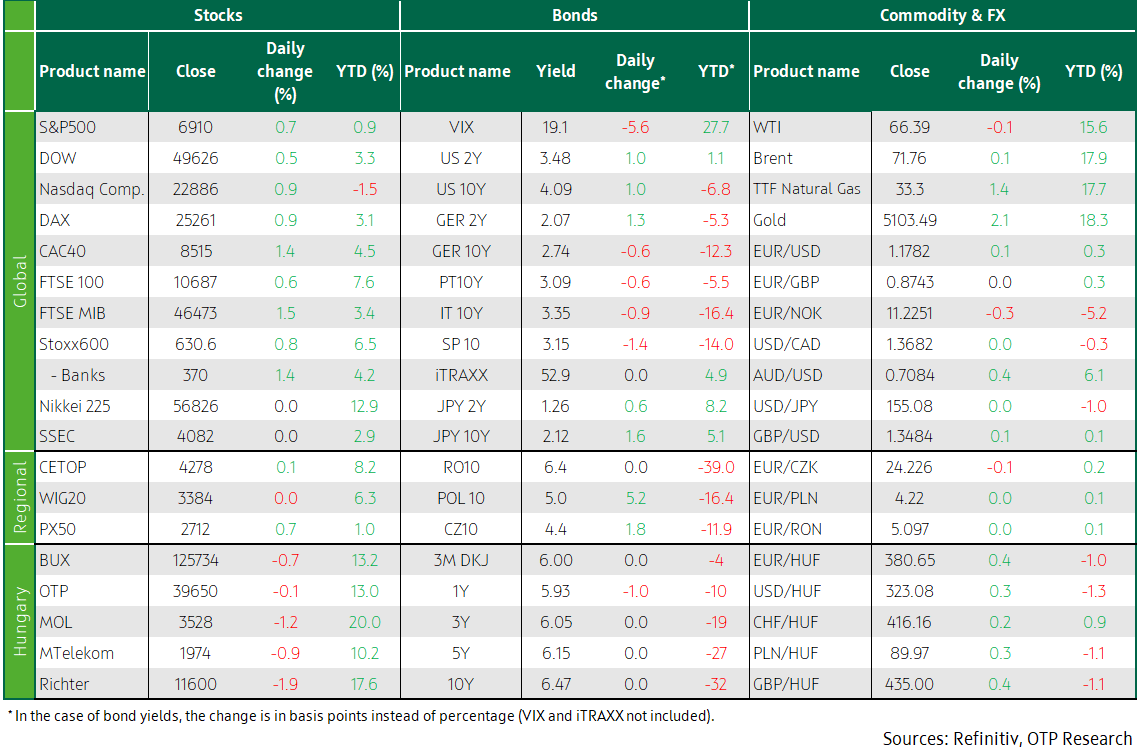
US markets shrugged off weak GDP, high CPI, and the Supreme Court's ruling against Trump tariffs. Donald Trump announced new global tariffs of 10%, and then 15% on Friday. Western Europe’s markets closed at all-time highs. Hungary’s stock market missed out on the benign sentiment. Brent oil price stuck near USD 72 amid fears about the US-Iran conflict, gold closed above USD 5,000 again. Despite the raft of macroeconomic releases, bond yields did not move much on Friday; the EUR/HUF rose above 380. This week, inflation data from Western Europe’s major economies and the European Commission's economic sentiment index will be in focus; Hungary releases investment data, and the MNB makes interestrate decision.
Western Europe’s stock markets closed at record highs
The STOXX 600 index closed at all-time high on Friday, despite the US Supreme Court’s ruling, which said that President Donald Trump's sweeping emergency tariffs imposed in April 2025 were illegal. The STOXX 600 (+0.8%), the CAC40, and FTSE100 all closed at record highs.
At sector level, household goods and chemicals were the top gainers. Most sectors ended the session higher, except for retail, oil, and healthcare. The personal and household goods sub-index grew by 2.2%, while the luxury goods sector surged 2.9%. Shares in luxury brand Moncler jumped by 13.4% after reporting 7% revenue growth in the fourth quarter, helped by solid growth in Asia and the Americas. Banking, which had suffered painful losses at the height of the AI ??disruption, was one of the best-performing sectors last week, gaining about 5%. Italian insurance company Unipol skyrocketed 8.7% on Friday after reporting a 36.8% annual profit growth. Energy stocks gave back 0.6% on Friday from Thursday’s 0.8% increase, while oil prices hovered near six-month highs.
Last week, the STOXX closed 2.1% higher and hit a series of historical highs, as investors’ fears about the AI disruption subsided, and reassuring news came from the European economy, such as improving PMIs and gradually slowing wage dynamics. The latter could be key for the ECB’s interest rate policy. The STOXX achieved its biggest weekly jump since the beginning of January.
But Hungary’s stock market could not benefit from the benign international backdrop. While most markets in CEE rose, Hungary’s BUX declined 0.7%. It was dragged down the by the painful losses of Richter (-1.9%) and MOL (-1.2%), but the other two blue chips also ended in the red. Over the past week, the BUX dropped by 1%, largely dragged down by MOL (-5.3%) amid issues with the Barátság (Friendship) oil pipeline. Richter came down 0.9% in a week.
Weak GDP, high inflation, and Supreme Court ruling on Trump tariffs left US markets unaffected
Ending a brief choppy period, US stock indexes closed higher on Friday, and Treasury yields also rose. Investors digested the US Supreme Court's ruling that overturned President Trump's tariffs, as well as a pale GDP report, and higher-than-expected inflation figures. All three major US stock indexes rose immediately following the Supreme Court's ruling. Its 6-3 decision struck down Donald Trump’s sweeping tariffs imposed in April 2025 under the National Emergencies Act, which have far-reaching consequences for the global economy. Now the court ruled that President Trump had not properly invoked the national emergency. Hours after the ruling, Trump announced a new global tariff of 10%, this time under Section 122 of the Trade Act of 1974. That law allows tariffs to be imposed for up to 150 days without approval from congress. He later raised the tariff to 15%.
Before Wall Street opened, the Commerce Department released its preliminary estimate on fourth-quarter GDP, which showed that the US economy slowed markedly in Q4 2025 on a quarterly annualized basis: decelerating from 4.4% expansion in the third quarter, output grew by only 1.4%, which was well below economists’ forecast of 3%. Nevertheless, the government shutdown may have taken 1% off the data, government spending plunged by more than 5%, but the slowdown in household consumption (from 3.5% to 2.4%) can also be partly explained by this.
Meanwhile, the core PCE (personal consumption expenditure)index, an inflation measure closely followed by the Federal Reserve, rose by 0.4% MoM and 3% YoY in December, exceeding analysts’ expectations of 0.3% and 2.9%, respectively.
Against these headwinds, the Dow Jones (+0.5%), the S&P500 (+0.7%), and the Nasdaq Composite (+0.9%) all made it higher on Friday, and all three indexes closed last week’s trading with gains.
Oil prices made but subtle moves on Friday, but they grew by nearly 6% over the past week; fears about the US-Iran conflict shaped prices last week. Gold and silver also rose sharply; the former is well above USD 5,000 once again.
Despite a raft of macroeconomic data, bond yields did not move much on Friday; the EUR/HUF rose above 380
Despite last week's important data and events as well as the escalating US-Iran tensions, there were no significant changes in the bond and currency markets of advanced economies – neither on Friday nor last week. The US GDP data released on Friday were significantly softer than expected, mainly due to the government shutdown. The US industrial production data published in the first half of the week was stronger than thought; the Fed’s preferred inflation gauge, core PCE (personal consumption expenditure) was 0.4% MoM, and the annual gauge rose to 3%. Moreover, the minutes of the Fed's January interest rate-setting meeting revealed that decision-makers were strongly divided over the future interest rate path: in addition to supporters of further cuts and holding interest rates, some did not even rule out a rate hike as the next step. The surprise event of the week, however, was undoubtedly the US Supreme Court ruling that Donald Trump's tariffs were unconstitutional, to which the president responded by imposing a 10% global tariff, which he almost immediately raised to 15%. The ten-year US yield barely changed on Friday, but it rose by about five basis points over the past week (to 4.1%), but taking one step back, it has been fluctuating in the 4-4.2% range, around the bottom of the post-Covid trading range, for almost half a year. The market still expects two 25-basis-point cuts from the Fed this year, and prices nearly 50% chance of another cut next year. In Europe, particularly in Germany, the S&P confidence indices have been better than expected, while wage growth slowed to 3% in the fourth quarter, which may already be consistent with the inflation target, according to data published last week. The interest rate path expected from the ECB has not changed: the market does not expect the 2% key interest rate level to change this year. Germany’s ten-year bond yield hovered in a very narrow range around 2.75% throughout last week. However, the dollar appreciated: the EUR/USD has sunk from less than 1.19 to below 1.18.
Due to the strengthening dollar, the forint weakened slightly, together with the zloty, last week. The EUR/HUF rose from 377.5 to around 380. Hungary’s bond market fared well in the first half of last week, which was only partially affected by the uncertainty in the second half of the week. Over the past week, the yield on 3Y–5Y bonds sank by 5 basis points, and the 10Y–20Y segment by 10 basis points. The 10Y yield declined below 6.5%.
Today’s highlights
Japan’s Nikkei and China’s SSEC were both closed due to a public holiday. The remaining markets were heading for meaningful gains (Asia Dow: 0.6%, Hang Seng 2.3%). However, the European and American index futures did not bode well. Gold prices rose and oil prices fell ahead of a new round of talks between the United States and Iran in Geneva on Thursday; if no deal is reached, the risk of US military strikes remain.
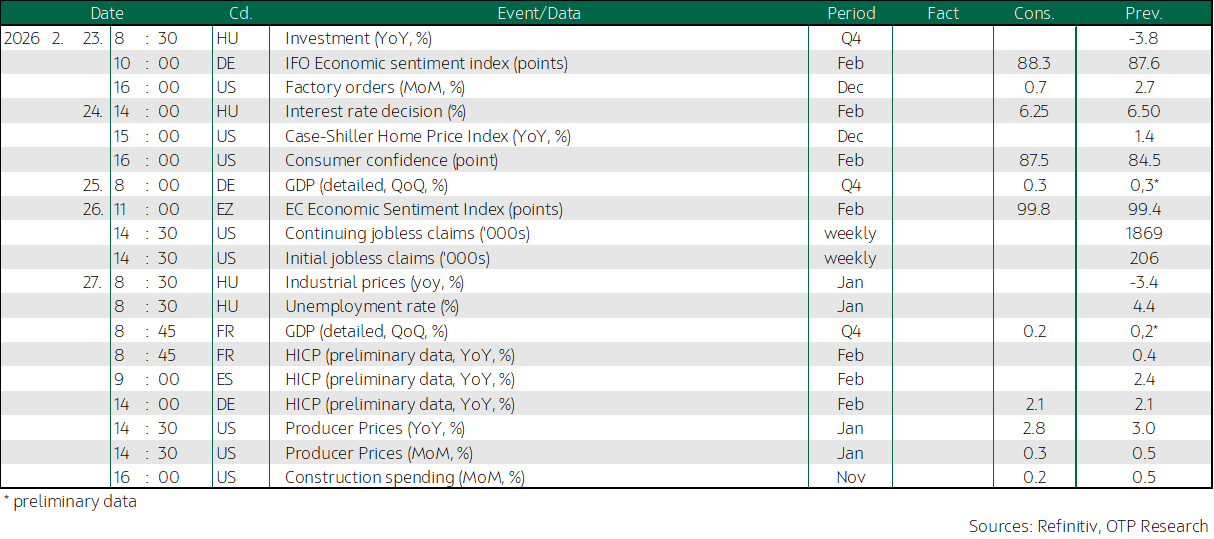
In Hungary, the MNB makes interest rate decision on Tuesday. It seems that the time has come: the MNB’s Monetary Council is expected to cut its key interest rate, which has been flat since September 2024, by 25 basis points in February. Having left the base rate on hold for a long while, the central bank’s new leadership announced in December, simultaneously with the publication of the new Inflation Report, that it would switch to data-driven mode, thus opening the door to interest rate cuts. Although December's reading of inflation still caused a negative surprise, in January both headline and core inflation slowed stronger than expected and, more importantly, services inflation has also eased, suggesting that this year's average inflation may fall below 3%. The fact that the forint has remained strong also points to an interest rate reduction; the EUR/HUF is trading below 380. Market prices imply that the base rate may sink as low as to 5.5% this year, and bond yields have fallen to their one-year low.
Before the interest rate decision, Hungary’s fourth-quarter investment data will be released on Monday. In recent years, investment has been one of the main drags on GDP growth; 2025 may have been the fourth consecutive year of decline. There are several factors behind the shrinking investment; the significantly higher interest rate environment in connection with the inflation crisis, low public investments due to fiscal adjustment, the missing EU funds, the structural problems of the manufacturing industry (weak growth in Europe, tariff war, increasing competition from China, high energy prices), and the overcapacities that have developed in several sectors due to the high investment rate before 2022, which rose much higher than the average in the CEE region. However, we expect a positive turn in 2026, partly owing to the recovery in public investment, partly due to the rebound in housing investments (which have fallen to the lowest since 2016), and partly on account of the improving economic outlook in Europe. There are already signs of a turnaround: in the third quarter, investment stopped falling on a quarter-on-quarter basis (which could be a sign of bottoming out), construction orders increased significantly in the past half-year, and corporate lending picked up in the second half of 2025.
In Western Europe, the focus will be on the preliminary data on the February inflation data from Germany, France, and Spain. The indicators of the large member states usually provide a good picture of the eurozone data, but this time it is a bit more difficult because the preliminary data for Italy will only be released on the following week, on 3 March, at the same time as the eurozone’s data. The eurozone’s February inflation could be particularly interesting, after January's disinflation and the 1.7% annual index, the indicator could accelerate slightly, to 1.8-1.9%, supporting the view that the ECB does not need to change the key interest rate this year, as inflation is fluctuating around the 2% target. However, if inflation continues to decline, then the voices that say inflationary pressure is decreasing rapidly and there could be up to two 25-basis-point interest rate cuts this year may intensify; this makes the direction the incoming data so important.
The European Commission's economic sentiment index is also worth checking. In January 2025, it rose to a level last seen in January 2023, indicating an improvement in the European economy.
A string of corporate earnings figures will be released in the USA later in the week: Nvidia will report on Wednesday, while Dell and software developer Salesforce on Thursday, among others.
Get more out of your investments!
Global Markets Services
OTP Global Markets offers a broad range of services in the field of local and international money and capital markets.
Read morePrivate Banking Services
Personal care and expertise with OTP Private Banking, along with the knowledge, security, and innovations of a multinational banking group.
Read more