
OTP Morning Brief: Markets resume growth as tensions ease
Related content
OTP Morning Brief: US producer price index came in above expectations, yet the US 10-year Treasury yield still declined
Western European equities continued to advance despite ongoing pressure on the technology sector. Wall Street indices also rebounded, recovering some ground after Wednesday’s sell-off. Healthcare was the standout performer on both sides of the Atlantic. Eurozone industrial production declined by 0.5% month-on-month in August. In the US, the producer price index accelerated to 6.3%, delivering another upside surprise in inflation developments. US retail sales increased by 0.8% compared to August. The US 10-year Treasury yield declined by more than 10 basis points. The long end of the Hungarian government bond yield curve also declined by 7-9 basis points. In Hungary, August wage data will be released today, while in the US, September industrial production figures are due.
OTP Morning Brief: US CPI data came in above expectations
European equity markets advanced, supported by strong results from ASML and the outstanding performance of the healthcare sector. US equity markets came under pressure following higher-than-expected September CPI data. The annual CPI rate accelerated to 3.7%, driven primarily by a surge in gasoline prices, while core CPI rose by 0.3% month-on-month, supported by higher housing costs and rising transportation service prices. Oil prices rose amid escalating tensions in the Middle East and the impact of the IEA's oil market report. US Treasury yields retreated after an initial increase, driven by Fed commentary, while European bond yields generally moved higher. The US macro calendar will be busy today, with investors focusing on September retail sales and producer price index data, as well as the New York Fed Manufacturing Index, weekly jobless claims, and business inventories. August industrial production data from the euro area will be released today.
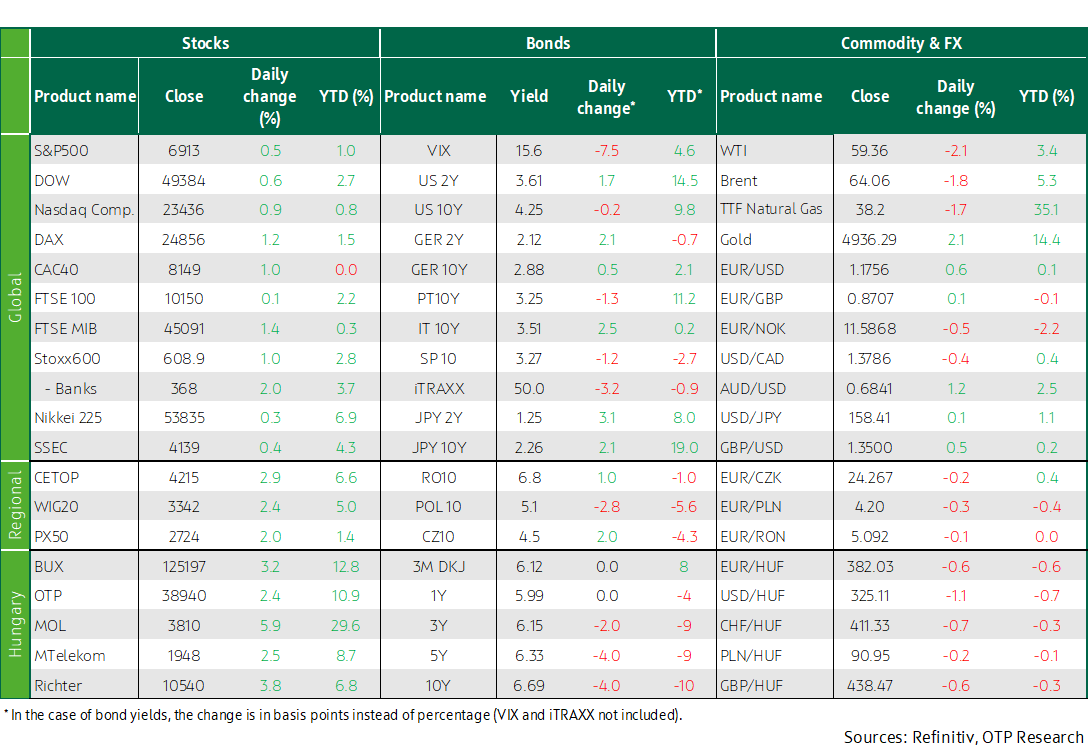
Europe’s stocks rose on Donald Trump's backtracking, the CEE region had a bright trading day. The easing of tensions helped US markets climb higher, the November gauge of consumer prices was in line with expectations. European bond market calmed down after Donald Trump's speech. The HUF’s strengthening drove the EUR/HUF to 382.5. Bank of Japan left its key interest rate unchanged. PMIs and Russia-Ukraine-USA negotiations will be the main focus today?.
European stocks picked up after Donald Trump's backtracking, CEE markets saw upbeat trading
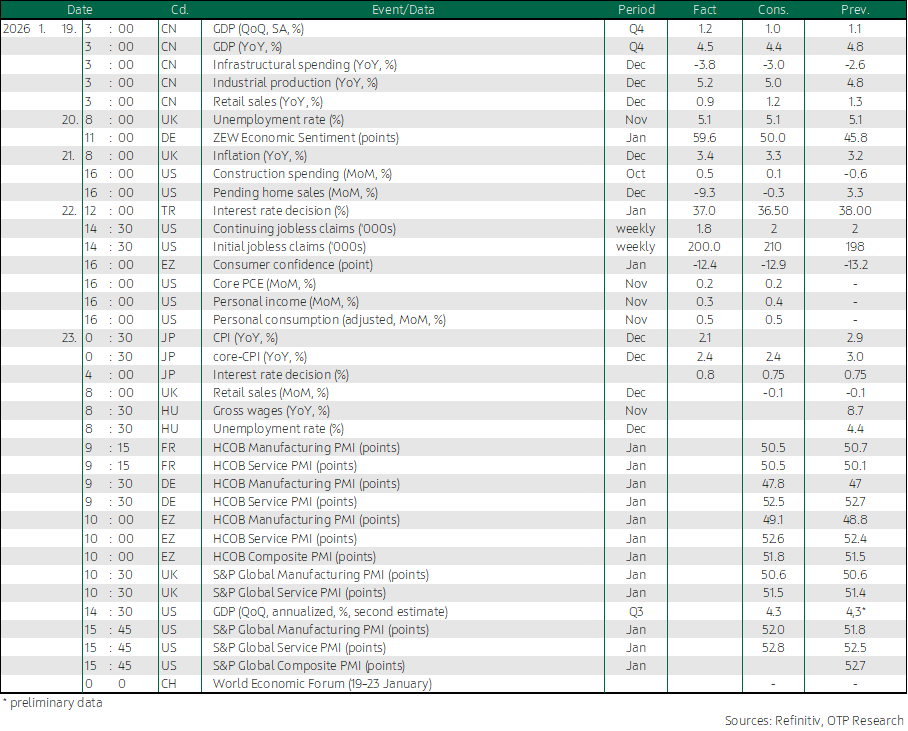
In Europe, stocks recovered sharply after Donald Trump backtracked on Greenland by rejecting military action and abandoning tariffs on European countries. This came after the US President held talks with NATO Secretary General Mark Rutte and said a deal was starting to take shape, which would build on a previous agreement from 1951 between Denmark and the USA. The Stoxx 600 jumped 1%, as Germany's DAX (+1.2%) and France's CAC40 (+1%) grew. The clear winner of the day was the automotive sector, which advanced 2.2%, mainly thanks to a 6.5% rebound in Volkswagen as Europe's largest carmaker reported better-than-expected net cash flow for 2025. The banking and telecommunications sectors both soared 2%. The latter benefited from the 7% surge in Norway’s Telenor, following the sale of its Thai subsidiary. In the eurozone, the consumer confidence index rose to -12.4 points in January, exceeding the -12.9 forecast and the previous month’s reading of -13.2 points.
The sentiment was also remarkable in the CEE region, where Czechia’s TX (+2.0%), Poland’s WIG (+2.4%), and Hungary’s BUX (+3.2%) all excelled. The latter was fuelled by MOL’s 5.9% jump, but the other three blue chips also posted impressive gains, with Richter surging 2.9%, MTelekom growing by 2.5%, and OTP soaring 2.4%; the banking share closed at an all-time high again.
US markets rose further as tensions eased, November’s PCE was in line with expectations
Donald Trump's softer rhetoric was also appreciated by US investors: America’s stock markets increased for the second day in a row, with the S&P500 and Dow closing 0.5% higher and the Nasdaq gaining 0.9%. Procter & Gamble shares grew by 2.6% after the release of quarterly results, while Intel, which reported after the close, upped 0.1% before plunging 7% in after-hours trading as its revenue fell short of investors' expectations because it failed to keep up with demand for chips used in servers. Abbott nose-dived 10%, in its biggest single-day drop since 2002, after the medical technology company forecast weaker-than-expected quarterly profit. GE Aerospace slumped 7.4%, even though the company raised its full-year profit forecast higher than the consensus thought. All Magnificent Seven shares grew, particularly Meta (+5.7%) and Tesla (+4.2%).
Several macroeconomic data were released on Thursday. The 0.2% monthly change in the core PCE inflation, an index closely watched by the Federal Reserve, was in line with both analysts’ forecasts and the previous month’s figure, indicating some stability in US prices. US consumer spending also rose 0.5% in November, as expected; this may contribute to the US economy’s performance in the fourth quarter. At the same time, personal income data showed 0.3% monthly increase, slightly below the 0.4% rate projected by analysts. Weekly jobless claims rose slightly to 200,000, but fell short of analysts' forecasts. Oil prices slipped nearly 2%, hitting a weekly low, on news suggesting de-escalation.
Europe’s bond markets calmed after Donald Trump’s speech; the forint strengthened to 382.5 against the euro
Following Donald Trump's Wednesday speech, Europe’s bond markets saw a calm trading day on Thursday, with no significant or clear movement in bond yields. France’s 10Y government bond yield sank, that of Italy rose, and the German yield was flat, the latter remained slightly below 2.9%, near the upper edge of its post-covid trading range. In the USA, the ten-year yield rose due to the revision of third-quarter GDP growth from 4.3% to 4.4%; the yield surpassed 4.25% again. As tensions eased, the euro regained some ground from the dollar, driving the EUR/USD higher, towards 1.173.
The forint appreciated by almost 0.5% against the euro, to 382.5. There was particularly strong demand at the ÁKK's auction of 3Y, 5Y, and 10Y bond yesterday, when the agency offered a total of HUF 70 billion debt, bids exceeded HUF 250 billion. The ÁKK sold nearly HUF 140 billion worth of securities, with average yields a few basis points below Wednesday's benchmark yields. Ultimately, benchmark bond yields eased by 2-4 basis points, with the ten-year yield sinking below 6.7%.
Today’s highlights
Today, the Bank of Japan raised its growth forecast and maintained forecast for higher inflation, but left its key interest rates unchanged. Meanwhile, Japan’s inflation data for December showed an annual price increase of 2.1%, down from 2.9% in November, the lowest since March 2022, mainly due to falling energy prices. Core inflation was 2.4%. The Nikkei rose 0.3% on the news, but most Asian markets also benefited from the easing of global tensions.
Today’s important publications include the HOCB and S&P purchasing managers' indices for the eurozone, the United Kingdom, and the USA. Hungary releases wage and unemployment statistics.
On the geopolitical scene, the first trilateral meeting of representatives of Russia, Ukraine, and the USA may take place in Abu Dhabi. The summit was announced by President Zelensky in Davos, and it is expected to last from Friday to Saturday, even though Russia has not yet officially confirmed its participation.
Get more out of your investments!
Global Markets Services
OTP Global Markets offers a broad range of services in the field of local and international money and capital markets.
Read morePrivate Banking Services
Personal care and expertise with OTP Private Banking, along with the knowledge, security, and innovations of a multinational banking group.
Read more