
OTP Morning Brief: The Bank of Japan raised its interest rate to 0.75%, the highest level in 30 years.
Related content
OTP Morning Brief: US producer price index came in above expectations, yet the US 10-year Treasury yield still declined
Western European equities continued to advance despite ongoing pressure on the technology sector. Wall Street indices also rebounded, recovering some ground after Wednesday’s sell-off. Healthcare was the standout performer on both sides of the Atlantic. Eurozone industrial production declined by 0.5% month-on-month in August. In the US, the producer price index accelerated to 6.3%, delivering another upside surprise in inflation developments. US retail sales increased by 0.8% compared to August. The US 10-year Treasury yield declined by more than 10 basis points. The long end of the Hungarian government bond yield curve also declined by 7-9 basis points. In Hungary, August wage data will be released today, while in the US, September industrial production figures are due.
OTP Morning Brief: US CPI data came in above expectations
European equity markets advanced, supported by strong results from ASML and the outstanding performance of the healthcare sector. US equity markets came under pressure following higher-than-expected September CPI data. The annual CPI rate accelerated to 3.7%, driven primarily by a surge in gasoline prices, while core CPI rose by 0.3% month-on-month, supported by higher housing costs and rising transportation service prices. Oil prices rose amid escalating tensions in the Middle East and the impact of the IEA's oil market report. US Treasury yields retreated after an initial increase, driven by Fed commentary, while European bond yields generally moved higher. The US macro calendar will be busy today, with investors focusing on September retail sales and producer price index data, as well as the New York Fed Manufacturing Index, weekly jobless claims, and business inventories. August industrial production data from the euro area will be released today.
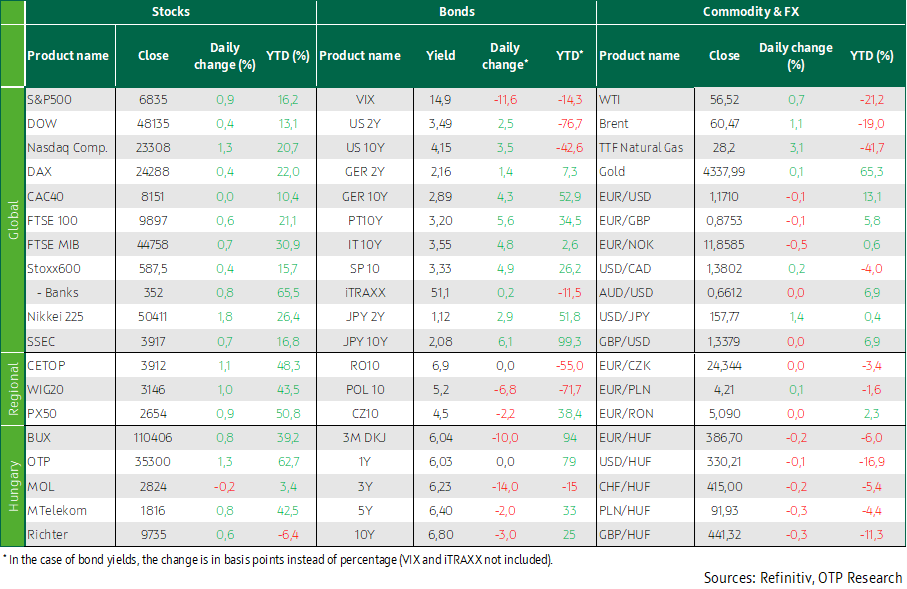
The 10-year Japanese government bond yield climbed above 2%, marking a 26-year high. European and U.S. stock market indicies rose further. OTP’s share price hit a historic high, exceeding 35,000 forints. The forint strengthened slightly after weakening earlier in the week. Domestic bond market yields continued to decline on Friday. Wage growth in Hungary remains slightly below 10%.
European stock markets rose, OTP shares hit an all-time high
European equities continued to climb, with most Western European indices gaining around 0.5%, except for the flat French market. For the week, Germany’s DAX rose 0.4%, France’s CAC 40 added 1%, STOXX 600 advanced 1.6%, and the UK’s FTSE 100 surged more than 2.5%, supported by the Bank of England’s rate cut. Friday’s rally was again led by defense and banking stocks, while consumer goods lagged—particularly sportswear makers, as Adidas fell 1.2% and Puma dropped 3% after Nike reported disappointing sales in China.
Two minor macro updates hit Europe on Friday: German consumer confidence unexpectedly fell to a two-year low, while the ECB’s wage indicator pointed to slower-than-expected moderation, projecting wage growth near 3%.
In Central Europe, regional markets gained close to 1% on Friday, with Hungary’s BUX up 0.8%. Weekly performance was mixed: BUX rose less than 1%, Poland’s WIG climbed over 2%, and Prague’s PX gained 3%. The main drag was MOL, down 0.2% Friday and 4% for the week, while OTP soared 1.3% on Friday to a new all-time high of HUF 35,300, driven by a massive end-of-session transaction worth HUF 27 billion.
The U.S. equity rally continued
After early-week declines, American indices rose on Thursday and Friday, driven mainly by the technology sector. The Dow Jones gained just 0.4%, the S&P 500 advanced 0.9%, and the Nasdaq Composite climbed 1.3%. Among tech leaders, Oracle jumped 6.6%, Nvidia rose 4%, and Alphabet added 1.5%. Despite the late-week rebound, U.S. markets underperformed Europe: the Dow ended the week down 0.7%, the S&P was flat, and even the best-performing Nasdaq posted less than a 1% gain.
On the macro side, the University of Michigan consumer sentiment index improved, though less than expected, while inflation expectations eased.
Gold price rose 0.3%, while silver jumped 2.5%, reaching a new all-time high above $67.
Both Japan’s key policy rate and the 10-year government bond yield hit multi-decade highs
After the ECB kept its key rate unchanged at 2% on Thursday, as expected, the Bank of Japan raised its policy rate by 25 basis points to 0.75%—a 30-year high—following November inflation data showing around 3% growth. The 10-year Japanese government bond yield also climbed above 2%, a 26-year high, after the BoJ signaled it would not intervene in market dynamics. This pushed European and U.S. yields higher on Friday: German, Italian, and French 10-year yields rose about 5 basis points, leaving weekly changes roughly the same and keeping European yields near the top of their post-pandemic trading range, as markets expect the ECB to hike rates in late 2026 or early 2027. In the U.S., the 10-year Treasury yield edged up 2 basis points Friday to around 4.15%, but posted a slight weekly decline amid rising unemployment and unexpectedly low November inflation, reinforcing expectations for at least two 25-basis-point Fed rate cuts in 2026.
The dollar strengthened against the euro on Friday and over the week, recovering from the prior week’s sharp drop, though EUR/USD remained above 1.17.
In Hungary, October data from the statistical office showed gross average wages up 8.7% year-on-year, keeping wage growth in the high single digits. The EURHUF rebounded Thursday and Friday to 386.5 from a midweek highs around the 390 levels. Early-week weakness was driven by two factors: the central bank cautiously opened the door to rate cuts at its December meeting—already priced in for Q1—and PM Viktor Orbán expressed concern about potential freezing of Hungary’s FX reserves. Markets now expect three 25-basis-point rate cuts in 2026, up from two previously priced. Domestic bond yields fell: discount treasury bills and bonds dropped 2–4 basis points Friday and 10–20 basis points for the week, with the 10-year yield dropping to 6.8% by Friday.
Today’s highlights
With Monday’s rate decision, China has now kept its benchmark loan prime rates (LPR) unchanged for the seventh consecutive month, in line with market expectations. The one-year LPR remains at 3%, while the five-year LPR stays at 3.5%.
As markets near the close, Asian indices are trading strongly in positive territory. The Nikkei and KOSPI are up by 1.7–1.8%, while the Hang Seng has gained 0.2% and the SSEC is up 0.8%.
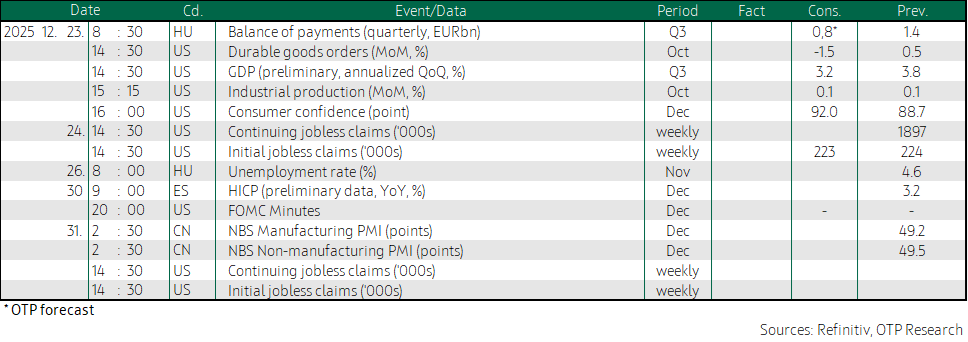
Before Christmas, key macro data will still arrive on Tuesday. Alongside the U.S. third-quarter GDP, Hungary’s Q3 current account balance will also be released on December 23.
Get more out of your investments!
Global Markets Services
OTP Global Markets offers a broad range of services in the field of local and international money and capital markets.
Read morePrivate Banking Services
Personal care and expertise with OTP Private Banking, along with the knowledge, security, and innovations of a multinational banking group.
Read more