
OTP Morning Brief: Framework on future Greenland deal discussed in Davos
Related content
OTP Morning Brief: US producer price index came in above expectations, yet the US 10-year Treasury yield still declined
Western European equities continued to advance despite ongoing pressure on the technology sector. Wall Street indices also rebounded, recovering some ground after Wednesday’s sell-off. Healthcare was the standout performer on both sides of the Atlantic. Eurozone industrial production declined by 0.5% month-on-month in August. In the US, the producer price index accelerated to 6.3%, delivering another upside surprise in inflation developments. US retail sales increased by 0.8% compared to August. The US 10-year Treasury yield declined by more than 10 basis points. The long end of the Hungarian government bond yield curve also declined by 7-9 basis points. In Hungary, August wage data will be released today, while in the US, September industrial production figures are due.
OTP Morning Brief: US CPI data came in above expectations
European equity markets advanced, supported by strong results from ASML and the outstanding performance of the healthcare sector. US equity markets came under pressure following higher-than-expected September CPI data. The annual CPI rate accelerated to 3.7%, driven primarily by a surge in gasoline prices, while core CPI rose by 0.3% month-on-month, supported by higher housing costs and rising transportation service prices. Oil prices rose amid escalating tensions in the Middle East and the impact of the IEA's oil market report. US Treasury yields retreated after an initial increase, driven by Fed commentary, while European bond yields generally moved higher. The US macro calendar will be busy today, with investors focusing on September retail sales and producer price index data, as well as the New York Fed Manufacturing Index, weekly jobless claims, and business inventories. August industrial production data from the euro area will be released today.
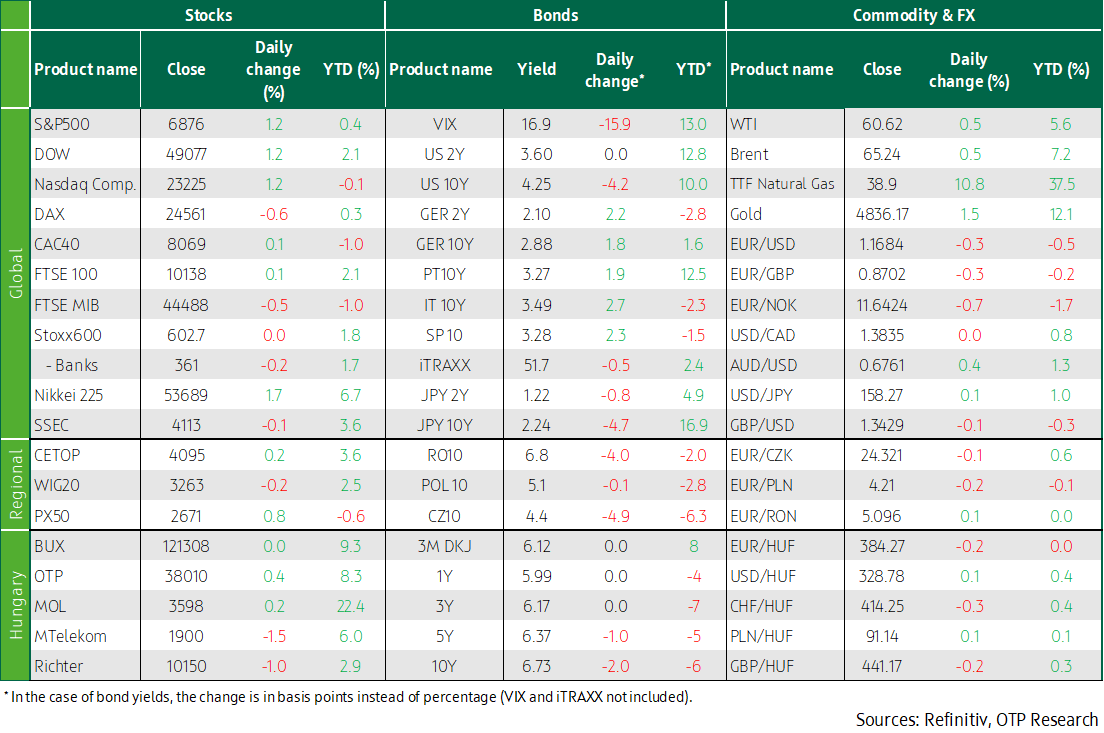
Europe’s major stock markets closed mixed yesterday after Donald Trump's Davos speech; In Britain, December inflation accelerated more than expected. In the USA, the key indices closed higher as Donald Trump backed off from imposing new tariffs on Europe; pending home sales fell in December from the previous month while October construction spending grew stronger than thought. All eyes were on Davos, where Donald Trump gave a speech. Despite harsh words about Europe, he ruled out acquiring Greenland by military force, and later he claimed a Greenland deal, and dropped plans to impose additional tariffs on European countries. Today, the focus will be on the US core PCE index as well as personal income and spending figures.
Europe’s stock markets closed mixed yesterday after Donald Trump's Davos speech; UK December inflation was higher than expected
In Europe, the main stock markets ended mixed on Wednesday as US President Donald Trump's speech at the World Economic Forum in Davos had stoked fears about an EU-US trade war. The Stoxx Europe 600 index ended the day almost flat, paring earlier losses, while its sectors moved in all directions. In his speech, Donald Trump confirmed his intention to acquire Greenland –this time he ruled out the use of military force–, while threatening tariffs against European countries. Following his speech, European lawmakers announced that they would suspend the approval of the EU-US trade agreement concluded in 2025. On behalf the European Parliament, Bernd Lange said the tariff threats were tantamount to an attack on the EU's economic and territorial sovereignty. European Commission President Ursula von der Leyen has previously called the US tariff threats a mistake, while French President Emmanuel Macron has indicated that the EU may consider using the Anti-Coercion Instrument (ACI) in response. In equity markets, mining shares soared, led by Anglo American, Rio Tinto, and Glencore.
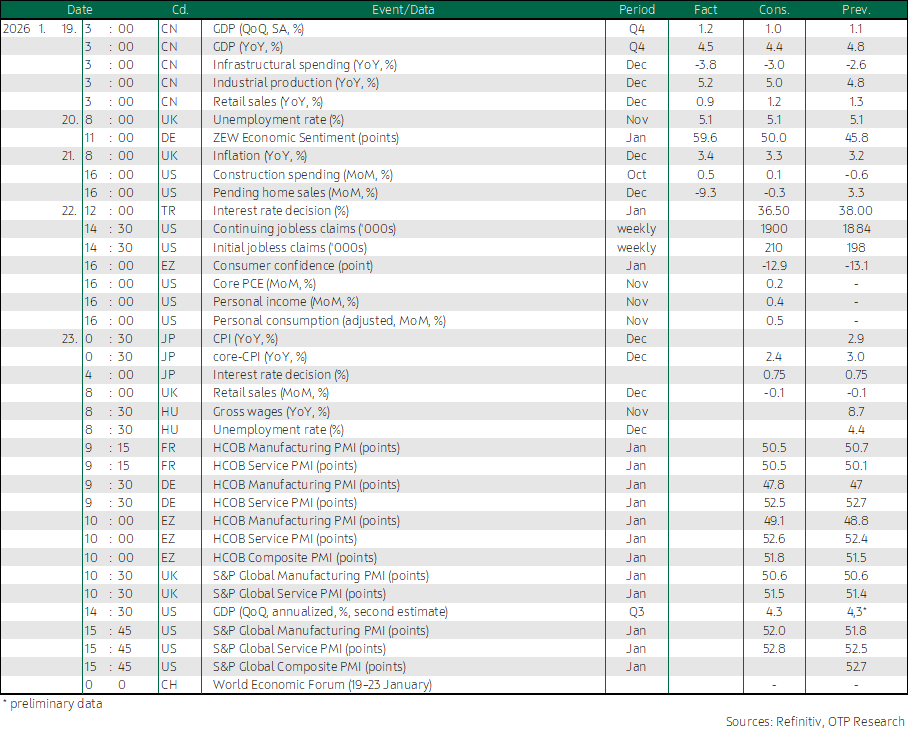
In December, the UK’s consumer price index rose to 3.4%, from an eight-month low of 3.2% in November; it slightly exceeded market expectations (3.3%), and marked the first acceleration in inflation since July. The acceleration, which is expected to be temporary, was fuelled by a surge in the prices of alcohol and tobacco products due to the timing of tobacco excise duties, as well as higher airfares. Services inflation rose to 4.5% from 4.4%, but remained below expectations, while core inflation stabilized at 3.2%, its lowest level since December 2024.
The indices of the CEE region closed mixed: Warsaw’s WIG declined, but the BUX and Prague indices rose. Of the former’s blue chips, the share prices of MOL and OTP increased, while those of the other two stocks sank.
America’s key indices closed higher after Trump backed off from imposing new tariffs on Europe; pending home sales fell in December from the previous month but October’s MoM construction spending grew stronger than expected
US stock markets grew meaningfully yesterday as Donald Trump backed off from imposing new tariffs on Europe after European markets’ close, as he claimed that the framework for an agreement on Greenland had been formed. Markets had started to rise already after Donald Trump's speech in Davos, as the US president ruled out the use of military force, but the withdrawal of tariff threats has further boosted risk appetite. Donald Trump said he was working on a future Arctic deal that would avoid the tariffs scheduled for 1 February, citing talks with NATO Secretary General Mark Rutte. The rally was driven by technology stocks, including Nvidia and AMD, but bank stocks also rose.
In the United States, pending home sales slumped 9.3% month-on-month in December, in the biggest fall since April 2020, well below the consensus for a 0.3% decline and markedly stronger than November’s 3.3% increase. The halt in a four-month upward trend reflected declines in all regions. In annual terms, sales slipped by 3.0% from a year earlier. In contrast, US construction spending increased by 0.5% month-on-month in October 2025, picking up from a 0.6% decline in September, significantly exceeding the 0.1% uptick expected by the market: private sector construction increased by 0.6% (+1.3% in residential construction, -0.2% in the non-residential segment), while public construction inched up 0.1%. On an annual basis, however, construction spending decreased by 1%.
On Wednesday, all eyes were on Davos, where US President Donald Trump gave a speech. Despite harsh words about Europe, he ruled out acquiring Greenland by military force, and later claimed he had reached an agreement on Greenland and that there would be no need for punitive tariffs
Trading in the fixed income and currency markets of developed countries saw large swings on Wednesday. In the morning, Japan’s bond market reversed sharply from the previous days’ rapid increase in yields, and the 10Y yield fell from a thirty-year peak of 2.35% to less than 2.3% after the announcement that the government may reduce the issuance of longer-term bonds and the Bank of Japan may slow down the tapering of its bond portfolio. After Donald Trump's Davos speech and ending tariff threats against European countries, the tension in the bond market eased, the ten-year US yield sank by five basis points from 4.3%. Meanwhile, European bond yields rose; the 10Y German yield is drawing near 2.9%, very close to the upper edge of its post-covid trading range. The dollar’s appreciation pushed the EUR/USD back below 1.17.
The CEE region’s currencies mostly appreciated, the koruna (CZK) trivially, while the forint (HUF) and the zloty (PLN) lost around 0.25%. The Hungarian currency strengthened, driving the EUR/HUF to 384. Hungary’s government bond yields did not budge, the 10Y yield remained above 6.7%.
Today’s highlights
Most of Asia’s stocks were heading higher today, following Donald Trump's statements in Davos. South Korea’s GDP unexpectedly contracted by 0.3% quarter-on-quarter in the fourth quarter of 2025, but grew by 1.5% year-on-year, falling short of expectations. Japan’s exports expanded by 5.1% in December, also falling short of market expectations (6.1%).
Today, consumer confidence data will be released in Europe. On the other side of the Atlantic, the Fed's preferred gauge, the core PCE (personal consumer expenditures) index, as well as personal income and spending data will be in focus. The US will also release weekly jobless claims figures.
In Turkey, the central bank will hold a rate-setting meeting.
In Hungary, the ÁKK auctions 3Y, 5Y, and 10Y bonds, offering HUF 20, 25 and 25 billion government debt, respectively.
Get more out of your investments!
Global Markets Services
OTP Global Markets offers a broad range of services in the field of local and international money and capital markets.
Read morePrivate Banking Services
Personal care and expertise with OTP Private Banking, along with the knowledge, security, and innovations of a multinational banking group.
Read more