
OTP Morning Brief: USA's Greenland plans intensify market tension
Related content
OTP Morning Brief: US producer price index came in above expectations, yet the US 10-year Treasury yield still declined
Western European equities continued to advance despite ongoing pressure on the technology sector. Wall Street indices also rebounded, recovering some ground after Wednesday’s sell-off. Healthcare was the standout performer on both sides of the Atlantic. Eurozone industrial production declined by 0.5% month-on-month in August. In the US, the producer price index accelerated to 6.3%, delivering another upside surprise in inflation developments. US retail sales increased by 0.8% compared to August. The US 10-year Treasury yield declined by more than 10 basis points. The long end of the Hungarian government bond yield curve also declined by 7-9 basis points. In Hungary, August wage data will be released today, while in the US, September industrial production figures are due.
OTP Morning Brief: US CPI data came in above expectations
European equity markets advanced, supported by strong results from ASML and the outstanding performance of the healthcare sector. US equity markets came under pressure following higher-than-expected September CPI data. The annual CPI rate accelerated to 3.7%, driven primarily by a surge in gasoline prices, while core CPI rose by 0.3% month-on-month, supported by higher housing costs and rising transportation service prices. Oil prices rose amid escalating tensions in the Middle East and the impact of the IEA's oil market report. US Treasury yields retreated after an initial increase, driven by Fed commentary, while European bond yields generally moved higher. The US macro calendar will be busy today, with investors focusing on September retail sales and producer price index data, as well as the New York Fed Manufacturing Index, weekly jobless claims, and business inventories. August industrial production data from the euro area will be released today.
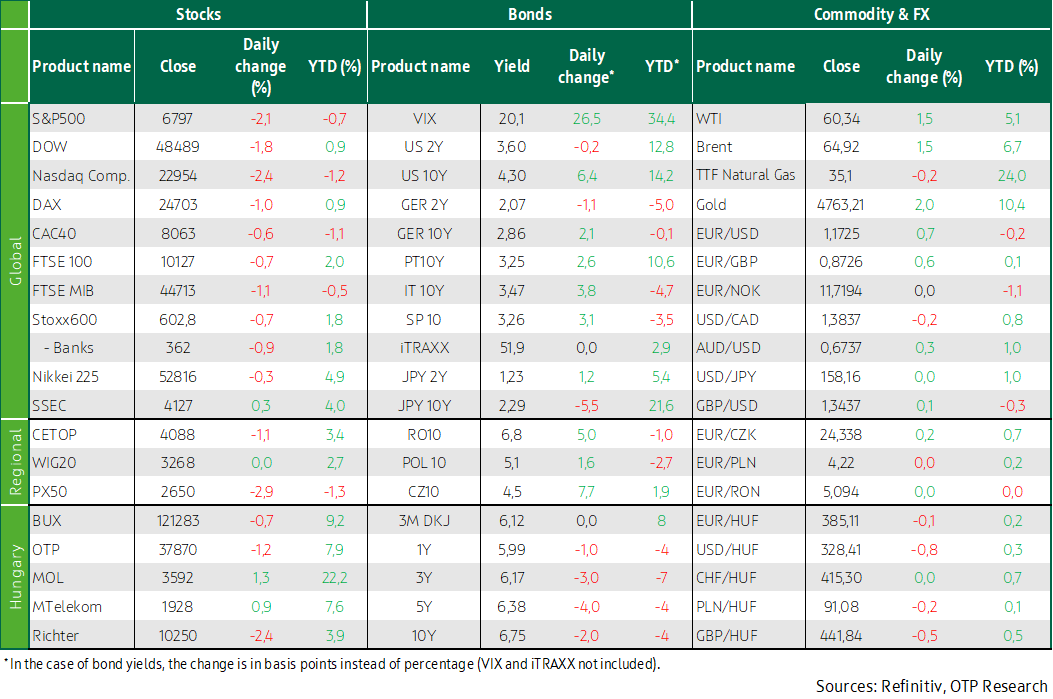
The USA’s plan to buy Greenland is stoking tensions. Tuesday's trading ended with painful losses on Europe’s and America’s benchmark stock markets. The BUX’s 0.7% drop ranked it in the middle of the CEE league table. Gold and silver hit new highs. All eyes are on Donald Trump's Davos speech today.
Tensions are rising over US plan to buy Greenland
2026 has been marked by heightened geopolitical tensions, and Greenland is currently in the eye of the storm. This is the dominant theme at this year’s World Economic Forum in Davos, where several leading politicians from European and non-European NATO member states spoke out against US ambitions. However, the Trump administration still insists that it has right to buy the Danish-administered island, even though the Greenlandic population rejects the claim. Meanwhile, several of Denmark’s allies are joining the country’s military exercises in Greenland, in response to an unprecedented situation within NATO. According to the Greenland’s Prime Minister, the island’s population and authorities should prepare for a possible military invasion. Investors are now trying to navigate such troubled waters: they are worried about a new chapter in the trade war in addition to a military clash, after the USA threatened its European allies that it may increase tariffs if they do not cooperate in the Greenland issue.
Western Europe’s leading stock markets extended their losses on Tuesday
In Western Europe, the key stock markets fell deeper on Tuesday, continuing Monday’s slip, owing to the tariff threats. On Saturday, Donald Trump announced additional 10% import tariffs on eight European countries (Denmark, Norway, Sweden, France, Germany, the Netherlands, Finland, the United Kingdom) from 1 February, on top of the existing ones. The rate would increase to 25% on 1 June, and remain in force until these countries make concessions on the Greenland issue. Donald Trump threatened another 200% tariff on French wine and champagne yesterday, after French President Emmanuel Macron reportedly refused to join his “Board of Peace” on Gaza. The STOXX 600 fell 0.7%, with all sectors in the red except for the stagnant technology and media. Utilities, insurance, and telecommunications were among the biggest losers, but real estate was the weakest performer, in line with rising bond yields.
Reversing Monday’s drop in carmakers, Renault’s shares soared 2.2% on Tuesday, on the back of a 3.2% surge in sales in 2025. Britain’s Wise jumped 16% on strong third-quarter figures. Citi downgraded its recommendation for continental European stocks to Neutral for the first time in more than a year, saying that rising transatlantic tensions and uncertainty over tariffs had hurt the short-term investment appeal of European stocks.
In the CEE region, only Poland’s WIG20 eked out a slight gain, while Czechia’s PX50 (-3%), and Hungary’s BUX (-0.7%) closed in the red. Hungary’s blue chips closed mixed, only MTelekom and MOL achieved gains. The latter increased by 1.4%, continuing Monday’s rise after a binding agreement was signed to acquire the majority, currently Russian, ownership in the Serbian oil company NIS. Now Serbia’s government is waiting for approval from the US Treasury Department, to ensure the smooth operation of the Pančevo refinery.
After a long weekend, Wall Street started the week with heavy losses
After Monday's bank holiday, the winds of tension over Greenland have reached Wall Street, where benchmark indices started the week with near-2% losses. In the S&P, all sector indices, except for consumer staples, turned red; technology and consumer staples took the biggest hit, losing almost 3%. Of technology heavyweights such as Microsoft, Nvidia, and Apple closed with painful losses, but Meta, Google, Tesla, and Amazon also fell sharply. The VIX, also known as the ’fear index’, which measures market volatility, exceeded the 20 mark, a level last seen in November 2025.
Netflix's quarterly report, which came after market close, has slightly surpassed expectations for earnings per share and revenue. The streaming giant also announced that it has reached 325 million paid subscribers worldwide, marking a new milestone. Netflix and Warner Bros Discovery (WBD) announced on Tuesday morning that they have revised their original plan: now Netflix is prepared to pay Warner Bros. and HBO fully in cash, rather than a mix of cash and stock. The companies hope the new offer will help fend off Paramount’s bid for all of WBD.
Speaking at a press conference yesterday to mark the first anniversary of his second inauguration, President Trump did not back down from his plans to buy Greenland. When asked how far he would go to buy Greenland, he said, ’You will find out.’ The president will speak in Davos today.
On Tuesday, Treasury Secretary Scott Bessent said that the announcement on the Fed’s next chairman could come as early as next week. This has brought US interest rate expectations back in focus, but the market is still pricing in only a 50-basis-point cut by the end of the year. Four candidates – Kevin Hassett, Christopher Waller, Kevin Warsh and Rick Rieder – remained on the shortlist, but whoever becomes the chair, the White House will expect him to cut interest rates more aggressively than currently priced in.
Geopolitical tensions continued to fuel the growth in gold price, which was further boosted by the weakening dollar: gold price exceeded 4,700 USD/oz. The price of silver has also hit a new high, exceeding 95 USD/ounce for the first time.
Chevron-led Kazakh oil producer Tengizchevroil announced on Monday that it had temporarily halted production at its Tengiz and Korolev fields, owing to a problem with power distribution systems; the outage may last 7-10 days. Brent crude price barely changed yesterday amid geopolitical tensions, while WTI crude rose more than 1% from Friday.
U.S. natural gas futures jumped more than 25%, to a three-week high on Tuesday as extreme cold is expected in the central and eastern USA over the next few days, with the coldest temperatures expected next week.
Developed markets’ yields continued to rise
The bond yields of advanced economies continued Monday’s increase on Tuesday. In addition to the geopolitical tension around Greenland and the new tariff threats, the ongoing selling wave in the Japanese government bonds also fuelled growth; the latter was given a new boost by the abolition of the sales tax on food, and the announced snap elections. The ten-year Japanese bond yield rose by another seven basis points, to a thirty-year high of 2.34%, the American one jumped comparably, closer to 4.3%, and the German one rose by two basis points, to above 2.85%. The dollar weakened by 0.7%, sending the EUR/USD closer to 1.1725.
The sentiment in Hungary’s bond and FX markets was not bad yesterday. While the zloty (PLN) and the koruna (CZK) weakened trivially, the forint strengthened, trading at 385 against the euro. Hungarian bond yields eased by 2-4 basis points (particularly at the belly of the curve, between the 3Y and 10Y tenors); the ten-year one returned to 6.75%. Despite the weak demand, the ÁKK sold the planned amount (HUF 30 billion) in 3M discount T-Bills at Tuesday’s auction, at an average yield of 6.11%.
Today’s highlights
Trading in Asia-Pacific stock markets was as gloomy today as it was in Europe and the United States on Tuesday. In the last hour of trading, most benchmark indices were seen in the red, while the price of gold continued to surge, rising by more than 2% in Asian trading.
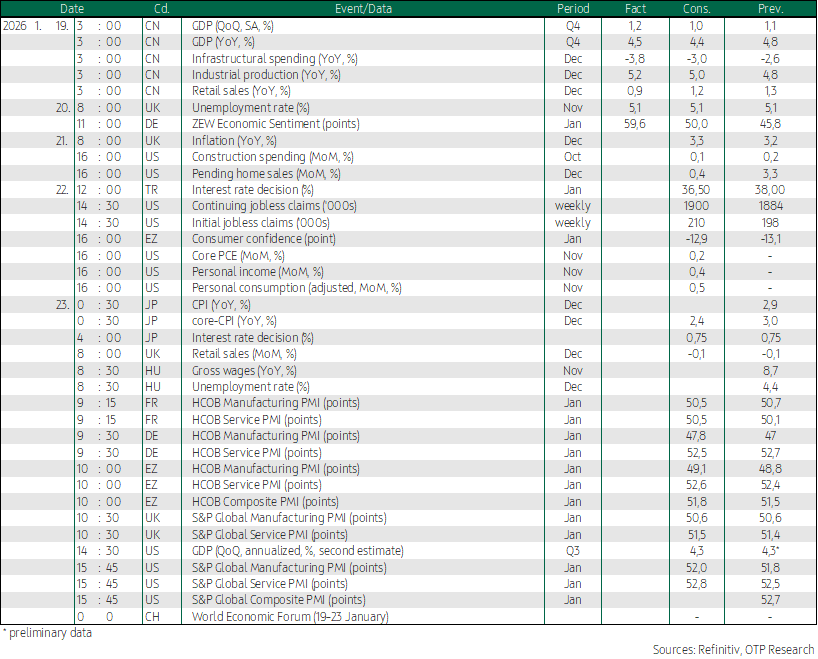
Today, investors will watch Donald Trump’s speech in Davos and developments related to Greenland. The earnings season continues with figures from J&J, among others.
Get more out of your investments!
Global Markets Services
OTP Global Markets offers a broad range of services in the field of local and international money and capital markets.
Read morePrivate Banking Services
Personal care and expertise with OTP Private Banking, along with the knowledge, security, and innovations of a multinational banking group.
Read more