
OTP Morning Brief: Technology sell-off keeps on dragging down global equities
Related content
OTP Morning Brief: Monday's rally lost momentum as equities pulled back, with technology stocks weakening
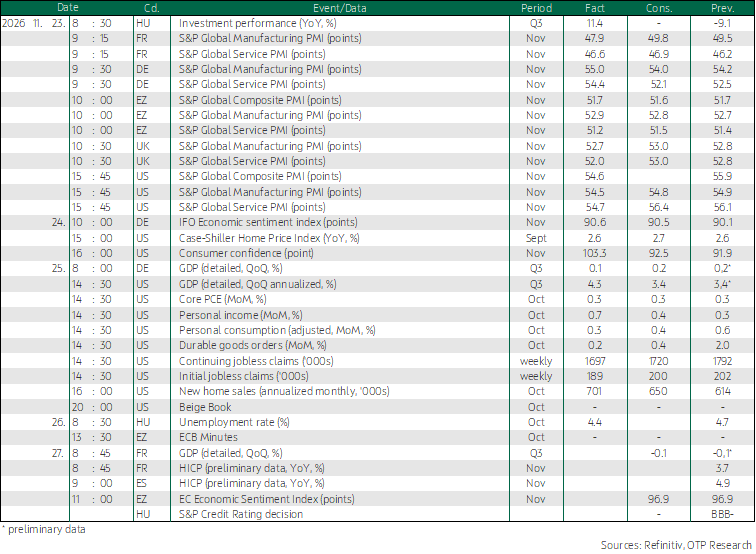
Following Monday's rebound, European equities declined on Tuesday, with the STOXX 600 slipping 0.7%. Despite Nvidia's nearly 6% decline, while both the Nasdaq and the S&P 500 closed in negative territory, the Dow managed to post gains. Oil prices rose following reports of renewed attacks on vessels in the Strait of Hormuz, with both Brent and WTI crude gaining 2.3%. Bond markets saw limited movement; US Treasury yields were mixed, while German government bond yields edged lower. The negative sentiment also spilled over into Asian markets: approaching the close, South Korea's Kospi posted a sharp decline, while the Nikkei, Hang Seng, and SSEC were all trading in negative territory. Today's focus is on the Fed's closely watched core PCE index for October, while data on US personal income and consumer spending are also due for release. Detailed data for Germany's Q3 GDP and the second estimate of US Q3 GDP are due today, while the Fed will release its latest Beige Book later in the evening.
OTP Morning Brief: Stock markets rise on news of Nvidia CEO's return
Investor sentiment improved markedly in Monday's trading after Nvidia announced that Jensen Huang would return to the CEO position. The STOXX 600 rose 1.8%, the S&P 500 gained 4.7%, while the Nasdaq surged 6.5%, led primarily by technology stocks. US Treasury yields moved higher and the dollar strengthened, while oil prices fell sharply amid increased Middle Eastern supply and the restart of a Libyan oil pipeline. Today, Germany will release the November Ifo Business Climate Index, while in the US, the September Case-Shiller Home Price Index and the November Consumer Confidence Index are scheduled for publication. Among corporate events, earnings reports from Dell Technologies, Analog Devices, Medtronic, Workday, Autodesk, and HP are in focus, while Hungary's Government Debt Management Agency (ÁKK) will auction HUF 20 billion worth of 3-month discount Treasury bills.
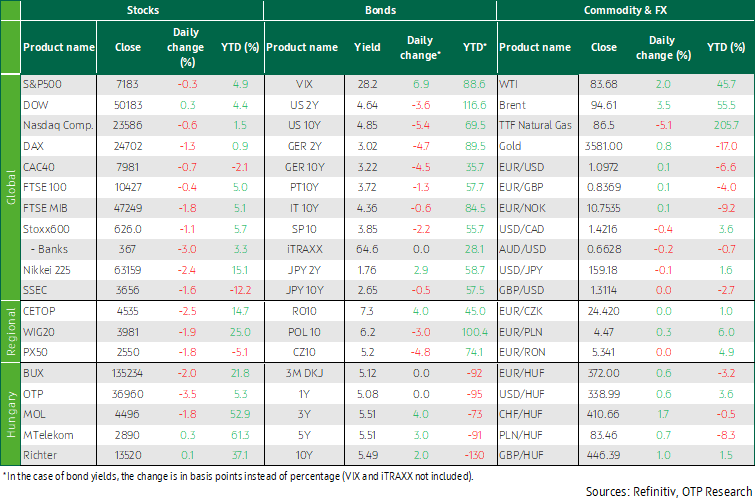
Risk-aversion continues to prevail on global stock markets. On Wednesday, technology sell-off did not ease in either Europe or the USA: the Stoxx600 fell 1.1%, while the S&P and Nasdaq dropped 0.3% and 0.6%, respectively. Nvidia continued to decline, Standard & Poor’s put chipmaker's rating on downgrade watch. In line with risk-off sentiment, long-term yields in developed markets fell further; the US 10-year yield dropped 10 bps intraday but reversed following the release of the core PCE price index. The CME FedWatch Tool priced in a 98% probability of a 25-bp Fed rate hike in December, which could be followed by further tightening next year. The EUR/USD stagnated around 1.097. The forint weakened, with the EUR/HUF jumping 0.6% to 372, while it surged 1.4% to over 410 vs the Swiss franc, the highest since April. Crude oil prices continue to rise amid escalating tensions in the Persian Gulf; however, in November, both WTI and Brent fell by app. 20%. Markets in the US will be closed today due to holiday, while in Europe, the latest ECB minutes will be today's highlight.
European stock indices fell on Wednesday, led by the technology and banking sectors
Stock markets in Western Europe closed Wednesday’s trading session with slight declines. The FTSE 100 edged down 0.2%, the CAC 40 slipped just 0.1%, while the DAX fell 0.8%. The pan-European Stoxx600 lost 1.1% after an initial rise. The technology sell-off did not ease, and market sentiment was not helped by President Trump’s renewed tariff announcement either. The new tariff measures also affect the EU, though under last year’s agreement between the US and the EU, the rate will not exceed 15%. Expectations of an interest rate hike have strengthened. Following the yesterday's release of the October core PCE price index - a key indicator for interest rate expectations - a Fed rate hike in December is now widely anticipated. And there is no doubt that the ECB will also end the year with a rate hike. According to a revised estimate of Q3 GDP, the German economy expanded only 0.1%, falling short of the preliminary estimate of 0.2%. Fitch warned that the outlook for Western European sovereign credit ratings is deteriorating.
In this environment, banks - along with the technology sector - were the day’s biggest laggards among the Stoxx600 sector indices, with a 3% decline. Banco Santander and Commerzbank dropped 4%, Banco BPM lost 3.7%, and SocGen fell nearly 3%. Technology investor Prosus reported lower-than-expected earnings, which further fueled concerns: its shares fell 4.9%. Bucking the trend, auto sector stocks rose 1.5% after JPMorgan confirmed its preference for truck, tire, and luxury car manufacturers. Shares of both Volkswagen and BMW rose by around 3%. A few positive earnings reports offset the gloomy market sentiment: spirits maker Remy Cointreau rallied 13% after raising its forecast. Shares of Sectra, a medical imaging software company, jumped 12% after it reported strong quarterly results. Rockwool, a mineral wool manufacturer, however, plummeted nearly 16% after revising its full-year outlook downward.
- the Fed rate hike in December is now widely anticipated. And there is no doubt that the ECB will also end the year with an interest rate hike. According to a revised estimate of third-quarter GDP, the German economy grew by only 0.1%, falling short of the preliminary estimate of 0.2%. Fitch warned that the outlook for Western European sovereign credit ratings is deteriorating.
In this environment, banks - along with the technology sector - were the day’s biggest laggards among the Stoxx600 sector indices, with a 3% decline. Banco Santander and Commerzbank dropped 4%, Banco BPM lost 3.7%, and SocGen fell nearly 3%. Technology investor Prosus reported lower-than-expected earnings, which further fueled concerns: its shares fell 4.9%. Bucking the trend, auto sector stocks rose 1.5% after JPMorgan confirmed its preference for truck, tire, and luxury car manufacturers. Shares of both Volkswagen and BMW rose by around 3%. A few positive earnings reports offset the gloomy market sentiment: spirits maker Remy Cointreau rallied 13% after raising its forecast. Shares of Sectra, a medical imaging software company, jumped 12% after it reported strong quarterly results. Rockwool, a mineral wool manufacturer, however, plummeted nearly 16% after revising its full-year outlook downward.
Stock markets across the CEE region all closed with significant declines: the WIG20 fell 1.6%, the PX dropped 1.8%, and the BUX lost 2% of its value. Among Hungarian blue chips, OTP’s 3.5% decline was the most significant; Mol slipped 1.8%, while Richter’s marginal gain and MTelekom’s 0.3% rise were not enough to lift the BUX.
The technology sector falls futher, dragging down the Nasdaq and the S&P; prices continue to soar in the crude oil market
Major US stock indices closed mixed on Wednesday. The sell-off in the technology sector showed little sign of abating, but dip-buyers pushed prices higher, allowing quite a few companies to rebound from Tuesday’s decline. Nevertheless, the Nasdaq still ended Wednesday’s trading 0.6% lower, the S&P slipped 0.3%, while the Dow edged up 0.3%. Among the S&P sector indices, the consumer cyclicals joined the IT sector as main laggards, while materials posted the best performance. The Philadelphia SE Semiconductor Index dropped 0.7%, though the largest chipmakers posted mixed results. Nvidia’s stock price fell another 4%, but it is still up 20% from Friday’s low, while it has lost more than a third of its value compared to its October high. Standard & Poor’s warned that the independence of the board of directors at Nvidia could be jeopardized by Jensen Huang’s reappointment and put the chipmaker on downgrade watch.
In commodities market, crude oil prices continued to rise on Wednesday, with Brent rising 3.5% and WTI adding 2%, as the situation in the Persian Gulf remains tense. Yemeni Houthi rebels continue to attack Saudi targets - including the key oil export terminal on the Ras Tanura Peninsula - while Iran reported that several ships had struck mines in the Strait of Hormuz. Supply-side concerns may be alleviated by the fact that crude oil shipments through the strait have increased this month, and the IEA forecasts a supply surplus for the fourth quarter of this year. In November, Brent and WTI prices fell by 19% and 20%, respectively. European TTF natural gas futures fell 5% on Wednesday after expectations of increased Norwegian gas supplies eased pressure stemming from recent supply disruptions and maintenance work in the region. However, supply risks remain, as cold spells in northwestern and central Europe are expected to persist through early December, which could potentially increase heating demand and deplete gas stocks faster than anticipated. Filling levels at EU gas storage facilities are below 68%, which is significantly lower than the five-year seasonal average of 86%.
In addition to the long-awaited PCE price indices, several other key economic data points were released yesterday. According to the revised Q3 GDP reading, economic growth may have accelerated to an annualized rate of 4.3% qoq, compared with the preliminary estimate of 3.4%. However, durable goods orders slowed to 0.2% in October - more than the market consensus had anticipated - though the September figure was revised slightly upward. The number of weekly jobless claims came in slightly lower than expected and below the previous week’s level, while the four-week average also declined slightly. Consumer spending stagnated in real terms in October, but showed stronger-than-expected growth in the third quarter. According to the latest data, the number of building permits issued declined in October, while new home sales rose more than expected.
Risk-aversion in developed markets continues to drive investors toward government bonds; the CHF/HUF surged to 410, the highest since April
Long-term yields dropped as the stock market sell-off drives investors to the Treasury market. The US 10-year yield fell by 10 bps intraday on Wednesday. One of the most anticipated macroeconomic events of the week was the release of the US core PCE price index, which pointed to persistent inflation. Expectations for an interest rate hike strengthened, causing long-term yields to reverse after the data release. The 10-year yield closed at 4.85%, a nearly three-week low, while the 2-year yield settled around 4.65%. Interest rate futures are now pricing in a 98% probability of a 25-bp Fed rate hike in December, which could be followed by further tightening of a similar magnitude in January and June, and then a possible rate cut in November. Eurozone yields also edged lower; demand for regional government bonds as safe-haven assets led to falling yields here as well, though by the end of the day, German 2- and 10-year yields had fallen by only 5 bps. The EUR/USD exchange rate remained near the 1.097.
There were no major shifts in the Hungarian bond market yesterday; yield changes were recorded only in the 3- to 10-year segment, with yields rising 2-4 bps according to the early-afternoon benchmark quotes. The forint weakened to 372 vs the euro, underperforming other regional currencies. Vs the US dollar, the forint depreciated by a similar margin, 0.6%, with the USD/HUF rising to 339. The forint fell the most against the Swiss franc, by 1.7%. The CHF/HUF surged to the 410 level for the first time since April.
Today's highlights
In Asian stock markets, while enthusiasm was not exactly overwhelming, the major indices posted modest gains. The positive sentiment may have been driven by the possibility that the tariffs hinted at by the US administration could be not as dire as initially feared. The Nikkei gained 0.9% this morning, the Hang Seng rose 1.2%, while the Shanghai Composite remained flat. South Korean indices rose around 0.5% this morning, with optimism stemming from the fact that, although the local central bank raised interest rates, it also raised its growth forecasts for this year and next. Stock index futures point to a positive opening in Europe, while markets in the US will be closed today for the Thanksgiving holiday.
Today, the Hungarian Central Statistical Office (KSH) will release employment data. ÁKK will auction 3-, 5-, and 10-year bonds, with a planned volume of 15, 25, and 25 billion HUF, respectively. On the international front, the ECB’s minutes of the latest interest rate-setting meeting will be today's highlight.
Get more out of your investments!
Global Markets Services
OTP Global Markets offers a broad range of services in the field of local and international money and capital markets.
Read morePrivate Banking Services
Personal care and expertise with OTP Private Banking, along with the knowledge, security, and innovations of a multinational banking group.
Read more