
OTP Morning Brief: Monday's rally lost momentum as equities pulled back, with technology stocks weakening
Related content
OTP Morning Brief: Stock markets rise on news of Nvidia CEO's return
Investor sentiment improved markedly in Monday's trading after Nvidia announced that Jensen Huang would return to the CEO position. The STOXX 600 rose 1.8%, the S&P 500 gained 4.7%, while the Nasdaq surged 6.5%, led primarily by technology stocks. US Treasury yields moved higher and the dollar strengthened, while oil prices fell sharply amid increased Middle Eastern supply and the restart of a Libyan oil pipeline. Today, Germany will release the November Ifo Business Climate Index, while in the US, the September Case-Shiller Home Price Index and the November Consumer Confidence Index are scheduled for publication. Among corporate events, earnings reports from Dell Technologies, Analog Devices, Medtronic, Workday, Autodesk, and HP are in focus, while Hungary's Government Debt Management Agency (ÁKK) will auction HUF 20 billion worth of 3-month discount Treasury bills.
OTP Morning Brief: Stock markets suffered a rare, sharp sell-off, while the volatility index skyrocketed
US equities extended their decline on Friday, with the Nasdaq losing 5.3%, a one-day correction of a similar magnitude having occurred only 40 times over the past 36 years, mostly during periods that were later identified as major market downturns. The major European indices were not spared from the correction either. The VIX index, often referred to as the market's "fear gauge" and reflecting expected near-term volatility, also surged significantly. In this environment, investors increasingly rotated into government bonds, leading to a modest decline in long-term yields. Currency markets remained relatively calm on the final trading day of the week; however, over the course of the week, the euro weakened significantly against the dollar, while the forint depreciated even more sharply against the euro.
Following Monday's rebound, European equities declined on Tuesday, with the STOXX 600 slipping 0.7%. Despite Nvidia's nearly 6% decline, while both the Nasdaq and the S&P 500 closed in negative territory, the Dow managed to post gains. Oil prices rose following reports of renewed attacks on vessels in the Strait of Hormuz, with both Brent and WTI crude gaining 2.3%. Bond markets saw limited movement; US Treasury yields were mixed, while German government bond yields edged lower. The negative sentiment also spilled over into Asian markets: approaching the close, South Korea's Kospi posted a sharp decline, while the Nikkei, Hang Seng, and SSEC were all trading in negative territory. Today's focus is on the Fed's closely watched core PCE index for October, while data on US personal income and consumer spending are also due for release. Detailed data for Germany's Q3 GDP and the second estimate of US Q3 GDP are due today, while the Fed will release its latest Beige Book later in the evening.
Monday's tech-driven rally ran out of steam as European equities weakened
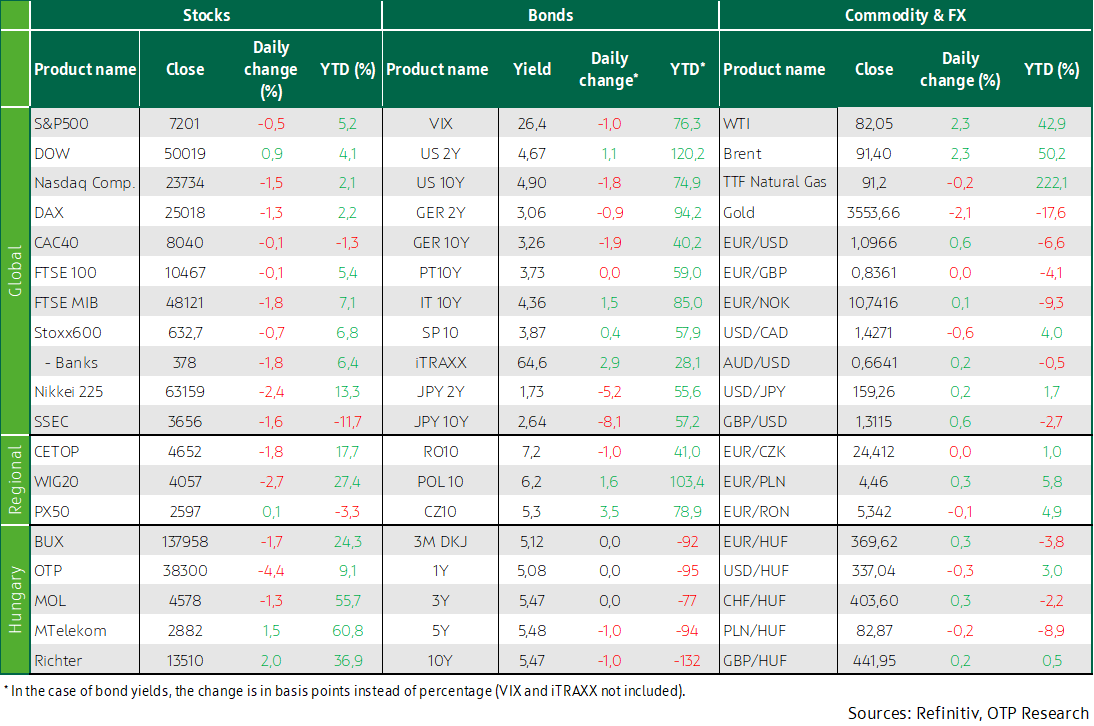
Following a six-month high in gains on Monday, European equity markets weakened on Tuesday, with the STOXX 600 closing 0.7% lower. The technology sector fell nearly 3% after surging more than 4% the previous day, as investors weighed the potential corporate governance and political implications of the leadership changes surrounding Nvidia. Among semiconductor stocks, Aixtron plunged 16.3% after being downgraded to Sell by UBS, while Infineon and ASM International each lost more than 8%. Mining stocks were the weakest performers, with the sector index falling 4.6%, partly driven by declines in gold and copper prices. Losses were partially offset by the healthcare sector, which rose nearly 2%, led by Sanofi. Shares of the French drugmaker surged 9.7% after it announced the $41 billion acquisition of US-based Insmed.
Among the major Western European indices, the DAX lost 1.3%, while both the CAC 40 and the FTSE 100 closed 0.1% lower. In the region, Poland's WIG20 fell 2.7% and Hungary's BUX declined 1.7%, while the Czech PX edged up 0.1%. Among Hungarian blue chips, Richter gained 2.0% and Magyar Telekom rose 1.5%, whereas Mol slipped 1.3%. The biggest loser was OTP, which dropped 4.4%.
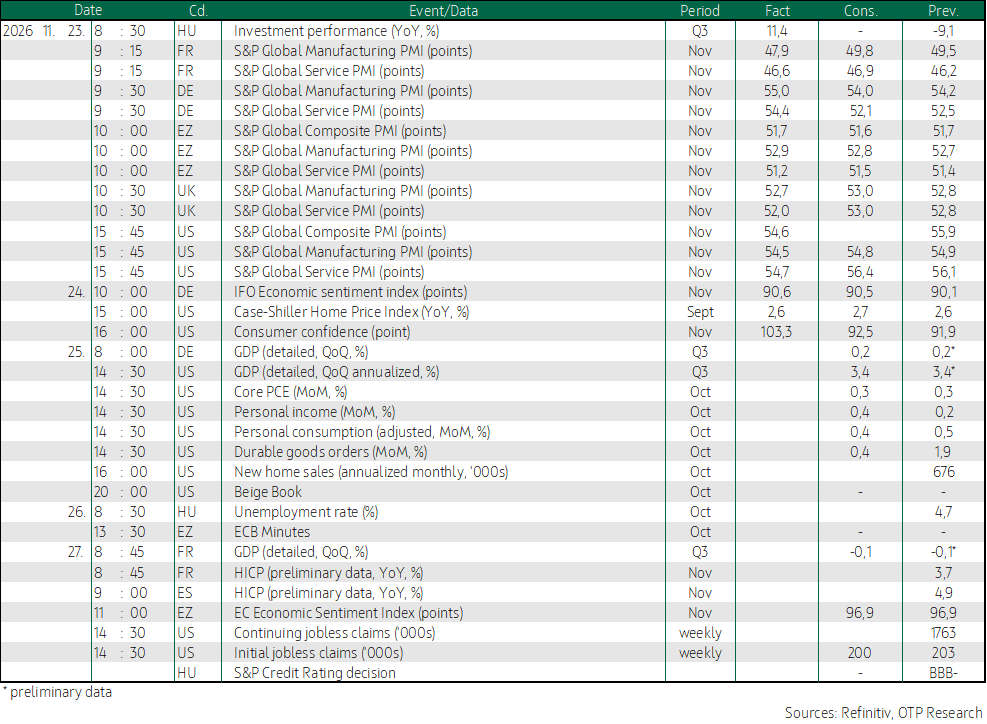
Germany's Ifo business climate index rose for a seventh consecutive month in November, increasing from 90.1 to 90.6, slightly exceeding expectations and reaching its highest level since May 2023. Companies assessed both current conditions and the six-month outlook more favourably, although sentiment in the manufacturing sector deteriorated after six consecutive months of improvement.
The Nasdaq and the S&P 500 closed lower following the previous day's Nvidia-led rally, while oil prices rose
Major US stock indices closed mixed on Tuesday. Following Monday's rebound, AI-related stocks came under pressure again, with the Nasdaq falling 1.5% and the S&P 500 declining 0.5%, while the Dow rose 0.9%. Nvidia shed 5.9% after soaring 31.5% the previous day. Among the S&P 500 sectors, technology was the weakest performer, down 2.8%, while the semiconductor index plunged 7.9%. Shares of Anthropic, which went public last week, fell 6.5%, closing below their $83 IPO price. Healthcare led the advancing sectors, and several retail stocks posted strong gains. Abercrombie & Fitch surged 19.7% and Dollar Tree rose 11.2% after both companies raised their profit guidance.
After declining on Monday, oil prices rose on Tuesday. Both Brent and WTI crude gained 2.3%, reaching $91.4 and $82.1 per barrel, respectively. The rebound was driven by renewed concerns over the security of oil shipments after the UK Maritime Trade Operations (UKMTO) reported that three vessels had been struck in the Strait of Hormuz.
The Case-Shiller index rose 2.6% year-on-year in September, matching August's pace but coming in slightly below the 2.7% consensus forecast. However, house price growth continued to lag inflation, meaning real home prices were lower than a year earlier for the 16th consecutive month.
The US Conference Board consumer confidence index jumped from 91.9 in October to 103.3 in November, its highest level since January 2025 and well above the market consensus of 92.5. The improvement was largely driven by consumers' more favourable assessment of current labour market conditions and reduced pessimism regarding employment prospects over the next six months.
Bond markets saw a subdued trading session, with only modest changes in yields
Trading was mixed in the US Treasury market on Tuesday, although yield movements remained modest: the two-year yield rose 1.1 basis points to 4.67%, while the ten-year yield edged 1.8 basis points lower to 4.90%. Eurozone bond markets were similarly subdued. Weakness in equity markets prompted some investors to seek safety in German government bonds, pushing the ten-year Bund yield down 1.9 basis points to 3.26%, while the two-year yield closed at 3.06% (-0.9 bp). France's ten-year yield also edged lower, while Italian and Spanish yields rose slightly and Portuguese yields were unchanged. The euro strengthened 0.6% against the dollar on Tuesday, with EUR/USD closing at 1.097, supported in part by improving German business sentiment.
Trading was quiet in the Hungarian government bond market, with yields moving only in the 5–20-year segment, where they declined by a modest 1–3 basis points. According to the Government Debt Management Agency's (ÁKK) early afternoon pricing, the 10-year benchmark yield stood at 5.47%. At Tuesday's discount Treasury bill auction, bids totalled HUF 17.4 billion against the announced HUF 20 billion offering, of which the debt manager accepted HUF 11.5 billion at an average yield of 5.14%. The forint weakened 0.3% against the euro but strengthened by the same magnitude versus the dollar, leaving EUR/HUF at 369.6 and USD/HUF at 337.0 at the close.
Today's highlights
Sentiment across Asian markets remained negative following the sell-off in Wall Street's technology stocks. Shares of South Korean and Japanese chipmakers came under significant pressure, while Chinese technology stocks were also weighed down by concerns over escalating US trade tensions. Approaching the close, at 7:30 a.m. CET, the Kospi was posting a steep decline of more than 6%, while the Nikkei, Hang Seng, and SSEC were all trading in negative territory.
Today's focus is on the Fed's closely watched core PCE index for October, while data on US personal income and consumer spending are also due for release. Detailed figures for Germany's third-quarter GDP and the second estimate of US Q3 GDP will be published as well, and later in the day the Fed will release its latest Beige Book.
Get more out of your investments!
Global Markets Services
OTP Global Markets offers a broad range of services in the field of local and international money and capital markets.
Read morePrivate Banking Services
Personal care and expertise with OTP Private Banking, along with the knowledge, security, and innovations of a multinational banking group.
Read more