
OTP Morning Brief: Stock markets rise on news of Nvidia CEO's return
Related content
OTP Morning Brief: Stock markets suffered a rare, sharp sell-off, while the volatility index skyrocketed
US equities extended their decline on Friday, with the Nasdaq losing 5.3%, a one-day correction of a similar magnitude having occurred only 40 times over the past 36 years, mostly during periods that were later identified as major market downturns. The major European indices were not spared from the correction either. The VIX index, often referred to as the market's "fear gauge" and reflecting expected near-term volatility, also surged significantly. In this environment, investors increasingly rotated into government bonds, leading to a modest decline in long-term yields. Currency markets remained relatively calm on the final trading day of the week; however, over the course of the week, the euro weakened significantly against the dollar, while the forint depreciated even more sharply against the euro.
OTP Morning Brief: Anthropic's IPO fails to restore confidence in the AI growth story
Leading European and US indices ended Thursday's trading session in negative territory. Uncertainty surrounding the profitability of AI investments and elevated technology stock valuations weighed on market sentiment. Anthropic, the developer of Claude, began trading at a $1.5 trillion valuation following its $81.3 billion capital raise on Wednesday. Long-term yields declined in the US, while moving higher in Europe. The dollar strengthened against the euro. The forint continued to weaken against the major currencies. Today, attention will be on the ECB’s Q3 wage data and the euro area’s November consumer confidence index. In Hungary, the focus will be on Moody's sovereign rating review.
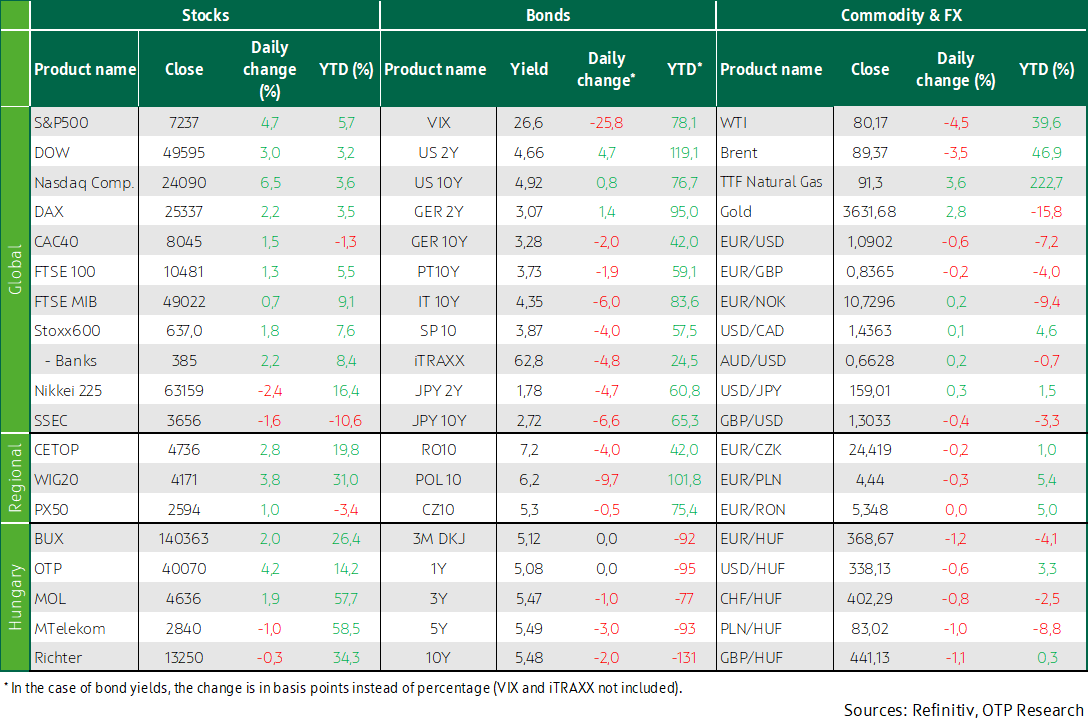
Investor sentiment improved markedly in Monday's trading after Nvidia announced that Jensen Huang would return to the CEO position. The STOXX 600 rose 1.8%, the S&P 500 gained 4.7%, while the Nasdaq surged 6.5%, led primarily by technology stocks. US Treasury yields moved higher and the dollar strengthened, while oil prices fell sharply amid increased Middle Eastern supply and the restart of a Libyan oil pipeline. Today, Germany will release the November Ifo Business Climate Index, while in the US, the September Case-Shiller Home Price Index and the November Consumer Confidence Index are scheduled for publication. Among corporate events, earnings reports from Dell Technologies, Analog Devices, Medtronic, Workday, Autodesk, and HP are in focus, while Hungary's Government Debt Management Agency (ÁKK) will auction HUF 20 billion worth of 3-month discount Treasury bills.
The Nvidia effect and favorable German PMI data support European equity markets
Investor sentiment improved markedly across European markets after Nvidia announced the return of CEO Jensen Huang, easing concerns surrounding the artificial intelligence sector. The STOXX 600 rose 1.8%, with technology stocks leading the gains. Among semiconductor-related companies, AT&S, Aixtron, and BE Semiconductor advanced, while AI infrastructure names such as Schneider Electric and Siemens Energy also moved higher. Defense, industrial, and mining stocks likewise delivered strong performances.
All major European equity markets closed higher, with the DAX gaining 2.2%, the CAC 40 rising 1.5%, and the FTSE 100 advancing 1.3%. Germany's market posted the strongest performance, supported not only by gains in technology stocks but also by better-than-expected November business sentiment data.
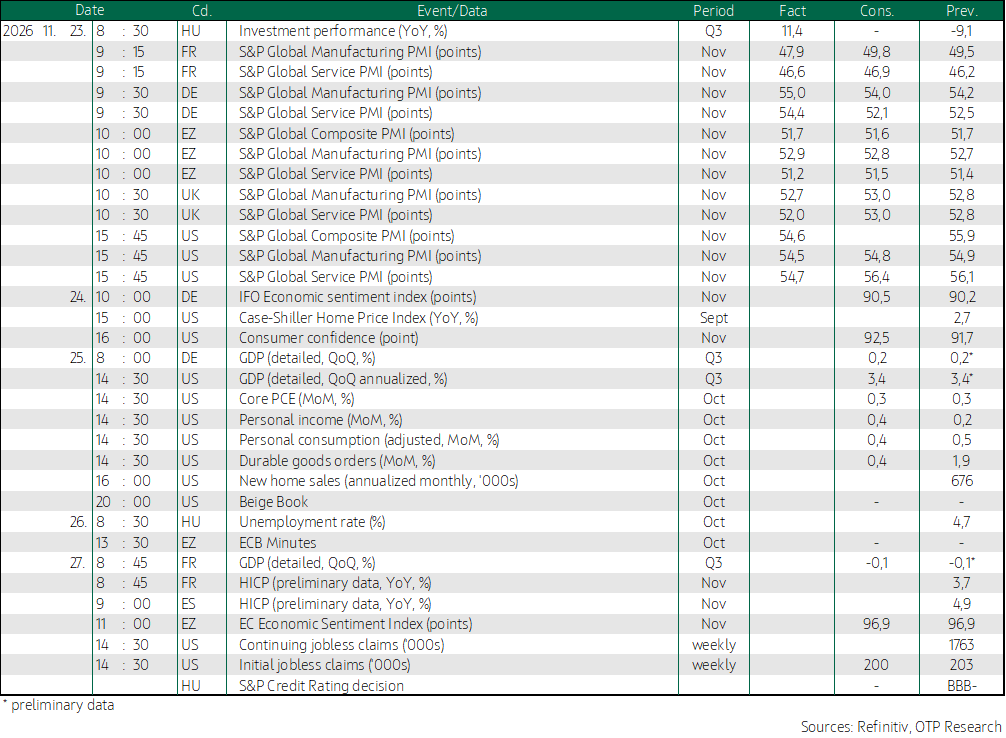
The eurozone's composite PMI remained unchanged at 51.7 in November, while the services PMI eased to 51.2 and the manufacturing PMI rose to 52.9. Growth was driven primarily by Germany, where activity in both the manufacturing and services sectors increased by more than expected, with manufacturing accelerating to its highest level in more than four and a half years. In contrast, both manufacturing and services activity contracted in France, while corporate sentiment toward the year ahead deteriorated to its most pessimistic level since 2012. In the UK, manufacturing activity continued to expand, partly supported by investment in data centers and defense, while growth in the services sector slowed.
Sentiment was also positive across the Central and Eastern European region, with Poland's WIG20 rising 3.8%, Hungary's BUX gaining 2.0%, and the Czech PX50 advancing 1.0%. Among Hungarian blue chips, OTP climbed 4.2% and MOL rose 1.9%, while Magyar Telekom declined 1.0% and Richter edged down 0.3%. In Hungary, the volume of investment was 11.4% lower year-on-year in Q3 2026, while the Hungarian Central Statistical Office (KSH) recorded a 2.8% quarter-on-quarter decline. The contraction was driven primarily by the manufacturing sector, while increasing investment activity in the energy sector partly offset the negative trend. Both corporate and government investment declined, whereas household investment increased.
Sharp rebound on Wall Street as concerns over the AI sector ease
US equity markets closed sharply higher, recouping a significant portion of last week's losses. The Dow gained 3.0%, the S&P 500 rose 4.7%, while the Nasdaq surged 6.5%. Trading was led primarily by technology and semiconductor stocks after Nvidia announced the return of Jensen Huang as CEO. Investors interpreted the move as a sign that uncertainties surrounding the outlook for the artificial intelligence sector could begin to ease. Nvidia shares soared nearly 32%, triggering a broad-based rally across the technology sector, as the market continues to view Huang as one of the key figures behind the AI investment boom. In recent weeks, investors had increasingly questioned the return potential of massive investments in AI data centers, making the resolution of the leadership uncertainty a welcome source of support for the sector.
Among the day's macroeconomic releases, the November PMI surveys were in the spotlight. According to the preliminary data from S&P Global, the US composite PMI eased to 54.6 in November from 55.9 in the previous month, marking a four-month low in private-sector activity while still pointing to solid economic expansion. The manufacturing PMI declined to 54.5, while the services PMI slipped to 54.7, as growth in both new orders and output lost some momentum. Inflationary pressures moderated, although increases in both input and selling prices remained elevated. At the same time, business confidence improved, supported by expectations of a more stable political environment following the midterm elections.
US yields rise; the dollar and the forint strengthen
On the US Treasury market, yields moved higher on Monday. The yield on the 2-year US Treasury note rose 5 basis points to 4.66%, while the 10-year benchmark yield increased 1 basis point to 4.92%. The move was driven primarily by improving equity market sentiment and easing concerns surrounding the technology sector, which reduced demand for safe-haven assets. Markets continue to price in a Fed rate hike in December, while investors are closely watching this week’s GDP and PCE inflation releases, along with comments from Federal Reserve policymakers.
In Europe, short-term yields edged higher, with the German 2-year government bond yield rising 1 basis point to 3.07%, while the German 10-year yield fell 2 basis points. In the foreign exchange market, the US dollar strengthened against major currencies as investors once again priced in a higher US interest rate path. The EUR/USD exchange rate traded near 1.09. In the oil market, a significant correction unfolded, with Brent crude falling from USD 92.57 to USD 89.37 per barrel, while WTI crude declined from USD 83.98 to USD 80.17. The drop was driven by increasing Middle Eastern supply, the restart of Libya’s Sharara pipeline, and the gradual recovery of Libyan oil production.
In Hungary's government bond market, yields edged lower across most maturities. The 3-year benchmark yield declined to 5.47%, the 5-year yield eased to 5.49%, while the 10-year benchmark yield fell to 5.48%. At the short end of the curve, the yield on the 3-month discount Treasury bill decreased to 5.12%. The forint strengthened against major currencies, with the EUR/HUF exchange rate trading at 368.67 and the USD/HUF rate around 338.13.
Today's highlights
Asian equity markets posted strong gains as investor sentiment improved, led by the technology sector. Taiwan's stock market surged 9.1%, South Korea's Kospi advanced 6.5%, and Japan's Nikkei rose 3.7%, while concerns over chip export restrictions tempered the positive market reaction in China. In contrast, the Indian equity market moved lower.
Today, Germany will release the November Ifo Business Climate Index. In the US, investors will focus on the September Case-Shiller Home Price Index and the November Consumer Confidence Index. Among corporate earnings releases, particular attention will be on Dell Technologies Inc., which is scheduled to report after the market close. Analog Devices, Inc. and Medtronic plc will publish their quarterly results before the opening bell, while Workday, Inc., Autodesk, Inc., and HP Inc. are set to report after the close. In Hungary, the Government Debt Management Agency (ÁKK) will hold an auction of HUF 20 billion worth of discount Treasury bills (DKJ) today.
Get more out of your investments!
Global Markets Services
OTP Global Markets offers a broad range of services in the field of local and international money and capital markets.
Read morePrivate Banking Services
Personal care and expertise with OTP Private Banking, along with the knowledge, security, and innovations of a multinational banking group.
Read more