
OTP Morning Brief: Stock markets suffered a rare, sharp sell-off, while the volatility index skyrocketed
Related content
OTP Morning Brief: Anthropic's IPO fails to restore confidence in the AI growth story
Leading European and US indices ended Thursday's trading session in negative territory. Uncertainty surrounding the profitability of AI investments and elevated technology stock valuations weighed on market sentiment. Anthropic, the developer of Claude, began trading at a $1.5 trillion valuation following its $81.3 billion capital raise on Wednesday. Long-term yields declined in the US, while moving higher in Europe. The dollar strengthened against the euro. The forint continued to weaken against the major currencies. Today, attention will be on the ECB’s Q3 wage data and the euro area’s November consumer confidence index. In Hungary, the focus will be on Moody's sovereign rating review.
OTP Morning Brief: Stronger-than-expected investor interest surrounded Anthropic’s IPO
Major European indices declined yesterday; mining stocks were among the worst performers following the sell-off in copper prices; the banking sector came under pressure on reports related to the ECB; UK inflation rose slightly less than expected. Major US indices closed mixed yesterday; Nvidia shares declined despite strong earnings results; Anthropic’s IPO attracted stronger-than-expected investor demand; mixed data arrived from the US housing market. Developed-market long-term yields mostly declined, even as further signals pointing to additional Fed tightening emerged; oil prices fell on the back of higher-than-expected inventories; the Hungarian forint weakened further. Today, alongside the usual weekly US initial jobless claims data, the Conference Board Leading Economic Index (LEI) will also be released.
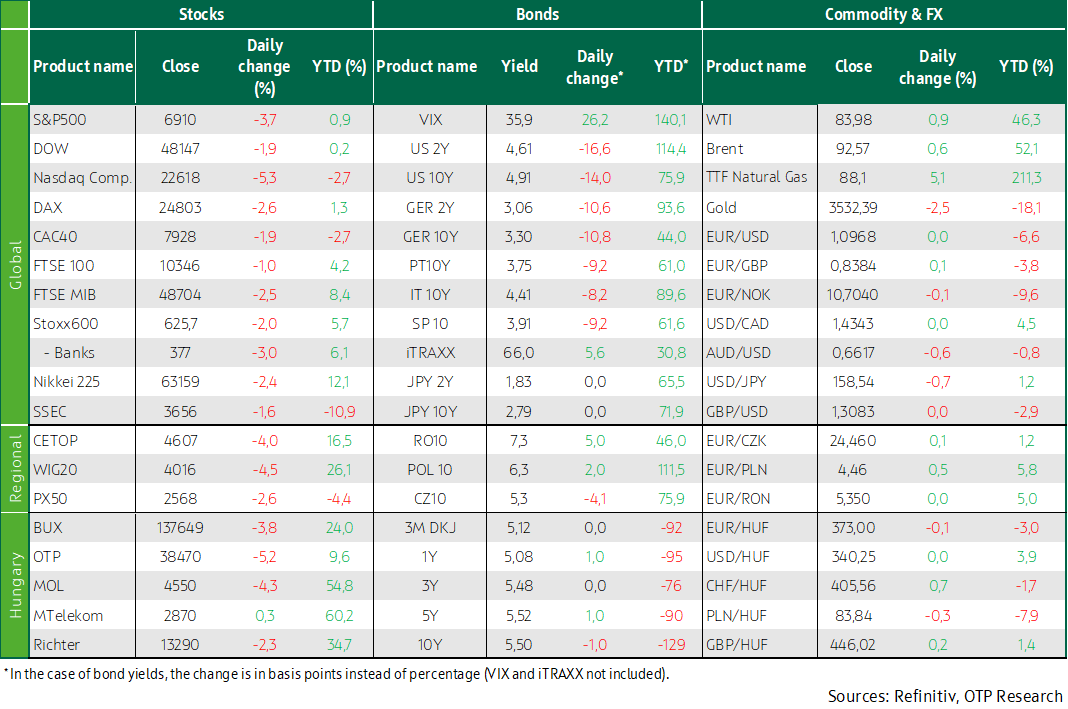
US equities extended their decline on Friday, with the Nasdaq losing 5.3%, a one-day correction of a similar magnitude having occurred only 40 times over the past 36 years, mostly during periods that were later identified as major market downturns. The major European indices were not spared from the correction either. The VIX index, often referred to as the market's "fear gauge" and reflecting expected near-term volatility, also surged significantly. In this environment, investors increasingly rotated into government bonds, leading to a modest decline in long-term yields. Currency markets remained relatively calm on the final trading day of the week; however, over the course of the week, the euro weakened significantly against the dollar, while the forint depreciated even more sharply against the euro.
Rare, steep sell-off across European equities on Friday leaves major indices deep in the red for the week
European equities declined on every trading day of the previous week, with Friday proving particularly painful: the Stoxx 600 fell 2.0% on the day, bringing its weekly loss to 5.8%. The sell-off in European stocks was less severe than the AI-related correction that triggered a broader rout across US equity markets, partly due to Europe's earlier market close. Nevertheless, the magnitude of the decline remained significant: since 1990, a larger daily drop in the Stoxx 600 has occurred on only 3.5% of trading days, while a greater weekly decline has been recorded in just 1.9% of weeks.
There were few sectors able to withstand the broadly negative market sentiment. European food producers were the only group to post gains on Friday, rising 0.8% (Nestlé: +1.0%, Danone: +0.7%), although they still ended the week in negative territory. Unsurprisingly, technology stocks led the sell-off (Friday: -5.4%, week: -10.6%), with ASML, Europe's largest semiconductor equipment manufacturer, plunging 9% on Friday alone. The Stoxx 600 banking sub-index also underperformed the broader market (Friday: -3.0%, week: -7.3%), despite the European Central Bank's Financial Stability Review published last Wednesday explicitly highlighting that European lenders have no significant direct exposure to AI-related assets. The weakness in bank stocks therefore suggests that investors were pricing in a broader increase in economic risks associated with the deflation of the AI bubble.
Equity markets across the CEE region also came under heavy pressure. On Friday, Warsaw fell 4.5%, Prague declined 2.6%, and Budapest dropped 3.8%, while weekly losses across the three regional exchanges ranged between 3% and 6%. On the Hungarian market, only Magyar Telekom managed to defy the global headwinds, edging up 0.3% on Friday, whereas the other domestic blue chips retreated by between 2% and 5%.
There was also some encouraging news on the European macro front at the end of last week. In the euro area, negotiated wage growth came in at 2.6% year-on-year in Q3, showing little change from the previous quarters (Q1-Q2: 2.5%). This suggests that wage dynamics are not generating significant inflationary pressure in the currency bloc, particularly given that core CPI is also hovering around 2.5%. As a result, if the decline in energy prices seen over the past two to three weeks continues, the ECB's room to avoid further rate hikes could increase substantially. At the same time, the CEE region delivered a negative surprise: Poland's business climate index unexpectedly fell to -8.3 points in November, marking its weakest reading of the year, including the period before the escalation of the Iran-Israel conflict in January and February.
Huge sell-off in US equities on Friday as the "fear gauge" surged to a multi-year high
US equity markets suffered a massive sell-off on Friday. While the Dow Jones limited its losses to 1.9%, the S&P 500 plunged 3.7% and the Nasdaq tumbled 5.3%. On a weekly basis, the former two indices lost around 8%, while the Nasdaq dropped 10%. The decline was broad-based and affected the overwhelming majority of stocks: nearly 4,000 Nasdaq-listed companies finished lower, while fewer than 1,000 managed to remain in positive territory. The correction was driven by mounting concerns over AI-related valuations, as an increasing number of investors began questioning whether current pricing levels have become excessive, drawing comparisons with the dot-com bubble of the early 2000s. Since 1990, declines in the Nasdaq of 5.3% or more in a single trading session have occurred on only 40 occasions, representing just 0.4% of all trading days. Of these episodes, 17 (43%) took place during the unwinding of the dot-com bubble in the 18 months following March 2000, nine (23%) occurred during the bear market that followed the collapse of Lehman Brothers in late 2008, and four (10%) were recorded during the Covid crisis in March 2020. Historically, daily declines of this magnitude have therefore tended to occur during periods that were later identified as prolonged and significant market corrections. In addition, the Nasdaq has now fallen 18% from its peak seven weeks ago on October 6, a decline comparable in scale, albeit somewhat smaller, to the 25% correction seen during the seven weeks following the market peak reached on March 10, 2000, at the height of the dot-com bubble.
The rise in the VIX index also suggests that investors are bracing for a more turbulent period ahead. This indicator derives the market's expected volatility for the next month from options prices on the S&P 500. The VIX climbed to 35.89 on Friday (previous day: 28.44; previous week: 19.3; a level below 20 is typically associated with normal market conditions). Comparable readings were last seen in April 2025, when Donald Trump announced US punitive tariffs. Since 1990, the VIX has closed above 35 on only 3.7% of trading days. Unlike sharp declines in the Nasdaq, however, elevated VIX levels have not been limited to periods that were later classified as crises. Moreover, during the first year of the dot-com bust in 2000, the index generally fluctuated between 20 and 30, meaning it did not reach levels as high as those seen today.
Friday was relatively quiet on the US macroeconomic front. The University of Michigan's November consumer sentiment index showed some improvement in household confidence, rising to 51.5 from 48.0 in the previous month. Even so, the indicator remains well below its historical levels, including the roughly 55-60 average recorded over the past five years. Meanwhile, further signals emerged from Federal Reserve officials suggesting that current interest rates may not be sufficiently restrictive given persistent inflationary pressures and the economy's solid growth momentum. This time, Lisa Cook, a member of the Fed's Board of Governors, made such remarks on Friday. Markets are now pricing in a cumulative 50 basis points of rate hikes by the end of January.
The equity market rout boosted the appeal of government bonds, driving yields lower across the board on Friday
Virtually all major developed-market bond yields moved significantly lower on Friday, resulting in notable weekly declines as well. The US 2-year Treasury yield closed at 4.61% (daily change: -17 bps, weekly change: -26 bps), while the 10-year yield finished at 4.91% (daily: -14 bps, weekly: -24 bps). In Western Europe, yield dynamics were somewhat different. Although yields also declined markedly on Friday (German 10-year: 3.30%, daily change: -11 bps; French 10-year: 4.87%, daily change: -8 bps), they had generally risen earlier in the week, leaving Friday's closing levels broadly unchanged compared with a week earlier. In the CEE region, however, traditional risk-off dynamics re-emerged. The drop in global risk appetite associated with the equity market sell-off pushed regional yields modestly higher on Friday: the Polish 10-year yield rose 2 bps to 6.29%, the Romanian 10-year increased 5 bps to 7.27%, while Hungarian yields were unchanged and only Czech government bonds managed to post modest declines. Overall, though, the bond market has not seen a particularly pronounced trend over the past one to one-and-a-half months. Yields in developed markets have generally edged lower by 0-10 basis points, while declines in peripheral markets, including Southern Europe and the CEE region, have ranged between 10 and 20 basis points.
Eventful week in currency markets, with the forint emerging as the biggest loser
The dollar was broadly unchanged against the euro on Friday, but strengthened by 0.5% over the course of the week and is now up 2.2% over the past 30 days. Overall, the greenback is trading at its strongest level since April 2025, following the announcement of Donald Trump's tariff measures, with the exchange rate once again falling below 1.10 USD/EUR. The move appears to have been driven by rising expectations of further US rate hikes, as well as growing, albeit still limited, uncertainty over the prospect of higher ECB interest rates.
The forint also showed little movement on Friday, but over the course of the week it depreciated by 2.4% against the euro and by 2.8% versus the dollar. By Friday, the exchange rate had weakened to around HUF 373 per euro, its lowest level since April 2026. The currency was partly weighed down by the broader deterioration in risk appetite toward emerging markets, as evidenced by the zloty's 1.2% weekly depreciation against the euro. However, the MNB's unexpectedly dovish communication following Tuesday's policy meeting, which all but signalled a 25-basis-point rate cut in December, likely also contributed to the move. So far, the Moody’s decision on Friday evening, after market close, to revise the outlook on Hungary's Baa2 sovereign rating from negative to stable has done little to improve sentiment toward the currency.
Commodities: natural gas prices rise, oil remains range-bound, precious metals tumble
Oil prices posted modest gains of less than 1% on Friday (WTI and Brent: USD 84 and USD 93 per barrel, respectively), but still declined by 3-5% over the course of the week, extending the downward trend that began three weeks ago following the US midterm elections. The TTF natural gas price fell 3.3% on a weekly basis to EUR 88.2/MWh, despite a significant rebound of 3.4% on Friday. Precious metals came under heavy pressure, with gold and silver prices dropping 9% and 16%, respectively, over the past week, including losses of around 3% on Friday alone. As a result, both metals fell to their lowest levels in more than a year. Silver has now lost roughly 60% of its value from this year's peak, while investors who entered the gold market at February's record highs are nursing losses of around one-third of their initial investment.
Today's highlights
Asian trading on Monday indicated that markets remain highly unsettled. South Korea's KOSPI, which has substantial exposure to AI-related stocks, opened down 3% and fell by more than 5% during the session, while China's SSE Composite and Taiwan's equity market both started the day with losses of around 1%. Japanese markets, meanwhile, were closed for a public holiday. In an effort to contain the sell-off, authorities across the region introduced a range of market-stabilisation measures: China eased margin requirements, Taiwan tightened rules on short selling, and South Korea's finance minister announced forthcoming support measures. These interventions helped markets recover part of their losses. By 7:30 a.m. CET, the KOSPI was down around 3%, while the SSE Composite had briefly moved back into positive territory.
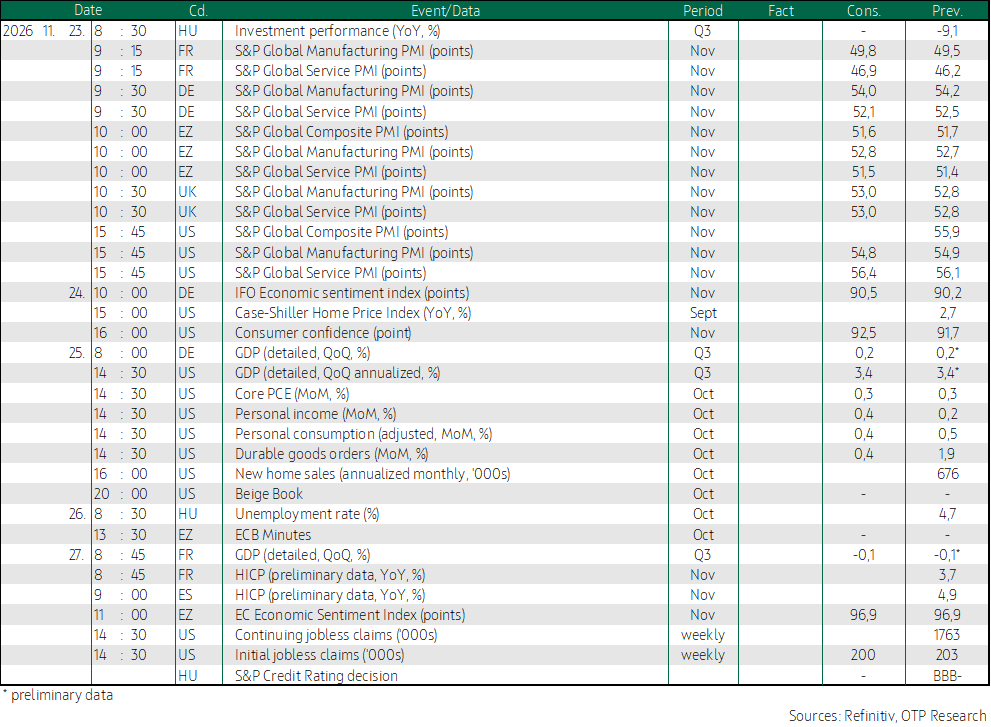
Among today's macro releases, the focus will be on the S&P Global PMI surveys for the euro area, its major member states, and the US.
Get more out of your investments!
Global Markets Services
OTP Global Markets offers a broad range of services in the field of local and international money and capital markets.
Read morePrivate Banking Services
Personal care and expertise with OTP Private Banking, along with the knowledge, security, and innovations of a multinational banking group.
Read more