
OTP Morning Brief: Stronger-than-expected investor interest surrounded Anthropic’s IPO
Related content
OTP Morning Brief: Risk aversion strengthened across markets ahead of Nvidia’s earnings release
Negative sentiment prevailed across equity markets on Tuesday: European exchanges suffered their steepest decline in several months, while the technology-led correction on Wall Street continued amid a wait-and-see approach ahead of Nvidia’s earnings release. In the US, comments from Fed policymakers further reinforced expectations of a December rate hike. The MNB kept its base rate unchanged; however, the decision was not unanimous. Growing caution led to declining yields across developed bond markets, while French government bonds outperformed within the euro area. In Hungary, yields edged lower, while the forint weakened against both the euro and the US dollar. Today’s releases include the UK’s October CPI data, several key US housing market indicators and Hungary’s September wage figures, while the minutes of the Fed’s latest rate-setting meeting will also be published later in the day. Among corporate earnings releases, quarterly results from Tencent and Palo Alto Networks will be in focus.
OTP Morning Brief: Stocks started the week in the red; Nvidia earnings are due today
Stocks closed lower on Monday, while the dollar continued to strengthen, pushing the EUR/USD exchange rate below 1.10, and oil prices declined sharply. Eurozone industrial production rose by 0.2% month-on-month in September. Today, investors will focus on the UK unemployment data, Germany’s ZEW Economic Sentiment Index, the MNB’s interest rate decision, as well as US retail sales and industrial production figures. Among corporate earnings releases, investors should keep a close eye on results from Nvidia, Home Depot, and Walt Disney.
Major European indices declined yesterday; mining stocks were among the worst performers following the sell-off in copper prices; the banking sector came under pressure on reports related to the ECB; UK inflation rose slightly less than expected. Major US indices closed mixed yesterday; Nvidia shares declined despite strong earnings results; Anthropic’s IPO attracted stronger-than-expected investor demand; mixed data arrived from the US housing market. Developed-market long-term yields mostly declined, even as further signals pointing to additional Fed tightening emerged; oil prices fell on the back of higher-than-expected inventories; the Hungarian forint weakened further. Today, alongside the usual weekly US initial jobless claims data, the Conference Board Leading Economic Index (LEI) will also be released.
Major European indices declined yesterday; mining stocks underperformed following the drop in copper prices; the banking sector came under pressure on ECB-related news; UK inflation rose slightly less than expected
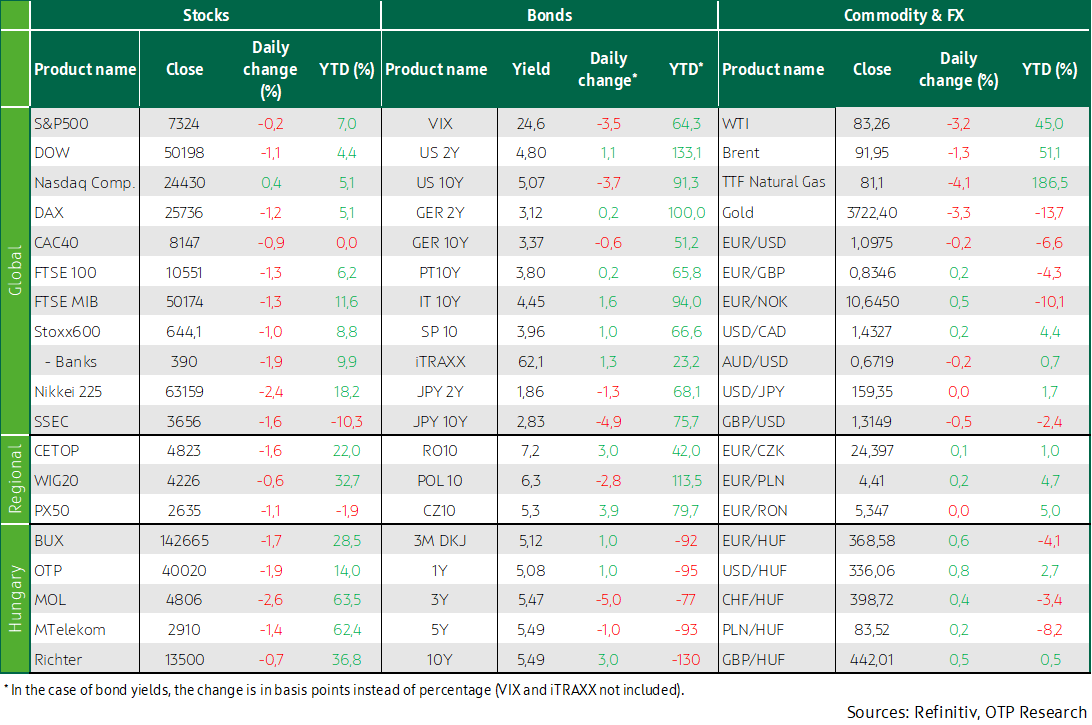
European equity markets declined for a third consecutive session on Wednesday, with the STOXX 600 index falling 1.0% to 644.1 points. Investor sentiment was primarily weighed down by caution ahead of Anthropic’s upcoming IPO, amid concerns that the transaction could absorb substantial liquidity from equity markets. Mining stocks led the declines as copper prices dropped to a seven-month low, with Glencore losing 6.1%. The technology sector also underperformed, as Nvidia’s upbeat guidance failed to ease concerns surrounding the outlook for the AI sector. Following its earnings release, Alstom fell 7.2% after reporting a net loss of EUR 822 million, while UK-based Experian gained 1.7% on better-than-expected revenue and the announcement of a USD 500 million share buyback programme. The banking sector came under significant pressure following a Reuters report suggesting that the ECB may discuss an increase in banks’ mandatory reserve requirements next week: UniCredit fell 2.2%, while ING lost 3.8%.
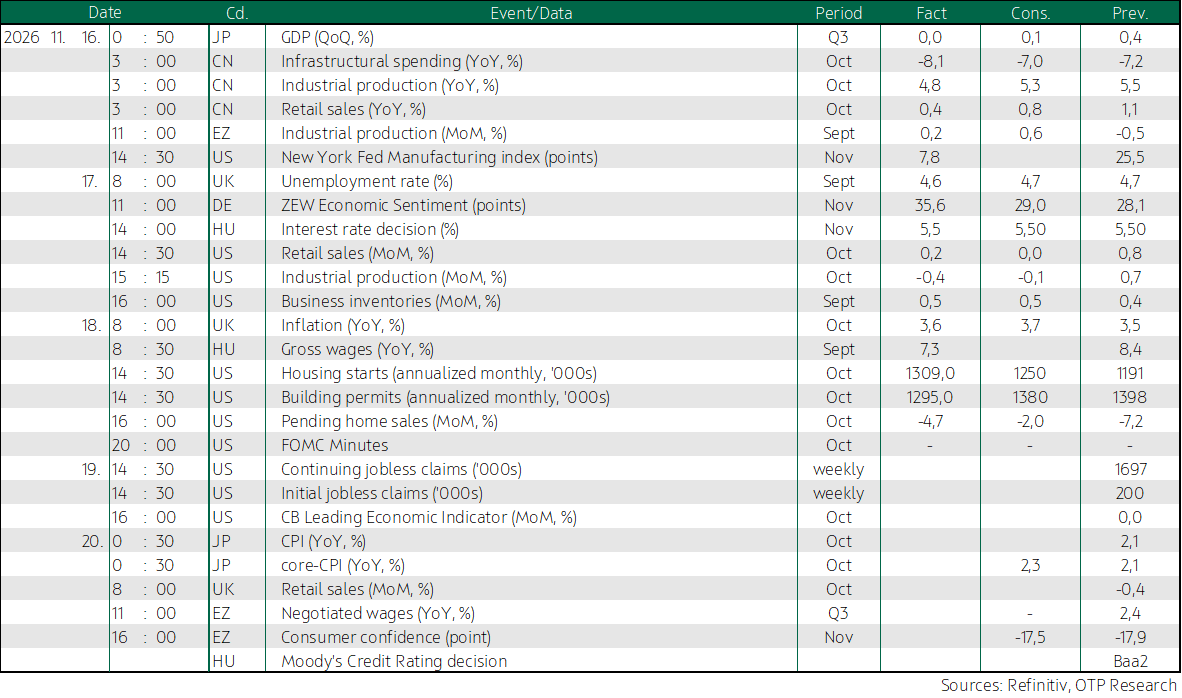
In the UK, annual CPI rose to 3.6% in October from 3.5% in September, marking a one-year high, although it came in slightly below the market expectation of 3.7%. The acceleration was driven primarily by transport costs, as fuel inflation surged from 29.8% to 33.2%. In contrast, food CPI eased from 1.3% to 0.9%, while the price index for restaurants and hotels moderated from 3.8% to 3.4%. Core CPI remained unchanged at 2.8%, while goods inflation accelerated to 3.5% and services inflation held steady at 3.7%. On a monthly basis, consumer prices rose by 0.5%, in line with market expectations.
The main CEE equity indices declined yesterday, with Hungary’s BUX posting the largest drop, weighed down in part by MOL’s decline alongside lower oil prices, while the other three domestic blue-chip stocks also closed lower. In Hungary, gross average earnings rose by 7.3% year-on-year in September, marking a slowdown from the 8.4% increase recorded in August. The deceleration was driven primarily by the public sector, where wage growth moderated from 9.2% to 5.5%, while earnings growth in the private sector slowed from 8.1% to 7.8%. Net real wages increased by 7.3% alongside 1.6% inflation.
Major US indices closed mixed yesterday; Nvidia shares declined despite strong earnings results; Anthropic’s IPO attracted stronger-than-expected investor demand; mixed data were released from the US housing market
US equity markets closed mixed yesterday, with the Dow and the S&P 500 ending lower, while the Nasdaq advanced. Investor attention was primarily focused on Nvidia’s earnings release. The company reported revenue and profit ahead of expectations and also raised its revenue guidance for the next fiscal year, projecting 75% year-on-year growth. Despite the strong results, the stock ultimately fell 2.9%, as investors remained uncertain about the company’s future leadership following the departure of CEO Jensen Huang. Sentiment toward the AI sector remained mixed. Some investors continue to question the sustainability of the substantial capital spending and debt financing associated with artificial intelligence-related companies, suggesting that elevated volatility is likely to persist across the sector. At the same time, the market remained optimistic about Anthropic’s IPO, which is expected to attract strong investor demand. Interest has been so robust that the previously indicated offering price was raised to USD 83 per share, allowing the company to raise USD 81.3 billion in capital. Trading in the shares is set to begin today.
In the US, housing starts rose by 9.9% month-on-month in October to an annualised rate of 1.309 million, up from 1.191 million in September and well above the market expectation of 1.25 million. The increase marked the end of three consecutive months of decline. At the same time, building permits fell to their lowest level since May 2020, while pending home sales dropped 4.7% month-on-month in October, significantly worse than the market forecast for a 2.0% decline. Overall, the US housing market continues to be restrained by persistently high mortgage rates.
Developed-market long-term yields mostly declined despite further signals pointing to additional Fed tightening; oil prices fell on higher-than-expected inventory levels; the Hungarian forint weakened further
Long-term US Treasury yields declined yesterday as investors assessed Fed communication and the prospect of further monetary tightening. Market attention was centred on remarks from Fed Governor Christopher Waller, who warned that inflation may prove more persistent than expected, potentially requiring a more forceful policy response from the central bank. According to Waller, a 50-basis-point rate hike at the December FOMC meeting could be justified, and he argued that the Fed should fully reverse at least the three rate cuts implemented last year. Expectations for further tightening were also reinforced by the minutes of the Fed’s October meeting, which showed that a majority of policymakers believe additional monetary restraint will be necessary to bring inflation back to the 2% target.
European long-term yields showed only modest moves, with the yield on the German 10-year Bund and its French counterpart edging lower, while the UK 10-year yield rose slightly. The yield on Hungary’s 10-year government bond reversed the declines seen on Monday and Tuesday, closing 3 basis points higher at 5.49%. The Hungarian forint extended its weakness following Tuesday’s MNB rate decision and closed above the 368 level against the euro.
Oil prices fell sharply after US inventory data showed a much larger-than-expected increase in stockpiles. The decline in crude prices was partly offset by ongoing shipping risks in the Strait of Hormuz. Several commercial vessels came under renewed attack, while Yemen’s Houthi rebels carried out drone strikes on Saudi energy infrastructure. At the same time, market participants are increasingly expecting a supply surplus to emerge in the global oil market, driven by rising Middle Eastern exports and growing inventory levels. The continuation of this downward trend could help ease inflationary pressures and support economic growth through lower interest rates, although significant risks remain and are not yet reflected in expectations for further rate hikes.
Today's highlights
Asian equity markets traded mixed this morning as investors awaited a meeting between Trump, Putin and Xi. Discussions at the trilateral summit are expected to focus on trade relations, the semiconductor industry, as well as the wars in Ukraine and Iran. Meanwhile, Australia’s unemployment rate rose to 4.9% in October, exceeding expectations for an unchanged reading, following the central bank’s aggressive rate-hiking cycle earlier this year.
Today, alongside the usual weekly US initial jobless claims data, the Conference Board Leading Economic Index (LEI) will also be released.
Get more out of your investments!
Global Markets Services
OTP Global Markets offers a broad range of services in the field of local and international money and capital markets.
Read morePrivate Banking Services
Personal care and expertise with OTP Private Banking, along with the knowledge, security, and innovations of a multinational banking group.
Read more