
OTP Morning Brief: Risk aversion strengthened across markets ahead of Nvidia’s earnings release
Related content
OTP Morning Brief: Stocks started the week in the red; Nvidia earnings are due today
Stocks closed lower on Monday, while the dollar continued to strengthen, pushing the EUR/USD exchange rate below 1.10, and oil prices declined sharply. Eurozone industrial production rose by 0.2% month-on-month in September. Today, investors will focus on the UK unemployment data, Germany’s ZEW Economic Sentiment Index, the MNB’s interest rate decision, as well as US retail sales and industrial production figures. Among corporate earnings releases, investors should keep a close eye on results from Nvidia, Home Depot, and Walt Disney.
OTP Morning Brief: Rate hike expectations moved higher again
The Stoxx 600 closed at a record high, rising 2.4% on a weekly basis. It outperformed the US indices both in November and throughout the autumn period. Although Brent rebounded in the second half of last week, it still ended the week down 2.5%, closing at around USD 96 per barrel. Amid the Jensen Huang scandal, Nvidia fell nearly 6% last week; nevertheless, the US indices still gained more than 2%, led in part by Broadcom and AMD. On Friday, the US 10-year Treasury yield rose a further 5 basis points to 5.15%, bringing its weekly increase to 29 basis points. Rate hike expectations moved higher in both the US and Europe, with markets pricing in three rate hikes over the next 12 months. Moreover, markets expect all three rate hikes to be delivered by March in the US, providing further support to the dollar. The recovery of Hungarian industry continued in September. This week, investors will be paying close attention to US economic indicators, negotiated wage data from Europe, and in Hungary, the MNB’s rate decision as well as Moody’s sovereign rating review.
Negative sentiment prevailed across equity markets on Tuesday: European exchanges suffered their steepest decline in several months, while the technology-led correction on Wall Street continued amid a wait-and-see approach ahead of Nvidia’s earnings release. In the US, comments from Fed policymakers further reinforced expectations of a December rate hike. The MNB kept its base rate unchanged; however, the decision was not unanimous. Growing caution led to declining yields across developed bond markets, while French government bonds outperformed within the euro area. In Hungary, yields edged lower, while the forint weakened against both the euro and the US dollar. Today’s releases include the UK’s October CPI data, several key US housing market indicators and Hungary’s September wage figures, while the minutes of the Fed’s latest rate-setting meeting will also be published later in the day. Among corporate earnings releases, quarterly results from Tencent and Palo Alto Networks will be in focus.
European equities posted sharp losses, with the technology sector leading the decline
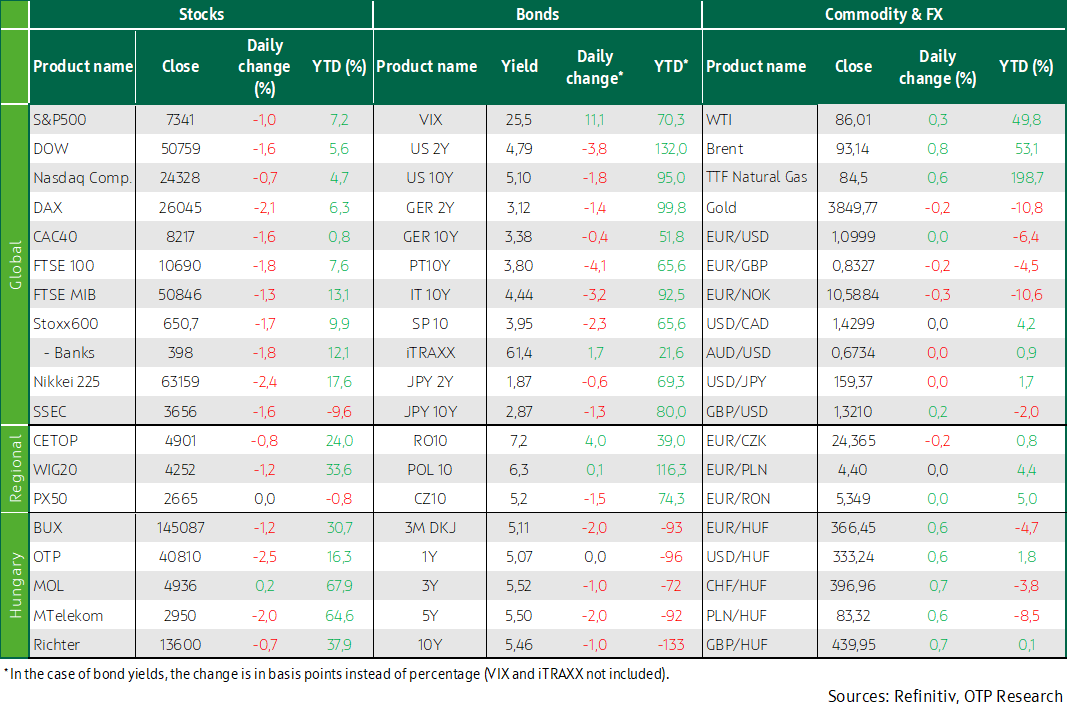
Yesterday, European equity markets came under significant pressure, with the STOXX 600 index falling 1.75%, marking its steepest daily decline since March. Investor sentiment was weighed down primarily by further weakness in technology and AI-related stocks, as well as heightened caution ahead of Nvidia’s earnings release.
The technology sector dropped 3.9%, marking its steepest one-day decline since early February. ASML fell more than 5%, while shares of Siemens Energy and Legrand also closed sharply lower. Within the banking sector, Deutsche Bank stood out on the downside, with its stock declining 6% after media reports suggested that leaked documents had revealed further details about the bank’s relationships with several former clients, including Russian oligarchs, Donald Trump and Jeffrey Epstein. Commodity-related stocks also came under pressure as copper prices fell to their lowest level in more than four months.
One of the day’s top performers was the German chemicals company Evonik, whose shares gained 4.2% after media reports suggested that fellow German group BASF was preparing a new takeover offer for its rival. Meanwhile, the biggest loser was Polish online brokerage XTB, whose stock plunged 17.5% after Poland’s financial regulator signalled stricter regulation of the CFD market.
The major Western European equity indices all closed sharply lower: Germany’s DAX lost more than 2%, while France’s CAC 40 and the UK’s FTSE 100 declined by 1.6% and 1.8%, respectively. Most regional equity markets also ended the session in negative territory, with the PX50 closing broadly unchanged, while both the WIG20 and the BUX fell 1.2%. Among Hungarian blue chips, MOL was the only stock to post gains (+0.2%), whereas OTP, Magyar Telekom and Richter declined by 2.5%, 2.0% and 0.7%, respectively.
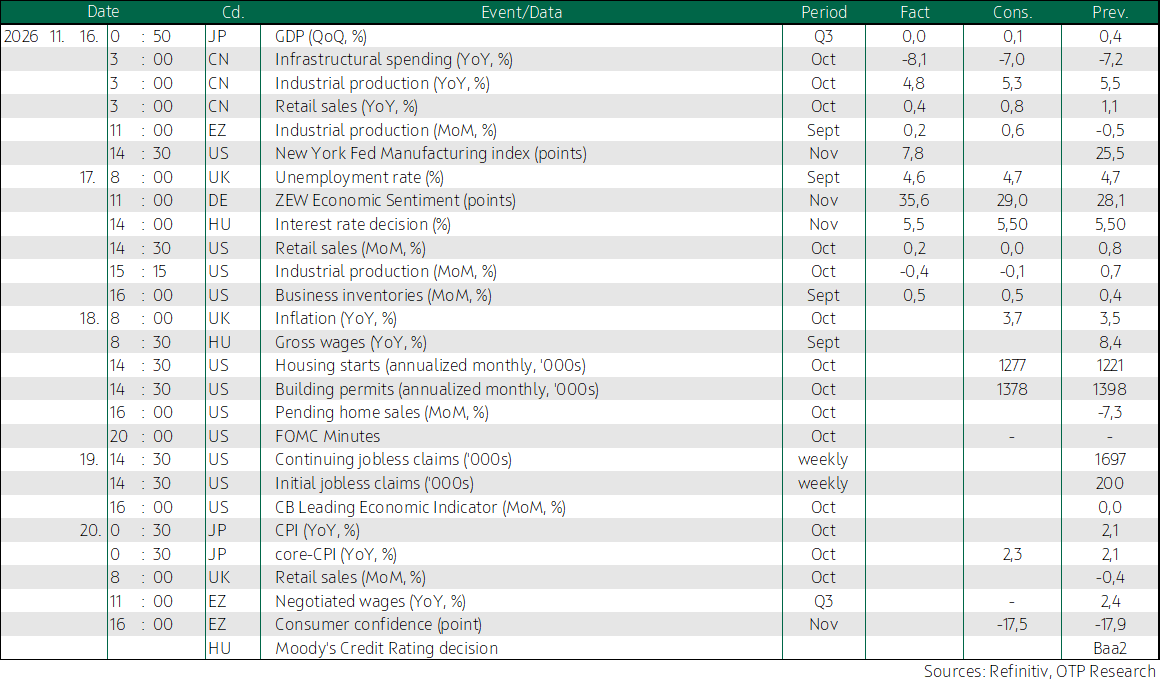
Overall, the European macroeconomic data released on Tuesday painted a favourable picture. Germany’s ZEW Economic Sentiment Index rose to 35.6 in November from 28.1 in October, significantly exceeding the market expectation of 29.0. The survey suggests that the gradual recovery of the German economy may continue, supported by rising industrial orders and lower oil prices, while perceptions of the current economic situation also improved. However, the sectoral outlook remained mixed: expectations improved in the chemicals, pharmaceuticals and electrical equipment industries, whereas sentiment deteriorated regarding the prospective performance of the metalworking and construction sectors.
In the UK, the unemployment rate declined to 4.6% in the July-September period from 4.7% in the previous three months, while markets had expected it to remain unchanged. The positive reading was supported by a 155,000 quarter-on-quarter increase in employment, alongside an 88,000 decline in the number of unemployed individuals.
Yesterday, the Monetary Council of the MNB kept the base rate unchanged at 5.5%, in line with market expectations. According to the Governor, the decision was not unanimous, as a proposal to cut rates was also discussed at the meeting. The statement noted that the favourable risk perception of Hungary, the persistence of benign CPI prospects and easing external uncertainty could increase the central bank’s room for manoeuvre. At the same time, the MNB continues to favour a cautious, data-driven approach in light of high and volatile energy prices, the international yield environment and ongoing uncertainty surrounding external conditions.
Wall Street's correction continued ahead of Nvidia’s earnings release; oil prices moved higher
US equity markets extended their technology-led correction on Tuesday, with the Dow Jones falling 1.6%, the S&P 500 declining 1.0% and the Nasdaq shedding 0.7%. The latter two indices thus recorded four consecutive losing sessions for the first time since September. Investors remained focused on Nvidia’s upcoming earnings release and Anthropic’s expected market debut, which, similarly to Europe, weighed on risk appetite.
The weakness was not confined to technology stocks alone, as all major sectors ended the day in negative territory. The heaviest selling pressure was seen in software companies, banks and airlines. Among software names, Salesforce, Workday, Intuit and Adobe fell by 4%-10%, while Microsoft declined 2.3%. Within the banking sector, JPMorgan stood out with a 2.4% drop after the company announced an upcoming transition in its chief financial officer position. Following the market close, however, Nvidia reported better-than-expected results, prompting its shares to gain nearly 3% in after-hours trading.
Meanwhile, comments from several Fed policymakers further strengthened expectations of a more restrictive interest rate path, with markets currently pricing in a nearly 95% probability of a 25-basis-point rate hike in December. Investors are also closely awaiting the release of the minutes from the Fed’s October meeting later today, which could provide further clues regarding the future direction of monetary policy.
Oil prices moved higher on Tuesday, with Brent rising to USD 93.1 per barrel (+0.8%) and WTI increasing to USD 86.0 per barrel (+0.3%). Price action was driven primarily by escalating geopolitical tensions in the Middle East following new incidents in the Strait of Hormuz, while military operations between Iran and the US also continued. However, gains were partially capped by supply-side expectations. According to the International Energy Agency (IEA), the global oil market could return to a surplus in Q4, as exports from the Middle East recover faster than demand growth. This view is supported by declining maritime freight costs and indications that Gulf exporters are already shipping volumes close to pre-conflict levels.
Macroeconomic data released during the day painted a mixed picture. US retail sales rose by 0.2% month-on-month in October, following a 0.8% increase in September. Sales in the control group, which is closely watched due to its significance for GDP, increased by a stronger-than-expected 0.6%, suggesting that household consumption remained resilient at the start of Q4. In contrast, industrial production disappointed, declining 0.4% month-on-month in October after a 0.7% increase in September, undershooting market expectations for a 0.1% decrease. The weaker reading was primarily driven by lower mining and utility output, while manufacturing production continued to post modest growth. Capacity utilisation declined to 76.4%, remaining below its long-term average.
Business inventories increased by 0.5% month-on-month in September, in line with market expectations (+5.1% year-on-year). Inventory accumulation accelerated among both wholesalers and retailers, while the pace of growth in manufacturing inventories showed a slight moderation.
Yields declined across developed bond markets, while French government bonds outperformed
Both US and euro area government bond markets saw yields move lower on Tuesday, as heightened caution ahead of Nvidia’s earnings release prompted investors to rotate into safe-haven assets. In the US, the 2-year Treasury yield fell by 3.8 basis points to 4.79%, while the 10-year benchmark yield declined by 1.8 basis points to 5.10%. In the euro area, the German 2-year yield edged down by 1.4 basis points, while the 10-year Bund yield closed at 3.38% (-4 bps). Meanwhile, French government bonds outperformed after Marine Le Pen unveiled her budget plans, narrowing the spread between French and German 10-year government bond yields by 7.2 basis points. The EUR/USD exchange rate was unchanged from the previous day, remaining close to 1.100.
In the Hungarian government bond market, yield movements remained modest. Yields declined by 1–2 basis points at the shortest maturities and across the segment beyond one year, while the 6–12-month tenors saw little meaningful change. Based on quotes published by the Government Debt Management Agency (ÁKK) early in the afternoon, the 10-year benchmark yield stood at 5.46%. Demand was strong at yesterday’s DKJ auction, with bids exceeding the announced amount by more than two times, and the ÁKK ultimately sold virtually the entire offered volume. The forint weakened against both the euro and the US dollar, with EUR/HUF closing at 366.45 after rising 0.6%, while USD/HUF ended the day at 333.24, also up 0.6%.
Today's highlights
Asian markets were supported by Nvidia’s better-than-expected results, although Chinese technology stocks remained under pressure amid expectations of further tightening of US export restrictions. As trading approached the close, at 7:30 a.m. CET, both the Nikkei and the Kospi were posting modest gains, while the Hang Seng and the SSEC remained in moderately negative territory.
Today’s releases include the UK’s October CPI data, several key US housing market indicators and Hungary’s September wage figures, while the minutes of the Fed’s latest rate-setting meeting will also be published later in the day. Among corporate earnings releases, quarterly results from Chinese technology giant Tencent and cybersecurity company Palo Alto Networks will be in focus. In addition, the ÁKK will hold a HUF 20bn Treasury bill auction, alongside two government bond switch auctions worth HUF 15bn each.
Get more out of your investments!
Global Markets Services
OTP Global Markets offers a broad range of services in the field of local and international money and capital markets.
Read morePrivate Banking Services
Personal care and expertise with OTP Private Banking, along with the knowledge, security, and innovations of a multinational banking group.
Read more