
OTP Morning Brief: Stocks started the week in the red; Nvidia earnings are due today
Related content
OTP Morning Brief: Rate hike expectations moved higher again
The Stoxx 600 closed at a record high, rising 2.4% on a weekly basis. It outperformed the US indices both in November and throughout the autumn period. Although Brent rebounded in the second half of last week, it still ended the week down 2.5%, closing at around USD 96 per barrel. Amid the Jensen Huang scandal, Nvidia fell nearly 6% last week; nevertheless, the US indices still gained more than 2%, led in part by Broadcom and AMD. On Friday, the US 10-year Treasury yield rose a further 5 basis points to 5.15%, bringing its weekly increase to 29 basis points. Rate hike expectations moved higher in both the US and Europe, with markets pricing in three rate hikes over the next 12 months. Moreover, markets expect all three rate hikes to be delivered by March in the US, providing further support to the dollar. The recovery of Hungarian industry continued in September. This week, investors will be paying close attention to US economic indicators, negotiated wage data from Europe, and in Hungary, the MNB’s rate decision as well as Moody’s sovereign rating review.
OTP Morning Brief: The company's stock price plummeted following the resignation of Nvidia's CEO
Europe benefited from its lower exposure to AI, and the Stoxx 600 rose to a record high. Overseas news was dominated by the resignation of Nvidia CEO Jensen Huang, and the stock price of the most prominent company in the AI boom took a sharp nosedive, which also cast a shadow over sentiment in the broader stock market. Meanwhile, uncertainty in the Middle East has intensified after Trump changed his position overnight, making a successful negotiation seem less likely once again, while oil prices continue to rise. This also pushed up bond yields in the United States, but had only a minor impact in Europe. The United Kingdom's economy posted a strong third quarter. Asian markets were mixed in the morning. Today, we can expect the release of eurozone employment data and the US producer price index.
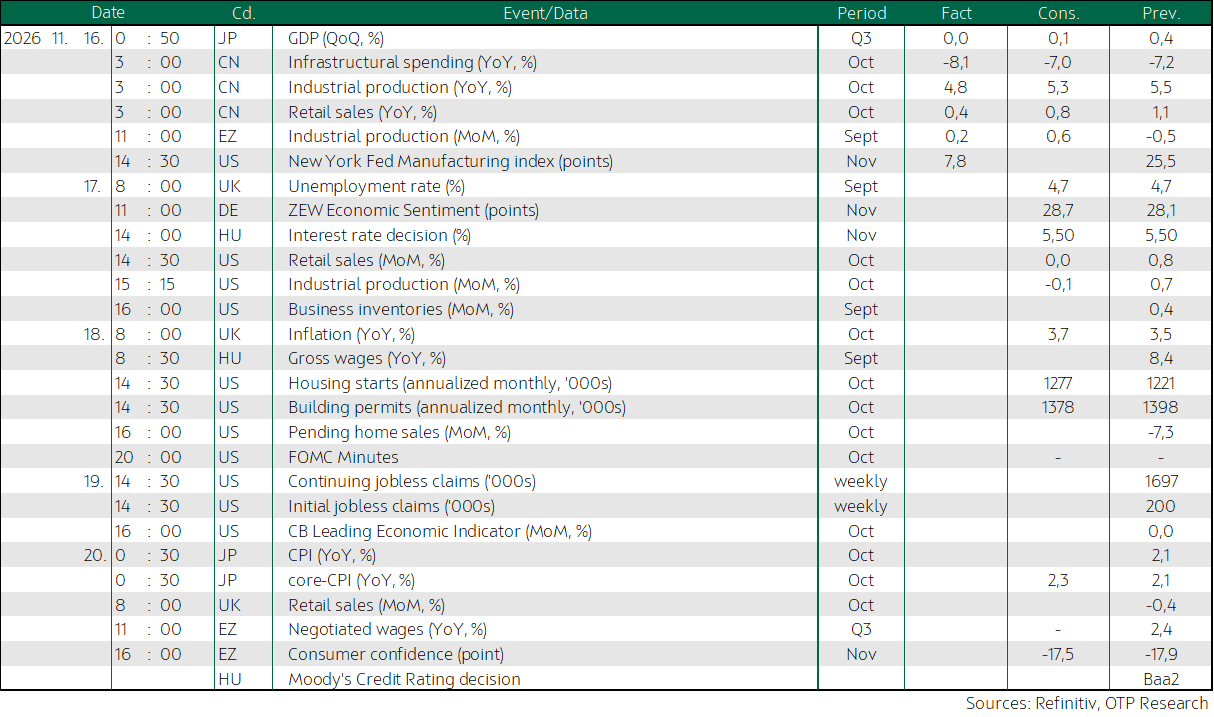
Stocks closed lower on Monday, while the dollar continued to strengthen, pushing the EUR/USD exchange rate below 1.10, and oil prices declined sharply. Eurozone industrial production rose by 0.2% month-on-month in September. Today, investors will focus on the UK unemployment data, Germany’s ZEW Economic Sentiment Index, the MNB’s interest rate decision, as well as US retail sales and industrial production figures. Among corporate earnings releases, investors should keep a close eye on results from Nvidia, Home Depot, and Walt Disney.
European markets retreat following record highs
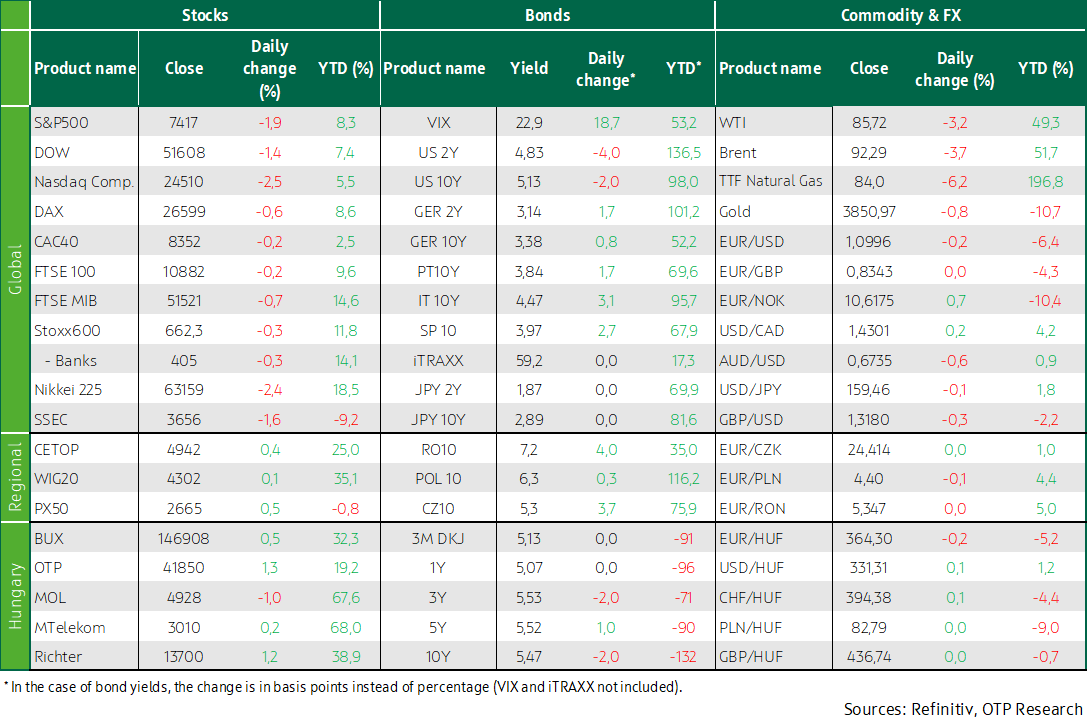
European equities closed lower on the first trading day of the week as investors took profits following last week’s rally, while uncertainty surrounding the outlook for artificial intelligence-related stocks also weighed on market sentiment. The STOXX 600 index fell by 0.3% after ending Friday at a record high, with technology and basic materials shares underperforming. The materials sector declined by 2.5% as metal prices retreated to multi-month lows, while the healthcare sector gained 0.8%.
The major Western European indices all ended the session in negative territory: the DAX fell by 0.6% after reaching a new all-time high on Friday, while the CAC 40 and the FTSE 100 both slipped by 0.2%. Technology stocks came under pressure, with AI-related names such as Siemens Energy and Legrand losing ground, while semiconductor companies including Aixtron, Technoprobe, and ASML also posted significant declines. Among the day’s top performers was Novo Nordisk, which gained 2.4% on the back of encouraging drug development results, whereas FLSmidth plunged 8.9% following the announcement of the unexpected departure of its CFO.
Regional markets delivered a mixed performance, with the BUX and the PX rising by 0.5% each, while Poland’s WIG20 closed 0.1% higher. On the corporate front, UniCredit secured approval from both the European Union and the US Federal Reserve for its acquisition of Commerzbank.
Among Hungary’s blue-chip stocks, OTP gained 1.3%, Richter advanced 1.2%, and Magyar Telekom rose 0.2%, while MOL declined by 1.0%. Strong performances from OTP and Richter supported the Hungarian index’s outperformance relative to Western European markets.
Eurozone industrial production rose by 0.2% month-on-month in September, pointing to modest growth in the region’s industrial sector.
Technology stocks dragged Wall Street lower; investors await Nvidia’s earnings report
Sentiment on US equity markets remained negative, driven primarily by uncertainty surrounding the AI and semiconductor sectors. Following last week’s strong performance, a correction took hold across major US indices, with the Dow falling 1.4%, the S&P 500 declining 1.9%, and the Nasdaq dropping 2.5%. Among the S&P 500 sectors, technology was the worst performer, while communication services (-2.8%), consumer discretionary (-2.2%), and energy (-2.0%) also posted notable losses. As a result, the Nasdaq slipped more than 10% below its all-time high, entering correction territory in technical terms.
Ahead of Nvidia’s earnings release on Tuesday and Anthropic’s IPO scheduled for later this week, investors reduced their exposure to AI-related stocks. Nvidia fell 4.1%, while the semiconductor sector dropped more than 5%. Intel declined 7.1%, Micron lost 7.6%, AI infrastructure provider CoreWeave dropped 6.1%, and Nebius fell 7.5%. Among the major technology companies, Alphabet slid 4.1%, Amazon retreated 3.4%, and Meta eased 2.4%. The sector also remained under pressure from new US restrictions on AI chip exports and ongoing uncertainty surrounding Nvidia’s leadership.
Macroeconomic data painted a mixed picture. The Empire State Manufacturing Index, compiled from the New York Fed’s monthly survey of manufacturers, fell to 7.8 in November from 25.5 in the previous month, missing market expectations. According to the survey, business activity continued to expand, although growth in new orders and shipments moderated. On a positive note, employment increased at its fastest pace in more than four years, while corporate investment intentions improved and signs of gradually easing price pressures also emerged.
Investor sentiment continued to be shaped by uncertainty surrounding the outlook for the AI sector. Markets also kept a close eye on developments in the Middle East, while oil prices declined markedly as crude exports through the Strait of Hormuz gradually recovered and expectations of a global supply glut strengthened.
The dollar strengthened on inflation and rate expectations; oil prices declined sharply
US Treasury yields edged lower on Monday. The yield on the 2-year US Treasury note declined by 4 basis points to 4.83%, while the benchmark 10-year yield fell by 3 basis points to 5.12%. Markets continue to fully price in a 25-basis-point Fed rate hike in December and assign a probability of more than 70% to another increase at the January meeting. Several Fed officials are scheduled to speak later today, potentially providing further guidance on the future path of monetary policy. In Europe, the yield on the 2-year German government bond rose by 2 basis points to 3.14%.
The dollar continued to strengthen in the FX market, pushing the EUR/USD exchange rate below 1.10 once again, while sterling weakened by 0.2% against the US currency. Oil prices fell sharply, with Brent declining to USD 92.44 per barrel and WTI dropping to USD 85.72, despite several tankers being involved in incidents near the Strait of Hormuz. Market sentiment continued to be driven by expectations of recovering exports and an emerging supply surplus. Meanwhile, the Dutch TTF natural gas price fell by approximately 6.8% to EUR 84.13/MWh.
Trading on the Hungarian government bond market was characterized by muted movements. No meaningful changes were seen at the short end of the curve, with the yield on the 3-month Treasury bill closing at 5.13% and the 1-year benchmark yield ending the day at 5.07%. Performance across medium maturities was mixed: the 3-year benchmark yield declined by 2 basis points to 5.53%, while the 5-year yield edged up by 1 basis point to 5.52%. At the long end of the curve, the 10-year benchmark yield fell by 2 basis points to 5.47%. The forint traded in a stable range, hovering around 364.27 against the euro and 331.25 versus the US dollar.
Today's highlights
Asian markets traded sharply lower on Tuesday morning. South Korea’s Kospi and Taiwan’s benchmark index both fell by 2%, while Japan’s Nikkei lost 1%. The regional MSCI Pacific Index declined by 1.5%.
Among today’s key macroeconomic releases are the September unemployment rate from the UK, Germany’s November ZEW Economic Sentiment Index, the MNB’s interest rate decision in Hungary, and in the US, October retail sales and industrial production data, along with September business inventories.
Among today’s corporate events, Nvidia’s earnings release due after the market close will be in the spotlight, while Home Depot and Walt Disney are also scheduled to report quarterly results before the opening bell. In addition, several Fed policymakers are expected to deliver remarks throughout the day.
The Government Debt Management Agency (ÁKK) will hold an auction of 3-month Treasury bills worth HUF 20 billion today.
Get more out of your investments!
Global Markets Services
OTP Global Markets offers a broad range of services in the field of local and international money and capital markets.
Read morePrivate Banking Services
Personal care and expertise with OTP Private Banking, along with the knowledge, security, and innovations of a multinational banking group.
Read more