
OTP Morning Brief: Rate hike expectations moved higher again
Related content
OTP Morning Brief: The company's stock price plummeted following the resignation of Nvidia's CEO
Europe benefited from its lower exposure to AI, and the Stoxx 600 rose to a record high. Overseas news was dominated by the resignation of Nvidia CEO Jensen Huang, and the stock price of the most prominent company in the AI boom took a sharp nosedive, which also cast a shadow over sentiment in the broader stock market. Meanwhile, uncertainty in the Middle East has intensified after Trump changed his position overnight, making a successful negotiation seem less likely once again, while oil prices continue to rise. This also pushed up bond yields in the United States, but had only a minor impact in Europe. The United Kingdom's economy posted a strong third quarter. Asian markets were mixed in the morning. Today, we can expect the release of eurozone employment data and the US producer price index.
OTP Morning Brief: CoreWeave shares soared nearly 25% yesterday
Major European indices advanced yesterday; optimism surrounding AI-related companies strengthened, while mostly favorable earnings reports emerged across Europe. Meanwhile, rising oil prices heightened inflationary pressures. Major US indices moved higher yesterday on the back of positive corporate developments; CoreWeave shares soared nearly 25%, while reports suggest strong investor interest in Anthropic’s IPO scheduled for next week. US bond markets were closed yesterday for a public holiday, while yields in Europe showed little change; oil prices rose following a renewed escalation of geopolitical tensions. Today, alongside the usual weekly US initial jobless claims data, housing market and federal budget figures will also be released, while the UK’s Q3 GDP data will provide further insight into economic performance.
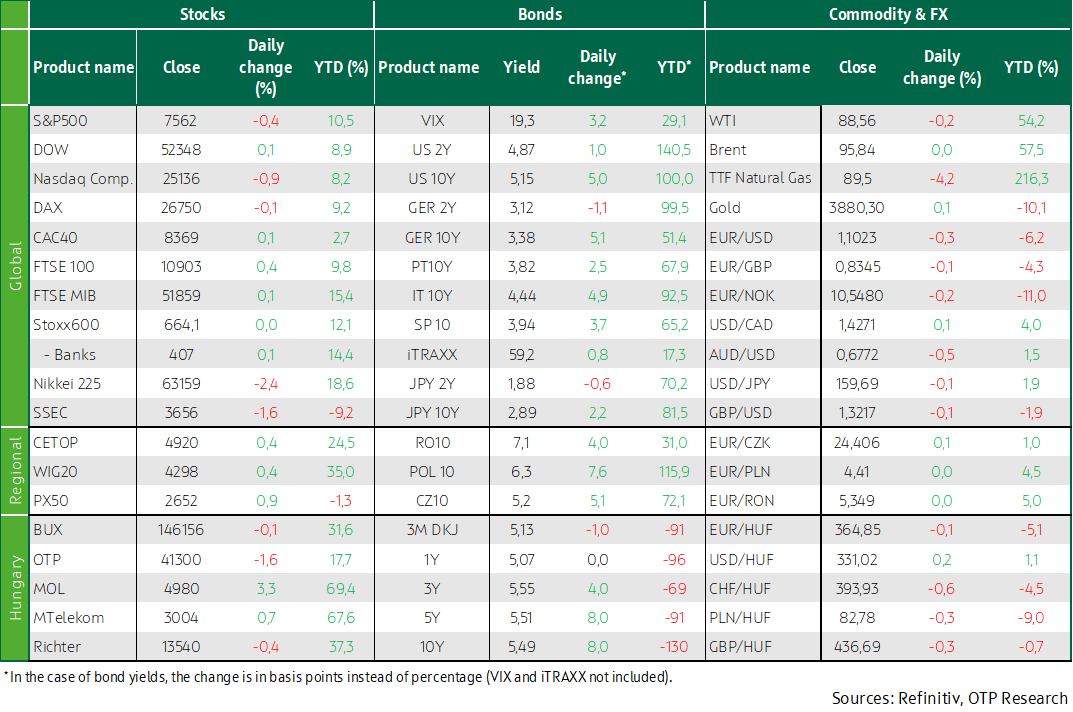
The Stoxx 600 closed at a record high, rising 2.4% on a weekly basis. It outperformed the US indices both in November and throughout the autumn period. Although Brent rebounded in the second half of last week, it still ended the week down 2.5%, closing at around USD 96 per barrel. Amid the Jensen Huang scandal, Nvidia fell nearly 6% last week; nevertheless, the US indices still gained more than 2%, led in part by Broadcom and AMD. On Friday, the US 10-year Treasury yield rose a further 5 basis points to 5.15%, bringing its weekly increase to 29 basis points. Rate hike expectations moved higher in both the US and Europe, with markets pricing in three rate hikes over the next 12 months. Moreover, markets expect all three rate hikes to be delivered by March in the US, providing further support to the dollar. The recovery of Hungarian industry continued in September. This week, investors will be paying close attention to US economic indicators, negotiated wage data from Europe, and in Hungary, the MNB’s rate decision as well as Moody’s sovereign rating review.
The Stoxx 600 outperformed US equity indices both in November and throughout the autumn period
Although the Stoxx 600 was little changed on Friday, it closed at a record high with a 2.4% weekly gain. The pan-European index outperformed US equity benchmarks both in November and throughout the autumn period, partly reflecting its lower exposure to the technology and AI sectors. European equities were also supported by generally solid Q3 corporate earnings. Following positive earnings releases, Siemens Energy surged nearly 10%, Adecco soared 15%, while UniCredit rose 5.4% over the week. Among the major indices, the DAX gained 3.6% and the CAC 40 advanced 2.8% on a weekly basis.
Eurozone employment remained unchanged in Q3 compared to Q2, falling slightly short of expectations for a 0.1% expansion.
The recovery of Hungarian industry continued in September, with industrial output rising 0.9% month-on-month in the first month of autumn and expanding by 8.2% year-on-year. Among manufacturing subsectors, motor vehicle production stood out, posting growth of more than 33% compared to a year earlier, while output in the computer, electronics and optical products segment increased by 11%. As a result, industrial production reached its 2021 level again for the first time in two and a half years. Meanwhile, the more volatile construction sector saw output fall by 9.9% month-on-month in September. The decline was driven by weaker activity in civil engineering projects, including roads, railways and utilities, while the buildings segment continued to expand. Poland’s economy grew by 0.8% year-on-year in Q3, while the Q2 growth figure was revised up to 1.1%. Across the region, Poland’s WIG20 rose 4.0% over the week, the BUX gained 1.9%, and the Czech PX50 advanced 0.8%.
The price of European benchmark TTF natural gas closed around EUR 90/MWh on Friday, posting a weekly gain of 4.1%. Brent crude, meanwhile, recovered only part of its losses from earlier in the week and still ended the period down 2.5%, slipping to just below USD 96 per barrel.
Wall Street indices gained more than 2% on a weekly basis
While the Dow Jones was little changed on Friday, the Nasdaq Composite fell 0.9% and the S&P 500 slipped 0.4%. Even so, the three major Wall Street indices posted weekly gains of 2.1%, 2.3% and 2.5%, respectively. The S&P 500 technology sector declined 1.7% on Friday, making it the worst-performing of the index’s 11 major sectors. Nvidia shares continued to weaken following Jensen Huang’s resignation on Thursday, leaving the chip designer down nearly 6% for the week. Although Broadcom and AMD dropped 4.8% and 8.8%, respectively, on Friday, both still managed to rise by more than 13% over the week, benefiting from Nvidia’s weakness. Microsoft edged 0.2% higher on Friday as disruptions affecting Outlook and Teams eased, although the stock still lost 3.8% over the week. Airline stocks moved lower late in the session after US authorities imposed a nationwide ground stop for all departing flights.
After October’s core CPI came in at 0.3% month-on-month last Tuesday, exceeding expectations, Friday’s producer price data showed a more moderate increase. The PPI rose by 0.3% month-on-month, below the consensus forecast of 0.4%, bringing annual producer price growth to 6.5% in October. Taken together, the CPI and PPI releases suggest that the Fed’s preferred inflation gauge, core PCE, may have risen by around 0.3% month-on-month in October.
Rate hike expectations moved higher over the week, while the US 10-year Treasury yield ended 29 basis points higher
Expectations for a resolution to the Middle East conflict deteriorated again in the second half of last week. Although Brent briefly dipped below USD 90 per barrel on Tuesday and the US 10-year Treasury yield remained below 4.9% until Wednesday, Brent ultimately closed the week at USD 95.8 per barrel, while the US 10-year yield ended at 5.15%. The latter marked a weekly increase of 29 basis points. The German 10-year yield rose more modestly, gaining 12 basis points over the week to reach 3.38%. Market expectations for policy rates shifted higher during the week, partly as several Fed officials signalled that the central bank could be open to a more aggressive tightening path. These expectations were reinforced on Friday by Mary Daly, President of the San Francisco Fed. In the US, markets are now pricing in a near-certain rate hike in December, potentially followed by additional increases in January and March. Meanwhile, investors expect the ECB to deliver three 25-basis-point rate hikes by the end of 2027, with moves anticipated in December, March and the third quarter. The dollar strengthened by more than 1% against the euro, appreciating to nearly 1.10.
Meanwhile, in Hungary, the 10-year government bond yield rose by 8 basis points on Friday to 5.49%, bringing its weekly increase to 12 basis points. The forint closed the week at 364.85 against the euro, marking a weekly depreciation of 0.5%.
Today's highlights
As trading approached the close, the Nikkei was down 2.4% and the KOSPI had fallen 3.7%, while the SSEC was lower by 0.8%. In contrast, the Hang Seng was up 0.7%.
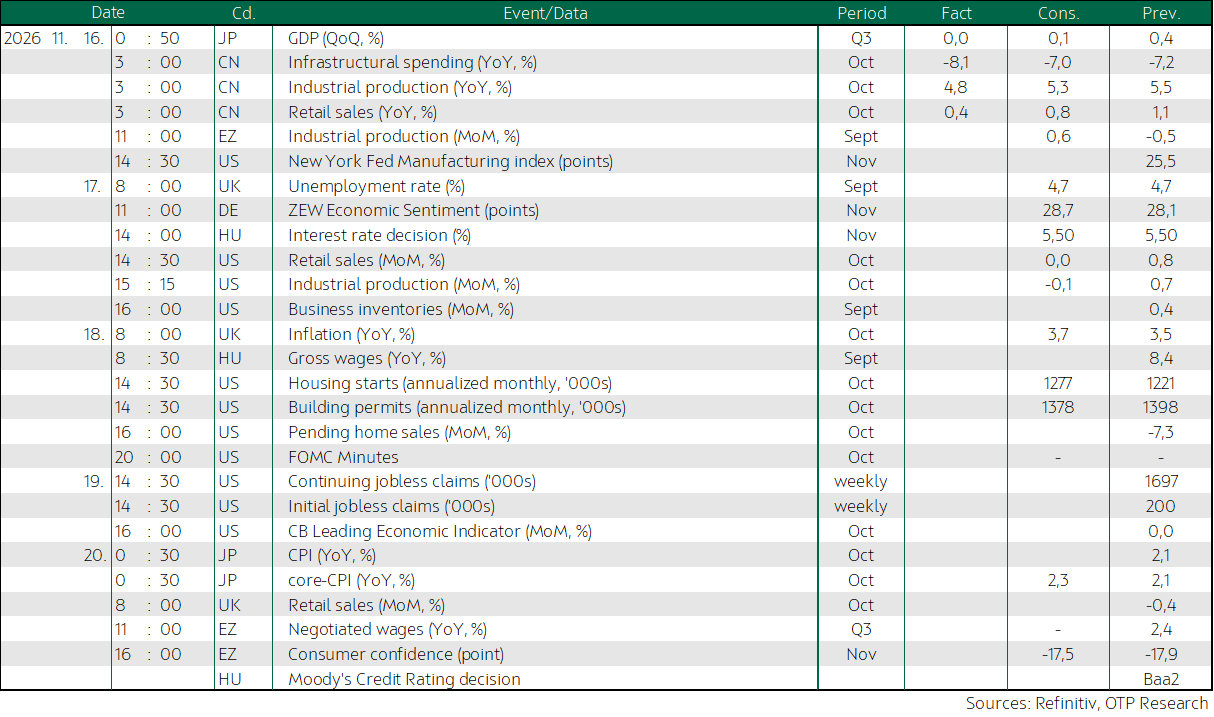
Japan’s Q3 GDP data came as a negative surprise early this morning. Instead of the expected 0.1% growth, the Japanese economy stagnated compared to Q2, which translates into a 0.1% year-on-year contraction based on preliminary estimates. In China, annual industrial production growth slowed to 4.8% in October, while domestic demand remained weak, as reflected by just 0.4% year-on-year growth in retail sales. Meanwhile, the decline in Chinese fixed-asset investment accelerated to 8.1% year-on-year during the first ten months of the year.
Eurozone industrial production data for September will be released today. On Tuesday, the MNB will hold its rate-setting meeting, where we expect the central bank to leave the base rate unchanged at 5.5%. In addition to the Hungarian rate decision, investors will be watching key US economic indicators, including October industrial production and retail sales figures. On Friday, the euro area will publish Q3 negotiated wage data alongside November consumer confidence readings. Moody’s is also scheduled to release the outcome of its review of Hungary’s sovereign credit rating on Friday. In its most recent assessment in May, the agency maintained Hungary’s Baa2 rating with a negative outlook, although an improvement to the outlook would not come as a surprise. The IPO of Anthropic is also expected to take place this week.
Get more out of your investments!
Global Markets Services
OTP Global Markets offers a broad range of services in the field of local and international money and capital markets.
Read morePrivate Banking Services
Personal care and expertise with OTP Private Banking, along with the knowledge, security, and innovations of a multinational banking group.
Read more