
OTP Morning Brief: OTP reported earnings above analysts' expectations this morning
Related content
OTP Morning Brief: Lower oil prices underpinned investor optimism
Major European and Wall Street indices closed Monday's trading session in positive territory, with gains broad-based across sectors. The positive sentiment was driven by lower oil prices after Donald Trump stated that a renewed strike against Iran was highly unlikely, provided there is progress in the negotiations. We saw a rebound in the technology sector after last week's sharp sell-off. The dollar weakened against the euro. The BUX climbed 1.8%, while all major Hungarian blue-chip stocks finished the session higher. The forint strengthened against the major currencies. October CPI figures for both Hungary and the US are due for release today.
OTP Morning Brief: US equities rebound after Thursday’s sell-off, but market nervousness remains elevated
US equities posted modest gains on Friday following Thursday’s sharp sell-off, but the VIX, widely known as the “fear index”, continues to signal greater-than-usual volatility in equity markets over the next month. European equities extended their decline on Friday, although markets did not experience anything close to the panic-driven selling seen in the US on Thursday at any point during the past week. Energy and bond markets, however, showed signs of stabilisation: natural gas prices declined particularly sharply on Friday, while oil also became significantly cheaper over the course of the week, and government bond yields continued the gradual easing trend that has been in place for nearly a month.
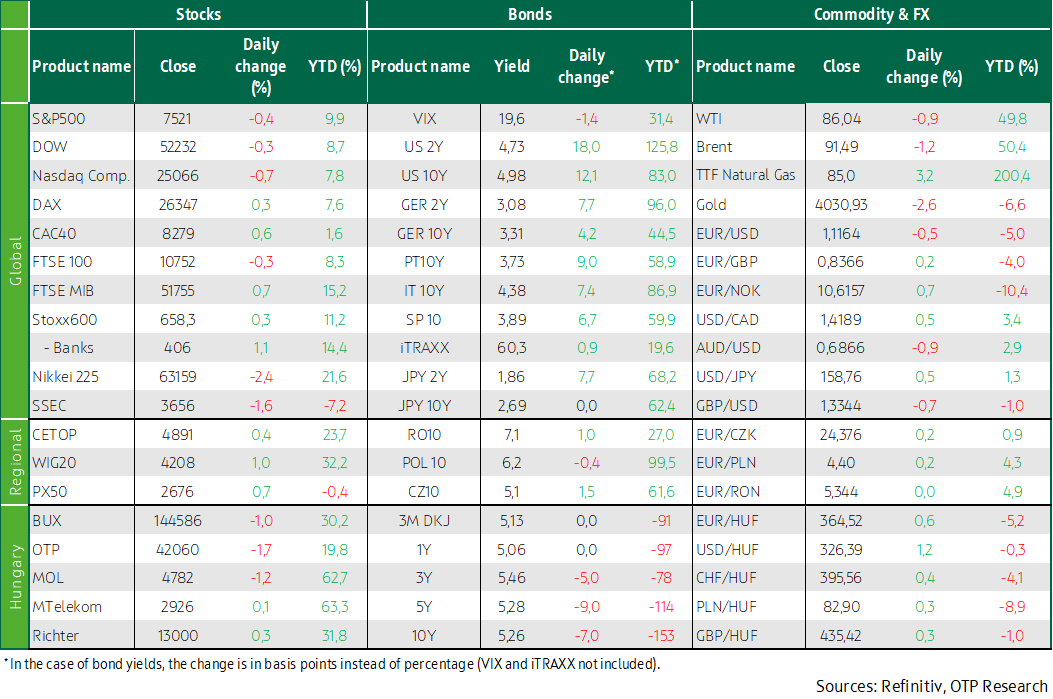
The US 10-year Treasury yield briefly climbed above 5% on Tuesday following the release of stronger-than-expected inflation data. Expectations for further Fed rate hikes strengthened, supported not only by the latest inflation data and last week’s exceptionally strong labour market figures, but also by hawkish comments from central bank policymakers. US equity indices weakened in the face of rising bond yields, with the IT sector emerging as the day's worst performer. In Europe, steadily declining oil prices provided further support to equity markets. The US dollar strengthened, with EUR/USD falling to 1.116. In Hungary, CPI accelerated to 2.0% in October, while core CPI rose to 2.1%. Hungarian long-term bond yields, however, edged lower, with the benchmark 10-year yield declining to 5.26%, its lowest level in nearly four months. The forint weakened alongside other regional currencies, albeit to a greater extent, with EUR/HUF edging up to 364.5. Investor attention is likely to focus on OTP’s Q3 earnings report released this morning.
Major European equity indices extended their gains
Oil prices continued to decline across global commodity markets on Tuesday, as investors remained optimistic about a near-term resolution of the conflict with Iran. Lower energy prices provided further support to Western European equities. The STOXX 600 and the DAX both gained 0.3%, leaving the former just a few points shy of its previous record high. France’s CAC 40 advanced 0.6%, Italy’s FTSE MIB rose 0.7%, while Spain’s IBEX climbed 1.0%. Alongside improving geopolitical prospects, better-than-expected corporate earnings also fuelled the European equity rally. At the same time, the region’s lower exposure to AI-related stocks helped support gains amid persistent uncertainty surrounding the technology sector. According to a Deutsche Bank analysis, the earnings growth gap between Europe and the US narrowed to its smallest level in more than three years during the current earnings season, while Europe has caught up with or even outperformed the US in six sectors. According to LSEG data, Q3 earnings are now expected to rise by 25%, up sharply from an earlier estimate of around 16%. Among individual stocks, Edenred was a standout performer, soaring more than 6% to become the top gainer in the STOXX 600. The move followed a court ruling revealing that a Brazilian judge had suspended parts of the new regulations governing meal vouchers for companies belonging to a local lobbying group, including Edenred Ticket. Corporate earnings releases also drove notable share price moves. Chemical producer K+S surrendered earlier gains and closed 4.5% lower despite reporting Q3 results above expectations. Meanwhile, Sunrise Communications fell more than 4% after the telecommunications provider published its quarterly earnings. Among STOXX 600 sector indices, banks posted the strongest gains, while insurers and the travel & leisure sector were also among the leading performers.
The weakest performance came from oil companies, with the sector declining 1.6%. Although both Brent and WTI crude ended the day only 0.5% lower, losses were considerably steeper during intraday trading. Brent approached the USD 90 per barrel level before rebounding to close near USD 92, while WTI hovered around USD 96 per barrel by the end of the session. President Trump indicated that no further airstrikes against Iran would be necessary, while Democrats in Congress are reportedly considering using the next government funding deadline as leverage to pressure the administration toward ending the conflict.
In the CEE region, both the Polish and Czech stock markets moved higher, while the Hungarian market underperformed, with the BUX falling 1.0%. Following Monday’s rally, OTP underwent a correction, while Mol also declined by nearly 1.2%. In contrast, Richter and Magyar Telekom both managed to close modestly higher.
Despite the continued decline in oil prices, European natural gas prices moved higher on Tuesday, with the TTF benchmark rising 3.2% to EUR 85/MWh.
OTP Group Nine Months 2026 Results
In 3Q 2026, the OTP Group continued its outstanding financial performance: profit after tax amounted to HUF 306 billion, thus the nine months results reached HUF 887 billion with a ROE of 21.1%. These indicators were calculated taking into account the pro-rata effect of special items recognized upfront for the full year. The reported consolidated quarterly profit after tax was HUF 355 billion (9M: HUF 839 billion) exceeding analysts’ expectations by 8%.
Core banking revenues for the first 9 months demonstrated excellent performance: the consolidated net interest income adjusted for FX changes advanced by 19% y-o-y, supported both by the continued dynamic expansion of business volumes and the increase of 9M net interest margin. The FX-adjusted net fees and commission income grew by 3% y-o-y. 9M operating expenses increased by 10% y-o-y and by 15 % FX-adjusted. The normalized ytd cost-to-income ratio stood at 41.3%. 9M net interest margin reached 4.61% after improving 31 bps y-o-y. Another sweet spot in the ytd performance was that the risk profile remained favorable: the Stage 3 loan ratio declined by 0.3 pp ytd and stood at 3.2% by end-September.
Loan volumes kept increasing, FX-adjusted performing (Stage 1+2) loan volumes grew by 4% q-o-q following a 3 and 5% expansion in the first and second quarters, thus ytd growth represents 12%. As for the geographical distribution of this growth, Ukraine excelled itself with 29% ytd expansion. Besides, in Hungary and Bulgaria performing volumes grew by 14 and 15% respectively. It was also encouraging that the Uzbek consumer loan volumes expanded by 16% ytd. As for the major loan segments, the mortgage books in Hungary and Bulgaria demonstrated above 20% ytd volume expansion. Within the framework of the Hungarian “Home Start” subsidized mortgage scheme launched in September 2025, by 3Q 2026 OTP Bank booked a 25% volume growth ytd. Consolidated FX-adjusted consumer loans expanded by 12% ytd. For the same period the consolidated performing FX-adjusted corporate loan book (including MSE) increased by 9% and the leasing exposure by 12%, respectively.
Consolidated FX-adjusted deposits grew by 8% ytd. Notably, the Hungarian deposits increased by 8% for the first 9 months. The Group’s net loan-to-deposit ratio stood at 80% at end of 3Q 2026, by 3 pp higher than end of 2025.
The volume of issued securities increased by 38% ytd. As part of this, the OTP Bank issued a record volume of MREL-eligible bonds exceeding EUR 2.5 billion in EUR, CHF and CNY. Furthermore, OTP Mortgage Bank also entered markets with a total EUR 2 billion mortgage bonds marking a record volume, too.
OTP Group’s consolidated IFRS-based CET1 ratio which is identical with its Tier 1 ratio was 17.8%. As for MREL ratio, the Bank comfortably aligns with the regulatory requirement applicable to the OTP resolution group. OTP Group’s MREL ratio stood at 27% at the end of 3Q 2026 compared with the minimum requirement of 23.9%.
In light of the first nine months performance and underlying trends, management made no change in its 2026 Guidance revised in August.
Strengthening expectations of further rate hikes weighed on sentiment across US equity markets
US equities moved lower as stronger-than-expected inflation data rekindled expectations of further Fed rate hikes, putting pressure on the major indices. The Dow slipped 0.3%, the S&P 500 fell 0.4%, while the Nasdaq Composite declined 0.7%. Within the S&P 500, investors once again rushed to shed IT stocks, while the materials sector also underperformed relative to the broader market. In contrast, financials and consumer discretionary stocks both closed with gains of around 0.5%. Nvidia’s troubles continued to weigh on sentiment. The FBI is now reportedly investigating the case involving the company’s CEO, and the stock tumbled 5.5% on Tuesday. Meanwhile, rival chipmakers delivered mixed performances, posting both gains and losses. Micron (-1.1%) and Broadcom (+3.9%) each plan to invest USD 1 billion in Anthropic. Micron has already committed to participating in the company’s upcoming IPO, while Broadcom intends to join a parallel private placement. The listing could lift Anthropic’s market valuation to USD 1.4 trillion. The Philadelphia Semiconductor Index edged just 0.4% lower. Shares of neocloud provider CoreWeave finished Tuesday’s session down 0.5%, although they gained around 2% in after-hours trading after the company beat analyst expectations on the back of strong demand for its cloud services. The results helped ease some recent concerns about the sustainability of the AI boom and the company’s debt burden. Even so, the stock remains down 32% year-to-date.
US 10-year Treasury yields surged towards 5% following stronger-than-expected inflation data, reinforcing expectations of further Fed rate hikes, while Hungarian CPI accelerated to 2.0% in October
In the US, the October consumer price index rose by 0.4% month-on-month, exceeding expectations of 0.3%, reinforcing expectations of a Fed rate hike in December. Ahead of the data release, Fed Governor Christopher Waller stated that the central bank should raise rates in December even if incoming data point to easing inflation, and that a 50 bp hike should be considered if inflationary pressures intensify. Several other Fed officials also struck a hawkish tone on Tuesday. Dallas Fed President Lorie Logan argued that the Fed should deliver at least two additional 25 bp rate hikes to bring inflation under control and should act sooner rather than later, while Kansas City Fed President Jeff Schmid described the current policy rate as “fairly accommodative”. Although Fed Vice Chair Michelle Bowman stopped short of explicitly calling for another hike, she acknowledged that inflation remains the central bank’s top priority. Money markets are now pricing in nearly a 90% probability of a 25 bp rate increase in December, while the CME FedWatch Tool implies close to a 70% chance of an additional move in January. Following the inflation release, US Treasury yields surged, with the 2-year yield climbing 18 bp to 4.73% by the close, while the benchmark 10-year yield rose 12 bp and finished just below 5%, having traded above that threshold during the session. The US dollar also strengthened, with EUR/USD falling 0.5% to 1.116.
In eurozone bond markets, long-term yields also moved higher on Tuesday, tracking developments in the US, although the increase was more moderate. Germany’s 2-year government bond yield rose by nearly 8 bp, while the 10-year yield climbed 4 bp to 3.3%. On the monetary policy front, ECB Chief Economist Philip Lane indicated that another rate hike may be needed in December, joining a growing number of policymakers who support a third rate increase this year. Market pricing also points to a December hike as the most likely outcome, while investors continue to factor in an additional increase in March.
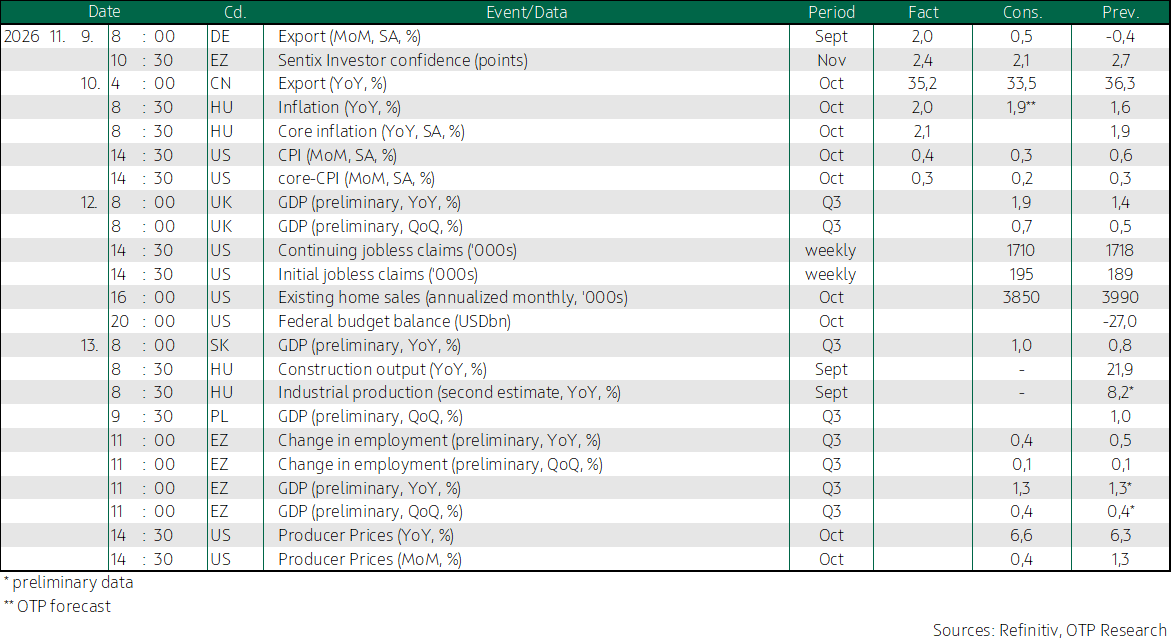
In Hungary, the release of October CPI data was the main focus on Tuesday. The annual reading came in at 2.0%, slightly above our expectations and up from 1.6% in September. On a year-on-year basis, the acceleration in headline CPI was primarily driven by higher prices for services, alcoholic beverages and tobacco products, as well as household energy. On a monthly basis, CPI rose 0.4%, while core CPI increased to 2.1% year-on-year. Yields continued to decline at the 3-, 5- and 10-year tenors, with the benchmark 10-year yield falling 7 bp to 5.26% based on the early afternoon benchmark fixing, marking its lowest level since mid-July.
At Tuesday’s 3-month T-bill auction, demand reached 175% of the offered amount, allowing the Debt Management Agency to sell the full announced volume of HUF 20 billion. The average yield came in at 5.16%, slightly above the previous day’s secondary market benchmark yield.
On Tuesday, regional currencies weakened modestly, although the forint underperformed its peers against the euro. EUR/HUF edged up to 364.5, while USD/HUF climbed by more than 1% to near 326.4.
Today's highlights
Asian-Pacific equity markets are moving higher this morning despite the weakness seen on Wall Street yesterday. Positive earnings from CoreWeave provided support for the technology sector, helping to ease concerns surrounding AI-related stocks. Japan’s Nikkei is up 1.3% ahead of the close, while South Korean benchmark indices have surged by 3-6%. China’s CSI 300 edged 0.4% higher, whereas Hong Kong’s Hang Seng slipped 0.8%.
Futures markets point to a positive open on both sides of the Atlantic, with European and US equity indices expected to start the session in positive territory.
No major macroeconomic data releases are scheduled either in Hungary or internationally today. Hungarian investors will be assessing OTP’s Q3 earnings report, while on global equity markets, quarterly results from BAT, Siemens Energy, EON, RWE and Henkel are likely to be in focus.
Get more out of your investments!
Global Markets Services
OTP Global Markets offers a broad range of services in the field of local and international money and capital markets.
Read morePrivate Banking Services
Personal care and expertise with OTP Private Banking, along with the knowledge, security, and innovations of a multinational banking group.
Read more