
OTP Morning Brief: Lower oil prices underpinned investor optimism
Related content
OTP Morning Brief: US equities rebound after Thursday’s sell-off, but market nervousness remains elevated
US equities posted modest gains on Friday following Thursday’s sharp sell-off, but the VIX, widely known as the “fear index”, continues to signal greater-than-usual volatility in equity markets over the next month. European equities extended their decline on Friday, although markets did not experience anything close to the panic-driven selling seen in the US on Thursday at any point during the past week. Energy and bond markets, however, showed signs of stabilisation: natural gas prices declined particularly sharply on Friday, while oil also became significantly cheaper over the course of the week, and government bond yields continued the gradual easing trend that has been in place for nearly a month.
OTP Morning Brief: Thursday trading brings equity market correction and rising oil prices
European equities closed slightly lower, primarily due to weakness in the technology and defence sectors. A more significant correction unfolded on US equities markets as a wave of selling hit technology stocks, while oil and natural gas prices rose markedly amid escalating geopolitical tensions. Amid growing investor caution, both US and German government bond yields declined, while the dollar edged higher against the euro after experiencing significant intraday volatility. Longer-dated yields also declined on the Hungarian bond market, while the forint weakened against both the euro and the dollar. The negative sentiment spilled over from US markets into Asia, with most major Asian equity indices trading in negative territory during the morning session. Today's focus will be on the October US labour market data, which could materially influence market expectations regarding the Federal Reserve's December rate decision. Additionally, retail sales data will be released from both the euro area and Hungary, while Germany will publish its September industrial production figures.
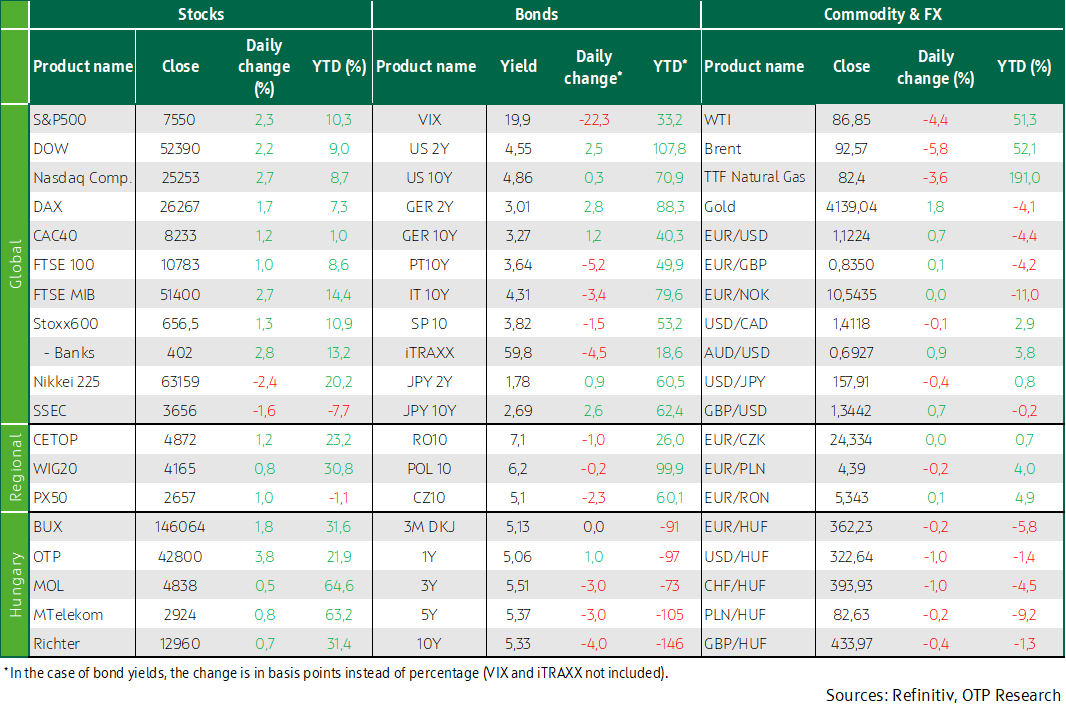
Major European and Wall Street indices closed Monday's trading session in positive territory, with gains broad-based across sectors. The positive sentiment was driven by lower oil prices after Donald Trump stated that a renewed strike against Iran was highly unlikely, provided there is progress in the negotiations. We saw a rebound in the technology sector after last week's sharp sell-off. The dollar weakened against the euro. The BUX climbed 1.8%, while all major Hungarian blue-chip stocks finished the session higher. The forint strengthened against the major currencies. October CPI figures for both Hungary and the US are due for release today.
Major European indices started the week on a positive note
Leading European equity indices closed Monday's session in positive territory, with the pan-European Stoxx 600 rising 1.3% as improving investor sentiment lifted most sectors. Optimism was further supported by falling oil prices after Donald Trump stated that a renewed strike against Iran was highly unlikely if progress is made in the negotiations. WTI crude fell 4.4%, while Brent declined 5.8%.
Energy-related companies posted modest losses as oil prices declined. Defence stocks led the gains, advancing 4.2%, while the banking sector also performed strongly. Sentiment was supported by news surrounding the proposed merger between Banco BPM (+10.7%) and the Italian subsidiary of Crédit Agricole (-0.3%), as well as UniCredit’s better-than-expected earnings results. The combination of Banco BPM and Crédit Agricole could create Italy’s third-largest bank. UniCredit shares rose 6.3% after the lender increased its profit by 24% year-on-year in Q3, comfortably beating analyst expectations, while also raising its full-year earnings guidance. UniCredit is seeking a key role in shaping Commerzbank’s future strategy, helping lift Commerzbank shares by 3.9%. The technology sector staged a modest rebound, rising 2.0% after suffering steep losses last week. Luxury goods manufacturers underperformed, with the sector ending the day in negative territory following reports of weaker-than-expected Chinese demand in October.
Stock markets across the CEE region also moved higher, with the BUX outperforming its regional peers after gaining 1.8%. All major Hungarian blue-chip stocks closed in positive territory, led by OTP, which advanced 3.8%.
European natural gas prices also moved lower alongside oil, with the TTF benchmark falling 3.7% to EUR 82.25/MWh, its lowest level since early October.
Leading Wall Street indices closed with gains of more than 2%
Major Wall Street indices posted strong gains on Monday as lower oil prices helped ease inflation concerns and supported equity markets, allowing the S&P 500 to recover part of its largest weekly decline since April 2025. Market sentiment was broadly positive, with all 11 S&P 500 sectors finishing higher and nine of them advancing by more than 1%. Industrials and consumer discretionary stocks led the rally, with both sectors gaining over 3%. Technology shares also rebounded sharply, as the Philadelphia Semiconductor Index surged 6.9% after losing more than 12% the previous week. Within the sector, Broadcom climbed 8.8% and AMD soared 13.3%, while Nvidia fell 4.3% after reports emerged suggesting a potential foreign intelligence operation involving the company's CEO, Jensen Huang.
The dollar weakened against the euro, while the forint strengthened against the major currencies
US Treasury yields saw only modest moves on Monday as investors increasingly focused on the inflation data due later today, following surprisingly strong October labour market figures that, together, could prove decisive for the outcome of the Fed’s December meeting. Markets are currently pricing in more than an 80% probability of another 25-basis-point rate hike at the final meeting of the year, a view that would be reinforced by inflation data in line with expectations. The yield on the 10-year US Treasury was little changed at 4.86%, as the decline in energy prices failed to offset concerns over persistently elevated inflation. In Europe, the yield on the 10-year German Bund rose by 2 basis points to 3.27%, while long-term yields declined by a few basis points across the southern euro area economies.
As oil prices moved lower, the dollar weakened against the euro, with EURUSD rising 0.7% to 1.122.
According to the benchmark quotations published by the Hungarian Government Debt Management Agency (ÁKK), yields on the Hungarian government bond market fell by 3-4 basis points at the 3-, 5- and 10-year maturities on Monday, while remaining broadly unchanged across the rest of the curve. At yesterday’s switch auction, the debt manager exchanged discount Treasury bills maturing in November and December this year for securities maturing in August 2027, in a total value of HUF 10.4bn.
Supported by a favourable international backdrop, the forint strengthened against the major currencies, with EURHUF falling to 362.225 and USDHUF declining to 322.64.
Today's highlights
Asia-Pacific equity markets are trading higher this morning, while the technology sector, which performed strongly on Wall Street yesterday, remains in rally mode in early trading today. China reported stronger-than-expected export data for October this morning, although imports also exceeded forecasts, resulting in a sharp narrowing of the country’s trade surplus.
Equity index futures point to a positive open on both European and US markets.
The Hungarian Government Debt Management Agency (ÁKK) will offer HUF 20bn worth of discount Treasury bills maturing in March 2027 at auction today.
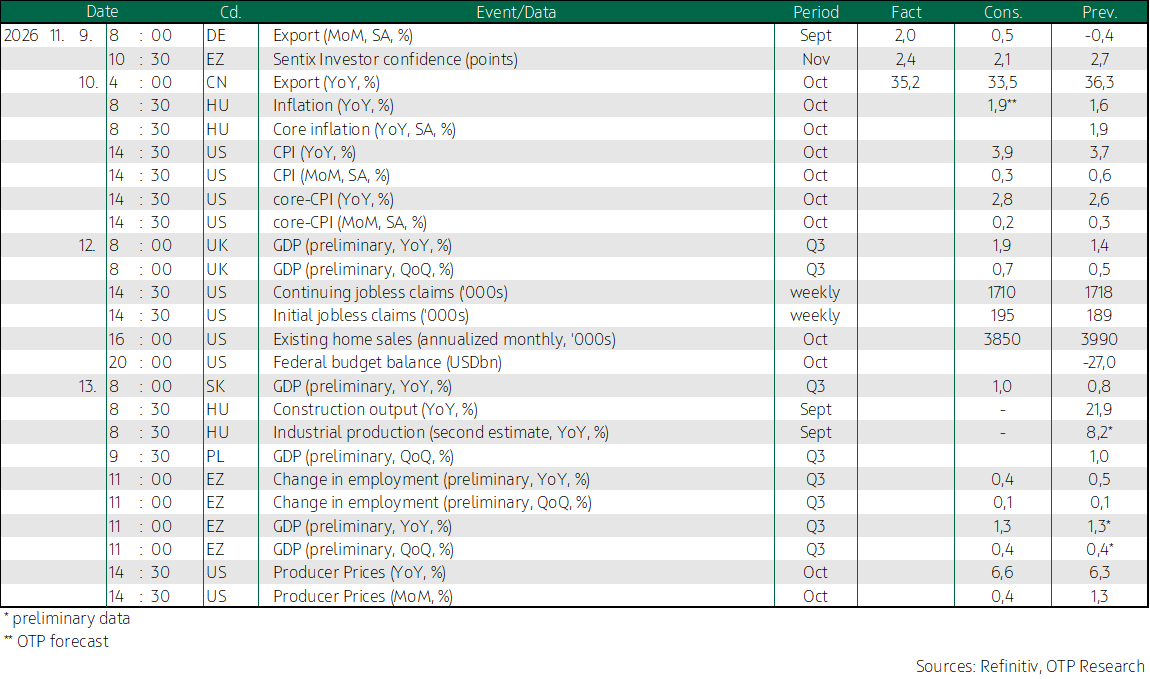
Hungary’s Central Statistical Office (KSH) will release October CPI data today. We expect the pace of price growth to have accelerated to 1.9% year-on-year in October from 1.6% in September. The pickup was likely driven mainly by higher fuel prices and a moderation in food price deflation, while core inflation is expected to have remained broadly unchanged.
October inflation data will also be released in the US today. Markets expect the month-on-month increase in both headline and core inflation to be more moderate than in September. However, a year-on-year comparison is not available, as the October 2025 data point that would serve as the base was never published due to disruptions to data collection during the government shutdown. The key question remains whether the acceleration in inflation driven by higher energy prices will remain isolated or begin to spread more broadly across consumer prices.
Get more out of your investments!
Global Markets Services
OTP Global Markets offers a broad range of services in the field of local and international money and capital markets.
Read morePrivate Banking Services
Personal care and expertise with OTP Private Banking, along with the knowledge, security, and innovations of a multinational banking group.
Read more