
OTP Morning Brief: US equities rebound after Thursday’s sell-off, but market nervousness remains elevated
Related content
OTP Morning Brief: Thursday trading brings equity market correction and rising oil prices
European equities closed slightly lower, primarily due to weakness in the technology and defence sectors. A more significant correction unfolded on US equities markets as a wave of selling hit technology stocks, while oil and natural gas prices rose markedly amid escalating geopolitical tensions. Amid growing investor caution, both US and German government bond yields declined, while the dollar edged higher against the euro after experiencing significant intraday volatility. Longer-dated yields also declined on the Hungarian bond market, while the forint weakened against both the euro and the dollar. The negative sentiment spilled over from US markets into Asia, with most major Asian equity indices trading in negative territory during the morning session. Today's focus will be on the October US labour market data, which could materially influence market expectations regarding the Federal Reserve's December rate decision. Additionally, retail sales data will be released from both the euro area and Hungary, while Germany will publish its September industrial production figures.
OTP Morning Brief: Investor sentiment improved following the Democrats’ congressional victory and the decline in oil prices
Lower bond yields and oil prices, driven by the Democrats’ expected congressional majority, improved market sentiment. Brent crude has fallen by roughly 20% since the beginning of the week, while the yield on the 10-year US Treasury note declined by 6 basis points to 4.89%. Amid the favourable risk environment, the US dollar weakened, with the EUR/USD exchange rate rising to near 1.123. In Europe, positive corporate news also supported market sentiment, with the STOXX 600 index rising by 1.8%, while shares of Novo Nordisk gained 5.6% after the company raised its full-year guidance. Today, investors will focus on German industrial orders, French industrial production and the euro area producer price index, alongside interest rate decisions by the Bank of England and the Czech central bank. In the US, weekly initial jobless claims, as well as Q3 productivity and labour cost data, will also be in the spotlight.
US equities posted modest gains on Friday following Thursday’s sharp sell-off, but the VIX, widely known as the “fear index”, continues to signal greater-than-usual volatility in equity markets over the next month. European equities extended their decline on Friday, although markets did not experience anything close to the panic-driven selling seen in the US on Thursday at any point during the past week. Energy and bond markets, however, showed signs of stabilisation: natural gas prices declined particularly sharply on Friday, while oil also became significantly cheaper over the course of the week, and government bond yields continued the gradual easing trend that has been in place for nearly a month.
US equities staged a partial rebound following Thursday’s sharp sell-off
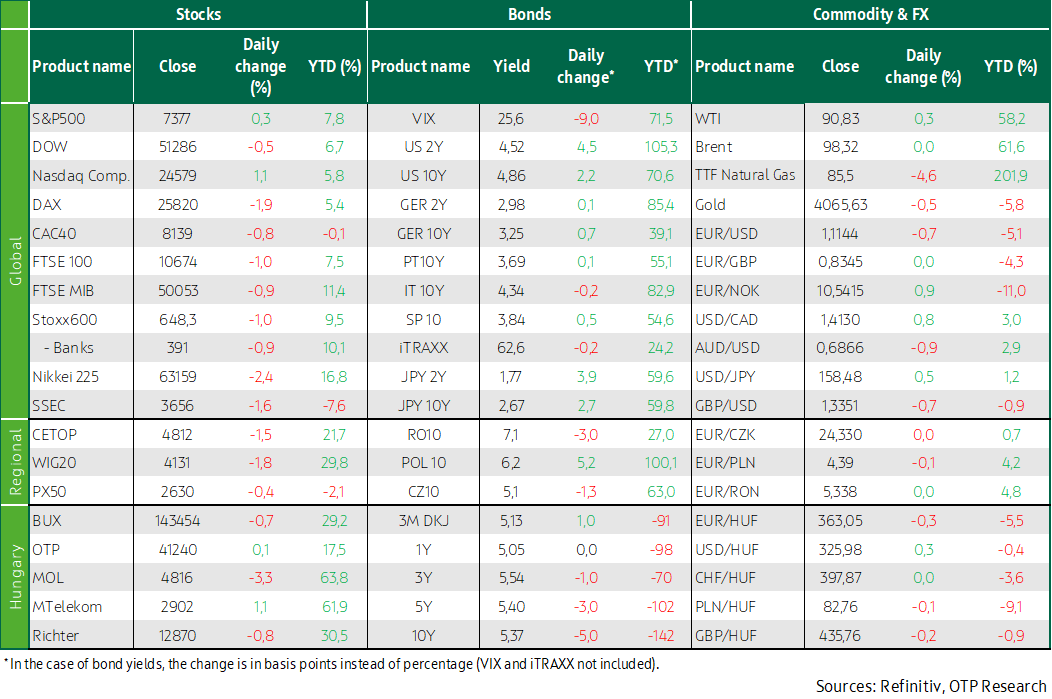
Following Thursday’s heavy sell-off (Nasdaq: -5.5%, S&P 500: -4.4%, Dow: -3.4%), all eyes were on US equity markets on Friday. This time, however, the decline did not continue. In fact, the Nasdaq rose 1.1% and the S&P 500 gained 0.3%, while the Dow Jones was the only major index to remain under pressure, slipping a further 0.5%. The rebound was largely led by the same companies that had driven Thursday’s sell-off, which was fueled by heightened regulatory concerns surrounding AI development and data centres following Tuesday’s Democratic election victory. These included technology stocks and the previous beneficiaries of the AI investment boom, such as semiconductor companies.
The Nasdaq’s modest rebound may not have been particularly surprising. Since the 1970s, there have been only 50 trading days on which the index fell by more than 5% (just 0.3% of all trading sessions), yet equities posted an average gain of 1.0% on the following day. In this respect, Friday’s performance was fully consistent with the historical pattern. At the same time, market nervousness remained elevated. With only a handful of exceptions, trading sessions marked by Nasdaq declines exceeding 5% have typically occurred during periods that later proved to be broader market downturns, such as 2000-2001, the second half of 2008 and March 2020. As a result, investors continue to debate whether the current correction represents the beginning of a reversal in the AI investment boom or merely reflects temporary concerns stemming from heightened political and regulatory risks.
The VIX index also indicated that market sentiment has not fully stabilised. Derived from options prices linked to S&P 500 constituents, the VIX measures the level of volatility investors are pricing in over the next 30 days and is therefore often referred to as the market’s “fear gauge”. The index typically remains below 20, but on Thursday it surged by more than 10 points to 28.18 before closing at 25.64 on Friday. A reading above 20 is generally viewed as a sign of elevated market turbulence. The last sustained period at such levels occurred in March, following the escalation of tensions in the Middle East, although the index had already edged slightly above the 20-point threshold ahead of Tuesday’s US election.
US economic indicators released on Friday painted a resilient picture of the economy. The unemployment rate edged down to 4.1% in October from 4.2% the previous month, while nonfarm payrolls increased by 165,000. Meanwhile, the preliminary consumer sentiment index published by the University of Michigan rose to 51 in November from 48 in October. Taken together, these figures suggest that the US economy continues to demonstrate strength despite elevated energy prices.
European equities extended their decline on Friday
The STOXX Europe 600 Index, which tracks the performance of Europe's largest listed companies, closed 1.0% lower on Friday. The negative sentiment was broad-based and affected nearly all sectors, with retail, media and insurance stocks each falling by more than 2%. Technology shares proved relatively resilient, slipping just 0.1%, while AI-related companies staged a notable rebound following the panic that accompanied the Nasdaq’s 5.5% decline on Thursday. Dutch semiconductor equipment manufacturer ASML, one of the sector’s key players, rose 5.0% on Friday, recouping a significant portion of the 6.5% drop recorded a day earlier. Overall, Western European equity markets showed considerably greater resilience than their US counterparts last week. Thursday’s correction was roughly an order of magnitude smaller (STOXX 600: -0.4%), and despite further losses on Friday, the index still finished the week slightly above its level from a week earlier.
Central and Eastern European markets were less fortunate. On Friday, equities in Warsaw (-1.8%), Prague (-0.4%) and Budapest (-0.7%) all closed in negative territory. Moreover, the latter two markets also posted negative weekly performance, while the Polish stock market managed to remain slightly positive, gaining 0.1% compared to the previous week. Among Hungary’s blue-chip stocks, Magyar Telekom (+1.1%) and OTP (+0.1%) recorded gains on Friday, whereas MOL underperformed, losing 3.3% of its value, likely reflecting the easing trend in energy prices.
Key macroeconomic data were also released. German industrial production increased by 0.7% month-on-month in September, marking its second-strongest monthly reading of the year after August. In contrast, euro area retail sales fell by 0.7% compared to the previous month, not only undershooting expectations but also recording the steepest monthly decline in two years. Given that private consumption currently serves as the main driver of euro area economic growth, it will be important to monitor whether these negative trends in retail activity persist in the coming months.
Hungary, by contrast, reported more encouraging retail sales figures for September. Retail turnover increased by 2.4% month-on-month and by 4.3% compared to the same period a year earlier. The data were broadly consistent with the trends seen in previous months and even exceeded preliminary market expectations.
Sharp decline in natural gas prices on the final trading day of the week, while oil also posted significant weekly losses
On Friday, Brent and WTI crude oil prices were little changed (closing at USD 90.8 and USD 98.3 per barrel, respectively). Looking at the week as a whole, however, Brent fell by 12.8% and WTI by 16.4%, with most of the decline occurring on Wednesday as markets began pricing in an easing of Middle Eastern tensions following the US midterm elections.
European natural gas prices also continued to ease on Friday. The TTF spot price declined by 3.9% to EUR 86.8/MWh, while the front-month futures contract fell by 4.6% to EUR 85.5/MWh. Over the course of the week, the spot contract dropped by 12.9%, while the front-month futures price fell by 17.7%. In our market monitor last Monday, we highlighted that the front-month TTF contract had been trading at an unusually large EUR 4/MWh premium to the spot price on the preceding Friday. We noted that this premium could disappear because volumes secured through one-month futures contracts expiring after 1 December would no longer count toward EU gas storage compliance targets. This is exactly what happened: during the first week of November, the front-month futures contract traded mostly below the spot price, including on Friday.
Broad-based decline in government bond yields
In sharp contrast to the turbulence seen in equity markets, bonds remained a relative safe haven. Across most regions and maturities, yields declined modestly over the course of the week, although Friday did bring a slight rebound of a few basis points in some segments. US Treasury yields have now been falling for five consecutive weeks across both the 2-year and 10-year maturities, closing Friday at 4.52% and 4.86%, respectively (weekly change: -6/-7 bps; Friday change: +4/+2 bps). German 2-year and 10-year yields have also been trending lower for a fourth straight week, declining by roughly 3-6 basis points per week on average. Last week was no exception, with both maturities ending Friday unchanged from their previous day's close at 2.98% and 3.25%, respectively. Italian, Spanish and Portuguese 10-year yields fell by 10-15 basis points over the week and were unchanged on Friday, while the French 10-year yield declined by more than 20 basis points, ending the week at 4.77%. In Japan, yields recorded a more pronounced drop on Friday, exceeding 10 basis points across both the 2-year and 10-year maturities. The latter closed at 2.64%, its lowest level since late June.
Government bond yields also moved lower across the CEE region over the course of the week. The Czech 10-year yield declined by 23 basis points to 5.13%, the Polish equivalent fell by 20 basis points to 6.18%, while the Hungarian 10-year yield eased by 8 basis points to 5.37%.
In the currency market, the US dollar strengthened by 0.7% against the euro on Friday, although this translated into only a marginal 0.1% move over the course of the week. The Hungarian forint also posted a strong weekly performance, appreciating by 0.3% against the euro on Friday and by 0.8% over the week as a whole. Overall, the forint reached its strongest levels against the euro in roughly one and a half months during the past week.
Today's highlights
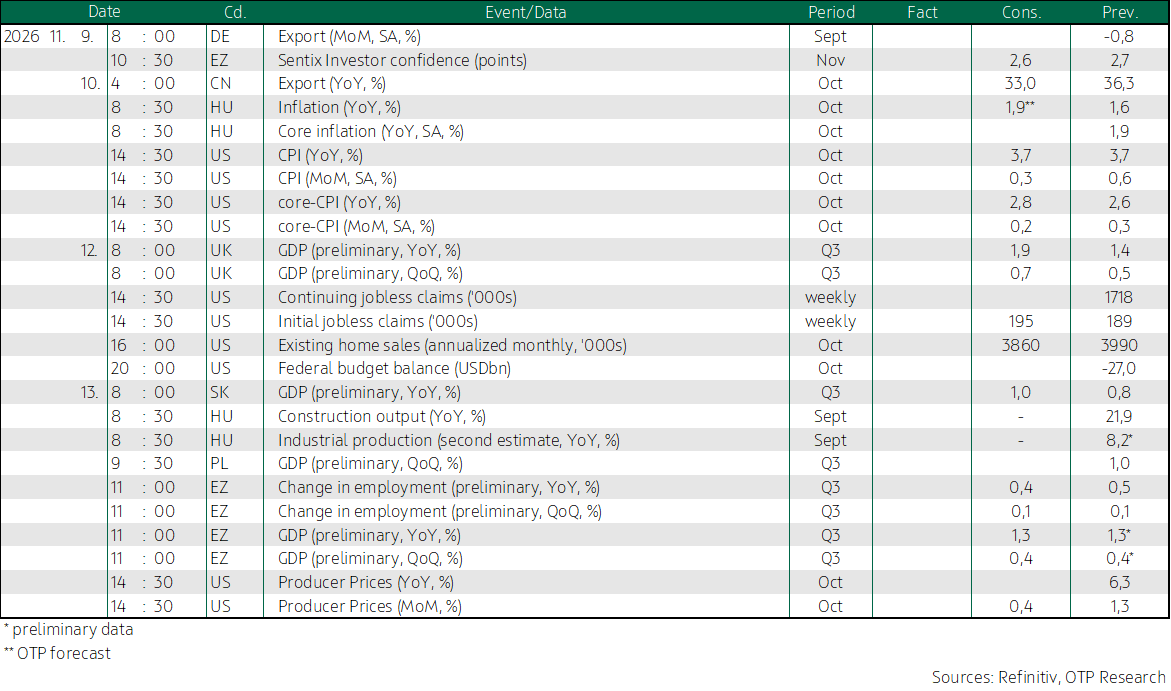
No major macroeconomic releases are scheduled for Monday, either from advanced economies or from the CEE region. Investors’ attention is therefore likely to remain firmly focused on equity markets. Trading in Asia on Monday morning reflected cautious optimism, with the Nikkei 225 up 2.2% as of 7:30 a.m., while China’s SSEC and Hong Kong’s Hang Seng posted more modest gains of 0.3% and 0.4%, respectively. South Korea’s KOSPI, by contrast, traded 0.7% lower. Sentiment toward AI-related stocks may be influenced by reports published on Sunday alleging that Nvidia CEO Jensen Huang had an extramarital relationship with a Chinese woman who was allegedly linked to Chinese intelligence services. Following these reports, Nvidia shares fell nearly 5% in pre-market trading. While such allegations would not normally be expected to have a meaningful impact on companies beyond the one directly involved, the current highly sensitive market environment suggests that investors may react more broadly than usual.
Get more out of your investments!
Global Markets Services
OTP Global Markets offers a broad range of services in the field of local and international money and capital markets.
Read morePrivate Banking Services
Personal care and expertise with OTP Private Banking, along with the knowledge, security, and innovations of a multinational banking group.
Read more