
OTP Morning Brief: Thursday trading brings equity market correction and rising oil prices
Related content
OTP Morning Brief: Investor sentiment improved following the Democrats’ congressional victory and the decline in oil prices
Lower bond yields and oil prices, driven by the Democrats’ expected congressional majority, improved market sentiment. Brent crude has fallen by roughly 20% since the beginning of the week, while the yield on the 10-year US Treasury note declined by 6 basis points to 4.89%. Amid the favourable risk environment, the US dollar weakened, with the EUR/USD exchange rate rising to near 1.123. In Europe, positive corporate news also supported market sentiment, with the STOXX 600 index rising by 1.8%, while shares of Novo Nordisk gained 5.6% after the company raised its full-year guidance. Today, investors will focus on German industrial orders, French industrial production and the euro area producer price index, alongside interest rate decisions by the Bank of England and the Czech central bank. In the US, weekly initial jobless claims, as well as Q3 productivity and labour cost data, will also be in the spotlight.
OTP Morning Brief: Democrats may secure majorities in both chambers of Congress in the midterm elections
Western European stock indices edged lower on a macroeconomically quiet day. US markets closed mixed. The tech-heavy Nasdaq rose, while concerns over memory chip prices weighed on Apple shares and supported gains in Micron Technology and Nvidia. The number of job openings in the US surged. Favourable macroeconomic data pushed bond yields higher on Tuesday. However, the focus remained on the midterm elections: based on the results available by this morning, a significant Democratic victory was taking shape, potentially allowing Democrats to secure majorities in both chambers of Congress. October CPI data for the eurozone is due for release today. Among others, McDonald’s and Novo Nordisk are set to report earnings today.
European equities closed slightly lower, primarily due to weakness in the technology and defence sectors. A more significant correction unfolded on US equities markets as a wave of selling hit technology stocks, while oil and natural gas prices rose markedly amid escalating geopolitical tensions. Amid growing investor caution, both US and German government bond yields declined, while the dollar edged higher against the euro after experiencing significant intraday volatility. Longer-dated yields also declined on the Hungarian bond market, while the forint weakened against both the euro and the dollar. The negative sentiment spilled over from US markets into Asia, with most major Asian equity indices trading in negative territory during the morning session. Today's focus will be on the October US labour market data, which could materially influence market expectations regarding the Federal Reserve's December rate decision. Additionally, retail sales data will be released from both the euro area and Hungary, while Germany will publish its September industrial production figures.
Weakness in the technology and defence sectors weighed on European equities
European equities closed modestly lower on Thursday. The STOXX 600 index fell 0.4%, mainly weighed down by declines in technology and defence stocks, while rising oil prices also dampened market sentiment.
The technology sector remained under pressure amid expectations that a Democratic majority following the midterm elections could introduce tighter regulations affecting artificial intelligence-related investments and data centre developments. As a result, share prices of European semiconductor and AI-linked companies declined sharply: ASML fell 6.6%, Infineon lost 8.5%, Aixtron dropped 9.8%, Siltronic retreated 12.3%, while Soitec plunged 16.7%. Overall, the technology sector index shed 3.2%.
The defence sector also underperformed, with the sector index falling 2.6% over the course of the day. Rheinmetall plunged 16.1% after the German defence contractor cut its 2026 revenue forecast for the second time in three months, raising concerns about the sector’s near-term growth prospects.
The corporate earnings season also delivered some positive news. Air France-KLM shares rose 12% after the airline reported third-quarter results that exceeded analysts’ expectations. Meanwhile, Danish renewable energy company Orsted also closed higher, supported by strong quarterly earnings.
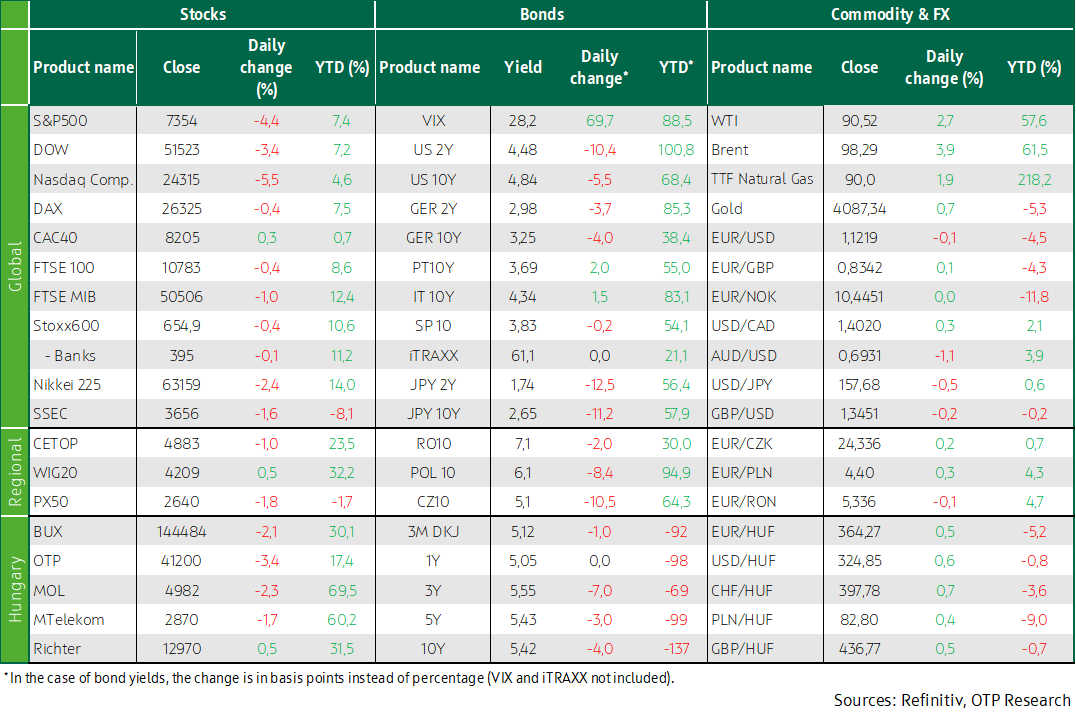
Leading Western European equity indices delivered mixed performance during Thursday's trading session. The CAC 40 gained 0.3%, while both the DAX and the FTSE 100 declined by 0.4% compared to their previous closing levels.
Among regional equity markets, Poland’s WIG20 rose 0.5%, while the Czech PX50 fell 1.8% and Hungary’s BUX declined 2.1%. Among Hungarian blue chips, Richter was the only stock to post gains, rising 0.5%, while OTP was the weakest performer, dropping 3.4%.
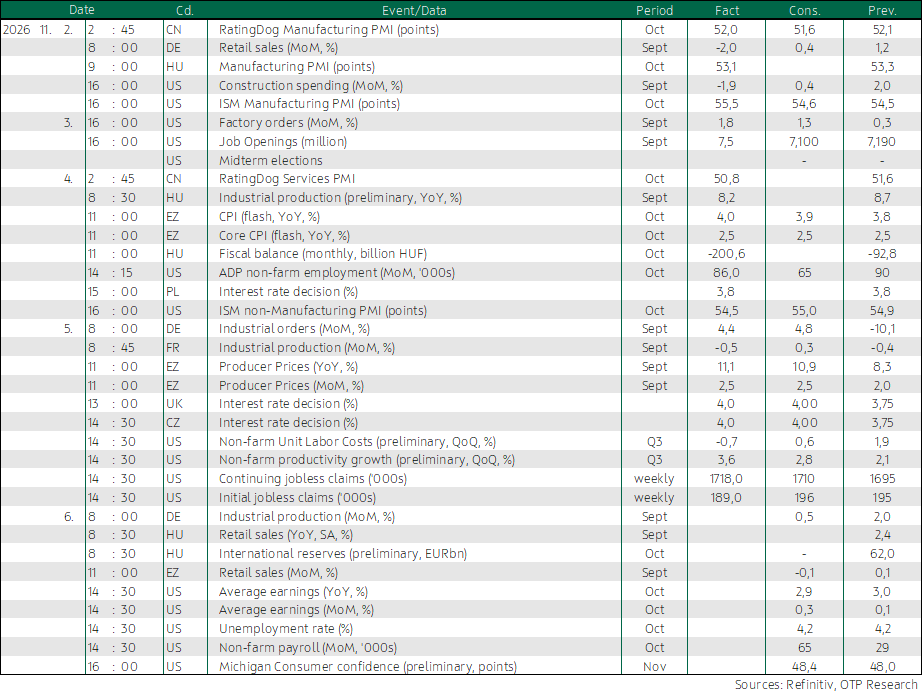
The euro area macroeconomic data released on Thursday did little to improve the region’s economic outlook. German industrial orders rose 4.4% month-on-month in September, marking a significant rebound from the 10.1% decline recorded in August, although the figure came in slightly below market expectations of 4.8%. Growth was driven primarily by stronger demand from the automotive and machinery sectors, while orders increased by just 0.2% on a quarterly basis, pointing to continued weakness in Germany’s industrial cycle.
French industrial production fell 0.5% month-on-month in September, marking another decline following August’s 0.4% drop, instead of the 0.3% increase expected by the market. The weaker-than-anticipated reading was primarily driven by a contraction in energy output, while manufacturing production rose 0.5%, supported in particular by a recovery in the automotive sector. On an annual basis, output declined 1.3%, marking the steepest drop since April 2025.
Euro area producer prices rose 2.5% month-on-month in September, following a 2.0% increase in August. The annual growth rate of the producer price index accelerated to 11.1%, its highest level since February 2023 and above market expectations. The acceleration was driven primarily by rising energy prices.
Both the Bank of England and the Czech National Bank raised their key policy rates by 25 basis points to 4.00%, in line with market expectations.
US equity indices plunge, while oil prices rise sharply
US equities closed sharply lower on Thursday following Wednesday’s rally, with the S&P 500 falling 4.4%, the Dow Jones declining 3.4%, and the Nasdaq Composite dropping 5.5%. The latter recorded its steepest daily decline since April 2025 and ended the session more than 10% below its all-time high reached on 6 October.
Similar to European markets, US technology stocks also came under heavy selling pressure amid concerns over potential regulation of the AI sector. Semiconductor companies posted sharp losses, including Nvidia, while AI-related data centre operators and cloud service providers ranked among the session’s worst performers. Companies affected included IREN, Applied Digital, CoreWeave and Nebius Group.
Following Wednesday’s gains, large-cap technology companies also came under pressure, with shares of Meta, Amazon and Alphabet all closing lower. Qualcomm stock also declined after the company’s fourth-quarter smartphone chip sales fell short of Wall Street expectations.
Oil prices closed sharply higher on Thursday, with Brent rising 3.9% to USD 98.3 per barrel and WTI gaining 2.7% to USD 90.5 per barrel, following declines of more than 8% on Wednesday. The rebound was driven by renewed concerns over the security of global oil supplies. According to the UK Maritime Trade Operations (UKMTO), at least five vessels have reported incidents in the Persian Gulf region since Sunday, while Iran reported a fire involving two oil tankers and a tugboat in the Strait of Hormuz. Geopolitical risks were further amplified by renewed attacks on Saudi Arabia by Yemen’s Houthi rebels, as well as Ukrainian drone strikes targeting Russian oil refineries. Investors have also become increasingly sceptical about the prospects for a swift diplomatic resolution to the conflict, helping to maintain a substantial geopolitical risk premium in oil prices. At the same time, European natural gas prices also moved higher, with the TTF benchmark climbing back above EUR 90/MWh.
US nonfarm business sector productivity increased at an annualised rate of 3.6% quarter-on-quarter in the third quarter, significantly exceeding both the market expectation of 2.8% and the 2.1% pace recorded in the second quarter. At the same time, unit labour costs declined by 0.7%, compared with expectations for a 0.6% increase, suggesting that wage-driven inflationary pressures remained contained.
Initial jobless claims came in better than expected last week, falling to 189,000, while the number of continuing unemployment benefit recipients slightly exceeded market consensus forecasts.
US and German government bond yields decline amid growing investor caution
Demand for US and German government bonds strengthened across developed bond markets, as the sharp sell-off in technology stocks prompted investors to seek the safety of fixed-income assets. The yield on the US 10-year Treasury fell 5.5 basis points to 4.84%, while the 2-year yield declined 10.4 basis points to 4.48%. In Europe, the yield on the 10-year Bund eased by 4 basis points to 3.25%, while the 2-year yield moved nearly 4 basis points lower.
Alongside the decline in German yields, movements across euro area bond markets were broadly mixed. Spain’s 10-year yield was largely unchanged, while Italian and Portuguese yields edged higher. France’s 10-year yield closed near the previous day’s level, although it touched a one-month low during the session. French government bonds were also supported by a successful debt auction, allowing the market to largely look through the protests and strikes directed against the Macron administration.
In the foreign exchange market, the dollar ultimately ended the session with a modest gain of 0.1% against the euro, despite significant intraday volatility. Following weakness in the early hours of trading, the US currency found support from rising oil prices, although the sharp decline in technology stocks later renewed pressure on the greenback. The EUR/USD exchange rate eventually closed the day around 1.122.
On the Hungarian bond market, the decline in yields continued during Thursday’s trading session, with yields across the 3-10 year segment falling by 3-7 basis points. Based on the Government Debt Management Agency’s (ÁKK) early afternoon quotation, the 10-year benchmark yield eased to 5.42%. Investor demand remained strong at Thursday’s auctions. Demand for the 2033/C bond reached nearly five times the amount offered, prompting the ÁKK to sell more than double the announced volume. The 2036/B bond auction and the discount Treasury bill auction also attracted substantial oversubscription. The forint weakened by 0.5% against the euro and 0.6% versus the dollar during the day, leaving EUR/HUF at 364.27 and USD/HUF at 324.85 by the close.
Today's highlights
The negative sentiment from US markets also spilled over into Asia, with Japan’s Nikkei 225, South Korea’s Kospi, as well as China’s SSEC and Hang Seng indices all trading in negative territory during the morning session. As trading approached its close, at 6:30 a.m. Hungarian time, the technology-heavy Nikkei was down more than 6%, while losses in the Kospi also exceeded 5%.
Today's focus will be on the October US labour market data, which could materially influence market expectations regarding the Federal Reserve's December rate decision. Additionally, retail sales figures will be released from both the euro area and Hungary, while Germany will publish its September industrial production data.
Get more out of your investments!
Global Markets Services
OTP Global Markets offers a broad range of services in the field of local and international money and capital markets.
Read morePrivate Banking Services
Personal care and expertise with OTP Private Banking, along with the knowledge, security, and innovations of a multinational banking group.
Read more