
OTP Morning Brief: Markets focus on the US midterm elections today
Related content
OTP Morning Brief: Further increase in energy prices, stock market correction in the US
On Friday, and over the course of last week as a whole, both oil and gas prices continued to rise. This longer-term trend was also reflected in the October inflation data released on Friday across eurozone member states, with CPI continuing to increase. At the same time, the better-than-expected Q3 GDP figures for the region, which were also published on Friday, continued to point to strong economic resilience. Stock prices declined in Europe and, even more markedly,in the US, with the Nasdaq posting its largest single-day drop since June,falling 3%. Bond yields edged lower, while Hungarian 10-year government bond yields declined significantly, falling by nearly 20 basis points.
OTP Morning Brief: Neither the Fed, the ECB nor the BoJ changed their key policy rates
European indices rose yesterday, supported by strong corporate earnings results. The ECB left its key policy rate unchanged, in line with expectations, after Christine Lagarde announced her departure from the helm of the central bank. Euro area economic sentiment declined in October, while Hungarian exports picked up in September. The major Wall Street indices declined yesterday. Disappointing earnings from Alphabet weighed on the technology and communication services sectors, setting the tone for their weak performance. US macroeconomic data released yesterday pointed to stronger-than-expected economic growth, while also signalling mounting inflationary pressures. Crude oil prices declined on Thursday following reports of renewed diplomatic efforts to restart US-Iran peace talks. The US 10-year Treasury yield fell by 6 basis points, dropping back below the 5% mark. The Hungarian forint strengthened by 0.4% yesterday. The Bank of Japan kept its key policy rate unchanged at 1.25%. Today, among other releases, the first estimates of Q3 GDP growth in Hungary and the euro area will be published.
Major European indices rose yesterday; German retail sales fell sharply on a monthly basis, while Hungary’s manufacturing PMI declined slightly. Major US indices closed mixed, while US manufacturing activity continued to strengthen; however, construction spending declined on a monthly basis following the previous month’s increase. US long-term yields edged lower, while rates in Europe were little changed; following the declines seen in recent days, the Hungarian 10-year government bond yield rose slightly. The US midterm elections take place today, determining whether the Republican Party can retain its majority in both the House of Representatives and the Senate. In addition, data on US factory orders and job openings will be released today.
Major European indices rose yesterday; German retail sales fell sharply on a monthly basis, while Hungary’s manufacturing PMI declined slightly
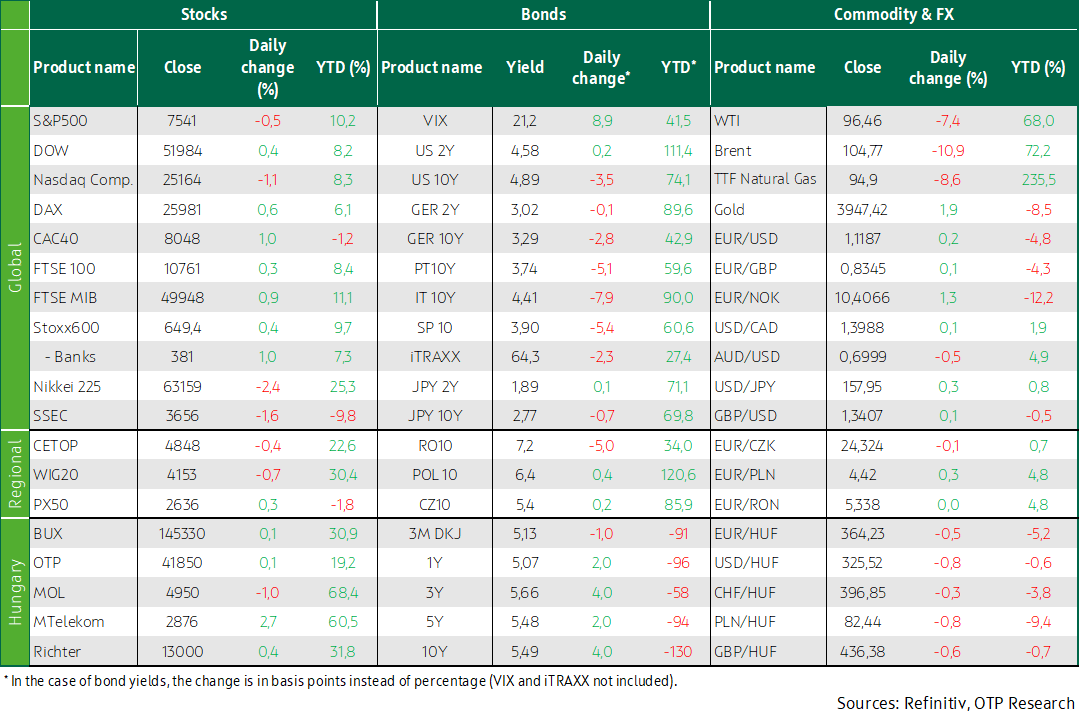
European equity markets started the week on a positive note, with the STOXX 600 rising 0.4% to reach an eight-week high. Investor sentiment was supported by signs of renewed diplomatic engagement between the US and Iran, easing concerns over further escalation of the Middle East conflict. As a result, oil prices declined, helping to alleviate worries about CPI-related risks. Among the major European markets, Spain delivered the strongest performance, while French, Italian and German indices also posted gains. In contrast, the UK’s FTSE 100 underperformed, primarily due to weakness in energy stocks. At the sector level, travel and leisure shares gained more than 3%, benefiting from lower fuel costs. Mining companies also performed well, supported by higher precious metal and industrial commodity prices: gold rose 1.9%, while silver surged more than 3%. The energy sector, however, remained under pressure after WTI crude oil fell below USD 100 per barrel. Among individual stocks, Alstom plunged more than 25% after the company once again downgraded its guidance.
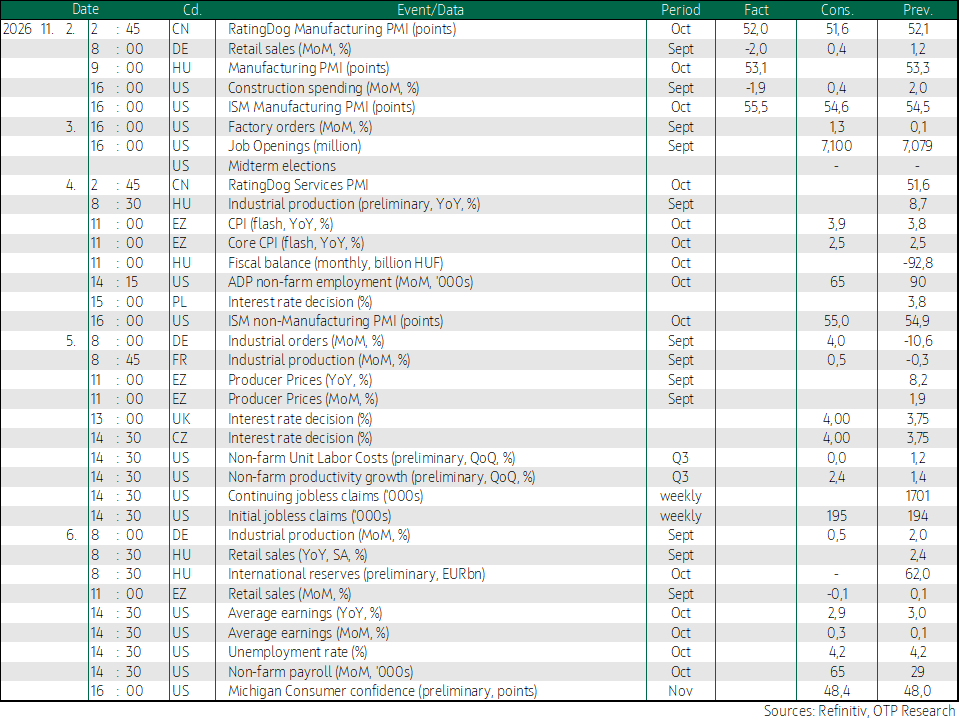
German retail sales fell 2.0% month-on-month in September, following a 1.2% increase in the previous month, and came in well below market expectations of a 0.4% rise. This marked the fourth monthly decline so far this year. The weakness was broad-based, with sales in the food retail segment, non-food products, as well as online and mail-order trade all registering declines. On an annual basis, retail sales fell 2.3%, marking a further deterioration from the 0.3% drop recorded in August.
Mixed performance was seen across the major CEE markets, with the Prague and Budapest stock exchanges posting gains, while the Warsaw market declined. Among Hungary’s blue-chip stocks, only MOL lost ground, while the other three heavyweight shares moved higher. Hungary’s manufacturing PMI eased to 53.1 in October from September’s nine-month high of 53.3. The slowdown was primarily visible on the demand side, reflected in a weaker pace of growth in new orders. This was partly offset by stronger output and employment figures, while the increase in the purchasing price index suggests that accelerating cost pressures could once again pose a CPI risk for companies in the coming months. This would be consistent with rising global energy prices and the strengthening inflationary pressures observed worldwide in recent weeks.
Major US indices closed mixed, while US manufacturing activity continued to strengthen; however, construction spending declined on a monthly basis following the previous month's increase
Sector rotation continued in US equity markets, with weakness in technology stocks weighing on the Nasdaq and the S&P 500, while the Dow Jones managed to post gains. Although the major indices initially moved higher during the trading session, investors reduced their exposure to artificial intelligence-related stocks by the close. Several corporate developments added pressure to the technology sector. Oracle fell nearly 9% after announcing plans to raise a total of USD 20 billion through equity and debt offerings to finance its AI investments. Marvell Technology declined roughly 12%, while Lumentum dropped 18.6% after Marvell made a USD 115 billion takeover bid for the company. Investors continued to assess the return potential of AI-related spending, a concern that has placed significant pressure on technology stocks throughout October. As a result, the Nasdaq recorded its weakest monthly performance since March 2025, while some investors rotated into more defensive sectors. Sentiment was nevertheless supported by a sharp correction in oil prices, as expectations of a diplomatic breakthrough between the US and Iran strengthened once again. Ahead of its planned share offering, Anthropic also released its third-quarter results, reporting revenue growth but returning to a loss after posting a profit in the second quarter. Apple released its earnings after the market close, beating expectations on both revenue and profit; however, it issued disappointing margin guidance for the next quarter, sending its shares 2.8% lower in after-hours trading.
The US ISM Manufacturing PMI rose to 55.5 in October from 54.5 in September, exceeding market expectations of 54.6. The improvement was primarily driven by stronger production growth and continued resilience in new orders, while demand related to corporate investment, AI, data centres and semiconductors remained robust. Although the prices index eased from 77.9 to 75.2, it continued to signal elevated inflationary pressures. Overall, the data point to stronger-than-expected performance in the US manufacturing sector and highlight the continued resilience of economic activity.
US construction spending fell 1.9% month-on-month in September, following a 2.0% increase in August. The figure came in well below market expectations of a 0.4% rise and marked the largest monthly decline since April 2020. The weakness was primarily driven by a 2.4% drop in private-sector investment, including a 5.5% fall in residential construction, while spending on non-residential projects increased by 1.1%. Public construction spending edged down 0.1%, while total construction outlays were 2.7% lower than a year earlier.
US long-term yields edged lower, while European yields were little changed; following the declines seen in recent days, the Hungarian 10-year government bond yield rose slightly
Mixed movements were observed in the US Treasury market as investors prepared for key macroeconomic data releases, corporate earnings reports and the upcoming US midterm elections later in the week. The yield on the 10-year US Treasury fell by more than 3 basis points to below 4.90%, while the policy-sensitive 2-year yield was broadly unchanged at around 4.58%. Markets were supported by a sharp decline in oil prices after Secretary of State Marco Rubio indicated that Donald Trump continues to favour a diplomatic resolution to the conflict with Iran. This development eased concerns about inflationary risks and helped support demand for longer-dated government bonds. Sentiment also remained heavily influenced by developments in the technology sector. The equity market correction led by technology stocks at the end of the previous week increased demand for safe-haven assets. On the political front, investors were focused on the outcome of Tuesday’s midterm elections, as the result could have significant implications for future fiscal policy, government spending and, consequently, the outlook for the US Treasury market.
German and French government bond yields both moved lower, with the 10-year benchmark yields declining by 3 and 7 basis points, respectively. In Hungary, yields beyond the one-year segment increased by 2-4 basis points during the session. After the declines seen in recent days, the 10-year Hungarian government bond yield rose by 2 basis points to close at 5.48%. Meanwhile, the forint strengthened by 0.5% against the euro yesterday.
Today's highlights
Mixed sentiment prevailed across Asian markets this morning. The Shanghai Composite was down 1.5% after it appeared that Chinese authorities' efforts to support the stock market had failed to gain traction.
The US midterm elections take place today, determining whether the Republican Party can retain its majority in both the House of Representatives and the Senate. In addition, data on US factory orders and job openings will be released today.
Get more out of your investments!
Global Markets Services
OTP Global Markets offers a broad range of services in the field of local and international money and capital markets.
Read morePrivate Banking Services
Personal care and expertise with OTP Private Banking, along with the knowledge, security, and innovations of a multinational banking group.
Read more