
OTP Morning Brief: Further increase in energy prices, stock market correction in the US
Related content
OTP Morning Brief: Neither the Fed, the ECB nor the BoJ changed their key policy rates
European indices rose yesterday, supported by strong corporate earnings results. The ECB left its key policy rate unchanged, in line with expectations, after Christine Lagarde announced her departure from the helm of the central bank. Euro area economic sentiment declined in October, while Hungarian exports picked up in September. The major Wall Street indices declined yesterday. Disappointing earnings from Alphabet weighed on the technology and communication services sectors, setting the tone for their weak performance. US macroeconomic data released yesterday pointed to stronger-than-expected economic growth, while also signalling mounting inflationary pressures. Crude oil prices declined on Thursday following reports of renewed diplomatic efforts to restart US-Iran peace talks. The US 10-year Treasury yield fell by 6 basis points, dropping back below the 5% mark. The Hungarian forint strengthened by 0.4% yesterday. The Bank of Japan kept its key policy rate unchanged at 1.25%. Today, among other releases, the first estimates of Q3 GDP growth in Hungary and the euro area will be published.
OTP Morning Brief: The Fed left its benchmark interest rate unchanged as market attention turns to the ECB’s decision
The wait-and-see sentiment ahead of the ECB’s rate decision led to limited movements across European equity markets, while individual stock performance was driven primarily by corporate earnings releases. Wall Street closed modestly higher after the Fed left its benchmark interest rate unchanged, in line with expectations. Strengthening supply risks continued to drive energy prices higher, with the TTF benchmark soaring to its highest level since the 2022 energy crisis. While yields rose across US and European bond markets, the decline in the Hungarian government bond market continued. Today's focus is on the ECB’s rate decision, as well as the US GDP release and the core PCE inflation gauge closely monitored by the Fed. In addition to macroeconomic data, the earnings season continues, with Amazon among the companies set to report its quarterly results.
On Friday, and over the course of last week as a whole, both oil and gas prices continued to rise. This longer-term trend was also reflected in the October inflation data released on Friday across eurozone member states, with CPI continuing to increase. At the same time, the better-than-expected Q3 GDP figures for the region, which were also published on Friday, continued to point to strong economic resilience. Stock prices declined in Europe and, even more markedly,in the US, with the Nasdaq posting its largest single-day drop since June,falling 3%. Bond yields edged lower, while Hungarian 10-year government bond yields declined significantly, falling by nearly 20 basis points.
Energy prices continue their relentless climb
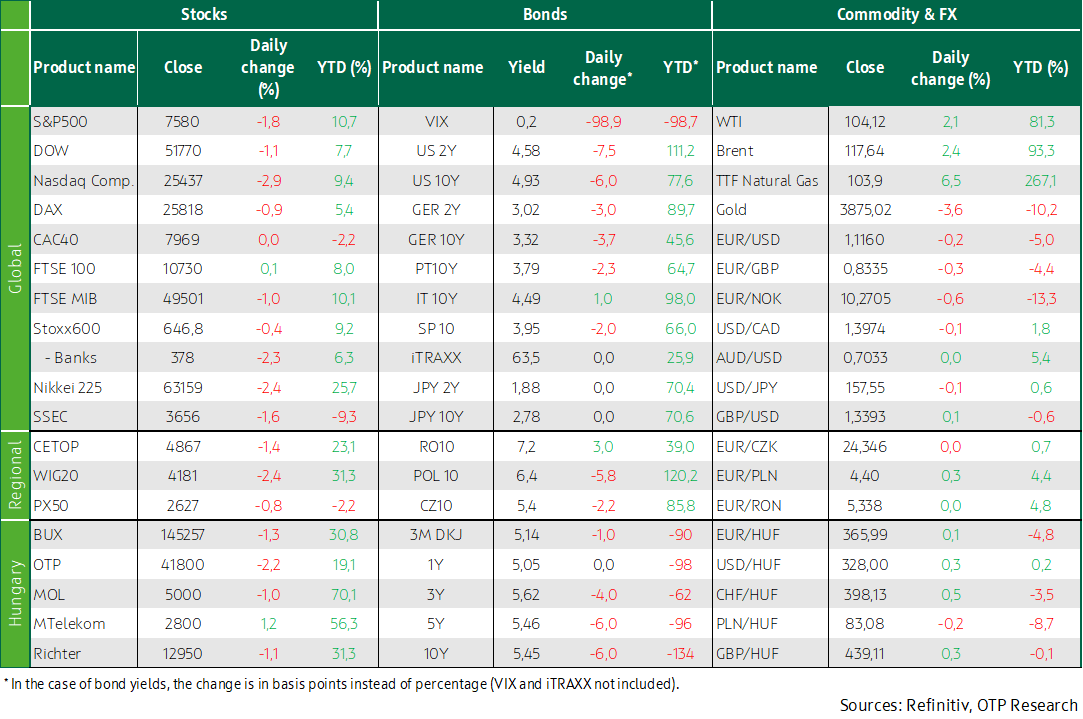
On the final trading day of last week, WTI crude rose 2.1% to USD 104.1 per barrel, while Brent gained 2.4% to USD 117.6. In both cases, prices exceeded their levels from a week earlier and moved even closer to the peaks reached in late March and early April. Energy prices continue to be driven higher by concerns that, following tomorrow’s US midterm elections, the US and Israel may resume military action against Iran. The issue had already featured prominently in Israel’s election campaign, with Benjamin Netanyahu referring to renewed strikes as virtually inevitable, while his main challenger, Gadi Eisenkot, criticized mainly the openness with which such plans were being discussed.
The price of TTF natural gas traded in Amsterdam also moved higher. The spot contract increased to EUR 99.9/MWh, while the one-month futures contract rose 6.5% to EUR 103.9/MWh, marking a new high for the year. As a result, the futures price traded 4% above the spot price, a relatively rare occurrence, as the two prices are typically much closer, usually within 1% of each other. Going forward, the spread between spot and futures gas prices will be particularly worth monitoring, as under EU regulations, member states are required to meet gas storage filling targets by 1 December. Consequently, gas purchased in November for one-month delivery would no longer count toward compliance with that deadline.
European stock markets edged lower following the release of mixed macroeconomic data
The STOXX 600 fell 0.4% to 646.8 on Friday, although it still stood 1% above its level a week earlier. The index was dragged lower primarily by the technology sector, which declined 2.7%, with its largest constituent, ASML, tumbling 6.5%. The banking sector also weighed on performance, falling 2.3%. In contrast, several other sectors, including healthcare, consumer goods, and food producers, managed to post gains of around 2%.
The CEE region was also unable to escape the broadly negative market sentiment. Prague fell 0.8% and the BUX declined 1.3% last Friday, although both indices still remained above their levels from a week earlier. The Polish stock market dropped 2.4% on Friday amid the deepening constitutional crisis in Warsaw, leaving it 0.4% below its level of a week earlier.
Friday brought a barrage of European macroeconomic releases, coming just one day after the ECB's decision to leave its key policy rate unchanged at 2.50%. Q3 GDP figures were published for the euro area, Germany, France, Spain, and Italy, and overall they continued to indicate stable growth broadly in line with expectations. Across the euro area, the economy expanded by 1.3% year-on-year in Q3 (Q2: 1.2%, market expectation for Q3: 1.1%), with a similar growth pattern observed across most member states. The sole exception was France, where GDP contracted by 0.1% year-on-year in Q3, compared with 0.5% growth in Q2, while analysts had not anticipated a negative reading. The decline was primarily driven by weaker investment activity and a drop in exports of aerospace equipment.
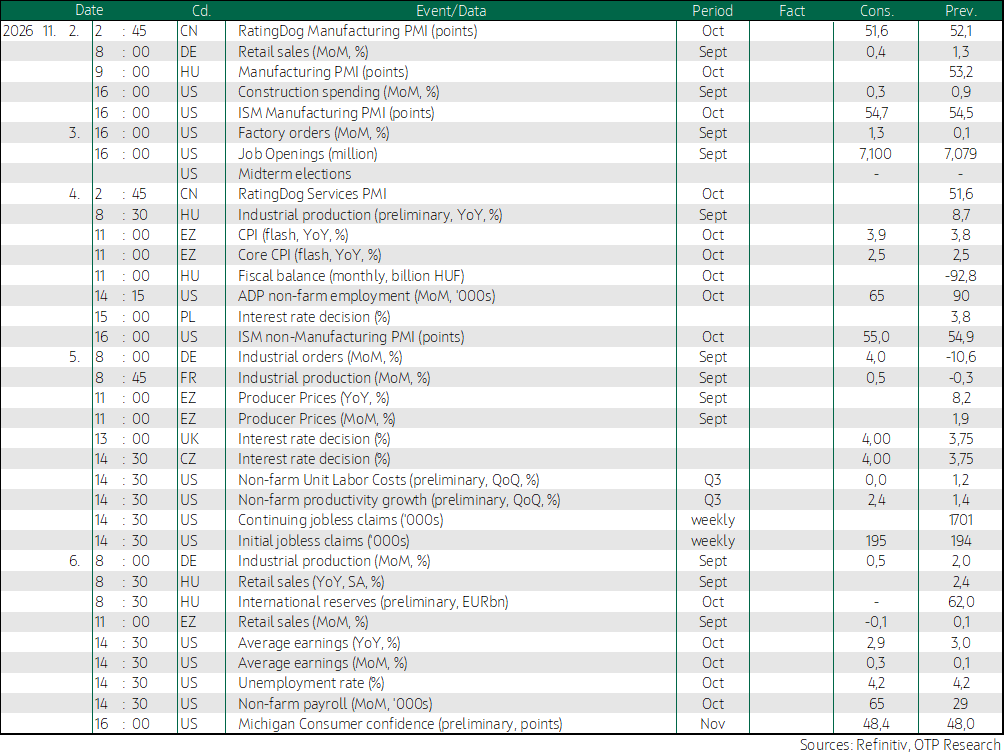
In addition, inflation data were released for the euro area's major economies, while the aggregate figure for the currency union is due only on Wednesday. The data suggested that CPI accelerated on a year-on-year basis in October in most countries, including France (October: 3.4%, September: 3.1%) and Italy (October: 5.4%, September: 4.2%). There were, however, exceptions, most notably Germany, where annual CPI eased to 2.8% in October from 3.3% in September. Even there, the moderation largely reflected the German government's decision to reduce fuel taxes from the beginning of October. For the euro area as a whole, it would be surprising if the October data due on Wednesday did not point to intensifying inflationary pressures.
Sharp correction in the US equity market
On Friday, all three major US equity indices moved lower, with the Dow Jones falling 1.1%, the S&P 500 declining 1.8%, and the Nasdaq dropping 2.9%. All three benchmarks also ended the week with losses of a similar magnitude. The sell-off was driven primarily by the technology sector. The key development was that Amazon and Intel, in their Q3 earnings reports released after Thursday's market close, announced ambitious investment plans that significantly exceed their cash flow generation capacity, despite reporting solid financial results. Investors viewed these plans as carrying elevated risk. The case of Intel was particularly striking. The company's shares plunged 28.6% on Friday following the earnings release, marking the stock's largest single-day decline since the 1970s, even though the report itself contained no especially dramatic developments. In fact, both Q3 revenue and profit exceeded not only last year's levels but also analysts' expectations. However, management projected Q4 revenue 9% below market forecasts and indicated that, while demand weakness in the personal computer market is likely to persist, demand for data centre products remains so strong that capacity is struggling to keep pace. Despite these positive elements, the share price fell sharply. It should be noted that Intel has historically been a highly volatile stock: Friday's closing price of USD 65.8 was less than half of its peak reached in June this year, yet still around 60% above its level at the beginning of the year. More broadly, the market has continued to decline despite strong Q3 earnings performance. Of the 299 S&P 500 companies that have reported results so far, 82% have exceeded expectations, yet the S&P 500 itself has already fallen 3% since the start of the earnings season.
No major macroeconomic data were released in the US on Friday.
Smaller moves in bond markets, but Hungarian long-term yields declined sharply
Bond market movements were more pronounced at the short end of the yield curve. The US 2-year Treasury yield declined by 8 basis points to 4.58% on Friday and was 10 basis points lower than a week earlier, while the German 2-year yield fell 3 basis points to 3.02%. Longer-dated developed market yields saw only limited moves: the US 10-year yield ended the week at 4.93% (down 6 basis points both from Thursday and from a week earlier), while the German 10-year yield closed at 3.32% (daily and weekly changes of -4 and -2 basis points, respectively). Italian, Spanish, and Portuguese 10-year yields declined by roughly 10 basis points over the course of the week, while the French 10-year yield fell 6 basis points, ending the week back below 5% at 4.97%. Across the CEE region, long-term yields moved by only a few basis points both on Friday and over the week as a whole. The main exception was Hungary, where the 10-year government bond yield declined by a more substantial 16 basis points over the week to 5.45%.
There were no significant moves in the foreign exchange market either. The most notable development over the past week was the Hungarian forint's 0.4% appreciation against the euro, while other major currency pairs saw only limited fluctuations.
Today's highlights
On Monday, no major macroeconomic releases are scheduled apart from a few economic sentiment indicators. However, the Q3 earnings season will continue, with Palantir and Apple, two companies closely watched in the context of the AI investment theme, set to report results, albeit only after the market close.
Asian markets painted a generally positive picture this morning. At 8:00 a.m. CET, the Nikkei was trading slightly lower, down 0.33%, while the Hang Seng was up 0.5%, the Shanghai Composite Index (SSE) had gained 1.0%, and South Korea’s KOSPI was higher by 2.2%.
Get more out of your investments!
Global Markets Services
OTP Global Markets offers a broad range of services in the field of local and international money and capital markets.
Read morePrivate Banking Services
Personal care and expertise with OTP Private Banking, along with the knowledge, security, and innovations of a multinational banking group.
Read more