
OTP Morning Brief: Neither the Fed, the ECB nor the BoJ changed their key policy rates
Related content
OTP Morning Brief: The Fed left its benchmark interest rate unchanged as market attention turns to the ECB’s decision
The wait-and-see sentiment ahead of the ECB’s rate decision led to limited movements across European equity markets, while individual stock performance was driven primarily by corporate earnings releases. Wall Street closed modestly higher after the Fed left its benchmark interest rate unchanged, in line with expectations. Strengthening supply risks continued to drive energy prices higher, with the TTF benchmark soaring to its highest level since the 2022 energy crisis. While yields rose across US and European bond markets, the decline in the Hungarian government bond market continued. Today's focus is on the ECB’s rate decision, as well as the US GDP release and the core PCE inflation gauge closely monitored by the Fed. In addition to macroeconomic data, the earnings season continues, with Amazon among the companies set to report its quarterly results.
OTP Morning Brief: Investor sentiment improved ahead of the Fed decision; strong corporate earnings supported markets
Strong corporate earnings and optimism surrounding the technology sector supported equity markets on both sides of the Atlantic. In Europe, the STOXX 600 rose 0.5%, while in the US the S&P 500 gained 0.6%, with the Nasdaq closing 1.2% higher. The BUX gained 1.9%, driven primarily by the strong performance of OTP. In bond markets, short-term US Treasury yields edged higher, while yields declined across Europe. The Hungarian forint traded steadily, while today’s focus will be on the Fed’s interest rate decision, along with earnings reports from Microsoft, Alphabet, Meta Platforms, UBS, Deutsche Börse and Mercedes-Benz.
European indices rose yesterday, supported by strong corporate earnings results. The ECB left its key policy rate unchanged, in line with expectations, after Christine Lagarde announced her departure from the helm of the central bank. Euro area economic sentiment declined in October, while Hungarian exports picked up in September. The major Wall Street indices declined yesterday. Disappointing earnings from Alphabet weighed on the technology and communication services sectors, setting the tone for their weak performance. US macroeconomic data released yesterday pointed to stronger-than-expected economic growth, while also signalling mounting inflationary pressures. Crude oil prices declined on Thursday following reports of renewed diplomatic efforts to restart US-Iran peace talks. The US 10-year Treasury yield fell by 6 basis points, dropping back below the 5% mark. The Hungarian forint strengthened by 0.4% yesterday. The Bank of Japan kept its key policy rate unchanged at 1.25%. Today, among other releases, the first estimates of Q3 GDP growth in Hungary and the euro area will be published.
The ECB left its key policy rate unchanged, in line with expectations, while Christine Lagarde may step down from the helm of the central bank ahead of schedule
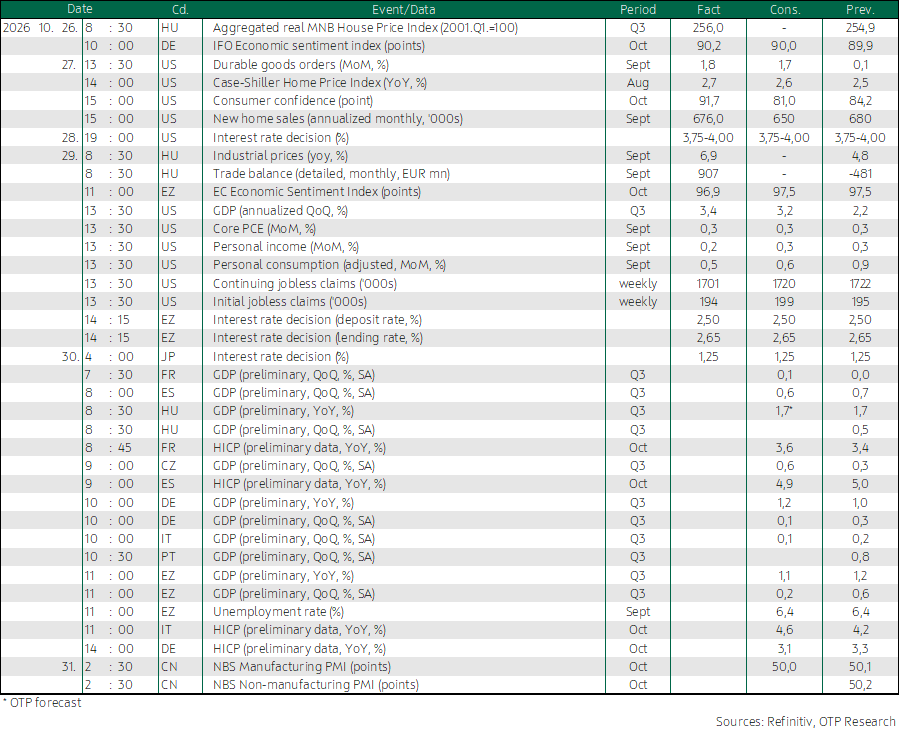
Major European equity indices closed higher yesterday, with the STOXX 600 gaining 0.8% as investor sentiment improved after a subdued first half of the trading session. Market participants focused on corporate earnings releases and the ECB’s policy decision. At its October meeting, the European Central Bank left its key interest rates unchanged, in line with market expectations, keeping the deposit rate at 2.5%. Policymakers nevertheless highlighted that elevated energy prices continue to pose upside risks to CPI while also weighing on economic growth, particularly if second-round effects from the energy shock intensify. According to the ECB’s assessment, underlying inflation dynamics have remained relatively stable so far, with little evidence that higher energy prices have triggered significant wage pressures. The ECB also refrained from providing explicit guidance on the future rate path, consistent with its previously communicated stance emphasizing heightened uncertainty and a data-dependent approach shaped by incoming economic indicators and geopolitical developments. During the press conference, Christine Lagarde confirmed that a rate hike had been discussed, although the Governing Council ultimately decided unanimously to leave rates unchanged. Shortly before the decision, reports emerged that Lagarde could step down from the helm of the ECB ahead of schedule. Such a leadership change would come at a sensitive time for the institution, as French government bond markets experience elevated volatility and high energy prices continue to increase CPI risks while posing a threat to economic growth.
Among corporate developments, Shell stood out by reporting nearly doubled earnings, sending its shares 2.1% higher. Adidas surged 5.8% after posting record profits and raising its full-year guidance. Renault gained nearly 7% after reaffirming its outlook for the year, while Volkswagen advanced 1.7% despite reporting a substantial quarterly operating loss. In the banking sector, BBVA fell 2.6% due to weaker domestic results, while Lloyds plunged 5% following a softer-than-expected earnings report. Overall, strong corporate results helped offset uncertainty surrounding the monetary policy outlook.
The euro area economic sentiment index declined to 96.9 in October from 97.5 in September, marking a second consecutive monthly deterioration and falling short of the market expectation of 97.5. Consumer confidence weakened to -17.9, its lowest level since May. Households became more pessimistic about both their past financial situation and future prospects. While CPI expectations eased slightly, they remained elevated. Business sentiment also deteriorated, with confidence indicators declining across the retail, construction and services sectors. In contrast, manufacturing sentiment showed a modest improvement. Overall, the data suggest that growth prospects in the euro area remain fragile and reinforce the view that geopolitical tensions and high energy prices continue to pose significant risks to the economic outlook.
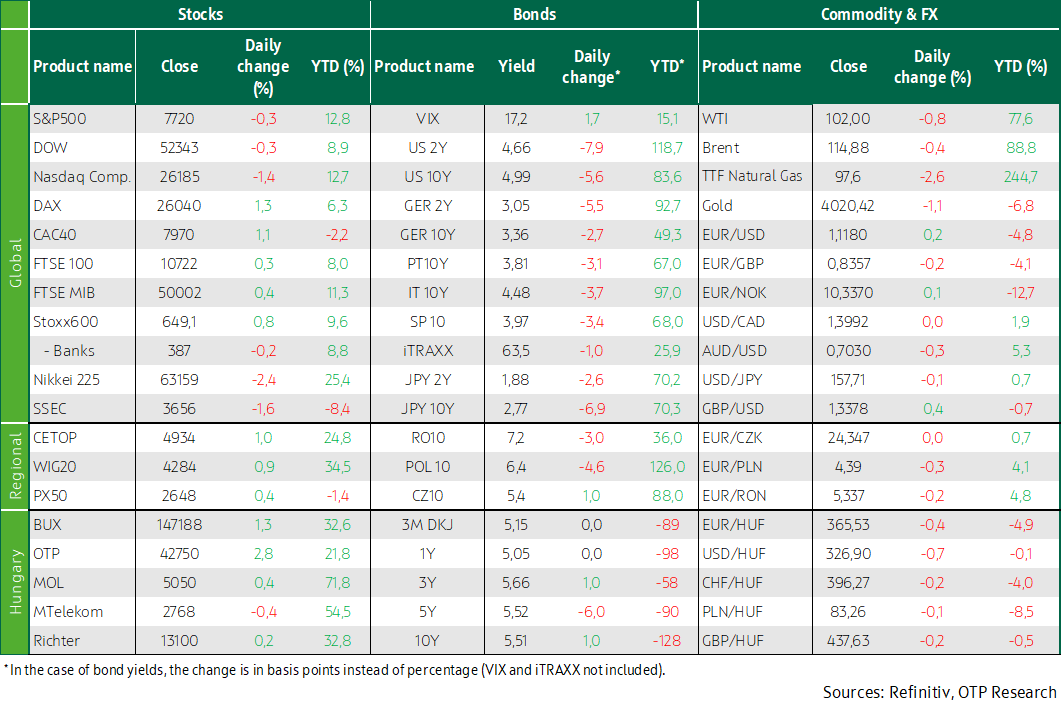
Regional equity markets moved higher yesterday, with the BUX outperforming after gaining 1.3%, supported in large part by a 2.8% rise in OTP shares. Among the domestic blue chips, only Magyar Telekom posted a modest decline. Hungary’s trade balance recorded a surplus of EUR 907 million in September, as the gap between export and import volume growth narrowed somewhat, driven primarily by stronger exports of machinery and transport equipment.
Disappointing earnings from Alphabet cast a shadow over Thursday’s trading, with the major Wall Street indices closing in negative territory
The major Wall Street indices closed Thursday’s session in negative territory. The Dow Jones and the S&P 500 both declined by 0.3%, while the technology-heavy Nasdaq fell 1.4%, as investors assessed the returns on artificial intelligence-related spending by major technology companies, corporate earnings releases and the latest inflation data. Weakness in the technology sector was driven by disappointing quarterly results from Alphabet, which also dragged down the communication services sector. Revenue at Google’s parent company fell short of expectations, while cash outflows related to AI investments accelerated, sending the stock down 12.6% in its steepest decline since the company’s 2004 market debut. The Philadelphia Semiconductor Index, which tracks semiconductor stocks, fell 1.4%, ending a four-day winning streak, while software companies also came under notable selling pressure. In contrast, the small-cap focused Russell 2000 advanced 1.0%.
Among corporate earnings releases, Caterpillar also stood out, with its shares falling 9.3%. Although the company beat profit expectations, it left its growth targets unchanged. In contrast, Eli Lilly gained 6.6%, Ford advanced 3.4%, and Merck rose 3.8%, supported by favourable results and outlooks. Shares of Marvell plunged 13.2% following media reports that the company is in advanced talks to acquire Lumentum, whose stock edged 0.6% higher. Amazon declined 4.3% by the closing bell and extended its losses by more than 7% in after-hours trading after issuing weaker-than-expected fourth-quarter revenue guidance and missing consensus estimates on both revenue and earnings per share. Intel exceeded expectations on both revenue and earnings per share, but its stock still fell 3.6% during regular trading and extended losses to around 20% after the close after the company issued a very weak fourth-quarter outlook.
Macroeconomic data released yesterday pointed to stronger-than-expected economic growth while also signalling mounting inflationary pressures. According to the first estimate, US GDP expanded at an annualised rate of 3.4% year-on-year in Q3, exceeding market expectations; the robust figure materially improves full-year growth forecasts, which had previously stood only slightly above 2%. Meanwhile, the Fed's preferred inflation gauge, core PCE, rose by 0.32% month-on-month in September, a pace that remains consistent with inflation running at nearly twice the central bank's 2% annual target.
Crude oil prices declined on Thursday as markets priced in a lower risk of supply disruptions in the Middle East following reports of renewed diplomatic efforts to restart US-Iran peace talks. Investor sentiment was further supported by reports that the US Vice President had established contact with the Iranian leadership, while Qatar reportedly put forward a new peace proposal.
Developed market government bond yields eased on Thursday
Alongside the release of a core PCE reading that came in line with expectations, the US 10-year Treasury yield fell by 6 basis points to 4.99%. Germany’s 10-year government bond yield also declined, easing by 2 basis points to 3.36%. Alphabet's earnings results, released after Wednesday’s market close, reignited concerns over the returns on AI-related investments, putting pressure on equities. The pattern was a familiar one: in the second half of last week, declining stock markets similarly boosted demand for safe-haven government bonds, providing support to fixed-income markets.
The Government Debt Management Agency (ÁKK) sold HUF 24 billion, HUF 86 billion and HUF 40 billion of the 2029/C, 2033/C and 2037/A bond series, respectively, amid strong investor demand. After the yield on the 10-year Hungarian government bond declined by a cumulative 19 basis points on Tuesday and Wednesday, it edged 1 basis point higher on Thursday to 5.51%. As a result, the benchmark 10-year yield has already retraced nearly half of the more than 30-basis-point increase seen in the wake of the recent fiscal policy announcements. The Hungarian forint strengthened by 0.4% yesterday, appreciating to 365.53 against the euro.
Today's highlights
Approaching the close, the Nikkei was down 2.4%, the KOSPI was falling 4.2%, the SSEC was trading 0.5% lower, while the Hang Seng was up 1.7%.
The Bank of Japan kept its key policy rate unchanged at 1.25%, in line with market expectations.
Today, the first estimates of Q3 GDP growth in Hungary and the euro area will be released, alongside GDP data from several other European countries.
Get more out of your investments!
Global Markets Services
OTP Global Markets offers a broad range of services in the field of local and international money and capital markets.
Read morePrivate Banking Services
Personal care and expertise with OTP Private Banking, along with the knowledge, security, and innovations of a multinational banking group.
Read more