
OTP Morning Brief: Oil and gas prices hit multi-year highs as equity markets slide
Related content
OTP Morning Brief: Earnings season continues to drive equities higher, while the French 10-year yield climbs above 5%
Stock markets moved higher yesterday in both Europe and the US, with technology stocks leading the gains on both sides of the Atlantic. Individual earnings reports released so far do not indicate that the AI investment boom is set to slow in the coming months. French financial indicators, however, are coming under increasing pressure from social and political uncertainty across both the corporate and public sectors: while French retail giant Carrefour issued a profit warning due to the unrest, French long-term bond yields soared to their highest level since 2002. The rise in yields also affected other countries, with the yield on 10-year Hungarian government bonds moving higher as well.
OTP Morning Brief: Better-than-expected earnings reports supported US equity indices
Major European indices closed slightly lower yesterday; Germany’s ZEW index declined more than expected; the UK unemployment rate developed favourably; and the MNB left its base rate unchanged, in line with expectations. Major indices closed mostly higher, supported by favourable earnings reports; several companies with significant AI exposure rebounded following the recent sell-off, while housing market data continued to point to weak activity in the US. Long-term US and European bond yields edged lower, while Hungarian long-term government bond yields rose more markedly following their decline in recent days. Today, UK CPI data will be in the spotlight.
By the end of last week, oil prices had climbed to their highest levels since spring, while European natural gas prices approached levels last seen in late 2022, driven by escalating tensions in the Middle East. Equity markets also turned lower by the end of the week: while the energy sector benefited from higher commodity prices and soared to record highs, all other sectors came under pressure. In the bond market, the US 10-year Treasury yield dipped back below 5%, while its German counterpart closed at a one-and-a-half-month low. French, Mediterranean, and CEE bond yields showed little movement on Friday, but over the course of the week they rose noticeably overall.
Oil closes near its spring highs, while gas ends at levels not seen since 2022
Both oil and natural gas prices surged at the end of last week amid escalating geopolitical tensions.
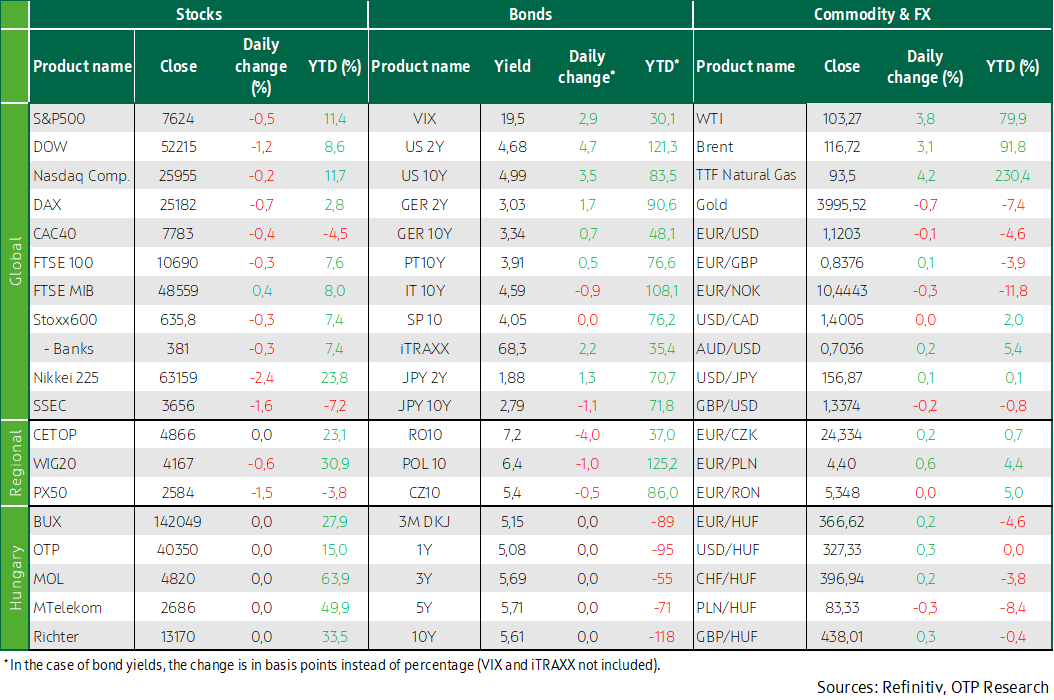
On Friday, WTI crude oil prices rose 3.8% to USD 103.3 per barrel, while Brent gained 3.1% to USD 116.7. On a weekly basis, WTI advanced 1.8% and Brent climbed 6.2%, with prices reaching levels last seen in May for WTI and April for Brent. The rally continued to be driven by escalating tensions in the Middle East. Yemen’s Houthi rebels launched further missile attacks on Saudi oil facilities and, although reports indicated that no major supply-disrupting strikes had been successful, the market increasingly priced in the risk that such an event could eventually occur. Sentiment was further affected by Saudi state-owned oil company Aramco's decision on Thursday to evacuate its headquarters in Dhahran on the Persian Gulf coast and instruct employees to work remotely. Meanwhile, the exchange of threats between Iran and the US also continued to intensify.
Gas prices also surged. On the Amsterdam exchange, the TTF spot price climbed 3.8% on Friday to EUR 93.8/MWh, bringing its weekly gain to 5.9%. Both the TTF spot price and the one-month futures contract have been rising for four consecutive weeks, reaching levels last seen in December 2022. In addition to heightened tensions in the Middle East, gas prices are being driven by expectations that Qatari LNG shipments could be completely absent from the European market this winter. Another key factor is that Europe is entering the heating season with historically low gas storage levels. According to data as of October 22, storage facilities were 75% full, compared with an average of 86% over the previous five years. By the end of the heating season, storage levels typically fall to around 30%, although in March this year the low point was closer to 25%. As a result, the current shortfall of roughly 10 percentage points in storage levels represents a significant difference for the market.
Negative sentiment weighed on European equity markets on both Thursday and Friday
The STOXX 600 fell 0.3% on Friday after declining 1.0% on Thursday. The oil and gas subsector soared to a record high, but apart from energy and chemicals, all other sectors ended Friday in negative territory. On a weekly basis, the STOXX 600 dropped 1.4%, with banks (-3.0%) and companies exposed to basic materials (-5.8%) and industrial goods (-4.2%) posting the weakest performance. The healthcare sector, however, recorded a strong gain (+4.6%). Over the past month, European bank stocks have underperformed all other sectors, falling by more than 10%. This may partly reflect the growing unrealised losses banks are facing on their government bond portfolios as bond yields continue to rise. Even so, bank shares are still trading around 25% higher than a year ago.
The negative sentiment that prevailed at the end of last week also weighed on Central and Eastern European markets. Warsaw fell 0.6% and Prague 1.5% on Friday, with both exchanges also ending Thursday and the week as a whole in negative territory. Budapest was closed on Friday due to the national holiday, but the BUX had already slipped 0.9% the previous day. Both OTP and MOL posted significant losses, dropping 2.9% and 1.8%, respectively. Richter, however, enjoyed a strong session, with its share price rising 4%, likely supported by the company's share buyback programme as well as the broader strength of the European healthcare sector.
On the macroeconomic front, S&P released its October Purchasing Managers’ Index (PMI) readings for the major European economies, including the euro area, across key sectors on Friday. With the exception of the German manufacturing sub-index, every sector across all surveyed economies deteriorated both compared to the previous month (September) and relative to the preliminary consensus forecast. The sharpest decline was recorded in France, where the composite index fell from 51.1 to 48.4, a level last seen in March. At the same time, current PMI readings, including the French indicators, do not differ significantly from their average levels over the past two years. As such, the latest declines on their own do not yet point to anything particularly alarming.
Equity markets also declined in the US
On Friday, all three major US equity indices moved lower: the Dow Jones declined 1.2%, the S&P 500 fell 0.5%, and the Nasdaq slipped 0.2%. Markets had already closed in negative territory on Thursday, although the weekly picture was more mixed overall. The Dow gained 0.5% over the week, while the S&P 500 and Nasdaq edged down 0.5% and 1.8%, respectively. The US energy sector performed strongly, rising 2.5% on Friday and, much like its European counterparts, closed at a record high. Despite the broadly negative market sentiment at the end of last week, the ongoing Q3 earnings season has so far painted a relatively encouraging picture. Although fewer than one-third of the companies have reported results to date, a majority have exceeded analysts’ expectations, while average profits have risen by 32% compared to a year earlier.
S&P also released its Purchasing Managers’ Index (PMI) readings for the US on Friday. The figures pointed to some deterioration in business sentiment, although the decline was modest and far less pronounced than the weakness observed in the European PMIs.
Bond yields declined over the week despite a modest rise on Friday
US Treasury yields rose modestly on Friday, with the 2-year yield increasing by 4 basis points to 4.68% and the 10-year yield also climbing 4 basis points to 4.99%. However, the latter had fallen by 20 basis points on Thursday, slipping below the 5.00% mark for the first time in a month. German government bond prices changed only marginally on Friday, but the 10-year Bund still closed at a one-and-a-half-month low yield of 3.34%. The picture was less favourable in the Mediterranean region: Spanish, Portuguese and Italian yields showed little movement on Friday, yet ended the week 5-10 basis points above their levels from a week earlier. Meanwhile, the French 10-year yield remained stuck above 5% at 5.03%, a level not seen since 2002. Long-term CEE bond yields followed a similar trajectory. While Friday brought only limited moves, the Czech 10-year yield rose 9 basis points over the week to 5.36%, and the Polish equivalent increased 10 basis points to 6.43%. Hungary’s 10-year government bond yield had climbed 30 basis points to 5.61% by Thursday compared with the previous week’s close, with no trading taking place on October 23 due to the national holiday.
In the foreign exchange market, the most notable development was the Hungarian forint's weakening against the euro last week, losing 0.9% overall and a further 0.2% on Friday. The forint was not alone in this trend across the region: the Polish zloty also depreciated, falling 0.7% from Friday to Friday, while the Romanian leu weakened by 0.5% against the euro over the same period. By contrast, the Czech koruna remained broadly stable against the common currency.
Today's highlights
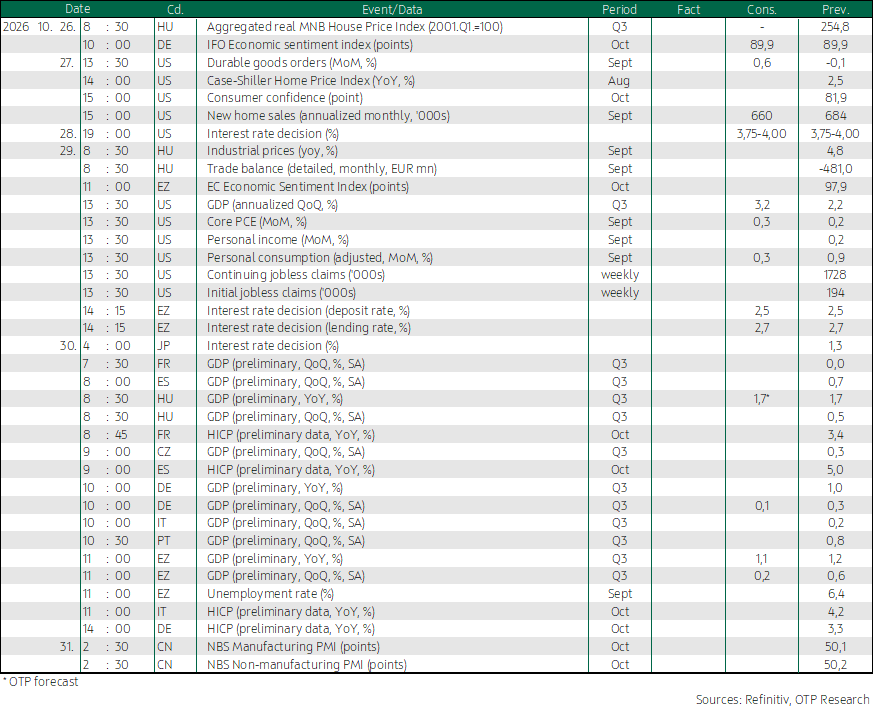
The Ifo Business Climate Index, which measures business sentiment among German companies, will be released on Monday morning. It will be particularly interesting to see whether it points to a similar deterioration in confidence as indicated by last week's S&P Purchasing Managers’ Index readings.
Asian markets painted a mixed picture this morning. As of 7:30 a.m. Budapest time, Hong Kong’s Hang Seng was up 0.5%, while Shanghai’s SSE Composite was trading broadly flat. In contrast, Japan’s Nikkei was down 0.7% and South Korea’s KOSPI had fallen 1.4%. Oil prices, meanwhile, have started to ease somewhat.
Get more out of your investments!
Global Markets Services
OTP Global Markets offers a broad range of services in the field of local and international money and capital markets.
Read morePrivate Banking Services
Personal care and expertise with OTP Private Banking, along with the knowledge, security, and innovations of a multinational banking group.
Read more