
OTP Morning Brief: Better-than-expected earnings reports supported US equity indices
Related content
OTP Morning Brief: Major indices started the week lower in Europe, while US equities advanced
Following last week's weak performance, the US equity market started the week on a stronger footing, while in France and across the broader euro area investor sentiment was weighed down by domestic political uncertainty. At the same time, market participants were positioning ahead of this week's earnings releases from Meta, Tesla and SpaceX. Bond yields edged higher across developed market sovereign debt markets. In Hungary, Péter Magyar outlined key details of the 2027 budget proposal. Most Asian equity markets traded in negative territory during the morning session.
OTP Morning Brief: Further declines in the US technology sector on Friday
Selling pressure on the technology sector remained elevated across developed equity markets on Friday. However, favorable corporate earnings offset the weakness in the IT sector in Europe. European equity markets also posted weekly gains, marking their strongest weekly performance since June. In the US, the decline in equity indices continued, with concerns surrounding AI-related companies further amplified by the CoreWeave episode. The sell-off in equity markets prompted investors to shift toward safer assets, while long-term bond yields continued to decline. The US 10-year Treasury yield declined by 15 bps over the past week, closing Friday’s session at 5.1%, supported in part by easing expectations of further rate hikes. Based on futures pricing, the Fed is expected to leave interest rates unchanged at next week’s meeting. Eurozone bond yields also moved lower, tracking developments in overseas fixed-income markets. The euro strengthened to 1.124 against the dollar. Long-term yields also declined sharply in the Hungarian government bond market over the past week, with the 10-year yield falling by 29 bps to a three-month low of 5.31%. Oil prices continued to rise amid the unresolved situation in the Middle East. European natural gas futures soared to an early four-year high over the past week. This week, in the Hungarian market, attention will focus on the 2027 budget to be released today and the MNB’s interest rate decision meeting on Tuesday.
Major European indices closed slightly lower yesterday; Germany’s ZEW index declined more than expected; the UK unemployment rate developed favourably; and the MNB left its base rate unchanged, in line with expectations. Major indices closed mostly higher, supported by favourable earnings reports; several companies with significant AI exposure rebounded following the recent sell-off, while housing market data continued to point to weak activity in the US. Long-term US and European bond yields edged lower, while Hungarian long-term government bond yields rose more markedly following their decline in recent days. Today, UK CPI data will be in the spotlight.
Major European indices closed slightly lower yesterday; Germany’s ZEW index fell by more than expected; the UK unemployment rate came in favourably; and the MNB left its base rate unchanged, in line with expectations
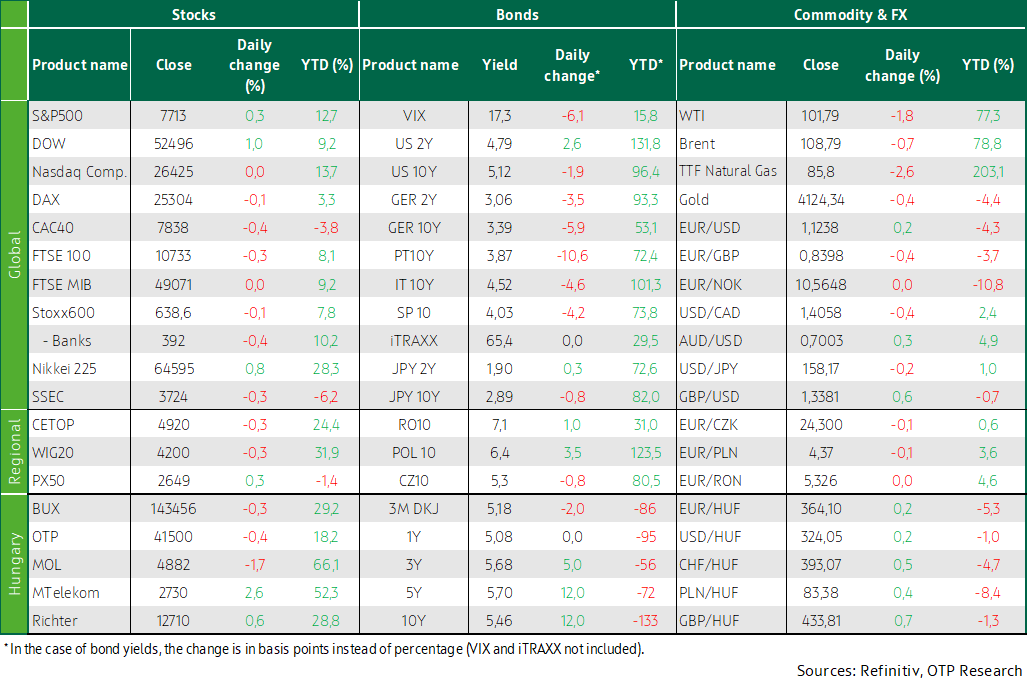
European equity markets recouped part of their intraday losses by the close yesterday, although major indices still ended the session modestly lower, with the STOXX 600 ultimately declining by 0.1%. The market was weighed down primarily by technology and industrial stocks. ASML shares fell 2.2% after the disappointing South Korean IPO of AI infrastructure developer Elice reinforced concerns that investors are becoming increasingly cautious about the substantial funding requirements of artificial intelligence-related companies. European firms linked to data centre investments also came under pressure, with Siemens, Schneider Electric and Siemens Energy all posting declines. The negative performance was partly offset by strength in the pharmaceutical sector. Sanofi gained 3.6%, while Belgian biotechnology company Argenx surged 6.3%, making it one of the best-performing European stocks of the day. Overall, trading continued to be driven by uncertainty surrounding AI-sector valuations and financing needs, weighing primarily on technology and industrial shares, while the defensive healthcare sector outperformed.
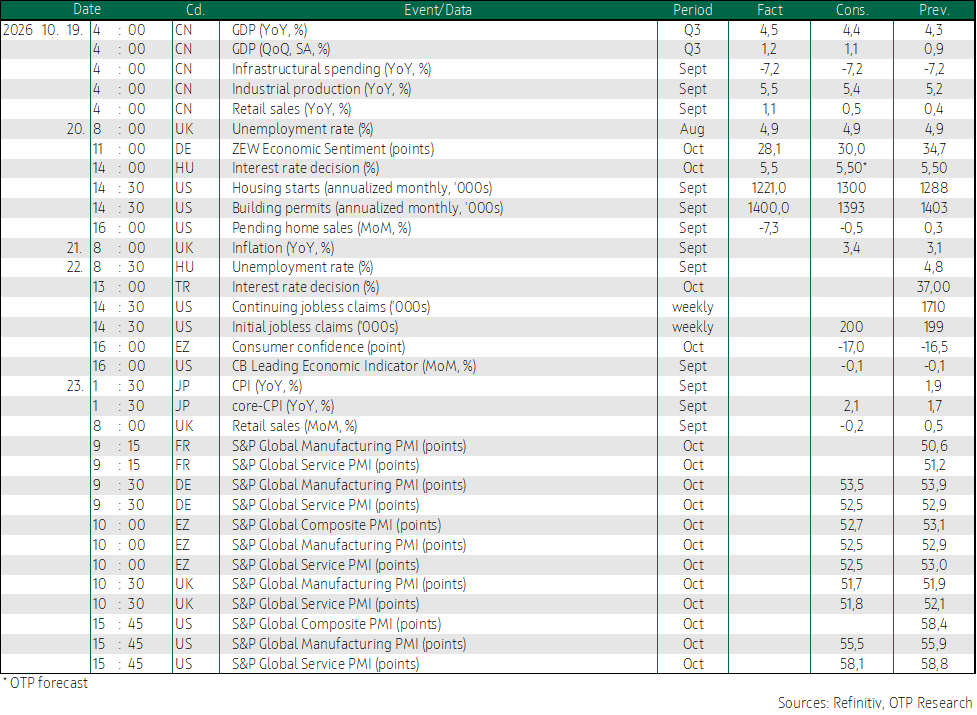
Germany’s ZEW Economic Sentiment Index fell to 28.1 points in October from 34.7 in September, coming in below the market expectation of 30.0. The decline suggests that analysts have once again become more cautious about Germany’s economic outlook, despite the improvement seen in recent months. The deterioration likely reflects the fact that the German recovery remains fragile, while elevated energy prices continue to erode purchasing power, increase corporate production costs and maintain inflationary pressure. One encouraging aspect of the survey was the improvement in the index measuring perceptions of current economic conditions, which reached its highest level since May 2023.
The UK unemployment rate fell to 4.7% in the three months to August from 4.9% in the previous period, while the market had expected the figure to remain unchanged at 4.9%. As a result, the indicator declined to its lowest level since July 2025. The improvement was driven primarily by a decrease in the number of short-term jobseekers. On an annual basis, the number of unemployed people fell by 26,000, while employment continued to increase, with the employment rate rising by 0.2 percentage points both quarter-on-quarter and year-on-year to 75.3%. Overall, the data suggest that the UK labour market remains resilient.
Major CEE equity indices delivered mixed performance, with the Prague Stock Exchange posting gains while the Warsaw and Hungarian markets moved lower. The Hungarian benchmark was weighed down by declines in OTP and MOL, while the other two blue-chip constituents advanced. At its October meeting, the Monetary Council of the National Bank of Hungary left the base rate unchanged at 5.5%, in line with expectations, meaning the MNB has eased monetary conditions four times so far this year. CPI remains subdued, with annual inflation rising to 1.6% in September from 1.3% in August, although the increase was smaller than expected by the market. Policymakers noted that ongoing geopolitical tensions continue to pose upside risks to energy prices and, consequently, to inflation dynamics, justifying a cautious monetary policy stance. Following Monday’s announcements, additional details emerged regarding Hungary’s fiscal trajectory. According to the government’s plans, after reaching a deficit of 4.9% in 2027, the budget shortfall is expected to decline to 4.0% and then 3.4%, before falling below the Maastricht threshold of 3% in 2030, when it is projected to reach 2.8%.
Major indices closed mostly higher, supported by favourable earnings reports; several companies with significant AI exposure rebounded following the recent sell-off, while US housing market data continued to point to weak activity
Major US indices closed mostly higher yesterday, with the Dow and the S&P 500 advancing while the Nasdaq ended the session little changed. Sentiment was supported by a series of better-than-expected corporate earnings reports, while lower oil prices also provided a tailwind for equities. Cyclical stocks led the gains, with 3M shares soaring more than 5.8% after the company reported quarterly results that exceeded expectations and raised its full-year guidance. Northrop Grumman also delivered a strong performance, rising 4.6% following better-than-expected earnings. Investor sentiment further improved as oil prices retreated from their earlier highs during the session. Performance within the technology sector remained mixed, as investors continued to worry about the sustainability of AI-related investment spending, rising leverage levels and the outlook for future demand. Nevertheless, several AI-exposed companies recovered by the end of the day, with Western Digital gaining more than 3%, CoreWeave advancing 1.7% and Marvell Technology adding 1.4%. Market participants are looking to the upcoming wave of technology earnings reports for greater clarity on the returns generated by large-scale data centre investments and AI-related expenditure, as well as the likely trajectory of capital spending plans in 2027. After the closing bell, SpaceX shares moved sharply higher after the company reported revenue and profit well above analyst expectations. Earnings continued to be driven primarily by the Starlink division; however, revenue from the AI business rose ninefold from last year’s low base, and management expects further rapid expansion in the segment. During the earnings conference call, Elon Musk indicated that the possibility of a merger between SpaceX and Tesla is being explored.
In the US, housing starts fell by 5.2% month-on-month in September, with the seasonally adjusted annualised rate declining to 1.221 million units from an upwardly revised 1.288 million in August. The figure came in below the market expectation of 1.30 million and marked the third consecutive monthly decline. Residential construction activity continues to be weighed down by elevated mortgage rates and subdued demand. As a result, homebuilders have become more cautious and are scaling back the supply of new homes.
Building permits issued in the US declined by 0.2% month-on-month in September, bringing the seasonally adjusted annualised rate down to 1.400 million units. Although the figure showed a slight decline compared to the previous month, it came in marginally above the market expectation of 1.390 million. The detailed data painted a mixed picture: the single-family housing segment continues to feel the adverse effects of the elevated interest rate environment, while multifamily development has shown greater resilience. In the latter segment, permits rose by 5.9% to 503,000 units.
Long-term US and European bond yields edged lower, while Hungarian long-term government bond yields rose more markedly after declining in recent days
US Treasury yields moved lower at the long end yesterday as investors focused on weaker-than-expected housing starts data and the outlook for next week’s Fed policy meeting. The 10-year Treasury yield fell by 2 basis points to 5.12%, while the policy-sensitive 2-year yield rose by nearly 3 basis points to 4.79%. Investors remained focused on next week’s Fed meeting. Based on market pricing, participants assigned an 83% probability to the Fed keeping its policy rate unchanged, compared with 42.4% a month earlier. In addition, the Fed’s preferred PCE inflation gauge is due for release next week and could provide important guidance on the future path of monetary policy. Inflation concerns were also eased somewhat by the correction in oil prices. WTI crude fell 1.8% to below USD 102 per barrel, while Brent crude declined 0.7% to below USD 109 per barrel. Although the conflict in the Middle East continues to pose upside risks to energy prices and inflation, yesterday’s decline in oil prices contributed to lower long-term bond yields.
Long-term bond yields also moved lower across European markets, with German Bund yields declining by 6 basis points and French government bond yields ending the day 4 basis points lower. In Hungary, however, yields beyond the one-year segment rose by 5-12 basis points during yesterday’s session. Following the decline seen in recent days, the 10-year Hungarian government bond yield climbed 12 basis points to close at 5.46%. The forint weakened by 0.2% against both the euro and the US dollar yesterday.
Today's highlights
Mixed sentiment prevailed across Asian markets this morning. Japanese equities advanced, led primarily by AI-related technology stocks after server manufacturer Super Micro Computer reported better-than-expected results. Investor sentiment was further supported by SpaceX’s strong earnings report. On the macroeconomic front, however, Japanese exports rose by 16.7% year-on-year in September, falling short of the market expectation of 20.1% and marking the slowest pace of growth since April. Nevertheless, exports have now expanded for 13 consecutive months, continuing to benefit from strong external demand for semiconductors and AI-related products.
UK CPI data will be in the spotlight today.
Get more out of your investments!
Global Markets Services
OTP Global Markets offers a broad range of services in the field of local and international money and capital markets.
Read morePrivate Banking Services
Personal care and expertise with OTP Private Banking, along with the knowledge, security, and innovations of a multinational banking group.
Read more