
OTP Morning Brief: Major indices started the week lower in Europe, while US equities advanced
Related content
OTP Morning Brief: Further declines in the US technology sector on Friday
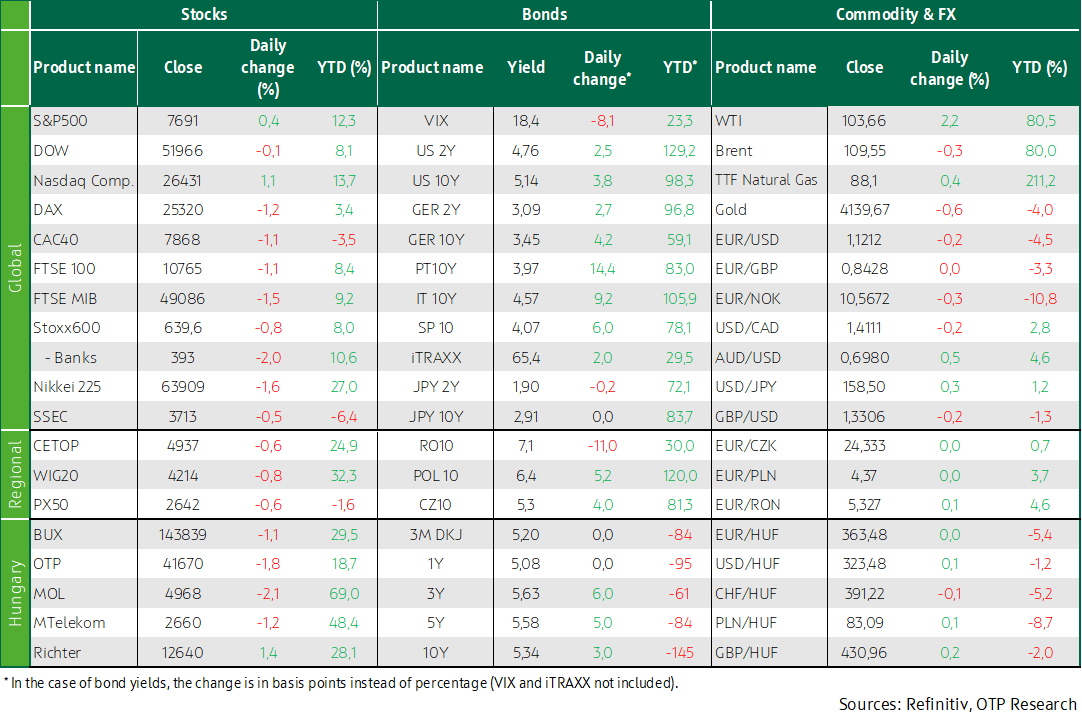
Selling pressure on the technology sector remained elevated across developed equity markets on Friday. However, favorable corporate earnings offset the weakness in the IT sector in Europe. European equity markets also posted weekly gains, marking their strongest weekly performance since June. In the US, the decline in equity indices continued, with concerns surrounding AI-related companies further amplified by the CoreWeave episode. The sell-off in equity markets prompted investors to shift toward safer assets, while long-term bond yields continued to decline. The US 10-year Treasury yield declined by 15 bps over the past week, closing Friday’s session at 5.1%, supported in part by easing expectations of further rate hikes. Based on futures pricing, the Fed is expected to leave interest rates unchanged at next week’s meeting. Eurozone bond yields also moved lower, tracking developments in overseas fixed-income markets. The euro strengthened to 1.124 against the dollar. Long-term yields also declined sharply in the Hungarian government bond market over the past week, with the 10-year yield falling by 29 bps to a three-month low of 5.31%. Oil prices continued to rise amid the unresolved situation in the Middle East. European natural gas futures soared to an early four-year high over the past week. This week, in the Hungarian market, attention will focus on the 2027 budget to be released today and the MNB’s interest rate decision meeting on Tuesday.
OTP Morning Brief: US producer price index came in above expectations, yet the US 10-year Treasury yield still declined
Western European equities continued to advance despite ongoing pressure on the technology sector. Wall Street indices also rebounded, recovering some ground after Wednesday’s sell-off. Healthcare was the standout performer on both sides of the Atlantic. Eurozone industrial production declined by 0.5% month-on-month in August. In the US, the producer price index accelerated to 6.3%, delivering another upside surprise in inflation developments. US retail sales increased by 0.8% compared to August. The US 10-year Treasury yield declined by more than 10 basis points. The long end of the Hungarian government bond yield curve also declined by 7-9 basis points. In Hungary, August wage data will be released today, while in the US, September industrial production figures are due.
Following last week's weak performance, the US equity market started the week on a stronger footing, while in France and across the broader euro area investor sentiment was weighed down by domestic political uncertainty. At the same time, market participants were positioning ahead of this week's earnings releases from Meta, Tesla and SpaceX. Bond yields edged higher across developed market sovereign debt markets. In Hungary, Péter Magyar outlined key details of the 2027 budget proposal. Most Asian equity markets traded in negative territory during the morning session.
Major European indices started the week on a weak note, Péter Magyar projected a 4.9% budget deficit for next year
Major European indices started the week deep in the red. The CAC 40 and the FTSE 100 both declined 1.1%, while the DAX fell 1.2% on Monday, leaving the Stoxx 600 down 0.8% by the close. French equities, and indirectly the broader euro area, were weighed down by the further escalation of weekend protests, which cast additional doubt on the outlook for a country already grappling with weak growth and a high debt burden. Shares of French banks, including BNP Paribas, Société Générale and Crédit Agricole, fell between 2.5% and 3.4%. Retailer Carrefour lost 2.2%, while shopping mall operator Unibail-Rodamco-Westfield declined 2.0%. Cyclical sectors led the downturn across European equity markets, with banking stocks posting the weakest performance. The European banking sector index dropped 2.2%, pressured in part by a 3.5% decline in Barclays. Defence stocks also came under pressure, retreating by an average of 1.5%. In contrast, the technology sector outperformed, ending the session in positive territory with a 0.7% gain.
The negative sentiment spilled over into the CEE region as well, with the PX 50 declining 0.6%, the WIG 20 falling 0.8%, and the BUX closing 1.1% lower. Apart from Richter, which gained 1.4%, Hungarian blue chips posted notable losses, with MOL dropping 2.1% and OTP retreating 1.8%. Yesterday, Péter Magyar presented the main pillars of next year's budget proposal before Parliament and stated that his government had set a budget deficit target of 4.9% for 2027.
The S&P started the week higher following a sharply negative week, while Brent crude traded near USD 110 per barrel
In contrast to Europe, major US equity indices started the week higher, driven primarily by a rebound in technology stocks following last week's sharp sell-off and ahead of a crucial week in the AI-related earnings season. Improved investor sentiment lifted the Nasdaq by 1.1% and the S&P 500 by 0.4%, while the Dow edged slightly lower. Later this week, earnings reports from companies such as Meta, SpaceX and Tesla could provide further direction for the market.
Brent crude rose above USD 109 per barrel on Monday, reaching its highest level in more than a month after surging nearly 5% during the previous week. The rally was driven primarily by renewed geopolitical tensions in the Middle East, which intensified market concerns over potential supply disruptions. A senior Iranian security official stated on Sunday that Tehran had prepared a new retaliatory plan in the event of another attack by the US and Israel. Meanwhile, Saudi Arabia intercepted several missiles over the Red Sea on Friday, including one reportedly headed toward the Yanbu oil export terminal, following multiple attacks on Saudi targets by Yemen's Houthi rebels last week.
US Treasury yields edged higher, while French bond yields recorded a more pronounced increase
US Treasury yields edged higher on Monday after the 10-year yield recorded its steepest weekly decline in seven months the previous week. Market sentiment was supported by easing concerns over the impact of a higher-rate environment on AI-related equities. Recent comments from Federal Reserve policymakers, including Chair Kevin Warsh, have reinforced expectations that the central bank is in no rush to deliver additional rate hikes. Speaking on Friday, Warsh expressed confidence in the strength of the US economy but stopped short of providing clear guidance on whether further tightening would be necessary or when it could occur. Long-term bond yields also moved higher in Europe. The French 10-year government bond yield rose by 13 basis points to 4.9%, while the German 10-year Bund yield, widely regarded as the euro area's benchmark rate, also increased. Amid heightened political and market uncertainty in France, the euro weakened against the dollar.
At the short end of the curve, Hungarian government bond yields showed little meaningful movement, while yields on longer-dated bonds rose by 3-6 basis points. The forint was largely unmoved by the key budget-related announcements, trading around the 363 level against the euro throughout the session.
Today's highlights
Asian equity markets broadly traded lower on Tuesday morning as investors awaited the latest earnings releases. Japan's Nikkei was down 1.6%, Hong Kong's Hang Seng fell 1.3%, while China's Shanghai Composite declined 0.5% in early trading.
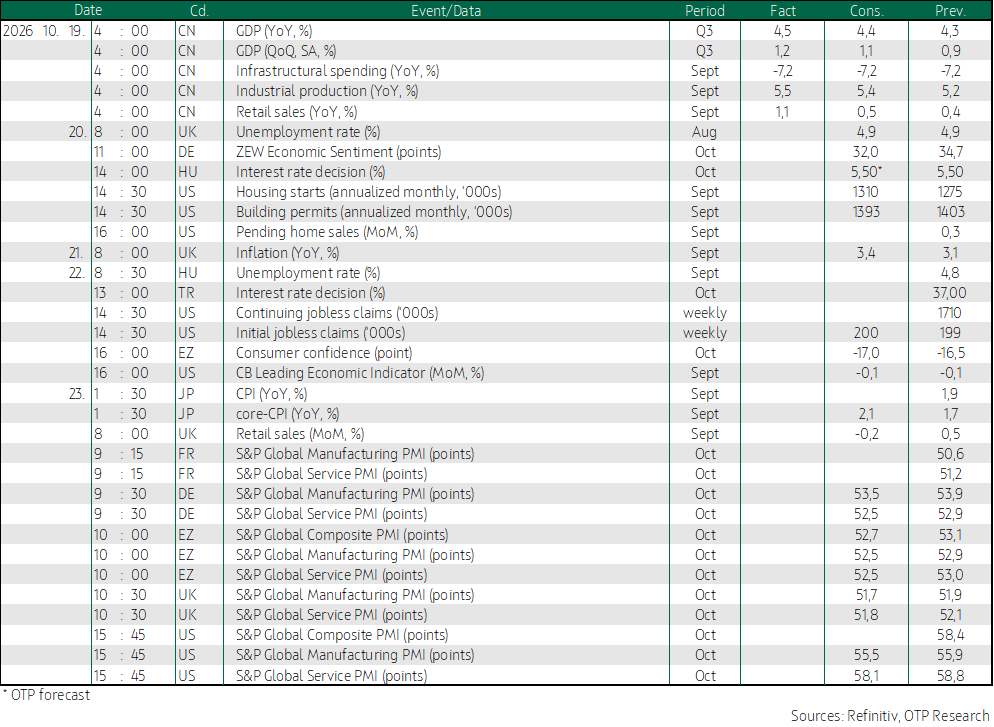
Today's main focus domestically will be the MNB's policy meeting, where the central bank is widely expected to leave the benchmark interest rate unchanged. Elsewhere, Germany's ZEW Economic Sentiment Index is due for release, while US housing market data will also be in focus later in the day.
Get more out of your investments!
Global Markets Services
OTP Global Markets offers a broad range of services in the field of local and international money and capital markets.
Read morePrivate Banking Services
Personal care and expertise with OTP Private Banking, along with the knowledge, security, and innovations of a multinational banking group.
Read more