
OTP Morning Brief: Further declines in the US technology sector on Friday
Related content
OTP Morning Brief: US producer price index came in above expectations, yet the US 10-year Treasury yield still declined
Western European equities continued to advance despite ongoing pressure on the technology sector. Wall Street indices also rebounded, recovering some ground after Wednesday’s sell-off. Healthcare was the standout performer on both sides of the Atlantic. Eurozone industrial production declined by 0.5% month-on-month in August. In the US, the producer price index accelerated to 6.3%, delivering another upside surprise in inflation developments. US retail sales increased by 0.8% compared to August. The US 10-year Treasury yield declined by more than 10 basis points. The long end of the Hungarian government bond yield curve also declined by 7-9 basis points. In Hungary, August wage data will be released today, while in the US, September industrial production figures are due.
OTP Morning Brief: US CPI data came in above expectations
European equity markets advanced, supported by strong results from ASML and the outstanding performance of the healthcare sector. US equity markets came under pressure following higher-than-expected September CPI data. The annual CPI rate accelerated to 3.7%, driven primarily by a surge in gasoline prices, while core CPI rose by 0.3% month-on-month, supported by higher housing costs and rising transportation service prices. Oil prices rose amid escalating tensions in the Middle East and the impact of the IEA's oil market report. US Treasury yields retreated after an initial increase, driven by Fed commentary, while European bond yields generally moved higher. The US macro calendar will be busy today, with investors focusing on September retail sales and producer price index data, as well as the New York Fed Manufacturing Index, weekly jobless claims, and business inventories. August industrial production data from the euro area will be released today.
Selling pressure on the technology sector remained elevated across developed equity markets on Friday. However, favorable corporate earnings offset the weakness in the IT sector in Europe. European equity markets also posted weekly gains, marking their strongest weekly performance since June. In the US, the decline in equity indices continued, with concerns surrounding AI-related companies further amplified by the CoreWeave episode. The sell-off in equity markets prompted investors to shift toward safer assets, while long-term bond yields continued to decline. The US 10-year Treasury yield declined by 15 bps over the past week, closing Friday’s session at 5.1%, supported in part by easing expectations of further rate hikes. Based on futures pricing, the Fed is expected to leave interest rates unchanged at next week’s meeting. Eurozone bond yields also moved lower, tracking developments in overseas fixed-income markets. The euro strengthened to 1.124 against the dollar. Long-term yields also declined sharply in the Hungarian government bond market over the past week, with the 10-year yield falling by 29 bps to a three-month low of 5.31%. Oil prices continued to rise amid the unresolved situation in the Middle East. European natural gas futures soared to an early four-year high over the past week. This week, in the Hungarian market, attention will focus on the 2027 budget to be released today and the MNB’s interest rate decision meeting on Tuesday.
European indices extended their gains on Friday, supported by favorable corporate earnings reports
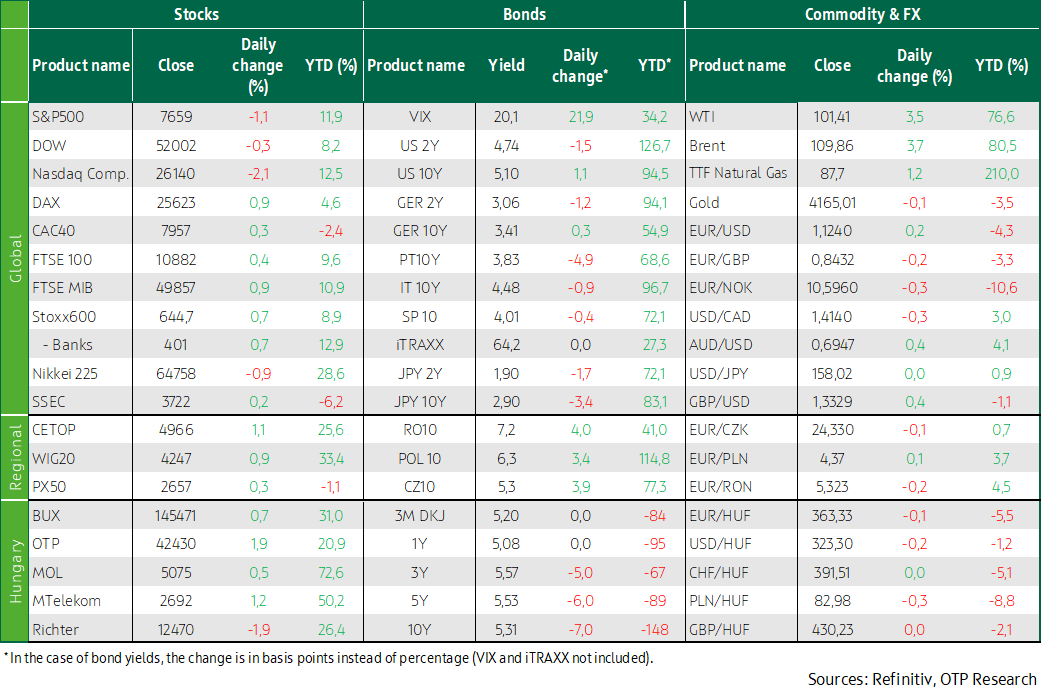
European indices extended their gains on Friday despite continued weakness in the technology sector across developed markets. The Stoxx 600 closed 0.6% higher, while the DAX gained 1.0%, the FTSE 100 rose 0.4%, and the CAC 40 added 0.3% by the end of the session. Momentum was supported by the latest earnings releases, with Aixtron rallying 6% after reporting order growth for a third consecutive quarter that exceeded expectations. Ericsson surged 11% after publishing quarterly results that significantly outperformed market forecasts, while Nordex shares soared more than 12% after the onshore wind turbine manufacturer reported stronger-than-expected Q3 earnings and raised its full-year margin guidance. Overall, earnings among Stoxx 600 constituents are expected to have risen by around 20% in the third quarter. Excluding healthcare, all Stoxx 600 sector indices ended the day in positive territory. Automobiles, retail, food and beverages, telecommunications, financials, utilities, and the oil and gas sector all advanced by more than 1%, while media and travel & leisure recorded the weakest performance among the gainers. Nestlé rose 1.7% after JPMorgan upgraded the Swiss food giant to overweight. Schneider Electric, meanwhile, reversed earlier gains and fell 1.8%, despite raising its 2026 revenue and earnings outlook for its core business for the second time.
Looking at weekly performance, Western European markets posted strong gains not seen since the summer. The Stoxx 600 and the DAX both advanced 2.1%, while the CAC 40 rose 2.0% and the FTSE 100 delivered a 3.0% gain. Over the course of the week, the best-performing sectors were food and beverages, consumer goods, retail, media, and healthcare, with gains ranging from 5% to 8%. Technology (-3%) and basic materials (-2%) recorded the weakest weekly performance.
According to the final September inflation data released on Friday, CPI in the Eurozone was in line with the preliminary estimate, accelerating to 0.6% month-on-month and 3.8% year-on-year, while core CPI rose to 2.5% on an annual basis.
Sentiment was also positive across CEE equity markets on Friday, with the WIG20 closing 0.9% higher, the BUX gaining 0.7%, and the PX edging up by 0.3%. For the week as a whole, the Czech and Hungarian benchmarks led the region with gains of around 3%. Among Hungarian blue chips, OTP stood out on Friday with a gain of nearly 2%, while Magyar Telekom closed 1.2% higher and MOL advanced 0.5%. On a weekly basis, both OTP and Magyar Telekom delivered rallies of more than 5%.
Technology stocks continued to decline on Friday, with the CoreWeave episode highlighting the key concerns weighing on investor sentiment toward AI-related investments
The sell-off weighing on the technology sector continued on Friday, dragging the Nasdaq Composite down 2.1%, while the S&P 500 fell 1.1% and the Dow Jones declined 0.3%. The Nasdaq dropped to its lowest level in more than a month, while the S&P 500 reached a two-week low. As a result, substantial weekly losses accumulated in both indices, with the Nasdaq down 4.5% and the S&P 500 posting a decline of nearly 2%. In contrast, the Dow gained 0.7% over the course of the week, as investors rotated into more traditional sectors amid the intense wave of selling across technology stocks.
Markets were driven over the past week by concerns over further rate hikes and the debt-fueled financing underpinning the AI boom, triggering a sell-off in technology and semiconductor stocks. Expectations for additional Fed tightening strengthened after higher-than-expected inflation data were released on Wednesday, prompting investors to shift heavily into US Treasuries and other government bonds.
Among the S&P sector indices, information technology and communication services were the weakest performers on Friday, both posting declines of around 2.5%. The Philadelphia Semiconductor Index fell nearly 4% on Friday alone and lost almost 9% over the course of the week. CoreWeave, an AI-focused company, plunged 12% on Friday and shed 25% of its market value during the week. The CoreWeave story encapsulates many of the concerns currently weighing on investor sentiment toward AI-related companies. The firm is the largest "neocloud" provider, a specialized cloud computing company that purchases Nvidia AI accelerators, deploys them in data centers, and leases vast amounts of computing power under long-term contracts. Its debt load, which stood at more than $11 billion at the beginning of 2025, had exceeded $51 billion by this summer, while financing costs increased in parallel. At the same time, these expensive borrowings are unlikely to be covered by profits in the near term, as analysts expect the company to generate losses of more than $2.1 billion on projected 2026 revenue of roughly $13 billion.
On Friday, semiconductor manufacturers remained under heavy pressure, with Micron, AMD, and Intel all falling by 5-6%, while Broadcom retreated 4.5%. Companies in the software infrastructure segment posted losses ranging from 2% to 8%, with Microsoft declining 1.9%, Oracle dropping 4.6%, and Palantir sliding 7.2%. The market downturn was partially offset by strength in traditional sectors, led by energy, followed by consumer staples, utilities, materials, and real estate. Walmart received an upgrade from Deutsche Bank from hold to buy, accompanied by an approximately 20% increase in the price target. Costco also benefited from a price target increase while retaining its buy recommendation. Coca-Cola gained 2% after signing a partnership agreement with restaurant chain KFC, which is replacing PepsiCo after decades of collaboration.
Energy stocks were supported by rising oil prices, with WTI moving above $100 per barrel on Friday and ultimately closing above $101, while Brent approached the $110 level, reflecting gains of 3.5% and 3.7%, respectively. For the week as a whole, WTI and Brent advanced by 10% and 5%, respectively, as no meaningful progress was achieved toward resolving the conflict in the Persian Gulf.
Houthi attacks against Saudi targets showed no sign of easing, with a key oil export hub in Yanbu coming under attack. Over the weekend, three tankers were reportedly damaged in the Strait of Hormuz, while the naval branch of Iran’s Revolutionary Guard continued to signal that the waterway would remain restricted and that vessels could transit only with its authorization. In Europe, Ukrainian strikes on Sunday triggered fires at an oil export terminal and a storage facility in St. Petersburg, while Kyiv launched more than 1,000 drones toward Russia in one of the largest aerial assaults of the war. Earlier, US President Donald Trump announced an agreement with Russia regarding diesel exports and postponed additional sanctions. European natural gas futures continued to climb, approaching EUR 88/MWh on Friday, their highest level since late 2022. Over the course of the week, LNG prices rose by nearly 8%.
On Friday, industrial production in the US came in stronger than expected, while manufacturing output matched market forecasts. August figures were also revised modestly higher for both indicators.
Significant decline in developed market bond yields, with Hungarian long-term yields also falling sharply; EUR/USD edged up to 1.124 on Friday, while the forint strengthened by 0.5% against the euro over the past week
The US 10-year Treasury yield closed Friday at 5.1% following a modest increase during the session, yet it continued to trade near a four-week low after Fed Chair Kevin Warsh, speaking at the IMF Annual Meeting in Bangkok, refrained from commenting on the likely outcome of the upcoming FOMC meeting at month-end while noting that the stronger-than-expected inflation data had not altered his assessment of the US economy. Markets interpreted these remarks as a signal that an October rate hike remains unlikely, a view previously echoed by San Francisco Fed President Mary Daly, who indicated that while further tightening may still be warranted, October would not be the appropriate timing. On Friday, interest rate futures implied an 85% probability that the Fed would leave rates unchanged at its late-October meeting, while the market-implied probability of a 25 bps hike in December continued to edge toward 80%. Easing expectations for imminent rate hikes, combined with the sell-off in technology stocks that prompted investors to rotate into safer assets, contributed to a significant decline in developed market bond yields over the past week. The US 10-year yield fell by 15 bps on a weekly basis, while the two-year yield declined by 6 bps. Eurozone government bond yields broadly followed moves in the US market, with the German 10-year yield falling by 8 bps, the French benchmark declining by 7 bps, and Italian, Portuguese, and Spanish yields dropping by 9-11 bps over the course of the week. Markets are still pricing in one additional 25 bps ECB rate hike in December. EUR/USD surged to 1.124 on Friday, leaving the euro 0.3% stronger over the week after several weeks of declines.
The decline in yields continued in the Hungarian government bond market as well, particularly at maturities beyond one year, with yields falling by 5-11 bps across the 3-20 year segment. Based on the Government Debt Management Agency’s early afternoon pricing, the 10-year benchmark yield declined to 5.31% on Friday, its lowest level since mid-July. Across the 3-10 year segment, yields fell by 20-30 bps over the course of the week. The forint strengthened by 0.1% against the euro on Friday, approaching the 363 level, bringing its weekly gain to 0.5% versus the euro and 0.7% against the dollar. Today, the Government Debt Management Agency will hold a switch auction, allowing investors to exchange Treasury bills maturing in November this year for bonds maturing in June 2027.
Today's highlights
As Asian markets approach the close, major equity indices are mostly trading in positive territory. While the Nikkei is down 0.6%, the TOPIX is posting a slight gain, and both the Shanghai Composite and Hang Seng are showing modest advances. Meanwhile, the KOSPI is climbing steadily in early trading today. Indonesian equities continue to decline sharply, extending losses seen in recent days after MSCI announced that Indonesian stocks would be removed from its Asian benchmark indices.
US equity index futures are pointing to a positive open.
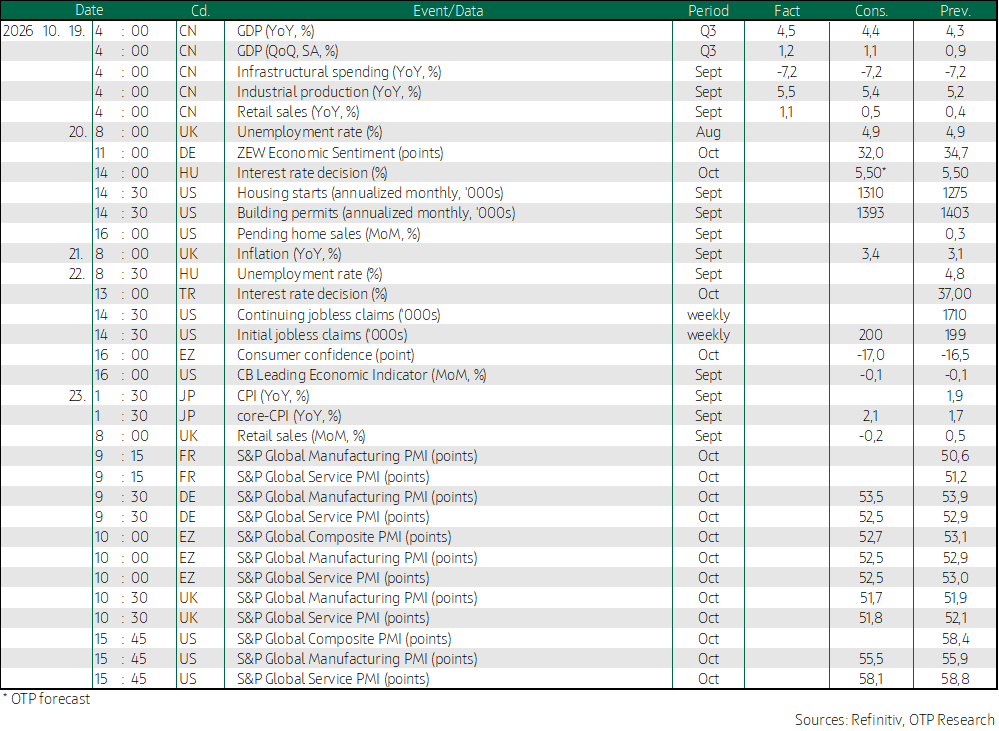
In China, a range of economic indicators were released today. Q3 GDP growth came in slightly above expectations, while both industrial production and retail sales accelerated in September. Infrastructure investment, however, continued to decline at a pace similar to that seen in previous months.
Looking ahead to the week, the focus in Hungary will be on the 2027 budget proposal due to be released today, as well as Tuesday’s MNB rate-setting meeting, where policymakers are widely expected to leave interest rates unchanged. In the Eurozone, attention will turn to economic activity indicators, with the ZEW Economic Sentiment Index scheduled for release on Tuesday likely to be the first major data point of interest.
In the US, no major market-moving data releases are scheduled for this week, although Friday’s PMIs may attract some attention from investors. The Fed has entered its blackout period ahead of the October 27-28 FOMC meeting, meaning no further public comments from policymakers are expected this week. As of Monday, markets were pricing in nearly a 90% probability that interest rates will remain unchanged following the October meeting.
With the Q3 earnings season just around the corner, several high-profile companies are scheduled to report this week. In the US, investors will be closely watching earnings releases from SpaceX, Tesla, Meta, and Netflix, while in Europe attention will focus on reports from SAP, ABB, Barclays, and BHP.
Get more out of your investments!
Global Markets Services
OTP Global Markets offers a broad range of services in the field of local and international money and capital markets.
Read morePrivate Banking Services
Personal care and expertise with OTP Private Banking, along with the knowledge, security, and innovations of a multinational banking group.
Read more