
OTP Morning Brief: US producer price index came in above expectations, yet the US 10-year Treasury yield still declined
Related content
OTP Morning Brief: US CPI data came in above expectations
European equity markets advanced, supported by strong results from ASML and the outstanding performance of the healthcare sector. US equity markets came under pressure following higher-than-expected September CPI data. The annual CPI rate accelerated to 3.7%, driven primarily by a surge in gasoline prices, while core CPI rose by 0.3% month-on-month, supported by higher housing costs and rising transportation service prices. Oil prices rose amid escalating tensions in the Middle East and the impact of the IEA's oil market report. US Treasury yields retreated after an initial increase, driven by Fed commentary, while European bond yields generally moved higher. The US macro calendar will be busy today, with investors focusing on September retail sales and producer price index data, as well as the New York Fed Manufacturing Index, weekly jobless claims, and business inventories. August industrial production data from the euro area will be released today.
OTP Morning Brief: Chipmakers' weakness kept equity markets under pressure
Global markets were characterized by a subdued, risk-off sentiment on Tuesday. In Europe, concerns over the technological advances of Chinese chipmaker CXMT weighed on technology stocks, with the STOXX 600 falling 0.1%, while the DAX, CAC 40 and FTSE 100 also closed 0.1% lower. In the US, trading was driven by weakness in the semiconductor sector and mixed corporate reactions during the early stages of the earnings season: the Dow fell 0.3%, the Nasdaq declined 0.2%, while the S&P 500 was unchanged. Ahead of Wednesday’s US inflation data, a wait-and-see approach and demand for safe-haven assets led to a decline in long-term bond yields, with the US 10-year yield easing to 5.22% and the German Bund yield falling to 3.46%. The dollar weakened against major currencies, with EUR/USD rising to 1.1199, while the Hungarian forint remained stable. Today's macro calendar will be highlighted by the September US inflation data, Chinese export figures, and the Fed's Beige Book due later in the evening.
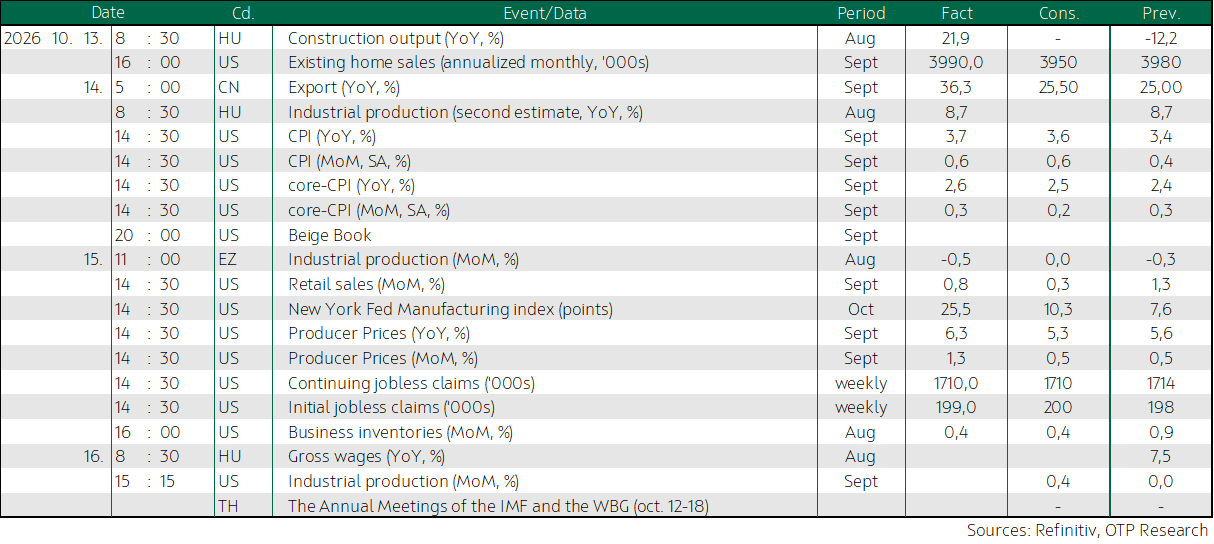
Western European equities continued to advance despite ongoing pressure on the technology sector. Wall Street indices also rebounded, recovering some ground after Wednesday’s sell-off. Healthcare was the standout performer on both sides of the Atlantic. Eurozone industrial production declined by 0.5% month-on-month in August. In the US, the producer price index accelerated to 6.3%, delivering another upside surprise in inflation developments. US retail sales increased by 0.8% compared to August. The US 10-year Treasury yield declined by more than 10 basis points. The long end of the Hungarian government bond yield curve also declined by 7-9 basis points. In Hungary, August wage data will be released today, while in the US, September industrial production figures are due.
European indices extended their gains despite weakness in the technology sector
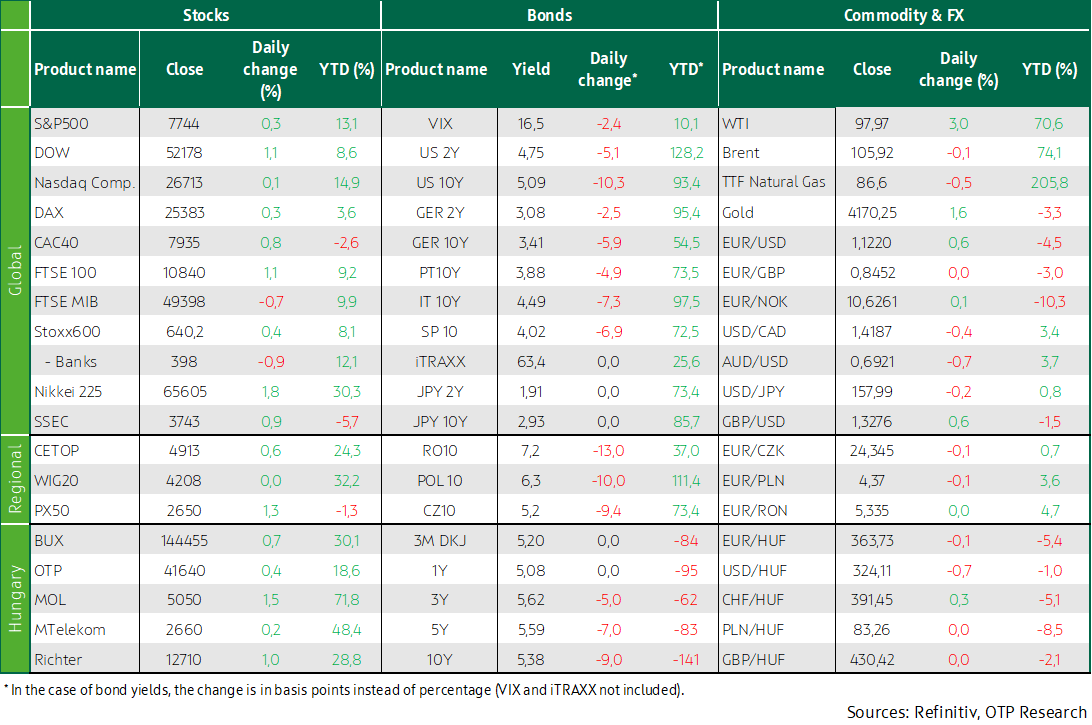
Leading Western European indices extended their gains on Thursday. The STOXX 600 rose 0.4%, the DAX added 0.3%, the CAC 40 advanced 0.8%, while the FTSE 100 climbed 1.1%. Shares of Ericsson gained 6.8% after the Swedish telecommunications equipment maker reported better-than-expected Q3 results. The healthcare sector index rose 2.4%, making it one of the day’s best-performing segments. In contrast, the technology sector lost 1.5%, weighed down primarily by a 13% plunge in shares of German semiconductor equipment manufacturer Aixtron. Among chip-related stocks, Infineon fell 5.2% and Soitec dropped 7.7%, while semiconductor equipment maker ASML declined 4.2%. Shares of Mondi retreated 7.9% after the paper and packaging producer announced price increases across several paper products in Q3 to offset higher energy and raw material costs. Antofagasta slipped 4.1% after the mining company reported that its copper production since the start of the year had declined by 8.3% compared with the same period in 2025.
Eurozone industrial production declined by 0.5% month-on-month in August, falling short of the consensus expectation for unchanged output.
In the region, the BUX gained 0.7%. Poland’s WIG20 was broadly unchanged, while the Czech PX50 advanced 1.3%. Following a 0.5% decline, TTF natural gas prices remained above EUR 86/MWh.
US producer price index also came in above expectations
After Wednesday’s sharp sell-off, US equities rebounded on Thursday. The S&P 500 rose 0.3%, the Nasdaq Composite gained 0.1%, while the Dow Jones advanced 1.1%. Pharmaceutical company Eli Lilly climbed more than 3%, UnitedHealth added 2.8%, and Walmart rose 1.4% following upgrades from Deutsche Bank. These three stocks were among the largest contributors to the S&P 500’s daily gain. Nvidia lost 1.8% after chipmaker TSMC struck a cautious tone regarding its 2027 outlook, despite reporting a sixth consecutive quarter of record profits driven by robust AI-related demand. Dell Technologies fell 6.9%, while Hewlett Packard Enterprise declined 7.1%. The two server manufacturers extended the substantial losses recorded a day earlier amid concerns over AI-related companies’ sensitivity to higher bond yields and borrowing costs. Eight of the eleven sectors within the S&P 500 closed higher. Defensive sectors led the advance, with healthcare rising 1.8%, followed by materials, which gained 1.7%.
Thursday brought a heavy flow of macroeconomic data from the US. Following Wednesday’s stronger-than-expected September CPI report, producer prices also delivered an upside surprise. Producer prices increased by 1.3% month-on-month and 6.3% year-on-year, marking a notable acceleration from the 5.6% annual pace recorded in August. US retail sales, which are not adjusted for inflation and therefore do not represent a pure volume measure, rose 0.8% compared to August, exceeding the consensus forecast of 0.3%. Higher fuel prices also contributed to the strength of the retail sales data. Meanwhile, weekly jobless claims continued to point to a resilient labour market.
US 10-year Treasury yield declined by more than 10 basis points
Concerns surrounding the AI sector and broader equity markets also supported a decline in US Treasury yields, with the 10-year yield falling by more than 10 basis points to close at 5.09%. The stronger-than-expected producer price data failed to reverse the move lower. Among Fed officials, San Francisco Fed President Mary Daly reiterated that while further rate hikes may still be warranted, October would not be the appropriate time for such a move. The breakeven inflation rate implied by 10-year Treasury Inflation-Protected Securities (TIPS) was last at 2.34%, suggesting that markets expect average annual inflation of roughly 2.3% over the coming decade. Meanwhile, the German 10-year Bund yield declined by 6 basis points to 3.41%.
In the Hungarian government bond market, the downward trend continued across maturities longer than one year, with yields in the 5-20 year segment declining by 7-9 basis points. Based on the Government Debt Management Agency’s (ÁKK) early afternoon quotations, the 10-year benchmark yield stood at 5.38%, its lowest level since early August. The forint strengthened by 0.1% against the euro, moving below the 364 level. At its auctions, ÁKK sold HUF 23.5 billion of the 2029/C, HUF 20 billion of the 2033/C, and HUF 90 billion of the 2037/A bond series, with all three maturities attracting substantial oversubscription.
Today's highlights
Leading Asian equity indices were trading sharply higher near the close. Japan’s Nikkei was up 1.8%, South Korea’s KOSPI gained 3.6%, while China’s SSEC and Hong Kong’s Hang Seng advanced 0.9% and 1.2%, respectively.
In Hungary, August wage data will be released today, while in the US, September industrial production figures are due.
Get more out of your investments!
Global Markets Services
OTP Global Markets offers a broad range of services in the field of local and international money and capital markets.
Read morePrivate Banking Services
Personal care and expertise with OTP Private Banking, along with the knowledge, security, and innovations of a multinational banking group.
Read more