
OTP Morning Brief: US CPI data came in above expectations
Related content
OTP Morning Brief: Chipmakers' weakness kept equity markets under pressure
Global markets were characterized by a subdued, risk-off sentiment on Tuesday. In Europe, concerns over the technological advances of Chinese chipmaker CXMT weighed on technology stocks, with the STOXX 600 falling 0.1%, while the DAX, CAC 40 and FTSE 100 also closed 0.1% lower. In the US, trading was driven by weakness in the semiconductor sector and mixed corporate reactions during the early stages of the earnings season: the Dow fell 0.3%, the Nasdaq declined 0.2%, while the S&P 500 was unchanged. Ahead of Wednesday’s US inflation data, a wait-and-see approach and demand for safe-haven assets led to a decline in long-term bond yields, with the US 10-year yield easing to 5.22% and the German Bund yield falling to 3.46%. The dollar weakened against major currencies, with EUR/USD rising to 1.1199, while the Hungarian forint remained stable. Today's macro calendar will be highlighted by the September US inflation data, Chinese export figures, and the Fed's Beige Book due later in the evening.
OTP Morning Brief: Oil prices rise, the technology sector struggles, and the earnings season gains momentum
The major European stock indices closed Monday's session in positive territory, with banks and utilities leading the advance. The BUX gained 0.9%, while Hungary’s blue-chip stocks delivered a mixed performance. TTF gas prices remain above EUR 84/MWh. Wall Street indices delivered a mixed performance yesterday, with the technology sector under pressure and semiconductor manufacturers posting declines. We saw an approximately 2% rise in crude oil prices. The euro weakened against the dollar as investors grew concerned about France’s fiscal position and the outlook for next year’s presidential election. The EUR/HUF exchange rate fell below 365. The earnings season continues today with reports from major companies.
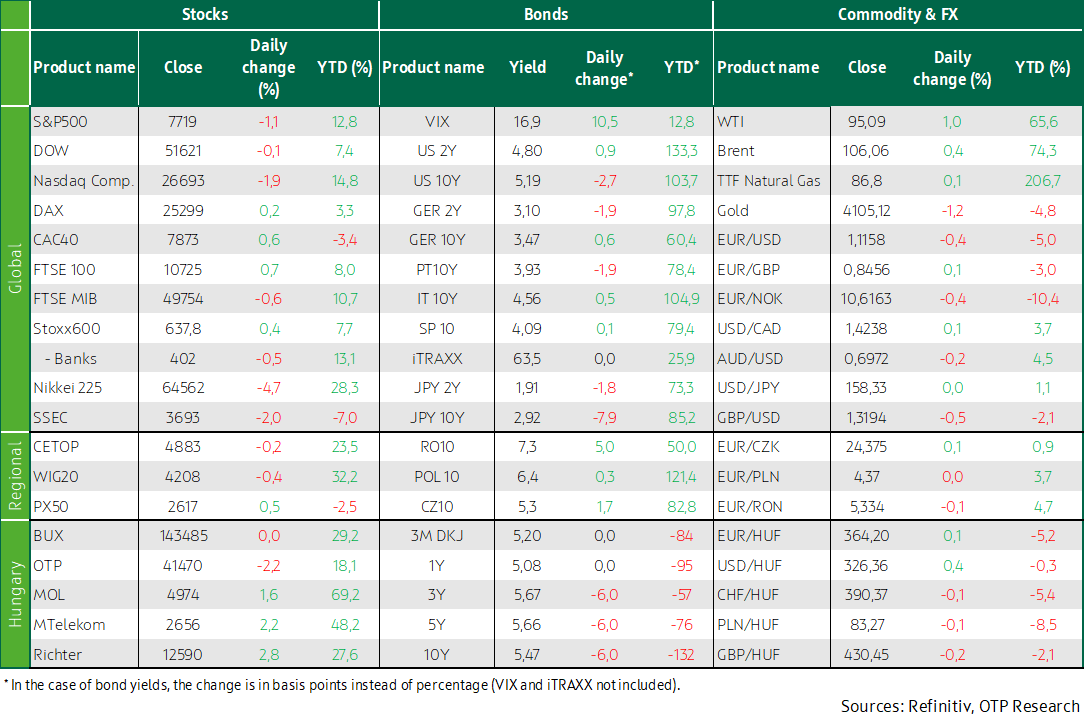
European equity markets advanced, supported by strong results from ASML and the outstanding performance of the healthcare sector. US equity markets came under pressure following higher-than-expected September CPI data. The annual CPI rate accelerated to 3.7%, driven primarily by a surge in gasoline prices, while core CPI rose by 0.3% month-on-month, supported by higher housing costs and rising transportation service prices. Oil prices rose amid escalating tensions in the Middle East and the impact of the IEA's oil market report. US Treasury yields retreated after an initial increase, driven by Fed commentary, while European bond yields generally moved higher. The US macro calendar will be busy today, with investors focusing on September retail sales and producer price index data, as well as the New York Fed Manufacturing Index, weekly jobless claims, and business inventories. August industrial production data from the euro area will be released today.
European equities advanced on the back of strong ASML results and the outstanding performance of the healthcare sector
European equity markets closed moderately higher on Wednesday, supported by stronger-than-expected results from ASML and growing confidence in the durability of AI-related investment demand. The Dutch technology company reported that customers are already showing interest in its most advanced chipmaking equipment for the 2029-2030 period, with its shares ending the session up 1.2%. The pan-European STOXX 600 index advanced by 0.4% overall. Healthcare stocks also made a significant contribution to market gains, with the sector rising 2.3% to its highest level in more than five weeks, making it the best-performing segment of the day.
Overall sentiment across Western European equity markets remained positive, with London’s FTSE 100 rising 0.7%, Paris’s CAC 40 gaining 0.6%, and Frankfurt’s DAX advancing 0.2%. Performance across the CEE region was mixed, however: Prague’s PX50 added 0.5%, while Poland’s WIG20 declined 0.4%. The BUX closed largely unchanged, as gains in Richter, Magyar Telekom, and MOL were largely offset by a 2.2% drop in OTP shares.
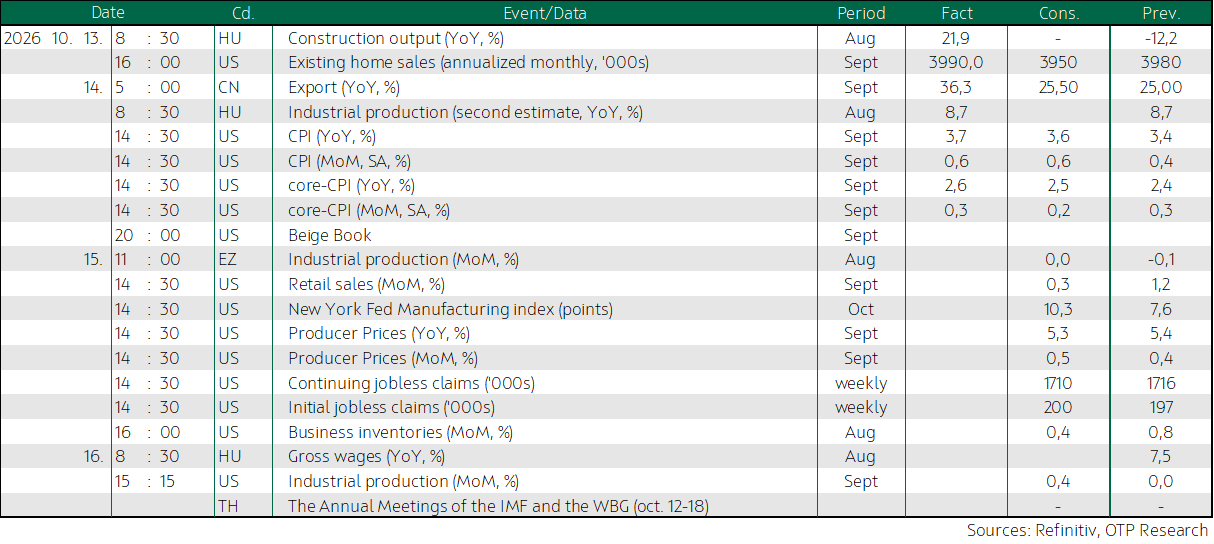
Hungarian industrial output grew by 8.7% year-on-year and 1.0% month-on-month in August, in line with the preliminary data. However, the expansion continued to be driven primarily by two export-oriented sectors: automotive manufacturing (+43%) and the production of computers, electronic and optical products (+30%). The strong performance was likely supported by the ramp-up in production at BMW’s plant in Debrecen and by increased output and exports at Foxconn’s Komárom facility, benefiting from the ongoing global AI boom. Output continued to decline across most other manufacturing subsectors, however.
Higher-than-expected CPI data put US equity markets under pressure
US equity markets closed sharply lower on Wednesday after stronger-than-expected September CPI data temporarily reinforced expectations of a Fed rate hike in October. Although market pricing partially reversed during the second half of the session, pressure on interest rate-sensitive technology and AI-linked stocks remained significant.
Among the major US indices, the Nasdaq fell 1.9%, the S&P 500 declined 1.1%, while the Dow Jones slipped 0.1%. Eight of the eleven sectors within the S&P 500 closed in negative territory. Technology was the worst-performing sector, retreating 2.6%, followed by communication services, which declined 1.8%.
Bank of America shares fell 4.8% after the bank reported a decline in Q3 profit, partly due to a $1.2 billion provision set aside to cover potential regulatory fines related to anti-money laundering compliance deficiencies. Meanwhile, Morgan Stanley lost nearly 3%, despite posting higher quarterly earnings.
US CPI data came in weaker than expected in September. The annual CPI rate accelerated to 3.7% from 3.4% in August, exceeding market expectations, primarily due to a rise in gasoline prices. Underlying inflationary pressures also showed little sign of easing, with core CPI increasing by 0.3% month-on-month, above the consensus forecast of 0.2%. Housing cost inflation accelerated, while transportation service prices rose by 0.6%, the fastest pace in six months, potentially signalling strengthening second-round inflationary effects stemming from higher energy prices.
The picture emerging from the CPI data was reinforced by the Fed’s Beige Book. According to the report, the US economy continues to expand at a moderate pace, while inflationary pressures have intensified across several regions. The labour market remains characterised by low levels of both hiring and layoffs, while housing demand continues to be constrained by elevated mortgage rates.
Brent crude rose 0.4% to USD 106.1 per barrel, while WTI gained 1.0% to USD 95.1 on Wednesday, as tensions in the Middle East escalated once again and the International Energy Agency (IEA) released its latest oil market assessment. According to Saudi Arabia’s Ministry of Energy, an administrative building belonging to state-owned oil producer Saudi Aramco was targeted in an attack. In response, the Saudi-led coalition reportedly carried out strikes against energy facilities and fuel storage sites under Houthi control in Yemen. The IEA's October report warned that tight conditions in the diesel market could persist through 2027, while renewed attacks targeting Saudi Arabia may threaten the recovery of global oil supply.
Although the TTF benchmark settled at around EUR 87/MWh on Wednesday, broadly unchanged from the previous day, prices continue to trade near levels not seen since 2022. Limited LNG supplies from the Middle East, below-average European gas storage inventories, and the possibility of a colder winter represent significant upside risks for natural gas prices.
US CPI data and Fed commentary shaped bond market movements
Significant volatility was observed in the US Treasury market on Wednesday. Following the release of stronger-than-expected September CPI data, yields initially moved higher. However, sentiment reversed during the second half of the session after several Fed officials, including Vice Chair Michelle Bowman, suggested that the central bank has time to assess the economic impact of September’s rate hike before deciding on any further tightening measures. The yield on the two-year US Treasury note climbed to as high as 4.95% during the trading day but ultimately closed near 4.80%, while the yield on the 10-year Treasury declined to 5.19% by the end of the session.
In Europe, government bond yields generally moved higher, with the yield on the 10-year German Bund ending the day at 3.47%. Uncertainty surrounding France’s fiscal outlook and next year’s presidential election continues to weigh on bond markets. At the same time, the spread between French and German 10-year government bonds narrowed to around 141 basis points, down from above 158 basis points at the beginning of October.
The euro weakened by 0.4% to USD 1.1158, with rising energy prices and concerns over France’s fiscal situation continuing to weigh on the common European currency.
In the Hungarian government bond market, the downward trend continued across maturities longer than one year. Yields fell by 6-9 basis points in the 3-20 year segment, while the short end of the yield curve remained broadly unchanged compared to Tuesday. Based on the Government Debt Management Agency (ÁKK)'s early afternoon fixing, the 10-year benchmark yield stood at 5.47%. The Hungarian forint weakened by 0.1% against the euro and by 0.4% versus the US dollar.
Today's highlights
Sentiment across Asian markets was negative this morning, with Japan’s Nikkei 225, South Korea’s Kospi, and China’s SSEC and Hang Seng indices all trading in the red. The South Korean market recorded the steepest losses, with the Kospi falling nearly 8%, putting it on track for its seventh consecutive losing session.
China’s exports surged by 36.3% year-on-year in September, significantly exceeding expectations, driven primarily by strong performance in electronic and semiconductor products as well as vehicle exports. Export growth was also supported by the global wave of AI-related investments and easing trade tensions with the US. However, the rapid expansion of Chinese exports is increasingly facing resistance from trading partners. Reflecting this trend, the EU and China reached an agreement last week to limit EU-bound exports of Chinese hybrid vehicles in order to protect European manufacturers.
The US macro calendar will be busy today, with investors focusing on September retail sales and producer price index (PPI) data, as well as the New York Fed Manufacturing Index, weekly jobless claims, and business inventories. August industrial production data from the euro area will also be released.
Get more out of your investments!
Global Markets Services
OTP Global Markets offers a broad range of services in the field of local and international money and capital markets.
Read morePrivate Banking Services
Personal care and expertise with OTP Private Banking, along with the knowledge, security, and innovations of a multinational banking group.
Read more