
OTP Morning Brief: Chipmakers' weakness kept equity markets under pressure
Related content
OTP Morning Brief: Oil prices rise, the technology sector struggles, and the earnings season gains momentum
The major European stock indices closed Monday's session in positive territory, with banks and utilities leading the advance. The BUX gained 0.9%, while Hungary’s blue-chip stocks delivered a mixed performance. TTF gas prices remain above EUR 84/MWh. Wall Street indices delivered a mixed performance yesterday, with the technology sector under pressure and semiconductor manufacturers posting declines. We saw an approximately 2% rise in crude oil prices. The euro weakened against the dollar as investors grew concerned about France’s fiscal position and the outlook for next year’s presidential election. The EUR/HUF exchange rate fell below 365. The earnings season continues today with reports from major companies.
OTP Morning Brief: Modest gains in equities, stronger rise in energy prices
Both US and European equity markets posted modest gains last Friday. The BUX largely recouped the losses accumulated over the previous week. There was no positive turnaround in energy prices, however: oil prices rose both on the last trading day of the week and over the week as a whole, while European natural gas prices surged above EUR 82/MWh, reaching levels rarely seen since 2022. The US-Russia diesel agreement announced over the weekend is also unlikely to bring meaningful relief to the market, as the volumes involved are negligible relative to global demand. Following the sharp rise in yields seen in September, October has so far been characterized by ongoing uncertainty on bond markets as investors continue to search for direction.
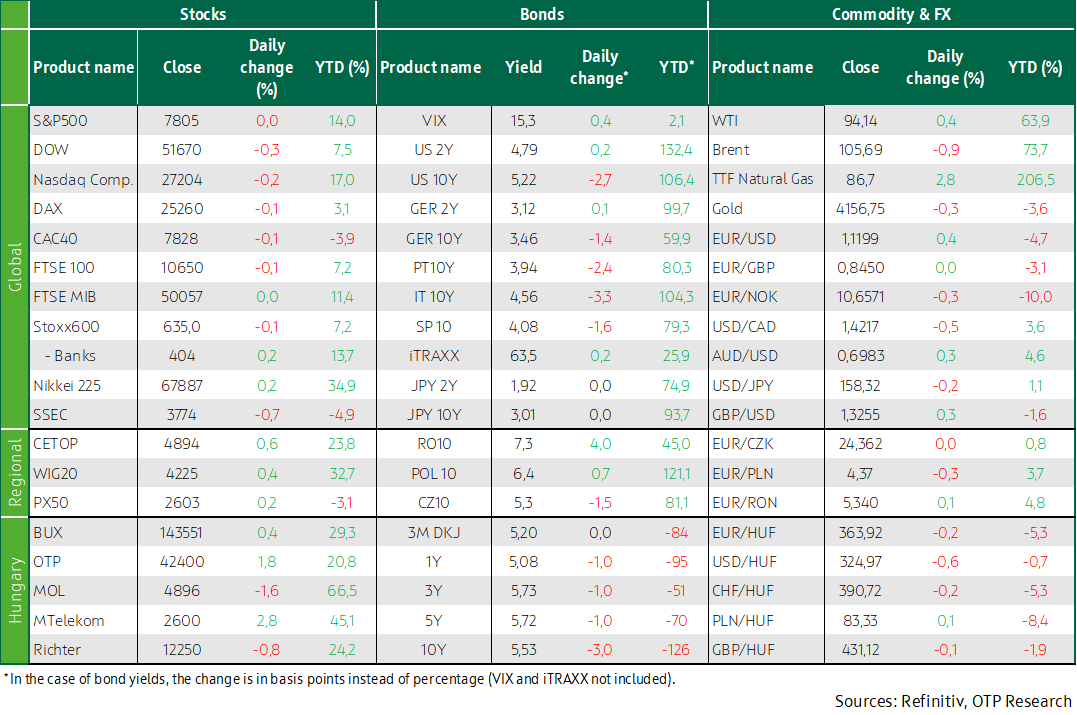
Global markets were characterized by a subdued, risk-off sentiment on Tuesday. In Europe, concerns over the technological advances of Chinese chipmaker CXMT weighed on technology stocks, with the STOXX 600 falling 0.1%, while the DAX, CAC 40 and FTSE 100 also closed 0.1% lower. In the US, trading was driven by weakness in the semiconductor sector and mixed corporate reactions during the early stages of the earnings season: the Dow fell 0.3%, the Nasdaq declined 0.2%, while the S&P 500 was unchanged. Ahead of Wednesday’s US inflation data, a wait-and-see approach and demand for safe-haven assets led to a decline in long-term bond yields, with the US 10-year yield easing to 5.22% and the German Bund yield falling to 3.46%. The dollar weakened against major currencies, with EUR/USD rising to 1.1199, while the Hungarian forint remained stable. Today's macro calendar will be highlighted by the September US inflation data, Chinese export figures, and the Fed's Beige Book due later in the evening.
The STOXX 600’s two-day advance came to an end as technological breakthroughs in China’s semiconductor industry weighed on technology stocks
A subdued, predominantly risk-off mood prevailed across major Western European equity markets. The STOXX 600 slipped 0.1%, ending its two-day winning streak. Technology and semiconductor stocks came under pressure after reports of technological advances by Chinese memory chipmaker CXMT highlighted concerns about intensifying Chinese competition in the AI-related segment. As a result, Dutch semiconductor equipment maker ASM International lost 6.3%, while France’s Soitec declined by nearly 6%. The technology sector fell 1.6%, while the index comprising defence and aerospace companies dropped 1.7%. Luxury goods manufacturers were also held back by weaker-than-expected results from LVMH. In contrast, the chemicals sector gained 2.0%, supported in part by a 9.2% surge in Swiss fragrance and flavour producer Givaudan following better-than-expected quarterly sales figures.
The major Western European indices all closed with modest losses. The FTSE 100, DAX and CAC 40 each ended 0.1% below their previous closing levels. Investor attention is now focused on the earnings season, and particularly on ASML's results due on Wednesday, which could provide important insight into the outlook for the technology sector.
Central and Eastern European equity markets, however, delivered positive performance: Hungary's BUX and Poland's WIG20 both gained 0.4%, while Prague's PX index advanced 0.2%.
The performance of Hungarian blue chips was mixed, although gains in OTP provided support for the domestic market. OTP rose 1.8%, while Magyar Telekom advanced 2.8%; meanwhile, MOL declined 1.6% and Richter fell 0.8%. As the only notable regional macroeconomic release of the day, Hungarian construction output increased by 21.9% year-on-year in August, driven primarily by strong growth in infrastructure and utilities-related projects.
Technology stocks dragged Wall Street lower as investors assessed the sustainability of AI spending and the early developments of the earnings season
Investor sentiment continued to be influenced by geopolitical risks and uncertainty surrounding energy supplies. Movements in the oil market were mixed: Brent fell 0.9% to USD 105.69 per barrel, while WTI closed 0.4% higher at USD 94.14. Market participants were simultaneously assessing supply risks stemming from attacks affecting Saudi Arabia and Yemen, as well as the possibility that a diesel agreement between the US and Russia could increase global fuel supply.
US equity markets closed in negative territory. The Dow fell 0.3%, the Nasdaq declined 0.2%, while the S&P 500 finished essentially unchanged. Trading was driven primarily by weakness in the semiconductor sector and investors' assessment of the first earnings releases of the reporting season. Semiconductor, healthcare and financial stocks remained under pressure. The PHLX Semiconductor Index extended its losing streak to five consecutive sessions.
Among corporate developments, bank earnings attracted the most attention. Although profits at Goldman Sachs and Citigroup exceeded market expectations, their shares declined, while Wells Fargo came under pressure after reporting lower-than-expected net interest income. JPMorgan's results also received a mixed market reaction. Applied Materials and Micron weakened as well, while Broadcom’s CEO warned of excessive speculation in certain parts of the sector. Apple, meanwhile, reached a new intraday record high of USD 348.15, while shares of Google, Microsoft and Meta also moved higher.
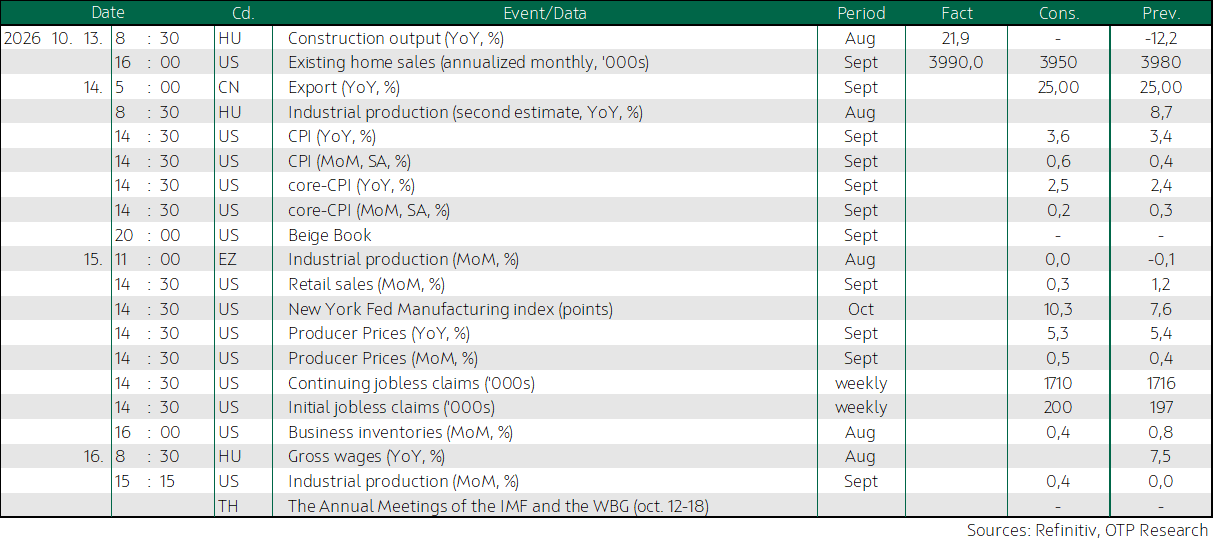
US existing home sales rose 1.5% month-on-month in September to an annualized rate of 3.99 million units, slightly exceeding the previous month's level. The housing market nevertheless remained subdued, as elevated mortgage rates continued to weigh on demand and limit borrowing capacity.
Long-term US and German bond yields declined, while the dollar lost ground against major currencies
In the US Treasury market, long-term yields declined ahead of the release of Wednesday's inflation data. The 10-year Treasury yield fell by nearly 3 bps to 5.22%, while the 30-year yield dropped 3 bps to 5.57%. The 2-year yield, however, was largely unchanged, closing at 4.8%, indicating that markets remain in a wait-and-see mode regarding the Fed's next move. According to the FedWatch tool, the probability of an October rate hike stood at around 22%, while investors continue to price in an additional 25-basis-point tightening by December.
Longer-dated government bond yields also declined across the eurozone. The yield on the 10-year German Bund eased by 1 bp to 3.46%, while the 2-year German yield remained unchanged at 3.12%. In the foreign exchange market, the dollar weakened, with the EUR/USD exchange rate rising to 1.1199.
The favourable sentiment in international bond markets also filtered through to Hungary, resulting in yield declines primarily along the medium- and long-term segments of the yield curve. The 10-year benchmark yield fell 3 bps to 5.53%, while the 5-year and 3-year yields both eased by 1 bp, to 5.72% and 5.73%, respectively. The Hungarian forint remained stable, with EUR/HUF trading around 363.92 and USD/HUF near 324.97, supported in part by the dollar's broad-based weakness.
Today's highlights
Asian equity markets traded mixed this morning. Japan's Nikkei gained 0.2%, as chipmakers staged a rebound following Tuesday's weakness. In South Korea, both Samsung Electronics and SK Hynix advanced by more than 2%, helping lift the MSCI Asia Pacific ex-Japan Index by 0.5%.
Today's macro calendar will be highlighted by the September US inflation report, with both the headline CPI and core CPI figures due at 14:30. In addition, the second estimate of Hungary's August industrial production will be released, along with China's September export data, while the Fed's Beige Book is scheduled for publication later in the evening.
Get more out of your investments!
Global Markets Services
OTP Global Markets offers a broad range of services in the field of local and international money and capital markets.
Read morePrivate Banking Services
Personal care and expertise with OTP Private Banking, along with the knowledge, security, and innovations of a multinational banking group.
Read more