
OTP Morning Brief: Oil prices rise, the technology sector struggles, and the earnings season gains momentum
Related content
OTP Morning Brief: Modest gains in equities, stronger rise in energy prices
Both US and European equity markets posted modest gains last Friday. The BUX largely recouped the losses accumulated over the previous week. There was no positive turnaround in energy prices, however: oil prices rose both on the last trading day of the week and over the week as a whole, while European natural gas prices surged above EUR 82/MWh, reaching levels rarely seen since 2022. The US-Russia diesel agreement announced over the weekend is also unlikely to bring meaningful relief to the market, as the volumes involved are negligible relative to global demand. Following the sharp rise in yields seen in September, October has so far been characterized by ongoing uncertainty on bond markets as investors continue to search for direction.
OTP Morning Brief: Developed market bond yields edged lower yesterday
European indices declined yesterday amid rising oil prices, while the German government revised its GDP growth forecast upward; German exports lost momentum toward the end of the summer; meanwhile, ECB policymakers see upside risks to European inflation. Major US indices moved mostly lower; OpenAI's revenue fell significantly short of previously projected levels; meanwhile, the number of initial jobless claims declined in the US. Long-term yields in both the US and Europe declined following the sharp increase seen in the previous period, while Christopher Waller noted that further Fed rate hikes do not necessarily need to occur at consecutive meetings. The focus today will be on the latest reading of the University of Michigan Consumer Sentiment Index.
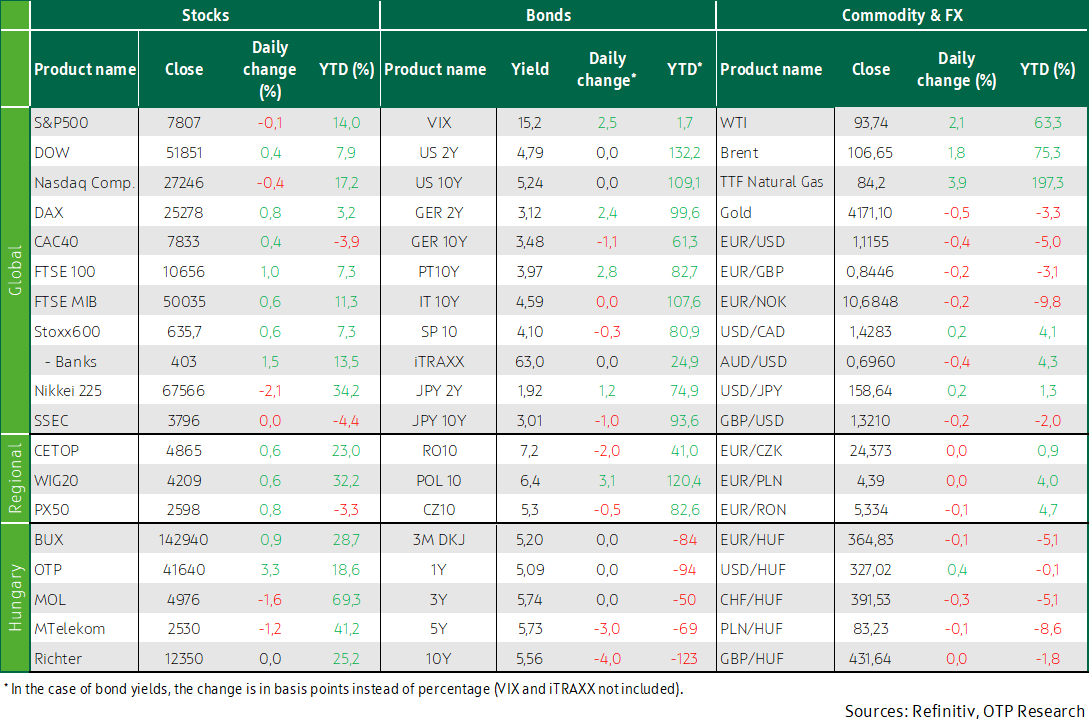
The major European stock indices closed Monday's session in positive territory, with banks and utilities leading the advance. The BUX gained 0.9%, while Hungary’s blue-chip stocks delivered a mixed performance. TTF gas prices remain above EUR 84/MWh. Wall Street indices delivered a mixed performance yesterday, with the technology sector under pressure and semiconductor manufacturers posting declines. We saw an approximately 2% rise in crude oil prices. The euro weakened against the dollar as investors grew concerned about France’s fiscal position and the outlook for next year’s presidential election. The EUR/HUF exchange rate fell below 365. The earnings season continues today with reports from major companies.
Major European stock indices closed Monday's session in positive territory; the BUX climbed 0.9%; TTF gas prices continued to rise
European equity markets moved higher on the first trading day of the week as investors shifted their focus from the expanding conflict in the Middle East and the rise in oil prices and bond yields to the start of the earnings season. The pan-European Stoxx 600 advanced 0.7%, with most of its constituents ending the session in positive territory. Banks and utilities were the top-performing sectors, while telecommunications and technology lagged behind. In line with this trend, Spain’s bank-heavy IBEX outperformed the region’s benchmark indices, climbing 1.3%.
After the close, French luxury goods group LVMH (+1.2%) reported weaker-than-expected organic revenue growth for the third quarter, weighed down by soft demand for fashion and leather goods.
Stock markets across the CEE region closed Monday’s session with modest gains. Hungary’s blue-chip stocks delivered a mixed performance, with OTP the only major constituent to finish higher.
The European TTF natural gas benchmark surged more than 4% to above EUR 84/MWh, bringing its gain since the start of October to more than 15%.
Wall Street indices closed mixed; crude oil prices moved higher
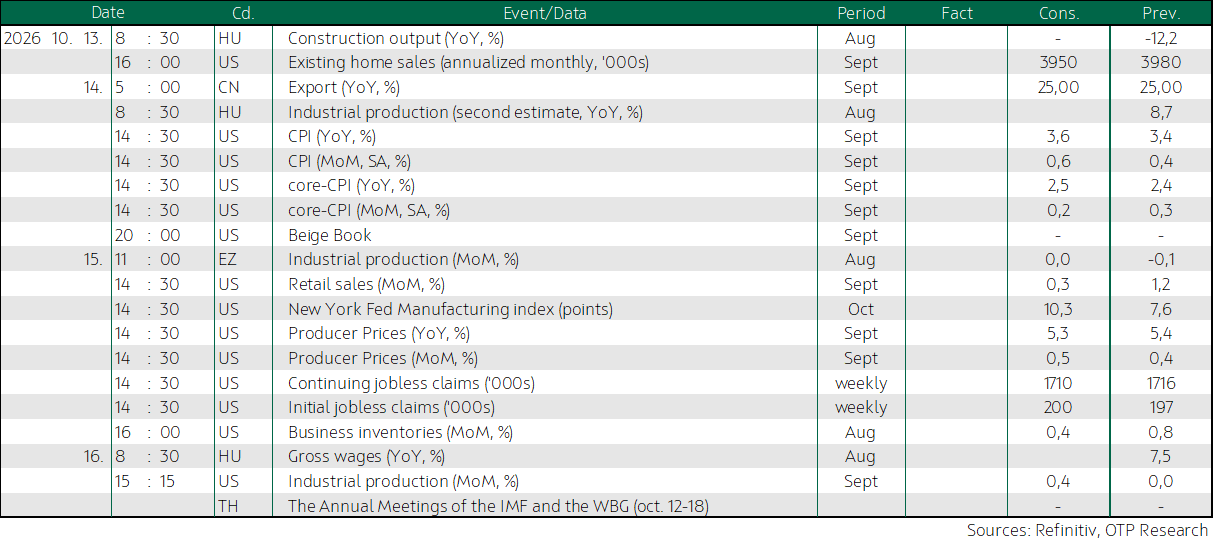
Major Wall Street indices closed Monday’s session with mixed results: the Dow Jones gained 0.4%, the S&P 500 was little changed, while the technology-heavy Nasdaq declined 0.4%. Investor sentiment was shaped by unfavorable developments over the weekend related to the Middle East conflict and higher oil prices, while market participants also kept a close eye on the start of the earnings season. Several major banks, including Goldman Sachs, Citigroup, and JPMorgan, are scheduled to release their earnings this week. In addition, September CPI data and a range of economic activity indicators are due for release.
At the sector level, energy stocks were the best performers, gaining 1.5% alongside higher oil prices, while the technology sector was among the biggest laggards, falling 0.9%. Semiconductor manufacturers were particularly weak, with the Philadelphia Semiconductor Index declining 2.7%. Microsoft advanced 1.1%, pushing its market capitalization above $4 trillion for the first time in a year after the company unveiled plans for the broad rollout of its in-house artificial intelligence chips. Shares of Chipotle fell 3.8% after Starbucks (+1.7%) announced that it would not pursue an acquisition of the fast-food chain.
We saw gains of around 2% in both Brent and WTI crude prices after the Iran-backed Houthi rebels in Yemen stepped up attacks against Saudi Arabia over the weekend, with oil tankers reportedly hit and the airport in the Saudi capital also targeted.
The energy ceasefire between Russia and Ukraine, announced by Donald Trump on Sunday, was reportedly violated by Russia on its very first day, according to Ukraine.
The euro weakened against the dollar, while the Hungarian forint strengthened beyond the 365 level against the euro
Long-term bond yields in the euro area remain close to multi-year highs, with yesterday’s trading session bringing no significant moves. Sentiment in the French bond market remains particularly tense as investors continue to weigh concerns over fiscal sustainability and the outlook for the upcoming presidential election. As a result, the yield on the French 10-year government bond now exceeds its German counterpart by more than 140 basis points.
The euro weakened against the dollar yesterday, with uncertainty surrounding France’s future also contributing to the move, pushing the EUR/USD exchange rate down to 1.1155.
The US Treasury market was closed yesterday for Columbus Day.
The short end of the Hungarian yield curve was unchanged, while yields at the longest maturities declined by 3-4 basis points. The yield on the Hungarian 10-year government bond fell to 5.56%. Meanwhile, the EUR/HUF exchange rate slipped below 365, with the forint strengthening against the euro.
Today's highlights
Sentiment across Asia-Pacific equity markets was negative this morning, with the technology sector coming under pressure following yesterday’s weakness on Wall Street. In South Korea, trading in the Kospi index was temporarily suspended after a sharp sell-off triggered market safeguards, with the benchmark on track to close down more than 6%. Meanwhile, equity index futures point to a mixed start to trading in both Europe and the US.
The Government Debt Management Agency (ÁKK) will offer HUF 30 billion worth of discount Treasury bills at today’s auction.
The Hungarian Central Statistical Office (KSH) will release August construction sector data today. In the US, housing market statistics are scheduled to be published.
Today's earnings calendar includes reports from several major names, including JPMorgan, Johnson & Johnson, UnitedHealth, Goldman Sachs, Wells Fargo, Citigroup, and Rio Tinto.
Get more out of your investments!
Global Markets Services
OTP Global Markets offers a broad range of services in the field of local and international money and capital markets.
Read morePrivate Banking Services
Personal care and expertise with OTP Private Banking, along with the knowledge, security, and innovations of a multinational banking group.
Read more