
OTP Morning Brief: Modest gains in equities, stronger rise in energy prices
Related content
OTP Morning Brief: Developed market bond yields edged lower yesterday
European indices declined yesterday amid rising oil prices, while the German government revised its GDP growth forecast upward; German exports lost momentum toward the end of the summer; meanwhile, ECB policymakers see upside risks to European inflation. Major US indices moved mostly lower; OpenAI's revenue fell significantly short of previously projected levels; meanwhile, the number of initial jobless claims declined in the US. Long-term yields in both the US and Europe declined following the sharp increase seen in the previous period, while Christopher Waller noted that further Fed rate hikes do not necessarily need to occur at consecutive meetings. The focus today will be on the latest reading of the University of Michigan Consumer Sentiment Index.
OTP Morning Brief: Long-end yields temporarily moved higher, putting equity markets under pressure
Wednesday's trading session was relatively uneventful, with a familiar pattern once again unfolding as the situation in the Persian Gulf drove oil prices higher, pushed yields up, and weighed on equity markets. The correction came within the day, as declining oil prices helped pull the US 10-year yield back from its multi-decade high of 5.36% to around 5.30%. The German 10-year yield followed a similar intraday pattern and ultimately ended the session unchanged from Tuesday's close at 3.48%. The EUR/USD closed at a 17-month low, just below 1.12. Equity markets, however, failed to regain momentum, with both the Nasdaq and the S&P pulling back from their recent highs as investors continued to digest the financing plans of AI-related companies. In Europe, banks led the declines, topping the list of worst-performing sectors. Regional stock markets, including Hungary’s, posted notable declines. The EUR/HUF rose to near 366. Hungarian long-term yields declined. Hungary’s September CPI came in slightly lower than expected. Asian equity indices declined in early trading. Today, German export data will be released, while weekly jobless claims figures are due from the US.
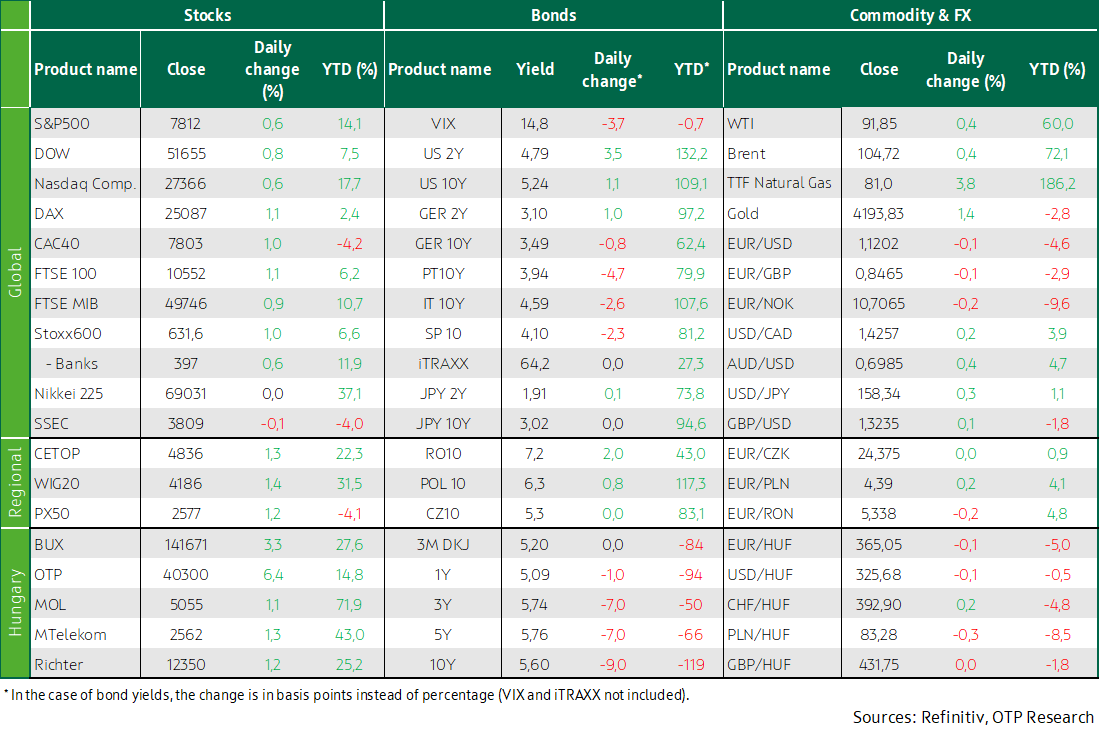
Both US and European equity markets posted modest gains last Friday. The BUX largely recouped the losses accumulated over the previous week. There was no positive turnaround in energy prices, however: oil prices rose both on the last trading day of the week and over the week as a whole, while European natural gas prices surged above EUR 82/MWh, reaching levels rarely seen since 2022. The US-Russia diesel agreement announced over the weekend is also unlikely to bring meaningful relief to the market, as the volumes involved are negligible relative to global demand. Following the sharp rise in yields seen in September, October has so far been characterized by ongoing uncertainty on bond markets as investors continue to search for direction.
Energy market pressures persist, with the Trump-Putin agreement unlikely to bring meaningful relief to diesel prices or inflation
Energy prices continued to climb last Friday, with both WTI and Brent crude rising 0.4% to USD 91.9 and USD 104.7 per barrel, respectively. On a weekly basis, the gains were even more pronounced, with WTI up 0.8% and Brent advancing 2.4%. The situation was even more challenging in the European natural gas market, where the TTF benchmark closed at EUR 82.35/MWh on Friday, 4.2% higher than the previous day and 8.6% above its level a week earlier. This was the second-highest daily closing price since 2022, exceeded only by the level recorded on September 14 this year.
Although US President Donald Trump and Russian President Vladimir Putin agreed on Friday that Russia would supply 300 thousand tonnes of diesel to the US in October, a further 500 thousand tonnes in November, followed by an additional 1 million tonnes thereafter, this is unlikely to fundamentally alter conditions in the diesel market, even if the agreement is fully implemented, as lawmakers from both parties in Congress have since voiced opposition to the deal. US monthly diesel consumption is approximately 16 million tonnes, meaning the planned October shipment would account for less than 2% of demand, while the November volume would cover barely 3%. Relative to global monthly diesel demand, the amount set to be released by Russia is even more negligible, representing only around 0.3%, while 5-10% of global supply has already been disrupted due to the conflict involving Iran. Given the strong integration of US refiners into the global economy, including their role as a key source of diesel imports for Europe, the announced Russian shipments are not expected to ease pricing pressures in the diesel market, even within the US itself.
European equities recouped their mid-week losses on Friday
The STOXX 600 gained 1.0% last Friday, allowing it to recover to its level from a week earlier after the declines seen on Wednesday and Thursday. Amid the broadly positive market sentiment, all sector indices closed in positive territory. The only exception was the telecommunications sector, where stocks, much like their US peers, fell sharply by around 3% following reports that SpaceX could enter the mobile telecommunications market by leveraging Starlink's infrastructure (see below). The decline was led by Deutsche Telekom, whose shares fell nearly 8%.
Central and Eastern European equities also advanced on the final trading day of the previous week, with Warsaw gaining 1.4%, Prague rising 1.2%, and Budapest closing 3.3% higher. Looking at the week as a whole, the picture was more mixed: the Polish market climbed 2.5%, even reaching a record high on Wednesday, while Czech equities declined 1.5% overall. Following a dramatic roller-coaster ride during the week, the BUX ultimately finished 1.2% above its closing level from the previous Friday. Trading on the Hungarian stock exchange was primarily driven by OTP shares, which at one point on Thursday were down 6% from their level a week earlier, but Friday’s 6.4% rally was enough to erase the stock’s entire weekly decline.
No major European macroeconomic data releases were published on Friday.
US indices remain resilient ahead of the earnings season
All three major US equity indices advanced on Friday, with the Dow Jones gaining 0.8%, while both the S&P 500 and the Nasdaq rose 0.6%. The latter two indices reached fresh record highs earlier in the week, on Tuesday, and continue to trade near those levels, with the S&P 500 sitting just 0.1% below its all-time high. One of Friday’s standout performers was Crown Castle, whose shares surged 16%. The company, which operates mobile communications towers, benefited from the same news that weighed heavily on major telecommunications providers in both Europe and the US, sending their shares sharply lower (AT&T: -10%, Verizon: -9%, T-Mobile US: -13%). SpaceX announced that it is preparing to acquire a licence to use the 800 MHz frequency band, which would enable it to enter the US mobile telecommunications market by combining Starlink’s satellite network with terrestrial communications towers. Interestingly, the news had only a limited impact on SpaceX itself, with the company’s shares rising just 1.25% during Friday’s session.
An important macroeconomic release also came from the US on Friday. The October reading of the Michigan Consumer Sentiment Index, a survey-based gauge compiled by the University of Michigan through telephone interviews with US households, came in at 46.3, significantly below both market expectations (47.6) and marking the second-lowest level of the past decade, surpassed only by the reading recorded in May 2026. The underlying survey indicated that US households, particularly lower-income consumers, have become increasingly pessimistic about living costs and the economic outlook. This may suggest that elevated energy prices are beginning to erode the resilience of the US economy as well.
Bond markets ended Friday on a calm note
There were no significant moves in bond markets on Friday, with major US and European government bond yields showing movements of well under 5 basis points across most maturities. One notable exception was the Japanese 10-year yield, which declined by 7 basis points to 3.02%. Hungarian government bonds also outperformed, with the 10-year yield falling 10 basis points to 5.60%. The lack of major market moves was also characteristic of the week as a whole. Although US yields continued to edge higher at the beginning of the week, albeit at a much slower pace than previously, this was followed by a gradual reversal in the second half of the week. As a result, the US 10-year Treasury yield closed at 5.24%, 4 basis points below its level a week earlier. A similar pattern was observed across other major markets. Overall, while long-term yields rose at a rarely seen pace in September, October has so far been characterised by a search for direction.
Today's highlights
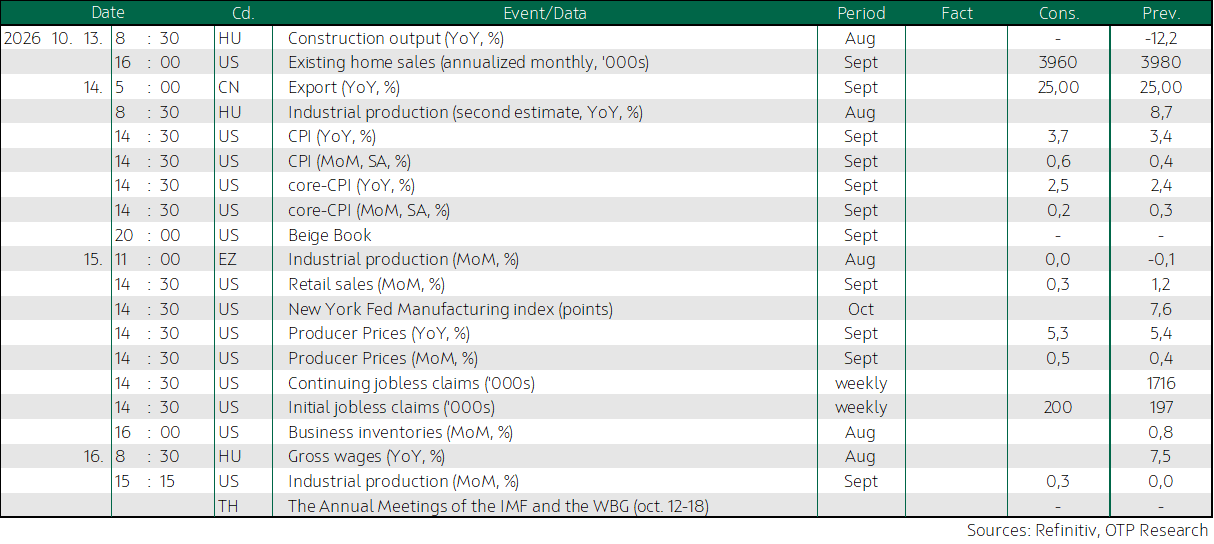
Monday is expected to be quiet on the macroeconomic front. Attention will turn to the earnings season on Tuesday, when major US banks are scheduled to report their results, while US CPI data will begin to be released from Wednesday onward.
Asian markets showed a mixed picture this morning. As of 7:00 a.m. CET, the Hang Seng was up 0.2%, while the Nikkei was trading broadly flat. In contrast, South Korea’s KOSPI opened 2.6% lower, with the decline led by Samsung, whose shares fell 3.5%. The sell-off was driven largely by speculation that if SpaceX proceeds with launching its own mobile service, it could eventually move into smartphone manufacturing as well.
Get more out of your investments!
Global Markets Services
OTP Global Markets offers a broad range of services in the field of local and international money and capital markets.
Read morePrivate Banking Services
Personal care and expertise with OTP Private Banking, along with the knowledge, security, and innovations of a multinational banking group.
Read more