
OTP Morning Brief: Developed market bond yields edged lower yesterday
Related content
OTP Morning Brief: Long-end yields temporarily moved higher, putting equity markets under pressure
Wednesday's trading session was relatively uneventful, with a familiar pattern once again unfolding as the situation in the Persian Gulf drove oil prices higher, pushed yields up, and weighed on equity markets. The correction came within the day, as declining oil prices helped pull the US 10-year yield back from its multi-decade high of 5.36% to around 5.30%. The German 10-year yield followed a similar intraday pattern and ultimately ended the session unchanged from Tuesday's close at 3.48%. The EUR/USD closed at a 17-month low, just below 1.12. Equity markets, however, failed to regain momentum, with both the Nasdaq and the S&P pulling back from their recent highs as investors continued to digest the financing plans of AI-related companies. In Europe, banks led the declines, topping the list of worst-performing sectors. Regional stock markets, including Hungary’s, posted notable declines. The EUR/HUF rose to near 366. Hungarian long-term yields declined. Hungary’s September CPI came in slightly lower than expected. Asian equity indices declined in early trading. Today, German export data will be released, while weekly jobless claims figures are due from the US.
OTP Morning Brief: Easing bond yields lifted equity markets on Tuesday
The rise in bond yields seen in recent days eased, supporting markets in both Europe and the US. In the euro area, Germany’s August industrial orders, French industrial output, and the region’s retail sales figures generally painted a negative picture. The BUX rose by 1.3%. In the US, both the S&P 500 and the Nasdaq closed at record highs. Although Brent crude started the day lower, it moved back toward the $100 per barrel mark by the close, driven by the Houthi attacks. A series of protests in France heightened uncertainty. The forint strengthened to nearly 365 against the euro. Asian equity indices declined in early trading. Today, Hungary’s CPI data will be worth watching.
European indices declined yesterday amid rising oil prices, while the German government revised its GDP growth forecast upward; German exports lost momentum toward the end of the summer; meanwhile, ECB policymakers see upside risks to European inflation. Major US indices moved mostly lower; OpenAI's revenue fell significantly short of previously projected levels; meanwhile, the number of initial jobless claims declined in the US. Long-term yields in both the US and Europe declined following the sharp increase seen in the previous period, while Christopher Waller noted that further Fed rate hikes do not necessarily need to occur at consecutive meetings. The focus today will be on the latest reading of the University of Michigan Consumer Sentiment Index.
European indices declined yesterday amid rising oil prices, while the German government revised its GDP growth forecast upward; German exports lost momentum toward the end of the summer; meanwhile, ECB policymakers see upside risks to European CPI
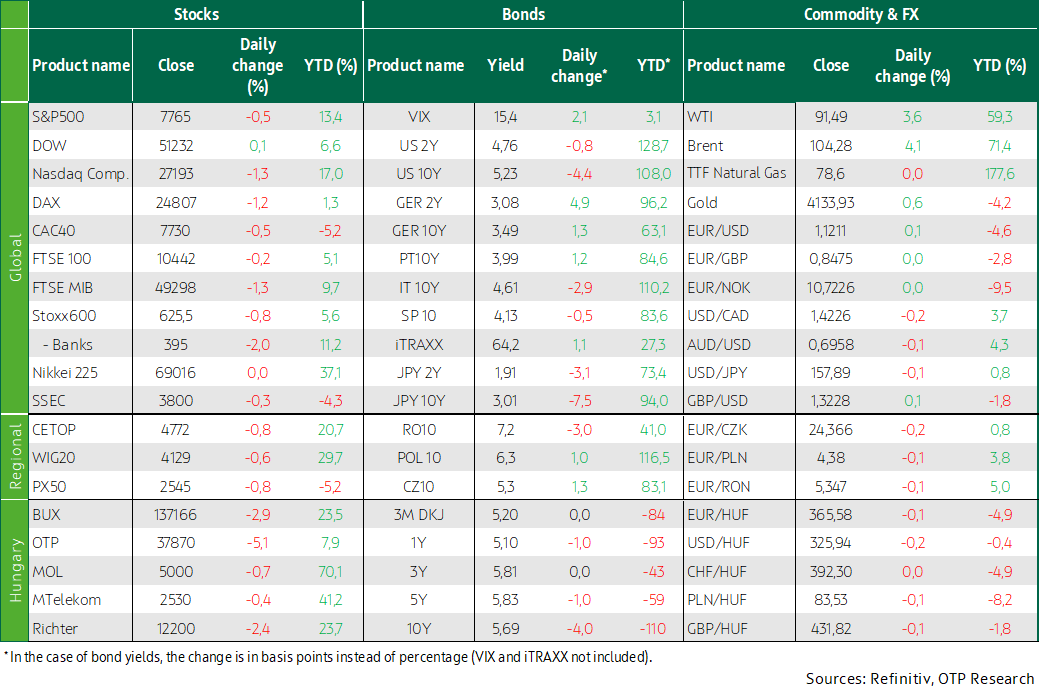
European equity markets declined yesterday, with the STOXX 600 index falling 0.8%, closing at its lowest level since mid-June. Investor sentiment was primarily weighed down by rising oil prices after reports emerged that the White House had asked the Pentagon to develop military options against Iran that could potentially be implemented before the midterm elections. Although President Trump later stated that he would not authorize military action against Iran ahead of the vote, escalating tensions in the Middle East continued to fuel concerns over global energy supplies. Market sentiment was further dampened by the minutes of the ECB’s latest policy meeting, which confirmed that Governing Council members continue to see upside risks to euro area CPI. According to policymakers, the inflation outlook remains subject to exceptionally high uncertainty, largely due to the ongoing US-Iran conflict and the war in Ukraine. The central bank noted that a wide range of economic and inflation scenarios remains possible under current conditions, reinforcing the case for maintaining a meeting-by-meeting, data-dependent approach to monetary policy.
The German government raised its GDP growth forecasts for both this year and next. It now expects the economy to expand by 1.3% in 2026, up from the 0.5% projection published in April, while the forecast for 2027 was revised higher to 1.1% from 0.9%. The expected acceleration in growth is primarily driven by government spending on infrastructure projects and military modernization, as well as stronger export performance. The conflict in the Middle East has so far had a smaller-than-expected impact on the German economy. However, consumers are likely to feel its adverse effects through higher CPI, which is projected to reach 2.7% this year and 3.0% next year.
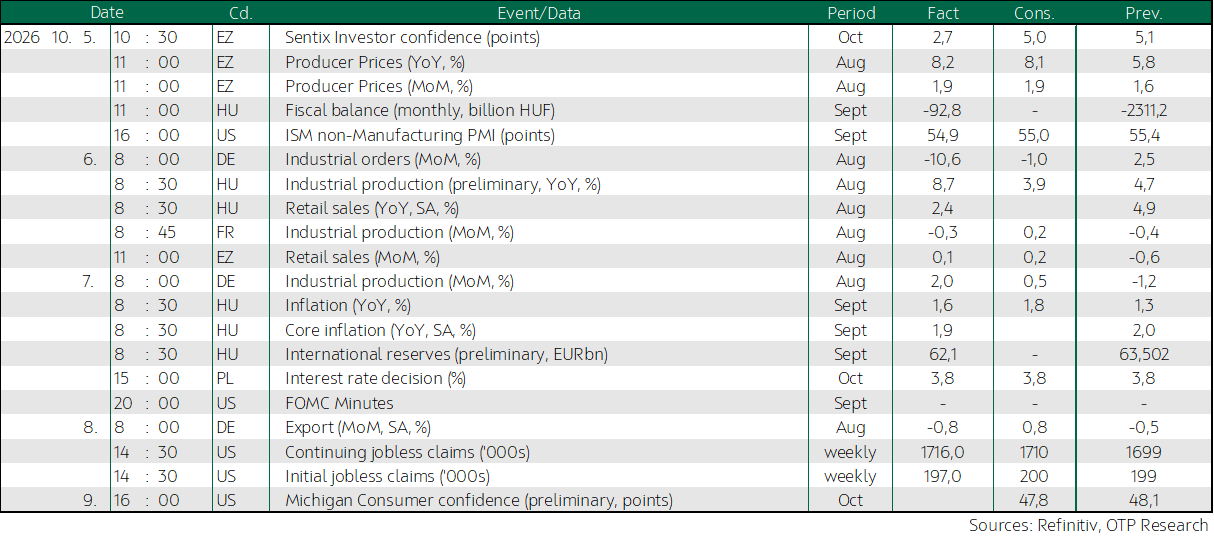
German exports lost some momentum in August, declining by 0.8% month-on-month and falling well short of market expectations, which had pointed to a 0.8% increase. Following a 0.5% drop in July, this marked the second consecutive monthly decline in exports, signalling weaker external trade performance in the euro area's largest economy. A key driver of the downturn was a 0.6% decrease in exports to European Union member states. Within this, shipments to non-euro area EU countries fell sharply by 3.5%, while exports to euro area partners rose by 0.8%. Exports to non-EU countries also weakened, declining 1.1% on a monthly basis. The drop was largely driven by a 6.3% fall in exports to the US, which more than offset a 4.7% increase in shipments to China and a 16.7% rise in exports to the UK. On an annual basis, however, the picture remained more encouraging: German exports were 6.2% higher than a year earlier, while export growth reached 4.4% during the first eight months of the year.
Major indices across the CEE region moved lower, with the BUX underperforming its regional peers. Among Hungarian blue chips, OTP extended its downward trend amid the negative international market backdrop, with the stock falling 5.1%, while the other three heavyweight constituents also ended the session in negative territory.
Major US indices moved mostly lower; OpenAI's revenue fell significantly short of previously projected levels; meanwhile, the number of initial jobless claims declined in the US
The Nasdaq and the S&P 500 closed lower yesterday, while the Dow Jones posted a modest gain. Equity markets were primarily dragged down by weakness in the technology sector after reports emerged that OpenAI's annualized revenue was roughly USD 20 billion below previously indicated levels. Shares of companies closely tied to the AI theme came under significant pressure, with Oracle falling 5.5%, Nvidia losing 2.9%, and AMD declining 3.9%. Investor sentiment was further weighed down by comments from US President Donald Trump, who initially ruled out the possibility of reaching an agreement with Iran, although he later indicated that he does not plan to launch military action against the country before the early-November midterm elections.
The resilience of equity markets was highlighted by the fact that major US indices remained close to their all-time highs. Analysts noted, however, that a further rise in long-term bond yields could begin to materially weigh on the outlook for equities. On the corporate front, shares of Palantir gained 2.4% after Goldman Sachs upgraded the stock, citing growth opportunities linked to artificial intelligence.
In the week ending October 3, the number of initial jobless claims in the US fell by 2,000 to 197,000. The figure came in below the market consensus of 200,000 and marked the lowest reading since July, when claims dropped to 189,000, their lowest level in nearly six decades. Continuing claims, however, increased by 17,000 to 1.716 million, though they remained close to the more than three-year low recorded in the previous week. This suggests that while slightly more people are remaining in the benefit system, the pace of layoffs continues to be exceptionally low. Overall, the data once again underscores the resilience of the US labour market.
Long-term yields in both the US and Europe declined following the sharp increase seen in the previous period, while Christopher Waller noted that further Fed rate hikes do not necessarily need to take place at consecutive policy meetings
A moderate correction unfolded in the US Treasury market after long-term yields had climbed to multi-decade highs earlier in the week. The yield on the 10-year Treasury note declined by roughly 4.4 basis points to 5.23%, retreating from levels not seen in 24 years. Markets closely monitored comments from Christopher Waller, who indicated that further Fed rate hikes may still be necessary to return inflation to the 2% target, while stressing that such increases do not necessarily need to occur at consecutive policy meetings. His remarks initially pushed yields higher, although they later reversed course and moved lower. The decline in yields was also supported by comments from US President Donald Trump, who signalled that he does not plan to take military action against Iran ahead of the November midterm elections. In addition, the US Treasury sold USD 22 billion of 30-year bonds, with the auction attracting solid overall demand. Analysts noted, however, that the reception of the 30-year offering was not as strong as that of the previous day's 10-year auction, which had been met with exceptionally robust demand.
In European bond markets, yields showed a mixed performance despite rising oil prices, with the 10-year Bund yield ultimately increasing by 1.3 basis points. Hungarian government bond yields beyond the one-year segment declined by 2-4 basis points during yesterday's session, while the 10-year yield closed at 5.69% after falling by 4 basis points. Despite the volatile international market environment, the Hungarian forint was little changed against both the euro and the US dollar on Thursday.
Today's highlights
Sentiment across Asian markets was relatively positive this morning, with both Indian and Hong Kong indices posting gains, while Japanese and Chinese equities continued to edge lower. Market sentiment was supported by a modest decline in oil prices following yesterday's increase.
The focus today will be on the latest reading of the University of Michigan Consumer Sentiment Index.
Get more out of your investments!
Global Markets Services
OTP Global Markets offers a broad range of services in the field of local and international money and capital markets.
Read morePrivate Banking Services
Personal care and expertise with OTP Private Banking, along with the knowledge, security, and innovations of a multinational banking group.
Read more