
OTP Morning Brief: Long-end yields temporarily moved higher, putting equity markets under pressure
Related content
OTP Morning Brief: Easing bond yields lifted equity markets on Tuesday
The rise in bond yields seen in recent days eased, supporting markets in both Europe and the US. In the euro area, Germany’s August industrial orders, French industrial output, and the region’s retail sales figures generally painted a negative picture. The BUX rose by 1.3%. In the US, both the S&P 500 and the Nasdaq closed at record highs. Although Brent crude started the day lower, it moved back toward the $100 per barrel mark by the close, driven by the Houthi attacks. A series of protests in France heightened uncertainty. The forint strengthened to nearly 365 against the euro. Asian equity indices declined in early trading. Today, Hungary’s CPI data will be worth watching.
OTP Morning Brief: Major stock indices mostly advanced; crude oil prices eased
Investor sentiment improved across global equity markets on Monday. The STOXX 600 gained 0.4%, while the NASDAQ closed at a new all-time high. CEE equity markets also moved higher, with the BUX gaining 1.3%. Long-term bond yields continued to rise, with the US 10-year Treasury yield increasing to 5.31%. The Hungarian 10-year government bond yield rose by 5 basis points to 5.75%. The US dollar strengthened against the euro, while oil prices eased. Domestic and eurozone business sentiment indicators are due to be released today.
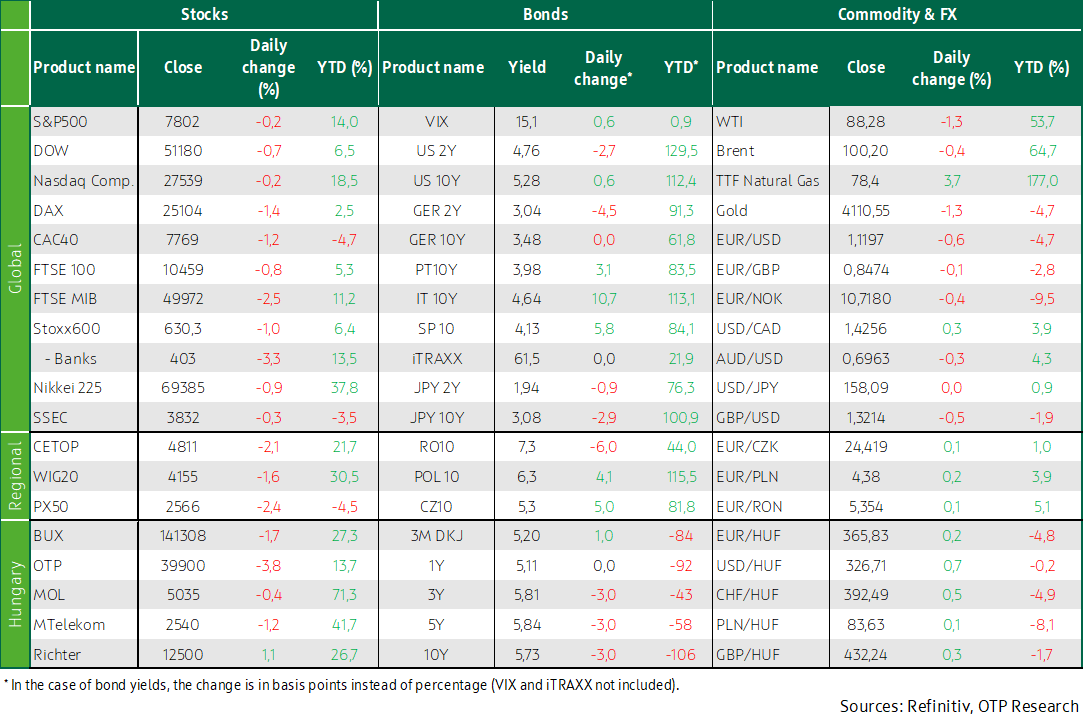
Wednesday's trading session was relatively uneventful, with a familiar pattern once again unfolding as the situation in the Persian Gulf drove oil prices higher, pushed yields up, and weighed on equity markets. The correction came within the day, as declining oil prices helped pull the US 10-year yield back from its multi-decade high of 5.36% to around 5.30%. The German 10-year yield followed a similar intraday pattern and ultimately ended the session unchanged from Tuesday's close at 3.48%. The EUR/USD closed at a 17-month low, just below 1.12. Equity markets, however, failed to regain momentum, with both the Nasdaq and the S&P pulling back from their recent highs as investors continued to digest the financing plans of AI-related companies. In Europe, banks led the declines, topping the list of worst-performing sectors. Regional stock markets, including Hungary’s, posted notable declines. The EUR/HUF rose to near 366. Hungarian long-term yields declined. Hungary’s September CPI came in slightly lower than expected. Asian equity indices declined in early trading. Today, German export data will be released, while weekly jobless claims figures are due from the US.
Market sentiment deteriorated, sending European equities lower
European equity markets closed sharply lower on Wednesday, snapping a three-day rally as soaring oil prices and rising bond yields dampened risk appetite. The pan-European Stoxx 600 fell 1.0%, sliding back toward its June low, while the DAX lost nearly 1.4% and the CAC 40 declined 1.2%. Banks suffered the steepest losses, with the Stoxx 600 Banks Index plunging 3.3%. Société Générale, Deutsche Bank, UniCredit and Intesa Sanpaolo were among the worst performers, ending the session down 4-5%. Technology stocks also retreated from their recent highs. BE Semiconductor Industries tumbled 8.5% after UBS downgraded the stock to a sell rating, citing risks surrounding the hybrid bonding technology used in the company's chip-packaging process. Automakers surrendered their earlier gains and finished slightly lower by the close. According to media reports, the European Commission is considering restrictions on imports of Chinese hybrid-electric vehicles. European Commissioner for Trade Maroš Šefčovič travelled to Beijing on Wednesday for talks aimed at reducing the EU’s trade deficit with China.
UK's Pennon Group PNN.L shed 18.6% after the water utility firm launched a fully underwritten 550 million pound ($728.5 million) rights issue and lowered its dividend in a bid to fix operational problems.
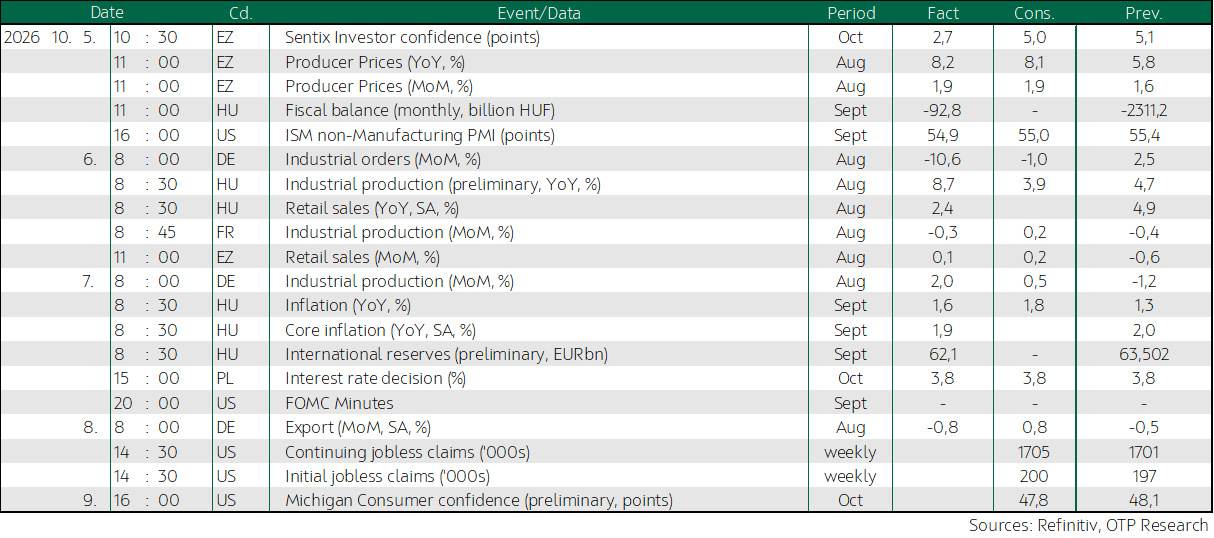
German industrial production data for August released yesterday showed a stronger-than-expected 2.0% month-on-month increase. This marked the fastest pace of expansion in the past year and a half, driven primarily by a 9.3% rise in construction output and a 5.3% increase in machinery manufacturing. Excluding construction and the energy sector, German industrial production grew by 0.6%. Meanwhile, automotive production declined 5.4% compared to the previous month. Output in energy-intensive industries fell 0.5% from July. On an annual basis, industrial production increased 2.3%, following a 1.8% contraction in July.
Sentiment also deteriorated across CEE markets, with the Czech PX falling 2.5%, the Polish WIG20 declining 1.6%, and the BUX dropping 1.7%. Among Hungarian blue chips, OTP posted the steepest decline, shedding 3.8% in line with broader European banking sector weakness, leaving the share price once again just below the 40,000 level. Magyar Telekom slipped 1.2%, while MOL eased 0.4%. Richter bucked the negative trend, closing with a gain of more than 1%.
The S&P and Nasdaq retreated from their record highs reached the previous day, while Brent remained above USD 100 per barrel
Wednesday's session also ended lower on Wall Street, with both the S&P 500 and the Nasdaq pulling back from the record highs reached a day earlier. The Dow slipped 0.7%, snapping a four-day winning streak, while the Nasdaq lost 0.2% after five consecutive days of gains. The latest developments in the Middle East once again fuelled soaring oil prices, reigniting inflation concerns and pushing government bond yields higher, weighing on overall market sentiment. The small-cap Russell 2000 index declined 1.3%. Among the S&P sector indices, industrials suffered the sharpest losses, while materials and real estate also posted notable declines. According to data from the Mortgage Bankers Association, the average interest rate on a 30-year fixed mortgage surged to a nearly three-year high last week following the rise in benchmark Treasury yields. The Philadelphia Housing Index and the homebuilder sub-index within the S&P fell 2.3% and 2.9%, respectively. Information technology and communication services posted more moderate declines, while the Philadelphia SE Semiconductor Index closed down by more than 1%. Healthcare performed strongly and emerged as the best-performing sector of the day, while the consumer sectors ended the session marginally in positive territory.
Relatively few company-specific developments emerged on Wednesday, although investors are already keeping a close eye on the Q3 earnings season set to begin next week. SpaceX declined 2.5% after media reports indicated that Elon Musk’s space company is seeking 40 billion dollars in financing to fund purchases of Nvidia chips. Levi Strauss fell nearly 2% in after-hours trading after the apparel company lowered its full-year revenue growth forecast.
Next week, the Q3 earnings season will kick into high gear, with investors set to digest results from four major banks on Tuesday: JPMorgan, Goldman Sachs, Wells Fargo and Citigroup. Particular attention is likely to focus on whether the massive investments being made in AI technologies are beginning to generate meaningful returns. At the same time, markets will closely monitor indicators of US consumer sentiment as inflationary pressures continue to build.
According to LSEG data, analysts currently expect aggregate earnings growth of 30.6% year-on-year for S&P 500 companies during the July-to-September period.
Oil prices moved higher at the start of the day after tankers transiting the Strait of Hormuz came under attack, reigniting concerns over supply shortages. At the same time, producers were forced to halt output as a tropical storm approached the Gulf of Mexico. Later in the session, reports about the release of international oil reserves eased price pressures, leading to a modest decline in both WTI and Brent crude prices. Nevertheless, Brent still closed above the 100 dollar-per-barrel mark. The price of European TTF natural gas soared nearly 4% on Wednesday amid fears of supply disruptions. Gold prices fell to a two-month low, weighed down by the strength of the US dollar.
Long-end yields on developed bond markets moved higher during the day but later corrected as pressures from the oil market eased. Hungarian long-term yields declined, while the forint weakened modestly
Oil prices posted meaningful gains at the start of trading on Wednesday, with government bond yields following suit. Brent crude's move back toward the 100 dollar-per-barrel level, driven by escalating tensions between Saudi Arabia and the Houthis as well as a storm heading toward major US oil-producing regions, reignited inflation concerns and pushed the yield on 30-year US Treasuries to a 24-year high. During the session, the US 10-year yield climbed as high as 5.36%, while the German 10-year yield rose to 3.52%. The trend later reversed, however, with bond yields retreating alongside easing oil prices, leaving only a modest increase or broadly unchanged yields by the close. Minutes from the Fed's September monetary policy meeting, at which policymakers unanimously approved the first rate hike since July 2023, highlighted differing views regarding the rationale behind the move. Some participants saw the hike as necessary to contain the effects of energy-price shocks, while others argued it was needed to curb demand-driven inflation. Nevertheless, all policymakers supported the decision, with the majority viewing at least one additional rate increase as necessary before year-end. According to CME FedWatch Tool data, financial markets currently assign roughly an 18% probability to another Fed rate hike at the end-of-October meeting, suggesting that such a move has been largely priced out. Looking ahead, futures markets imply that December this year, as well as March and June next year, are the most likely points at which an additional 25bp rate increase could be delivered. In the euro area, markets currently expect the ECB to raise rates twice more by March 2027, while swaps are pricing in roughly 75 basis points of additional tightening by the end of next year. The euro also came under pressure during yesterday's session, falling 0.6% to USD 1.1197, its lowest level in 17 months.
In the Hungarian government bond market, Wednesday's trading brought a modest decline in yields in the long-end segment, based on the Government Debt Management Agency's (ÁKK) early afternoon benchmark quotes. The 10-year yield fell to 5.73%. Wednesday's government bond switch auction was successful, with investors able to submit bids for bonds maturing in 2031 and 2038. Demand reached four-and-a-half times and ten times the offered amount, respectively, prompting the issuer to ultimately double and triple the quantities sold. In contrast, the six-month T-bill auction attracted relatively limited interest. The forint weakened slightly on Wednesday, with EUR/HUF rising toward the 366 level.
Yesterday, the Hungarian Central Statistical Office (KSH) released September CPI data, which came in slightly below consensus expectations. Nevertheless, headline CPI accelerated to 1.6% year-on-year from August. Looking at the main product categories, services and alcoholic beverages and tobacco products recorded notable price increases, while food prices and household energy costs declined. Core CPI eased further to 1.9%.
Today's highlights
Asian equity markets declined again on Thursday morning, with Japan’s Nikkei and the Shanghai Composite both falling 1.2%. The Hang Seng lost around 1%, while South Korean benchmark indices retreated by 2-3%. Investor sentiment was weighed down by concerns that the largest AI-related companies are aggressively seeking additional financing for their projects, further increasing their debt burdens.
Oil prices are moving higher again on Thursday morning, with Brent trading above 103 dollars per barrel and WTI near 89 dollars. The gains followed reports that the Trump administration had instructed the Pentagon to develop military options against Iran that could potentially be executed before the midterm elections. The development runs counter to the widely held expectation that President Donald Trump would avoid escalating tensions with Tehran ahead of the November vote. Meanwhile, oil producers operating in the Gulf of Mexico have shut in more than 510,000 barrels of daily crude output due to Tropical Storm Isaias, equivalent to roughly one-quarter of the region’s production.
Futures equity indices point to a weaker open in both Europe and the US.
Today, German export data are scheduled for release.
Investors will be watching earnings releases today from PepsiCo, Progressive, and Delta Air Lines, while attention will also be focused on the latest weekly US jobless claims data.
Get more out of your investments!
Global Markets Services
OTP Global Markets offers a broad range of services in the field of local and international money and capital markets.
Read morePrivate Banking Services
Personal care and expertise with OTP Private Banking, along with the knowledge, security, and innovations of a multinational banking group.
Read more