
OTP Morning Brief: Easing bond yields lifted equity markets on Tuesday
Related content
OTP Morning Brief: News of Anthropic's potential stock market debut drove the rally in the technology sector
Major European and US equity indices moved higher. In Europe, the defence sector led the gains, while technology stocks spearheaded the rally in the US. Anthropic submitted documentation for its stock market listing, putting the spotlight back on AI investment spending. Saudi Arabia and Iran held talks aimed at easing tensions between the two countries, while crude oil prices edged lower. There was little movement in developed bond markets, with investors focusing on the ECB's and the Fed's interest rate decisions due later this week. The US dollar extended its gains against the euro. The BUX climbed by more than 1% yesterday. The Hungarian forint continued to weaken against the major currencies. The earnings season continues today with major names such as Coca-Cola and Boeing reporting results.
OTP Morning Brief: Oil and gas prices hit multi-year highs as equity markets slide
By the end of last week, oil prices had climbed to their highest levels since spring, while European natural gas prices approached levels last seen in late 2022, driven by escalating tensions in the Middle East. Equity markets also turned lower by the end of the week: while the energy sector benefited from higher commodity prices and soared to record highs, all other sectors came under pressure. In the bond market, the US 10-year Treasury yield dipped back below 5%, while its German counterpart closed at a one-and-a-half-month low. French, Mediterranean, and CEE bond yields showed little movement on Friday, but over the course of the week they rose noticeably overall.
The rise in bond yields seen in recent days eased, supporting markets in both Europe and the US. In the euro area, Germany’s August industrial orders, French industrial output, and the region’s retail sales figures generally painted a negative picture. The BUX rose by 1.3%. In the US, both the S&P 500 and the Nasdaq closed at record highs. Although Brent crude started the day lower, it moved back toward the $100 per barrel mark by the close, driven by the Houthi attacks. A series of protests in France heightened uncertainty. The forint strengthened to nearly 365 against the euro. Asian equity indices declined in early trading. Today, Hungary’s CPI data will be worth watching.
European equities moved higher, while weak data pointed to a softer economic performance across the euro area in August
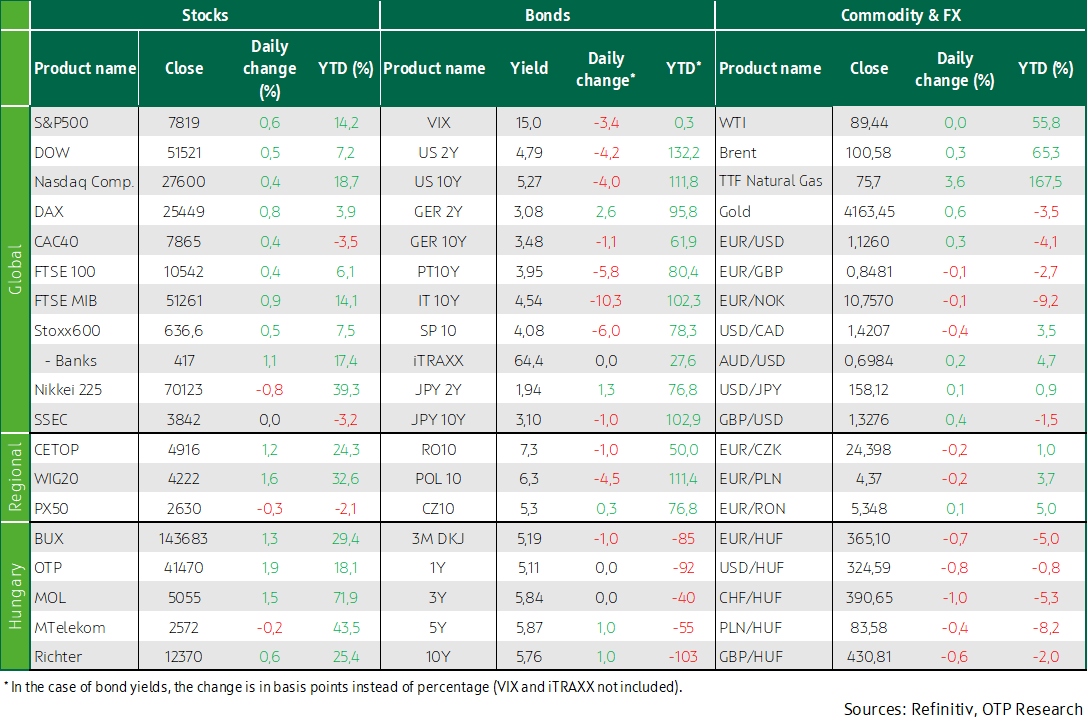
Most major European indices advanced as easing bond market pricing boosted investor sentiment. Germany’s DAX rose 0.8%, while France’s CAC 40 and the UK’s FTSE 100 gained 0.4% each, leaving the pan-European STOXX 600 up 0.5% by the close. Among sectors, travel and leisure led the rally with a 1.4% gain, followed by food and beverages at 1.3%, while most sectors finished Tuesday in positive territory.
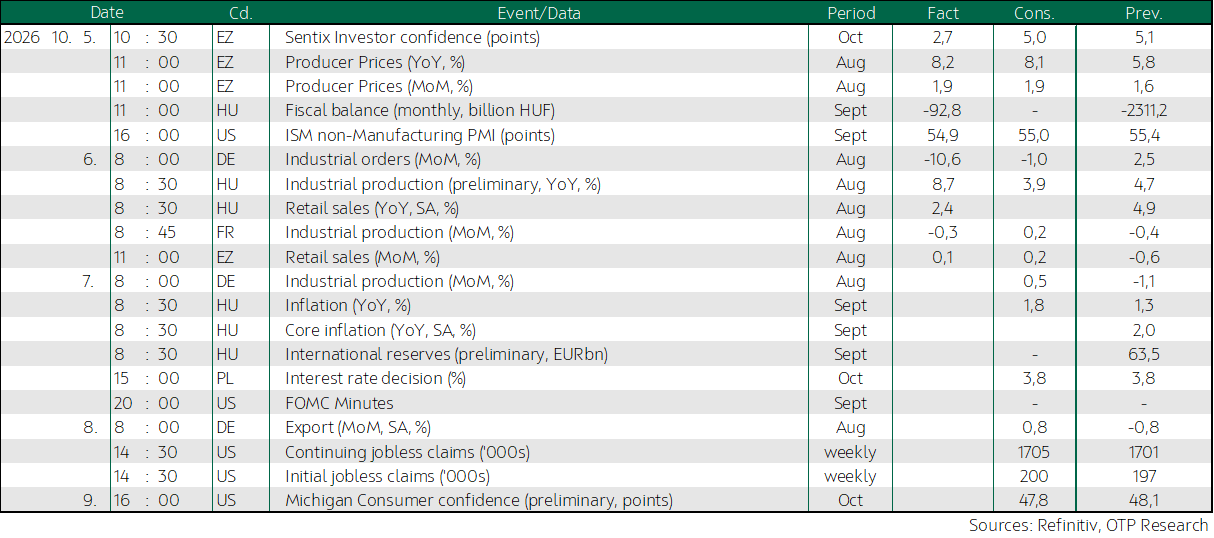
Several economic indicators released across the euro area yesterday painted a weak picture of the region’s Q3 performance. Germany’s industrial orders fell sharply by 10.6% month-on-month in August, driven by a decline in large-scale orders for aircraft, ships, rail equipment and military vehicles, far worse than the 1.0% contraction expected by analysts. In France, industrial output declined by 0.3% month-on-month in August 2026, compared to expectations for a 0.2% increase, following a 0.4% drop in July. The weakness was primarily attributable to the mining, utilities and water supply sectors, where output fell 2.4%, largely due to lower electricity generation. Meanwhile, euro area retail sales volumes increased by 0.1% month-on-month in August 2026, missing market expectations of 0.2% growth and only partially offsetting July’s 0.6% decline. The modest increase was mainly supported by stronger sales of non-food products, while fuel sales volumes plunged 1.9%, significantly weighing on overall retail activity.
Beyond the euro area, Hungarian data were also released. Retail sales in Hungary fell by 0.7% month-on-month in August, although they remained 2.4% higher year-on-year. Meanwhile, industrial production continued to expand, rising 1.0% month-on-month. On an annual basis, the sector was up 8.7% in August.
The mood across the CEE region was mostly positive, with Poland’s WIG20 gaining 1.6% and Hungary’s BUX rising 1.3%, while the PX50 posted a slight decline. Among Hungarian blue chips, OTP delivered the strongest performance of the day, advancing 1.9%.
The S&P 500 and the Nasdaq closed at record highs, while Brent finished the day above $100 per barrel once again
US equities also moved higher as pressure in bond markets eased somewhat. The Nasdaq (+0.4%) and the S&P 500 (+0.6%) both closed at record highs, while the Dow Jones added 0.5%. Chipmakers enjoyed a particularly strong session, with Marvell Technology rallying 5.8% after the semiconductor designer raised its 2028 revenue outlook, citing robust demand for data center chips. AMD shares gained 2.8% after CEO Lisa Su announced plans to significantly expand the company’s chip supply by 2027 to meet skyrocketing artificial intelligence demand. Meanwhile, Constellation Energy surged 12.3% after Alphabet signed a 3,590-megawatt power purchase agreement with the company.
According to the US Department of Commerce, the US trade deficit widened by 13.7% as imports climbed to a record high. Imports increased by 4.3% month-on-month and 28.4% year-on-year, reflecting robust domestic demand. Strong import growth was particularly evident in purchases related to AI investment, highlighting rising demand for the infrastructure required to support the sector. This trend could further intensify inflationary pressures, especially amid supply constraints associated with ongoing geopolitical conflicts.
Although Brent crude traded below $98 per barrel earlier in the day, helped by reports that oil exports passing through the Strait of Hormuz had, on some days, already exceeded pre-war levels, it nevertheless finished the session above $100 per barrel. The rebound followed reports from Saudi Arabia that a ballistic missile launched by the Houthis toward the city of Khamis Mushait had been intercepted and destroyed, reigniting supply concerns in the region.
Developed market bond yields eased, while funding concerns and a wave of protests kept French bonds under pressure
US Treasuries recovered on Tuesday after the sharp sell-off seen a day earlier had pushed long-term yields to multi-decade highs. Investors remained on the sidelines ahead of next week’s inflation data, looking for further guidance on the interest rate outlook and an opportunity to reassess recent market moves. The benchmark 10-year US Treasury yield fell 4.2 basis points to 5.269%, after reaching a 24-year high on Monday. At the short end of the curve, the 2-year Treasury yield declined 4.4 basis points to 4.789%. Euro area government bond yields also moved lower, while the spread between French and German 10-year government bond yields continued to narrow from the peak reached last Friday. The French 10-year yield dropped 8 basis points to 4.77%, while the German 10-year yield eased 1 basis point to 3.48%. Investors assessed whether the recent widening in France’s risk premium had been excessive and whether the move had occurred too rapidly. France’s borrowing costs have risen sharply in recent weeks, with the yield spread over German bonds reaching levels last seen during the 2011 euro area sovereign debt crisis. Concerns over the country’s deteriorating fiscal position have been the main driver, particularly with next year’s presidential election approaching. These worries were compounded on Tuesday as student protests over the state of the education system spread nationwide in France. In several locations, demonstrations turned violent, leading to thousands of arrests and numerous injuries, while the government, already under pressure from rising public debt and the upcoming election, sought to ease tensions with fresh reform pledges. The improvement in French bond market sentiment also supported the euro, which rose 0.3% against the dollar.
Only limited moves were seen along the Hungarian yield curve. The Government Debt Management Agency (ÁKK) offered HUF 30 billion of 3-month Treasury bills at auction and accepted bids for the full amount despite strong demand, at an average yield of 5.17%. The forint strengthened by 0.7% against the euro, ending the day slightly above the 365 level.
Today's highlights
Asian equities declined on Wednesday. Japan’s Nikkei fell 0.8%, mainly due to weakness in artificial intelligence-related stocks as investors took profits following the market’s recent rapid rally. South Korea’s KOSPI was down 1.5%, while Hong Kong’s Hang Seng lost 0.7%.
The Hungarian Central Statistical Office (KSH) is set to release September CPI data today, while August industrial production figures from Germany are also due. In Poland, the central bank will announce its latest interest rate decision, while in the US, the minutes from the Federal Reserve’s most recent policy meeting will be published.
The Government Debt Management Agency (ÁKK) will offer HUF 20 billion of 6-month Treasury bills at today’s auction, while several bond exchange auctions are also scheduled.
Get more out of your investments!
Global Markets Services
OTP Global Markets offers a broad range of services in the field of local and international money and capital markets.
Read morePrivate Banking Services
Personal care and expertise with OTP Private Banking, along with the knowledge, security, and innovations of a multinational banking group.
Read more