
OTP Morning Brief: Major stock indices mostly advanced; crude oil prices eased
Related content
OTP Morning Brief: Oil and gas prices hit multi-year highs as equity markets slide
By the end of last week, oil prices had climbed to their highest levels since spring, while European natural gas prices approached levels last seen in late 2022, driven by escalating tensions in the Middle East. Equity markets also turned lower by the end of the week: while the energy sector benefited from higher commodity prices and soared to record highs, all other sectors came under pressure. In the bond market, the US 10-year Treasury yield dipped back below 5%, while its German counterpart closed at a one-and-a-half-month low. French, Mediterranean, and CEE bond yields showed little movement on Friday, but over the course of the week they rose noticeably overall.
OTP Morning Brief: Earnings season continues to drive equities higher, while the French 10-year yield climbs above 5%
Stock markets moved higher yesterday in both Europe and the US, with technology stocks leading the gains on both sides of the Atlantic. Individual earnings reports released so far do not indicate that the AI investment boom is set to slow in the coming months. French financial indicators, however, are coming under increasing pressure from social and political uncertainty across both the corporate and public sectors: while French retail giant Carrefour issued a profit warning due to the unrest, French long-term bond yields soared to their highest level since 2002. The rise in yields also affected other countries, with the yield on 10-year Hungarian government bonds moving higher as well.
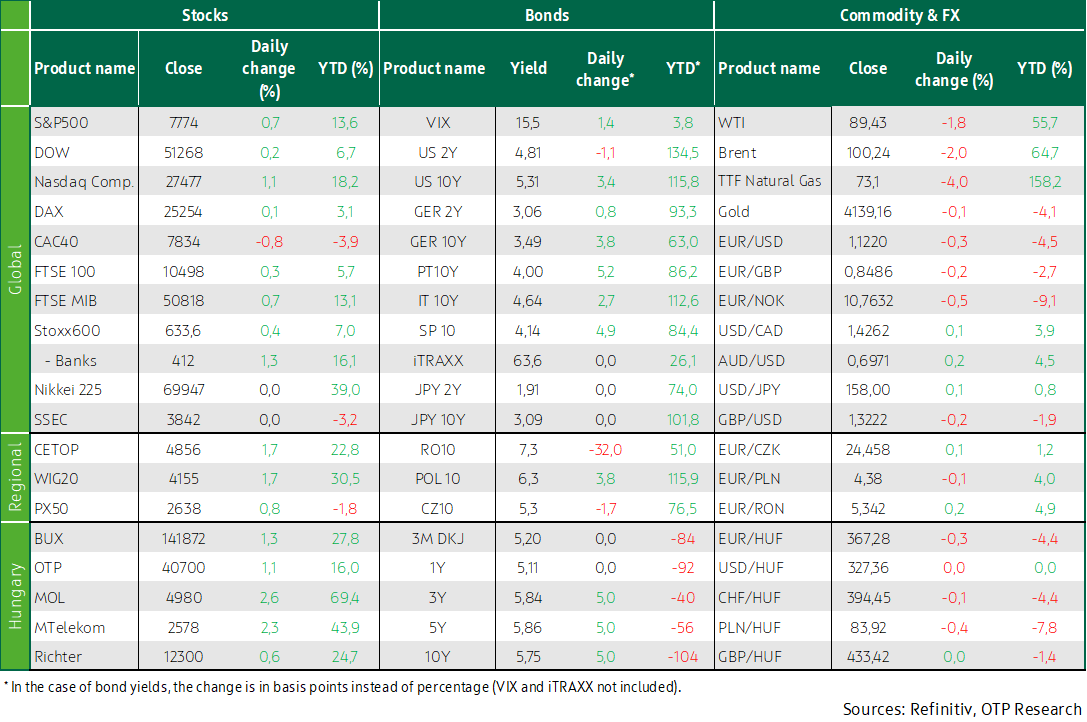
Investor sentiment improved across global equity markets on Monday. The STOXX 600 gained 0.4%, while the NASDAQ closed at a new all-time high. CEE equity markets also moved higher, with the BUX gaining 1.3%. Long-term bond yields continued to rise, with the US 10-year Treasury yield increasing to 5.31%. The Hungarian 10-year government bond yield rose by 5 basis points to 5.75%. The US dollar strengthened against the euro, while oil prices eased. Domestic and eurozone business sentiment indicators are due to be released today.
Major European indices mostly moved higher
Major European indices mostly moved higher on Monday, with the exception of France’s CAC 40. The pan-European STOXX 600 gained 0.4%, led by advances in the mining and banking sectors, which were among the strongest-performing industry groups. The French market underperformed, weighed down by a 10% drop in Schneider Electric shares after investors reacted negatively to the company’s planned USD 22.6 billion acquisition of US-based PTC (+33.5%). Concerns over a nationwide wave of protests, as well as growing worries about the sustainability of France’s fiscal and debt trajectory, also contributed to the weaker performance of the French equity market.
CEE equity markets moved higher, with the WIG20 gaining 1.7%, the PX50 advancing 0.8%, and the BUX rising 1.3%. The strong performance of the Hungarian market was supported by all major blue-chip stocks: OTP gained 1.1%, MOL advanced 2.6%, Magyar Telekom climbed 2.3%, while Richter added 0.6%.
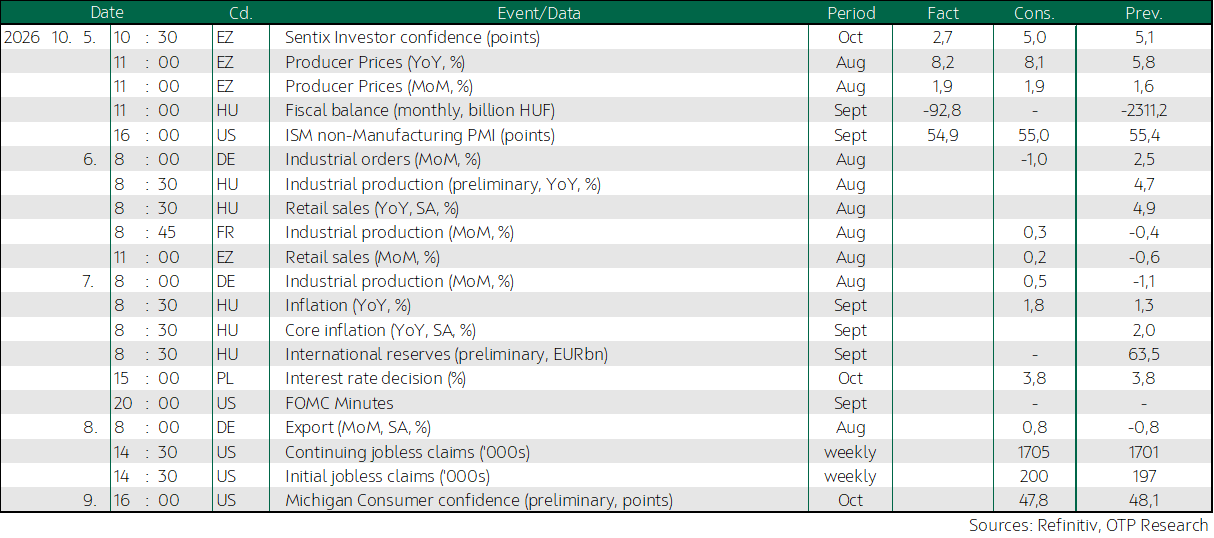
Producer price inflation in the euro area accelerated further in August. The producer price index rose by 1.9% month-on-month, following a 1.6% increase in July, while annual producer price inflation climbed to 8.2% from 5.8% in the previous month, marking its highest level since February 2023. The increase was driven primarily by higher energy prices.
At the same time, investor sentiment in the euro area deteriorated, with the October Sentix index falling to 2.7 points from 5.1 points in September, missing market expectations. The decline was driven primarily by a worsening assessment of the economic outlook, while perceptions of current conditions remained broadly unchanged.
In Hungary, the budget deficit narrowed to HUF 92.8 billion in September following the exceptionally high shortfall recorded in August. Over the first nine months of the year, the cumulative deficit reached HUF 5,262 billion.
The NASDAQ reached a new record high; crude oil prices eased
Investor sentiment continued to be shaped by geopolitical developments and expectations regarding monetary policy. While risks related to the Middle East conflict remain a key factor, investors are increasingly turning their attention to the upcoming earnings season and the Fed’s expected policy moves.
Easing oil prices and softer expectations for further rate hikes supported risk appetite yesterday, helping Wall Street’s major indices close higher. S&P sector indices delivered a broadly positive performance, including technology stocks, which helped lift the NASDAQ by 1.1% to a new record high. Materials and energy were also among the best-performing sectors.
Among the major technology companies, Nvidia gained 2.1%, Microsoft advanced 1.5%, Meta rose 1.9%, while Tesla climbed 2.2%. On the corporate front, RXO surged 22.5% following a takeover offer, while shares of the acquiring company, C.H. Robinson, fell 11%.
Among the latest data releases, the ISM Services PMI was worth highlighting. The index eased to 54.9 in September from 55.4 in August, remaining above the 50-point threshold that signals expansion for the 27th consecutive month. Growth in services activity and new orders moderated, while the employment component returned to expansion territory and the prices index remained elevated.
Brent and WTI crude oil prices eased yesterday. Several factors contributed to the decline: OPEC+ decided to leave its November production targets unchanged, G7 countries agreed to release 100 million barrels from their strategic oil and fuel reserves, Saudi Aramco unexpectedly cut its official selling prices for November deliveries to Asia, and shipping and export data indicated that traffic through the Strait of Hormuz is recovering and approaching pre-war levels.
US and German bond yields moved higher; the dollar strengthened against the euro
In the US, the long end of the yield curve moved higher. The 2-year Treasury yield closed unchanged at 4.83%, while the benchmark 10-year yield rose by 3 basis points to 5.31%. Long-term yields continue to face upward pressure from concerns over fiscal sustainability, an unsustainable debt trajectory, and inflation remaining elevated for an extended period.
In Europe, bond yields edged higher, with the German 10-year yield rising by 1 basis point to 3.5%. In the foreign exchange market, the euro weakened against the US dollar, with the EUR/USD exchange rate trading near 1.122. The euro’s decline was driven by concerns over France’s fiscal position, as well as the persistently elevated US yield environment.
The rise in global yields was also felt in the Hungarian market. Yields moved higher across the longer end of the domestic yield curve, with the Hungarian 10-year government bond yield rising to 5.75%. The forint was broadly unchanged against the major currencies, with the euro trading at 367.21 and the US dollar at 327.37.
Today's highlights
Asian markets opened higher on Tuesday morning, with Japan’s Nikkei gaining 0.8%, while the MSCI Asia Pacific ex-Japan Index advanced 0.2%. In the oil market, Brent crude stabilized at around USD 100 per barrel after falling nearly 2% on Monday.
Hungary’s Central Statistical Office (KSH) is set to release August industrial production and retail sales data today. Germany will publish its industrial orders figures, while France is due to report industrial production data. In the euro area, August retail sales figures are scheduled for release.
The Government Debt Management Agency (ÁKK) will offer HUF 30 billion worth of three-month discount Treasury bills at its auction today.
Get more out of your investments!
Global Markets Services
OTP Global Markets offers a broad range of services in the field of local and international money and capital markets.
Read morePrivate Banking Services
Personal care and expertise with OTP Private Banking, along with the knowledge, security, and innovations of a multinational banking group.
Read more