
OTP Morning Brief: Stocks advanced, long-term yields continued to climb, while eurozone inflation came in unexpectedly high
Related content
OTP Morning Brief: Earnings season continues to drive equities higher, while the French 10-year yield climbs above 5%
Stock markets moved higher yesterday in both Europe and the US, with technology stocks leading the gains on both sides of the Atlantic. Individual earnings reports released so far do not indicate that the AI investment boom is set to slow in the coming months. French financial indicators, however, are coming under increasing pressure from social and political uncertainty across both the corporate and public sectors: while French retail giant Carrefour issued a profit warning due to the unrest, French long-term bond yields soared to their highest level since 2002. The rise in yields also affected other countries, with the yield on 10-year Hungarian government bonds moving higher as well.
OTP Morning Brief: Better-than-expected earnings reports supported US equity indices
Major European indices closed slightly lower yesterday; Germany’s ZEW index declined more than expected; the UK unemployment rate developed favourably; and the MNB left its base rate unchanged, in line with expectations. Major indices closed mostly higher, supported by favourable earnings reports; several companies with significant AI exposure rebounded following the recent sell-off, while housing market data continued to point to weak activity in the US. Long-term US and European bond yields edged lower, while Hungarian long-term government bond yields rose more markedly following their decline in recent days. Today, UK CPI data will be in the spotlight.
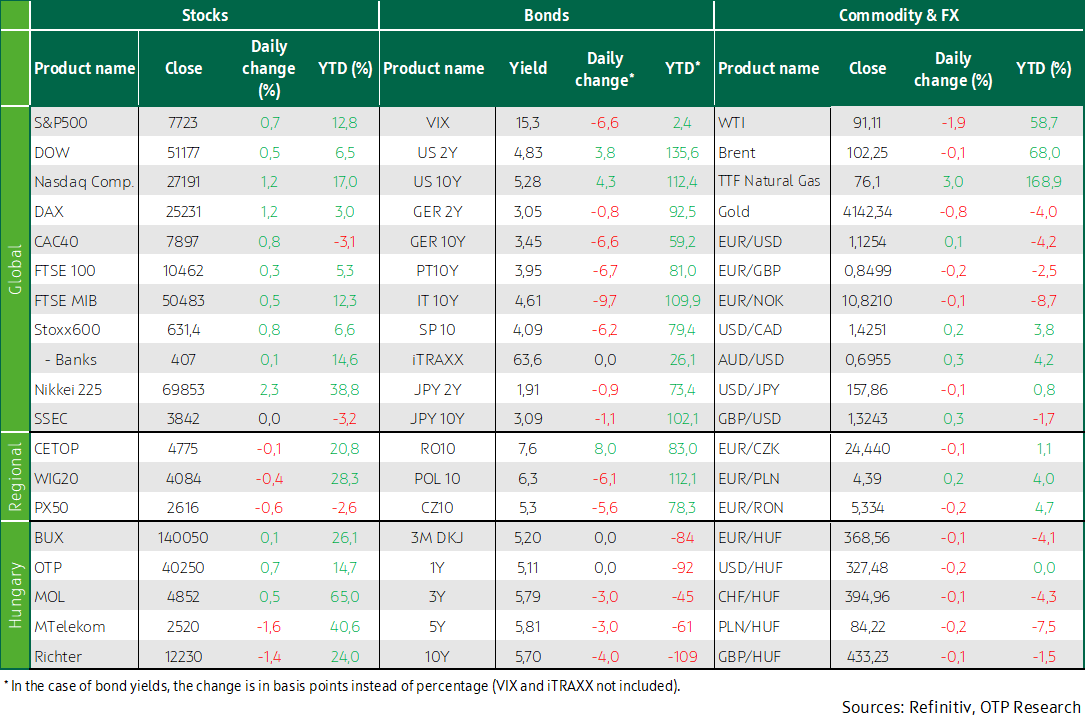
European and US equity markets both closed higher on Friday, including the Hungarian stock exchange, despite what had otherwise been a particularly weak week for the market. Bond markets showed a more divergent picture across countries, with long-term yields rising in the US, Japan and France, while they edged lower in Germany and across the CEE region. An unexpectedly high inflation reading was reported in the eurozone: headline CPI rose by 3.8% year-on-year in September, well above both the 3.6% market consensus and August’s 3.2% reading. This could further fuel expectations of additional rate hikes in Europe. In the US, however, labour market data showed a slight deterioration, making an October Fed rate hike appear even less likely.
Energy markets: oil prices eased, while natural gas reached a weekly high on Friday
Geopolitical developments that shape energy markets saw some modest progress. According to reports, Donald Trump sought to pressure European partners into releasing larger volumes from their strategic diesel reserves by raising the possibility of restrictions on US diesel exports. The discussions reportedly involved the release of 50 million barrels (around 7 million tonnes) of diesel, equivalent to roughly 15% of the EU’s total diesel reserves and about 70% of its annual import requirement. European countries did discuss the issue on Friday, and Trump claimed they had agreed to release part of the reserves. If confirmed, such a move could help ease market pressures caused by disruptions to Middle Eastern and Russian diesel exports, supporting lower diesel prices and, in turn, improving the outlook for European CPI.
Meanwhile, oil prices edged lower on Friday, with WTI crude falling 1.9% to USD 91.1 per barrel and Brent declining 0.1% to USD 102.3 per barrel. On a weekly basis, both benchmarks also moved lower, with WTI down 1.6% and Brent falling 2.9%, although prices still remain roughly 50% above their February levels. Meanwhile, the price of European natural gas (TTF) rose 2.4% on Friday to EUR 75.8/MWh and was 6.2% higher than a week earlier.
Western Europe: equities rebound, inflation accelerates
Following Thursday’s gloomy session, European equities staged a modest rebound on Friday. The STOXX 600 advanced 0.8%, while the DAX gained 1.2% and the CAC 40 rose 0.8%. Despite the recovery, weekly performance remained weak, with all three indices ending the week roughly 1-2% lower. Nearly every sector posted gains on Friday, led by basic materials (+2.2%), technology (+2.6%), and telecommunications (+1.8%). Optical semiconductor manufacturer ams-OSRAM soared 15%, taking its year-to-date gain to nearly 200%. Meanwhile, IG Group, one of the world's leading online trading platforms, plunged 23% after reporting lower revenues, driven primarily by a decline in recoveries from clients who incurred losses on derivative positions.
The day’s key release was undoubtedly the eurozone’s preliminary inflation data. Consumer prices rose 3.8% year-on-year in September, delivering a negative surprise relative to the 3.6% consensus forecast and marking an acceleration from 3.2% in August. The unexpectedly strong increase in prices was driven primarily by the sharp rise in energy costs, including gasoline, diesel and natural gas prices during September. At the same time, core CPI, which excludes energy and food prices, also accelerated, albeit much more modestly, reaching 2.5% year-on-year in September, compared with 2.4% in August. These figures continue to paint a complex picture regarding the ECB’s likely policy path. While the acceleration in headline CPI would normally support the case for further policy tightening, the more subdued increase in core CPI suggests that higher energy prices have not yet broadly filtered through to the rest of the economy or inflation expectations. This would argue against the ECB rushing into additional rate hikes, although core CPI at 2.5% remains above the eurozone’s 2% inflation target in its own right. For now, market consensus does not anticipate further tightening at the ECB’s October policy meeting. However, investors are pricing in an additional 25-basis-point hike in December, which would take the deposit rate to 2.75%, with expectations for it to rise further to 3.25% by the end of 2027. Rate hike expectations are also being supported by the continued resilience of the European economy despite geopolitical tensions and elevated energy prices. Reflecting this strength, Bundesbank President Joachim Nagel reported on Friday that forecasts for German economic growth this year had been revised upward from 0.5% to around 1%, primarily due to stronger-than-expected exports and increased German government spending.
CEE and Hungary: quieter trading in equities and currencies on the final day of the week
Regional equity markets delivered mixed performance on Friday, with Prague and Warsaw closing 0.6% and 0.4% lower, respectively, while the BUX managed to post a marginal gain of 0.1%. Looking at the week as a whole, however, all three markets ended firmly in negative territory. The Hungarian index suffered the steepest decline, falling 7%, while the Polish and Czech markets also posted losses of 2% and 4%, respectively. All four Hungarian blue chips had a difficult week: OTP dropped 12%, MOL declined 6%, while Richter and Magyar Telekom also moved lower, losing 2% and 1%, respectively.
Friday was largely uneventful in regional currency markets, with exchange rate movements limited to 0.1-0.2%. Looking at the week as a whole, however, CEE currencies weakened against the euro. The largest declines were recorded by the Hungarian forint (-0.9%) and the Romanian leu (-1.1%), while the Polish zloty and the Czech koruna also depreciated by 0.3% each.
US: resilient indices, slightly deteriorating labour market conditions
All three major US equity indices advanced on Friday, with the S&P 500 gaining 0.7%, the Dow Jones rising 0.5%, and the Nasdaq climbing 1.2%. Once again, the technology sector led the rally. Looking at the week as a whole, the S&P 500 and the Dow Jones posted modest declines of 0.3% and 1.3%, respectively, while the Nasdaq managed to rise 0.5%, reaching its second-highest closing level on record. The index's only higher close this year was recorded on 22 September.
Among Friday’s macro releases, one of the most closely watched indicators, the unemployment rate, was published. The figure came in at 4.2% in September, representing a slight increase from both August’s 4.1% reading and the 4.1% market consensus, although it remained below the 4.3-4.4% levels recorded earlier this year. While it would be premature to draw far-reaching conclusions from a modestly weaker-than-expected labour market print, the softer data nevertheless made an October Fed rate hike appear even less likely. That said, markets had already assigned less than a 25% probability to further tightening as early as Thursday.
Bond markets diverged: long-term US yields moved higher, while German yields declined
Global bond markets showed less synchronised movements this week, including on Friday, than was the case throughout September. While yields in some markets, including the US, Japan and France, continued to push to new highs, others, such as Germany, Spain and the CEE region, showed signs of easing. For example, the yield on the US 10-year Treasury reached its highest level since April 2002, climbing to 5.29% on Wednesday before a brief pullback on Thursday and then closing Friday virtually unchanged at 5.28%. French 10-year government bond yields also rose above 5.0%, their highest level since 2012, while Japan's 10-year yield finished the week at a peak of 3.1%. In contrast, the German 10-year Bund yield ended Friday at 3.45%, down 7 basis points from the previous day and 17 basis points below its level a week earlier. At the shorter end of the curve, 2-year yields in both the US and Germany declined compared with the previous week, although the move was modest in the US (-3 bps) and considerably larger in Germany (-23 bps).
Across the region, Czech, Polish and Hungarian 10-year government bond yields all declined by 3-4 basis points on Friday and ended the week 6-10 basis points below their levels from the previous week.
Today's highlights
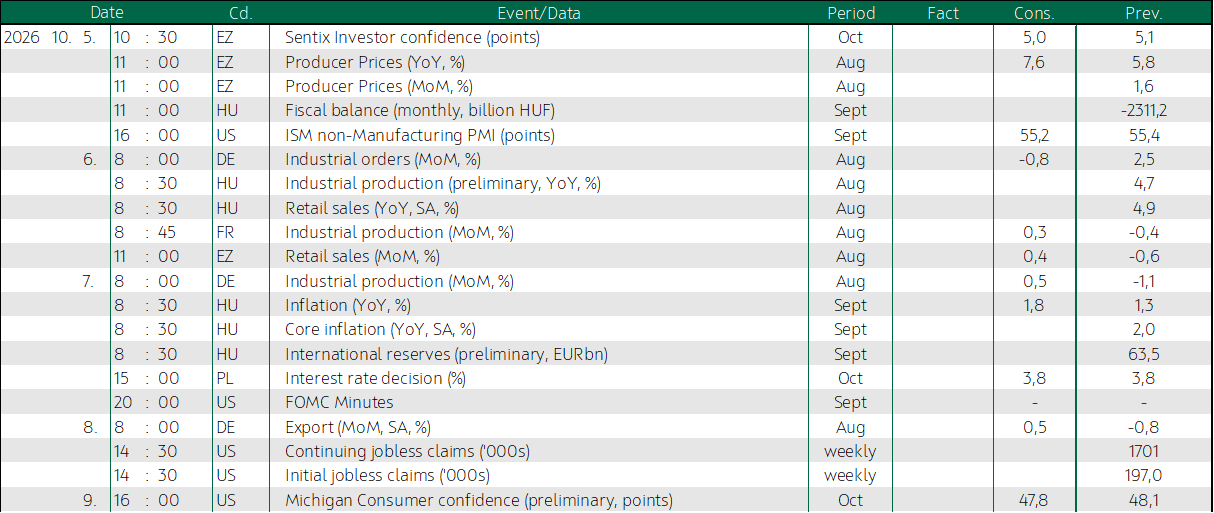
On Monday, the US services PMI will be released.
Asian markets presented a generally positive picture as of 7:00 a.m. Hungarian time, with the Nikkei up 2.1%, the KOSPI gaining 0.5%, while the Hang Seng was broadly unchanged, edging down 0.1%.
Get more out of your investments!
Global Markets Services
OTP Global Markets offers a broad range of services in the field of local and international money and capital markets.
Read morePrivate Banking Services
Personal care and expertise with OTP Private Banking, along with the knowledge, security, and innovations of a multinational banking group.
Read more