
OTP Morning Brief: Developed market bond yields eased following remarks from Fed policymakers
Related content
OTP Morning Brief: Earnings season continues to drive equities higher, while the French 10-year yield climbs above 5%
Stock markets moved higher yesterday in both Europe and the US, with technology stocks leading the gains on both sides of the Atlantic. Individual earnings reports released so far do not indicate that the AI investment boom is set to slow in the coming months. French financial indicators, however, are coming under increasing pressure from social and political uncertainty across both the corporate and public sectors: while French retail giant Carrefour issued a profit warning due to the unrest, French long-term bond yields soared to their highest level since 2002. The rise in yields also affected other countries, with the yield on 10-year Hungarian government bonds moving higher as well.
OTP Morning Brief: Better-than-expected earnings reports supported US equity indices
Major European indices closed slightly lower yesterday; Germany’s ZEW index declined more than expected; the UK unemployment rate developed favourably; and the MNB left its base rate unchanged, in line with expectations. Major indices closed mostly higher, supported by favourable earnings reports; several companies with significant AI exposure rebounded following the recent sell-off, while housing market data continued to point to weak activity in the US. Long-term US and European bond yields edged lower, while Hungarian long-term government bond yields rose more markedly following their decline in recent days. Today, UK CPI data will be in the spotlight.
Leading Western European indices fell by more than 1% on Thursday. Wall Street indices posted modest gains. The energy and technology sectors were the day's top performers. Bond yields declined following a volatile trading session. Fed policymakers called for patience regarding further rate hikes. The probability of an October rate hike fell below 25% in market pricing. The dollar continued to strengthen against the euro. The Hungarian Central Statistical Office (KSH) reported a budget deficit of 3.3% in Q2. The September Manufacturing PMI reinforced the positive turnaround trend in the Hungarian industrial sector. Today, investors will pay close attention to the euro area's September CPI data and US labour market releases.
Leading Western European stock markets fell by more than 1%
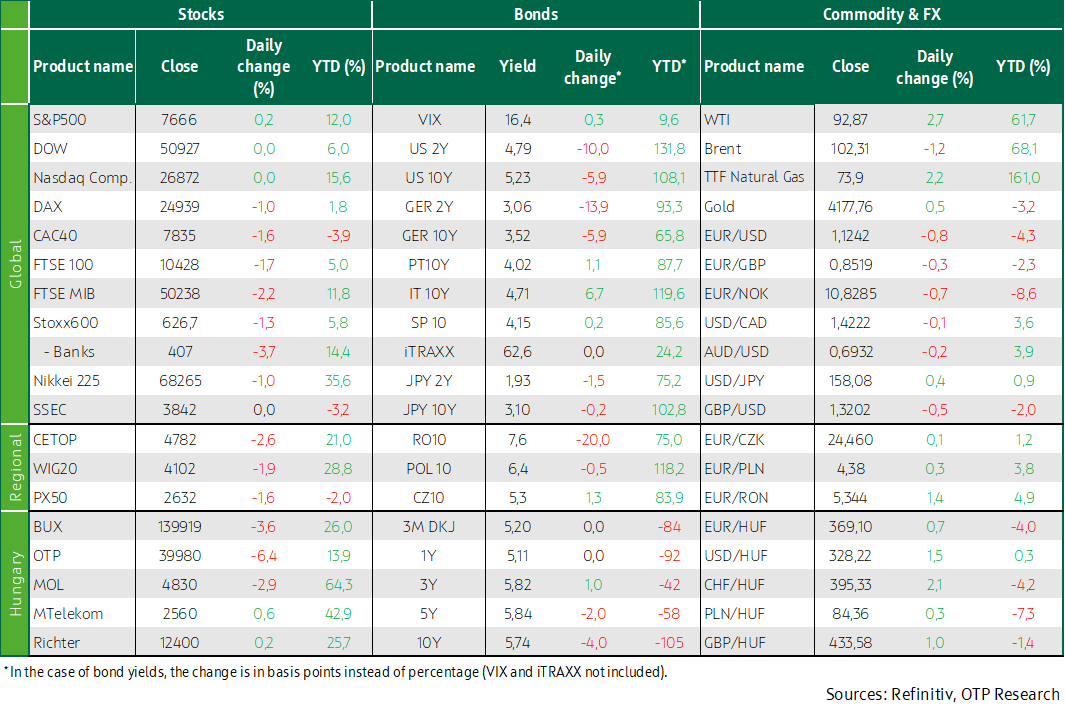
Leading Western European indices closed Thursday's session with losses exceeding 1%, with the STOXX 600 declining 1.3%. The banking sector was among the worst performers, falling 3.7%. Among UK lenders, HSBC and Barclays both dropped 4.1%, while Lloyds lost 4.5%, as investors grew increasingly concerned about the UK's fiscal position ahead of this month's budget announcement.
Among individual stocks, Zealand Pharma shares fell 6.1% after clinical trial results were released for Boehringer Ingelheim’s obesity drug, survodutide. In contrast, Capgemini surged 7.3%, making it the best-performing constituent of the STOXX 600. The broader technology sector rose 0.5%.
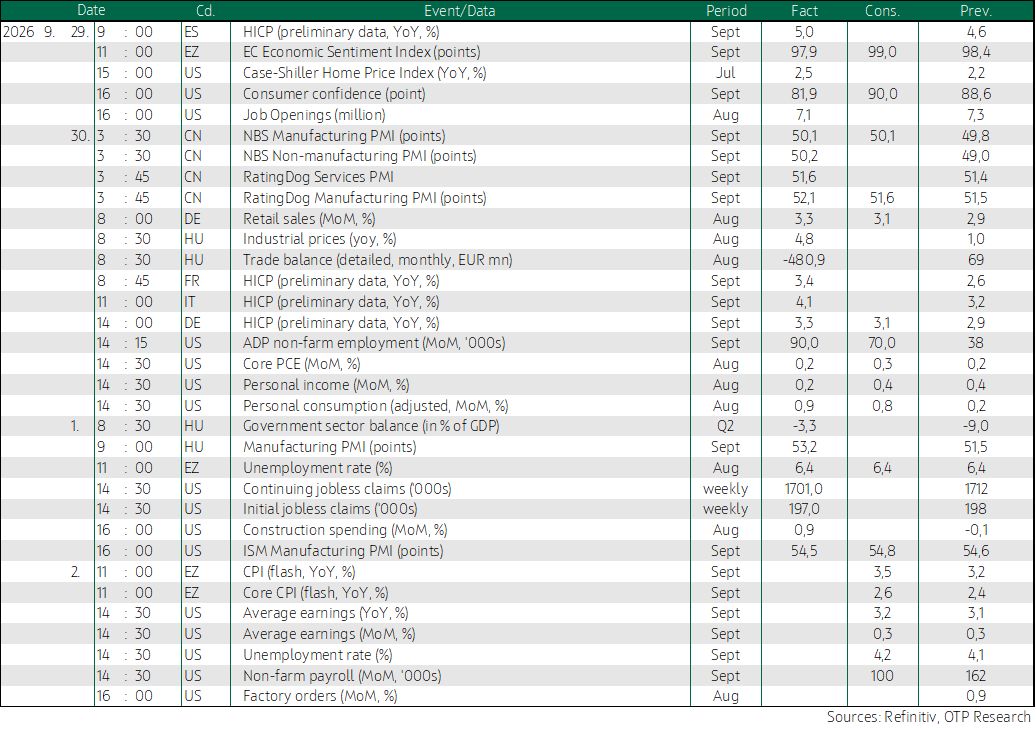
The unemployment rate in the euro area remained unchanged at 6.4% in August.
According to data released by the Hungarian Central Statistical Office (KSH), Hungary's budget deficit stood at 3.3% of GDP in Q2. Combined with the 9.0% figure recorded in Q1, this resulted in a fiscal deficit equivalent to 6.2% of GDP in the first half of the year. Signs of a positive turning point have been visible in the Hungarian industrial sector since spring. This assessment was reinforced by the September Manufacturing PMI, which rose from 51.5 to 53.2 points.
The BUX underperformed the region, falling 3.6%. Among the blue chips, OTP and MOL weighed on the index, while Richter and Magyar Telekom posted modest gains. The Czech PX50 declined 1.6%, while Poland's WIG20 lost 1.9%.
Modest gains in the US
On Thursday, all three major US equity indices closed modestly higher after recovering from early losses. Rising oil prices continued to fuel inflation concerns. Brent crude climbed by more than $4 during the session after China suspended fuel exports. Amid the rise in oil prices, the S&P 500 energy sector advanced 1.9%, making it the best-performing sector among the index's 11 major groups. The technology sector also posted gains, rising 0.8%. Software stocks moved 1.0% higher following Accenture's earnings release. Shares of the IT consulting firm soared nearly 16% after the company projected annual revenue growth above analyst expectations. Accenture's strong performance also provided support for the share price of its European peer, Capgemini. Meanwhile, Micron Technology gained 3% after the chipmaker reported a better-than-expected revenue outlook.
Following remarks from New York Fed President John Williams, Fed Vice Chair Philip Jefferson also stressed that there is no need to rush monetary policy decisions. As a result, market pricing reflected a further decline in the probability of an October rate hike, which fell below 25%. In recent months, market expectations regarding additional rate hikes had moved ahead of both analyst consensus and, at times, policymakers’ own guidance in both Europe and the US. Comments from Fed officials may therefore have been aimed, at least in part, at providing clearer direction to markets. Following Jefferson’s remarks, however, Minneapolis Fed President Neel Kashkari stated that he still expects further rate hikes, although he is not convinced that the next move needs to come as early as this month.
The Institute for Supply Management (ISM) reported that US manufacturing activity was little changed in September, while input prices rose sharply amid strong demand, pointing to persistent inflationary pressures. The number of initial jobless claims remained below 200,000 for a third consecutive week, continuing to signal strength in the labour market.
Developed market bond yields declined following a volatile trading session
Partly in response to Philip Jefferson’s remarks, US Treasury yields reversed their initial gains and moved lower on Thursday. The 10-year yield fell by 6 basis points to 5.23%, while the yield on the two-year Treasury note, which typically tracks Fed rate expectations closely, declined by around 10 basis points. The German 10-year Bund yield also eased by nearly 6 basis points. Meanwhile, the yield on France’s 10-year government bond soared to 4.92%, its highest level since 2002, ahead of the presentation of the government's 2027 budget. The fiscal package includes unpopular austerity measures, although it remains uncertain whether meaningful fiscal consolidation can be achieved amid the current political deadlock.
The dollar continued to strengthen against the euro on Thursday, gaining 0.8% and reaching the 1.124 exchange rate level. The Hungarian forint weakened 0.7% against the euro, closing at 369.10, while the yield on the Hungarian 10-year government bond fell by 4 basis points to 5.74%. Meanwhile, the Government Debt Management Agency (ÁKK) sold HUF 11 billion, HUF 20 billion and HUF 43 billion of 3-year, 5-year and 10-year government bonds, respectively, at its auction yesterday.
Today's highlights
Due to the Chinese National Day holiday, the SSEC will remain closed between 1 and 7 October. Approaching the close, Japan’s Nikkei was down 1.0%, while Hong Kong’s Hang Seng fell 2.6%. In contrast, South Korea’s KOSPI was trading 0.2% higher.
Following national CPI releases from member states, the euro area's September CPI figure is due on Friday. In the US, investors will focus on labour market data, including the non-farm payrolls report, one of the most closely watched indicators among analysts.
Get more out of your investments!
Global Markets Services
OTP Global Markets offers a broad range of services in the field of local and international money and capital markets.
Read morePrivate Banking Services
Personal care and expertise with OTP Private Banking, along with the knowledge, security, and innovations of a multinational banking group.
Read more