
OTP Morning Brief: Favourable inflation data cooled rate hike expectations in the US
Related content
OTP Morning Brief: Better-than-expected earnings reports supported US equity indices
Major European indices closed slightly lower yesterday; Germany’s ZEW index declined more than expected; the UK unemployment rate developed favourably; and the MNB left its base rate unchanged, in line with expectations. Major indices closed mostly higher, supported by favourable earnings reports; several companies with significant AI exposure rebounded following the recent sell-off, while housing market data continued to point to weak activity in the US. Long-term US and European bond yields edged lower, while Hungarian long-term government bond yields rose more markedly following their decline in recent days. Today, UK CPI data will be in the spotlight.
OTP Morning Brief: Major indices started the week lower in Europe, while US equities advanced
Following last week's weak performance, the US equity market started the week on a stronger footing, while in France and across the broader euro area investor sentiment was weighed down by domestic political uncertainty. At the same time, market participants were positioning ahead of this week's earnings releases from Meta, Tesla and SpaceX. Bond yields edged higher across developed market sovereign debt markets. In Hungary, Péter Magyar outlined key details of the 2027 budget proposal. Most Asian equity markets traded in negative territory during the morning session.
The Fed’s preferred PCE gauge came in below expectations, easing rate hike expectations in the US, at the same time, several other data releases pointed to continued strength in domestic demand. However, this was not enough to save US equities, with the S&P 500 posting sharp losses both on Wednesday and over the course of September as a whole. Sentiment was also negative in Europe, as elevated CPI readings from several countries weighed on markets and pushed equity indices lower. Different inflation releases drove divergent moves in bond markets, with yields rising in the US while declining in Germany and Hungary. Asian equity markets traded higher, while further rate hikes may be on the horizon in Japan. Today, investors will primarily focus on Hungary’s Q2 general government balance data.
Major European indices ended September lower, while negative news emerged from Germany
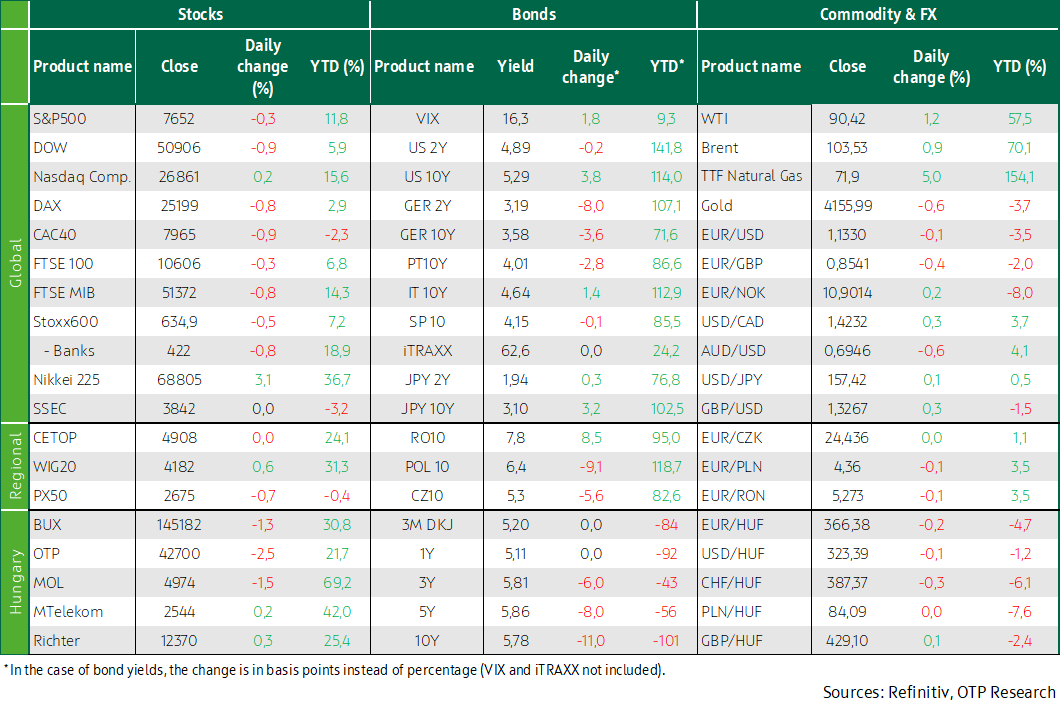
European markets mostly declined on Wednesday as a surge in global bond yields reduced appetite for riskier assets, while investors continued to assess the implications of softer-than-expected US inflation data. The pan-European STOXX 600 closed 0.5% lower, making September its first losing month in six months, with a decline of 2.5%. Among the major national indices, the CAC 40 led losses with a 0.9% drop, followed by the DAX, down 0.8%, and the FTSE 100, which fell 0.3%. For the month as a whole, both the DAX and CAC 40 lost 5.2%, while the FTSE 100 posted a more modest decline of 2.0%. Most STOXX 600 sectors ended the session in negative territory. Banking stocks fell 0.8%, while industrial shares declined 0.7%. Insurers were the worst performers, with the sector shedding 1.4%. Energy stocks dropped 0.9% on the day but still delivered a 2.7% monthly gain, making them the best-performing sector over the period. The UK market received support from utility stocks after British Prime Minister Andy Burnham announced several policy measures affecting the sector. Shares of Pennon, SSE and National Grid advanced by between 2.0% and 2.6%, helping the broader European utilities sector close 0.6% higher.
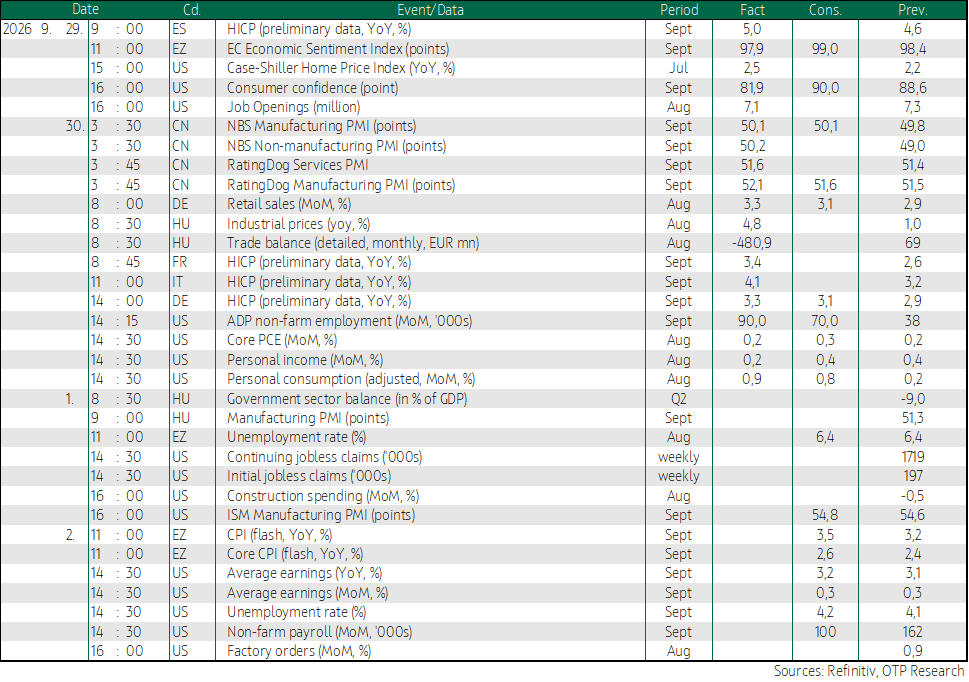
The German market was held back by preliminary data showing that harmonised CPI in Germany accelerated to 3.3% year-on-year in September, up from 2.9% in August and slightly above the 3.2% consensus forecast. The increase was driven primarily by the energy price shock stemming from the Iran war. At the same time, core inflation, which excludes energy and food prices, remained unchanged at 2.4% for the third consecutive month. As a result, German inflation accelerated to its highest level since December 2023. To mitigate the impact of soaring fuel prices, the German federal government led by Friedrich Merz will cut excise duties on gasoline and diesel by EUR 0.17 per litre from 1 October through the end of December. Additional disappointing news came from Germany’s retail sector, where August retail sales increased by 1.3% month-on-month, falling short of analysts’ expectations of 1.5%. Although this marked the strongest monthly increase in more than a year, the July figure was revised down to -3.2%. Elsewhere in the euro area, HICP stood at 4.1% in Italy and 3.4% in France.
The CEE region delivered mixed performance, with the PX50 falling 0.7% and the BUX declining 1.3%, while the WIG20 managed to gain 0.6%. The Hungarian benchmark was weighed down by a 2.5% drop in OTP and a 1.5% decline in MOL, while Richter and Magyar Telekom closed with modest gains. Over the course of September, the BUX lost 2.7%, with Richter posting the steepest decline at 5.8%, whereas Magyar Telekom advanced 0.6%. Several August macroeconomic indicators were also released in Hungary on Wednesday. Trade data showed a merchandise trade deficit of EUR 481 million, as exports edged down 0.1% year-on-year while imports rose 13%. Industrial producer prices were on average 4.8% higher than a year earlier. Tourism data painted a negative picture, with the number of visitors and guest nights falling by 7.3% and 5.8% year-on-year, respectively, mainly due to a decline in foreign tourist arrivals.
Favourable inflation data cooled rate hike expectations, while the S&P 500 ended the month in negative territory
Major US indices delivered mixed performance on Wednesday amid easing rate hike expectations, with the S&P 500 slipping 0.3% and the Dow falling 0.9%, while the Nasdaq gained 0.2%. A similar pattern emerged over September as a whole, with the Nasdaq the only major index to post gains, rising 1.9%, whereas the S&P 500 declined by 0.5%. The US equity market was primarily supported by large-cap technology and growth stocks. Microsoft, Apple and Nvidia all advanced, lifting the S&P 500 technology sector index by 0.6% and making it the best-performing sector of the day. Nevertheless, nine of the eleven major S&P 500 sectors ended the session in negative territory. Among individual stocks, Hewlett Packard Enterprise stood out with a 3.9% gain after the AI server manufacturer raised its long-term revenue growth forecast for its networking business and announced a USD 1.2 billion agreement with Vultr. In contrast, biotechnology company Moderna fell 5.3% after analysts at Citigroup downgraded the stock from “neutral” to “sell.”
The Personal Consumption Expenditures (PCE) price index, the Fed’s preferred inflation measure, once again proved to be a key market driver. The index rose by 0.2% month-on-month in August following a revised 0.1% increase in July, coming in below the 0.3% consensus forecast. On an annual basis, the measure increased by 3.4%, while core inflation, which excludes energy and food prices, also rose by 0.2% month-on-month. Following the favourable inflation release, expectations for an October rate hike, which had already been viewed as uncertain before the data, were effectively priced out by markets. However, analysts still assign a 57% probability to additional tightening in December. The softer-than-expected inflation reading may partly have reflected methodological changes in the PCE calculation related to portfolio management and investment advisory services, legal services, as well as computer software and accessories. Consumer spending, a particularly important indicator of economic activity that accounts for more than two-thirds of US economic output, increased by 0.9% in August following a revised 0.1% gain in July, surpassing the consensus estimate of 0.8%. In addition, Q2 GDP growth was revised up to an annualised rate of 2.2%. The upgrade was supported by still-robust household consumption and investment activity, particularly spending related to the buildout of AI infrastructure. Finally, private-sector employment increased by 90,000 in September, exceeding analysts’ expectations of 70,000, after the August figure was revised down to 36,000 jobs added. While the latest data pointing to resilient domestic demand could partly argue in favour of further monetary tightening, the inflation release clearly remained the dominant market focus on Wednesday.
Opposing forces shaped developed market bond yields, while yields rose sharply over September as a whole
Wednesday’s data releases also influenced bond markets. The yield on the 10-year US Treasury rose by more than three basis points, supported in part by a series of data points pointing to stronger economic activity, while easing rate hike expectations kept the short end of the curve largely unchanged, leaving the two-year yield up by less than one basis point. In Germany, however, the opposite dynamic was observed, as the stronger-than-expected CPI reading may have contributed to lower yields, with the two-year yield falling by eight basis points and the 10-year yield declining by four basis points. Over September as a whole, bond markets experienced a broad-based surge in yields, with US yields rising by more than 50 basis points, while German yields increased by around 25-27 basis points. Notably, the yield on France’s 10-year government bond recorded its largest quarterly increase in nearly four decades and its strongest monthly rise in almost four years. In addition to higher energy prices, French bonds were weighed down by the country’s elevated public debt burden and persistent political uncertainty, driving the German-French yield spread to its widest level since 2012.
Meanwhile, yields also moved higher in the Hungarian bond market, particularly at the long end of the curve. The yield on the 10-year government bond rose by 11 basis points, while the five-year yield increased by 8 basis points, whereas short-term yields remained largely unchanged. Over the course of September, the five-year yield recorded the largest increase, rising by 49 basis points, while the short end of the curve saw more modest movements. During the session, the forint strengthened slightly by 0.2%, ending the day around the 366.4 level against the euro.
Today's highlights
Asian markets traded with a positive tone this morning, with the Kospi up 1.7%, the Nikkei gaining 3.0%, and the Hang Seng advancing 0.4%. The rally in Japanese equities came despite the summary of the Bank of Japan’s September policy meeting showing that some policymakers believe there may be a need to accelerate the pace of rate hikes and move interest rates more quickly towards the central bank’s desired “target level”, increasing the likelihood of further monetary tightening in the future. At its September meeting, the Bank of Japan raised its policy rate to 1.25%, marking the highest level in 31 years.
This morning, attention will be on Hungary’s Q2 general government balance data, alongside the September Hungarian Manufacturing PMI. In the euro area, the August unemployment rate is due for release, while in the US, the usual weekly labour market data will be accompanied by August construction spending figures and September manufacturing data.
Get more out of your investments!
Global Markets Services
OTP Global Markets offers a broad range of services in the field of local and international money and capital markets.
Read morePrivate Banking Services
Personal care and expertise with OTP Private Banking, along with the knowledge, security, and innovations of a multinational banking group.
Read more