
OTP Morning Brief: Anthropic’s upcoming IPO provided a boost to the tech sector on Tuesday
Related content
OTP Morning Brief: Major indices started the week lower in Europe, while US equities advanced
Following last week's weak performance, the US equity market started the week on a stronger footing, while in France and across the broader euro area investor sentiment was weighed down by domestic political uncertainty. At the same time, market participants were positioning ahead of this week's earnings releases from Meta, Tesla and SpaceX. Bond yields edged higher across developed market sovereign debt markets. In Hungary, Péter Magyar outlined key details of the 2027 budget proposal. Most Asian equity markets traded in negative territory during the morning session.
OTP Morning Brief: Further declines in the US technology sector on Friday
Selling pressure on the technology sector remained elevated across developed equity markets on Friday. However, favorable corporate earnings offset the weakness in the IT sector in Europe. European equity markets also posted weekly gains, marking their strongest weekly performance since June. In the US, the decline in equity indices continued, with concerns surrounding AI-related companies further amplified by the CoreWeave episode. The sell-off in equity markets prompted investors to shift toward safer assets, while long-term bond yields continued to decline. The US 10-year Treasury yield declined by 15 bps over the past week, closing Friday’s session at 5.1%, supported in part by easing expectations of further rate hikes. Based on futures pricing, the Fed is expected to leave interest rates unchanged at next week’s meeting. Eurozone bond yields also moved lower, tracking developments in overseas fixed-income markets. The euro strengthened to 1.124 against the dollar. Long-term yields also declined sharply in the Hungarian government bond market over the past week, with the 10-year yield falling by 29 bps to a three-month low of 5.31%. Oil prices continued to rise amid the unresolved situation in the Middle East. European natural gas futures soared to an early four-year high over the past week. This week, in the Hungarian market, attention will focus on the 2027 budget to be released today and the MNB’s interest rate decision meeting on Tuesday.
The multi-decade highs in bond yields and uncertainty surrounding the situation in the Middle East continued to weigh on developed equity markets on Tuesday, though gains in AI-related companies helped offset some of the pressure. Reports have emerged that Anthropic’s upcoming IPO could value the company at more than $2 trillion, potentially setting a new benchmark for the valuation of AI-related businesses. The bond market sell-off eased somewhat in the euro area, with the German 10-year yield slipping to 3.61%. The US long end, however, continued to edge higher. Expectations for an October Fed rate hike eased, while the EUR/USD pair fell to a 16-month low. The EUR/HUF exchange rate was unchanged at 367 yesterday, while in the government bond market, the only notable move was seen in the 3-year maturity segment. Oil prices declined on Tuesday and the TTF benchmark moved lower, though there was still no sign of progress in the Middle East. US President Donald Trump announced on Tuesday that technology executives had agreed to develop voluntary standards for AI, and once again emphasized his support for the rapid expansion of data center capacity. Today, the focus will be on euro area CPI data, German retail sales figures, and the US core PCE price index.
Elevated bond yields at multi-decade highs and ongoing uncertainty surrounding the situation in the Middle East continue to weigh on European equity markets
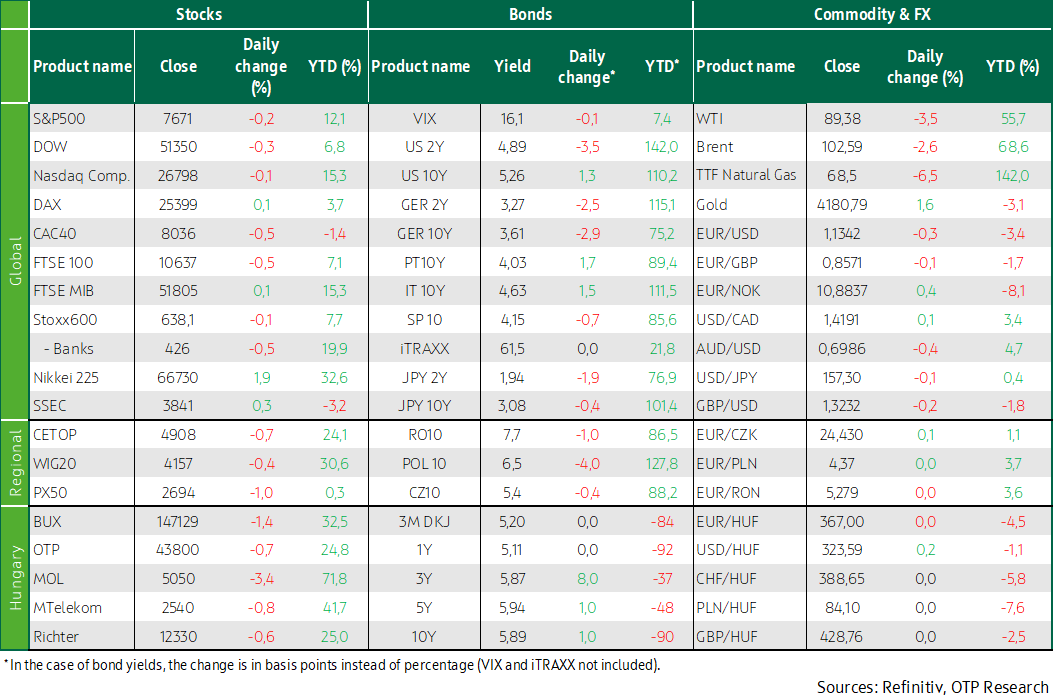
European equities remained under pressure on Tuesday, with the STOXX 600 slipping 0.1%, while the FTSE 100 and CAC 40 both lost 0.5%. Although oil prices moved lower, uncertainty surrounding a potential resolution of the conflict involving Iran showed little sign of easing. Persistently elevated bond yields, which remain near multi-decade highs, continued to dampen risk appetite, offsetting the strong performance of the technology sector. The latter was supported by renewed optimism surrounding artificial intelligence, this time driven by Anthropic’s upcoming IPO. According to a Reuters report, Anthropic’s valuation could exceed $2 trillion when it makes its stock market debut. In addition, the company is reportedly planning to invest $518 billion in cloud services, computing capacity and infrastructure, providing a major boost to businesses involved in AI infrastructure, including semiconductor manufacturers. The DAX gained 0.1%, supported by easing Bund yields and positive market sentiment toward AI-related companies, with shares of Infineon and Siemens Energy rising by nearly 5% and 4%, respectively.
Most STOXX 600 sector indices ended the day in negative territory, although technology was the standout performer, rising 2.5%. AT&S Austria and Soitec both soared by more than 9%. The biggest decliners were the food production and energy sectors, while banks also posted notable losses. Lindt plunged nearly 9%, making it the worst performer in the STOXX 600, after the chocolate maker cut its 2026 profit guidance for the second time this year. Julius Baer rallied 7% after the Swiss financial regulator closed its enforcement proceedings against the wealth manager related to private debt lending and its ties to two politically exposed Russian individuals.
Trading across the CEE region also ended lower on Tuesday. The PX fell 1.0%, the WIG20 declined 0.2%, while the BUX dropped 1.4%. Among Hungarian blue chips, MOL recorded the steepest loss, plunging 3.4%, whereas Magyar Telekom, OTP and Richter posted more moderate declines of between 0.5% and 1.0%.
US equity indices edged lower despite easing Fed rate hike expectations, while yields remained elevated
US benchmark equity indices closed modestly lower on Tuesday, with the S&P 500 slipping 0.2%, the Nasdaq Composite edging down 0.1%, the Dow Jones falling 0.3%, and the Russell 2000 declining nearly 0.4%. The negative impact of bond yields hovering near multi-decade highs was not fully offset by renewed enthusiasm for AI-related stocks following Anthropic’s planned IPO, nor by reports of resumed Saudi oil shipments, or the easing in rate hike expectations that followed comments from Federal Reserve Bank of New York President John Williams.
Anthropic’s IPO prospectus, which valued the company at $2 trillion, also provided a benchmark for the valuation of AI-related businesses. Chipmakers surged, with Marvell Technology rallying nearly 5%, while Broadcom closed 1.6% higher. Semiconductor equipment manufacturers Lam Research, KLA, and Applied Materials also posted gains of between 3% and 5%. Meta jumped more than 3%, despite OpenAI unveiling its always-on agents called “dots”, which autonomously pursue users’ objectives across applications and are viewed as a competitor to Meta’s recently launched Muse product. At the sector level, telecommunications companies and utilities were the best-performing segments within the S&P 500. Credit-scoring company Fair Isaac Corp. plunged 26.5% after Bill Pulte, Director of the Federal Housing Finance Agency, announced that government-sponsored mortgage institutions Fannie Mae and Freddie Mac would transition to a unified pricing framework. Another notable mover was used-car retailer CarMax, whose shares soared nearly 5% after reporting higher second-quarter revenue and profit.
Oil futures declined, with Brent closing nearly 3% lower and WTI falling almost 4% on Tuesday. According to preliminary data released by Kpler on Monday, crude oil exports from major Middle Eastern producers rose to 12.8 million barrels per day in September, driven by increased shipments from Saudi Arabia and the United Arab Emirates. This marked the highest level since February. US and Iranian officials separately held talks with mediators aimed at ending the seven-month-long war, according to officials from both countries. However, Donald Trump stated that he had offered Iran nothing in exchange for ending the conflict, rejecting media reports citing US officials that claimed he was willing to ease sanctions and release frozen assets if Iran took “concrete” steps regarding its nuclear program. Meanwhile, the TTF European natural gas futures contract fell 6.5% on Tuesday to below EUR 70/MWh, its lowest level in one month.
The bond market sell-off eased in the euro area, while the US long end continued to edge higher. Expectations for an October Fed rate hike moderated, although the EUR/USD fell to a 16-month low
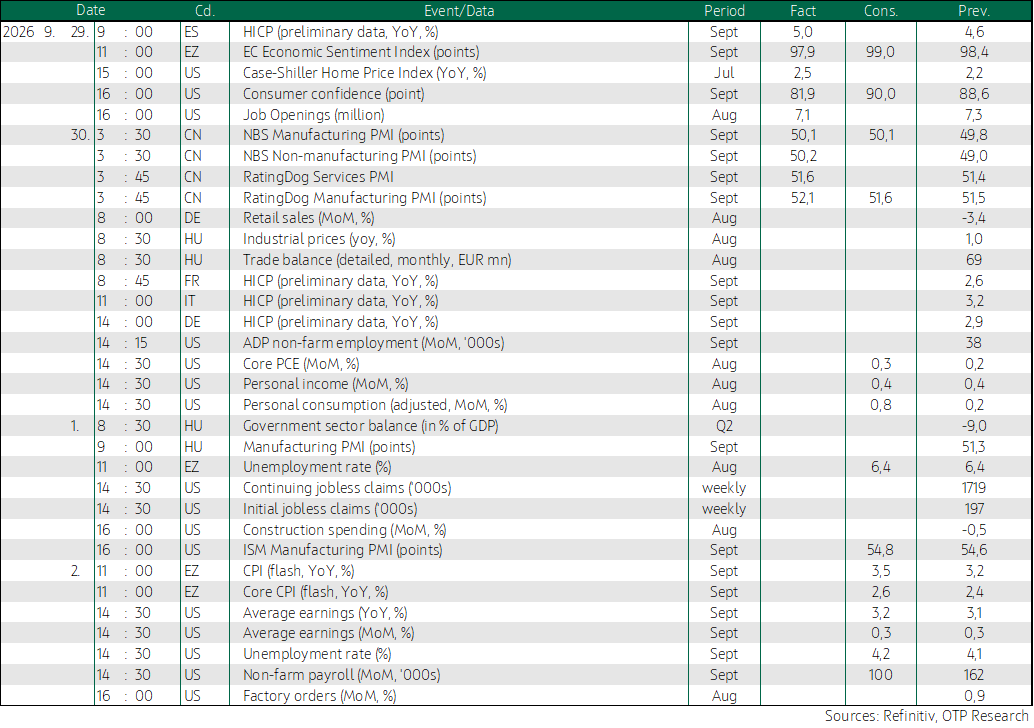
European long-term yields retreated from their recent multi-year highs on Tuesday, although French, Italian and Spanish yields were unable to maintain their intraday declines through the close. Markets also digested comments from ECB President Christine Lagarde regarding recent inflation data and elevated oil prices. According to Lagarde, the recent increase in inflation has not yet triggered significant second-round effects, suggesting that only a measured monetary policy response may be warranted. The German 10-year yield fell by 3bps to 3.61%, although it remained close to the more than 15-year high reached on Monday. Macroeconomic data released on Tuesday showed a deterioration in euro area economic sentiment, while the inflation expectations component of the consumer confidence index moved higher. Meanwhile, Spain’s preliminary September HICP came in slightly above forecasts on an annual basis.
US labor market data released yesterday showed that the number of job openings declined by more than expected in August. Consumer confidence also deteriorated markedly in September, contrary to expectations for a broadly unchanged reading. The US 10-year yield continued to edge higher, with the 5.26% level marking a near two-decade high, while the 30-year yield climbed to 5.62%, its highest level since 2002. The 2-year benchmark yield, however, fell by nearly 4bps, reflecting easing Fed rate hike expectations after John Williams, President of the Federal Reserve Bank of New York, stated that another rate increase by year-end could be warranted. According to the FedWatch Tool, interest rate futures are now pricing in less than a 50% probability of a 25bp Fed rate hike in October, compared with around 70% both one day and one week earlier. While Williams struck a relatively patient tone on further tightening, other policymakers remained more hawkish. Federal Reserve Governor Michael Barr said that additional rate hikes will likely be necessary, while Chicago Fed President Austan Goolsbee warned that allowing inflation to remain above the Fed’s target for five and a half years would amount to “playing with fire.” Meanwhile, the EUR/USD fell to 1.134, its lowest level in 16 months.
In the Hungarian government bond market, benchmark yields edged higher across maturities beyond one year, with the most notable increase seen at the 3-year tenor, where the yield rose by 8bps to 5.87%. The 10-year yield closed at 5.89% on Tuesday afternoon. At Tuesday’s 3-month Treasury bill auction, demand exceeded the planned issuance by more than twofold, although the Debt Management Agency kept issuance unchanged at the originally planned HUF 30 billion. The average yield came in at 5.16%, slightly below the previous day’s secondary market closing level. The EUR/HUF exchange rate remained stable around 367 yesterday, while regional currencies against the euro also showed little to no movement, mirroring the forint’s performance.
Today's highlights
Most major equity indices in the Asia-Pacific region were trading higher this morning, as news surrounding Anthropic’s valuation pointed to more favorable pricing prospects for other AI-related companies as well. The Nikkei was up more than 2%, while the Shanghai Composite and CSI 300 gained 0.4%, and the Hang Seng edged 0.2% higher. China’s purchasing managers’ indices released today showed a modest improvement in September, broadly in line with expectations.
European equity futures point to a mostly positive open, while US futures indicate a mixed start to trading.
Investors’ attention today will focus on the PCE inflation report, with the core PCE reading likely to be the key market-moving indicator. In addition, the US will release data on personal income and spending, while the ADP employment report will also be closely watched.
For the euro area, investors will be watching preliminary September CPI readings from France, Germany and Italy, as well as German retail sales data, which may provide further insight into the region’s inflation trends and economic momentum.
Get more out of your investments!
Global Markets Services
OTP Global Markets offers a broad range of services in the field of local and international money and capital markets.
Read morePrivate Banking Services
Personal care and expertise with OTP Private Banking, along with the knowledge, security, and innovations of a multinational banking group.
Read more