
OTP Morning Brief: Uncertainty surrounding US-Iran negotiations and strengthening rate hike expectations drove market movements
Related content
OTP Morning Brief: Further declines in the US technology sector on Friday
Selling pressure on the technology sector remained elevated across developed equity markets on Friday. However, favorable corporate earnings offset the weakness in the IT sector in Europe. European equity markets also posted weekly gains, marking their strongest weekly performance since June. In the US, the decline in equity indices continued, with concerns surrounding AI-related companies further amplified by the CoreWeave episode. The sell-off in equity markets prompted investors to shift toward safer assets, while long-term bond yields continued to decline. The US 10-year Treasury yield declined by 15 bps over the past week, closing Friday’s session at 5.1%, supported in part by easing expectations of further rate hikes. Based on futures pricing, the Fed is expected to leave interest rates unchanged at next week’s meeting. Eurozone bond yields also moved lower, tracking developments in overseas fixed-income markets. The euro strengthened to 1.124 against the dollar. Long-term yields also declined sharply in the Hungarian government bond market over the past week, with the 10-year yield falling by 29 bps to a three-month low of 5.31%. Oil prices continued to rise amid the unresolved situation in the Middle East. European natural gas futures soared to an early four-year high over the past week. This week, in the Hungarian market, attention will focus on the 2027 budget to be released today and the MNB’s interest rate decision meeting on Tuesday.
OTP Morning Brief: US producer price index came in above expectations, yet the US 10-year Treasury yield still declined
Western European equities continued to advance despite ongoing pressure on the technology sector. Wall Street indices also rebounded, recovering some ground after Wednesday’s sell-off. Healthcare was the standout performer on both sides of the Atlantic. Eurozone industrial production declined by 0.5% month-on-month in August. In the US, the producer price index accelerated to 6.3%, delivering another upside surprise in inflation developments. US retail sales increased by 0.8% compared to August. The US 10-year Treasury yield declined by more than 10 basis points. The long end of the Hungarian government bond yield curve also declined by 7-9 basis points. In Hungary, August wage data will be released today, while in the US, September industrial production figures are due.
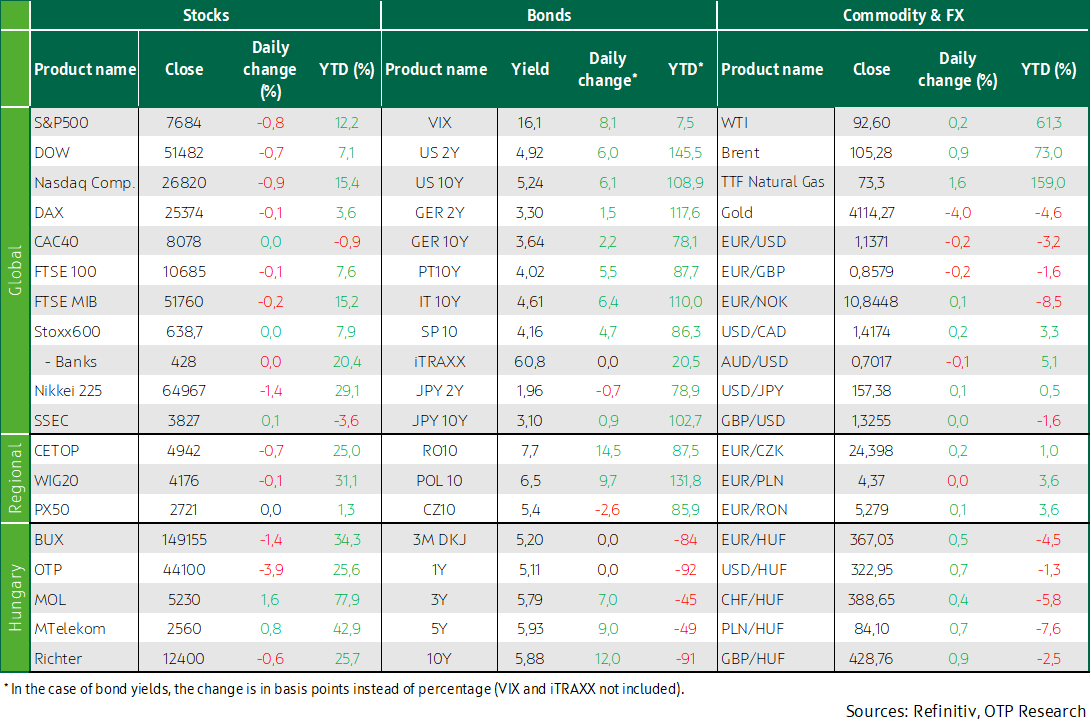
During Monday's trading session, investor sentiment was primarily driven by rising energy prices and expectations of a higher interest rate environment. Even a rally in UK homebuilder stocks was unable to meaningfully improve the performance of European equity markets. Uncertainty surrounding US-Iran talks caused significant volatility in energy markets; WTI closed the day 0.2% higher, while Brent ended the session up 0.9%. Higher energy prices and strengthening expectations of further Fed rate hikes kept Wall Street under pressure, with the major indices closing the session down between 0.7% and 0.9%. Bond yields continued to rise, the dollar strengthened against the euro, while the forint weakened against both the euro and the dollar. Today's key focus will be on Spain's CPI data, the eurozone's ESI economic sentiment index, as well as US consumer confidence and job openings figures.
Rising oil prices and bond yields offset the rally in UK homebuilder stocks
The pan-European STOXX 600 index closed virtually unchanged on the first trading day of the week. Beneath the seemingly calm market performance, however, significant sector divergences emerged. In the UK, homebuilder stocks surged by 10-15% after the government announced a new support scheme for first-time homebuyers, substantially improving the sector's outlook. Nevertheless, the strong performance of the industry was not enough to offset the adverse impact of higher bond yields and energy prices, leaving the FTSE 100 down 0.1% at the close.
European markets delivered a mixed performance: France's CAC 40 was little changed, while Spain's IBEX closed the day 0.5% lower. Rising oil prices supported energy stocks, whereas mining companies came under pressure as lower gold and copper prices weighed on the sector.
The CEE region's equity indices generally closed lower on Monday, with the WIG20 declining 0.1% and the BUX falling 1.4%. Among Hungarian blue chips, OTP delivered the weakest performance, dropping 3.9% after Bloomberg reported that the bank was assessing the possibility of a full withdrawal from the Russian market. Richter shares slipped 0.6%, while MOL and Magyar Telekom finished the day higher, gaining 1.6% and 0.8%, respectively. The Prague Stock Exchange remained closed due to a national holiday.
Trading in energy markets was marked by significant volatility. Brent briefly rose above the $110 per barrel level after Donald Trump rejected Iran’s proposal to fully reopen the Strait of Hormuz. However, gains moderated during the second half of the day as Qatari mediators signalled the prospect of further negotiations between the US and Iran, while reports also emerged about the partial restart of Saudi Arabia’s East-West pipeline. Brent ultimately settled at $105.3 per barrel, up 0.9% on the day, while WTI closed at $92.6, posting a 0.2% gain. Market participants also continued to monitor reports regarding potential restrictions on US diesel exports; the possibility of an export ban, driven by near-record diesel prices, further widened the Brent-WTI spread, which reached its highest level since May on Monday. European natural gas prices also moved higher, with the TTF benchmark rising 1.6%.
US equity indices declined amid strengthening Fed rate hike expectations
Negative sentiment dominated Wall Street trading on Monday as rising oil and diesel prices intensified inflation concerns, pushing US Treasury yields higher and reinforcing expectations for a more hawkish Fed rate path. The Dow Jones fell 0.7%, the S&P 500 declined 0.8%, while the Nasdaq Composite closed 0.9% lower.
The market was primarily driven by expectations that the Fed could continue tightening monetary policy in response to persistent inflationary pressures. According to Fed Governor Lisa Cook, demand related to AI investment and higher oil prices could continue to pose upside inflation risks in the coming months. CME FedWatch data show that markets are currently pricing in a 72.5% probability of another rate hike of at least 25 basis points in October, up from 57.6% a week earlier.
On the corporate front, Boeing dropped 6.9% after the US aviation regulator once again delayed certification of the 737 MAX 10 due to a newly identified software issue. In contrast, Nvidia gained 1.6% following the company's announcement of a $150 billion share repurchase programme, while Tesla shares fell 3.9% after J.P. Morgan lowered its price target, citing weaker-than-expected third-quarter delivery figures.
Investors' attention will turn to Wednesday's PCE inflation report and Friday's labour market data later this week, as both releases could play a key role in shaping expectations for the Fed's next policy moves.
Bond yields continued to rise, while the dollar strengthened
Yields continued to rise across developed bond markets. The US 10-year Treasury yield climbed as high as 5.274% intraday, its highest level since mid-2007, before closing near 5.24%, up roughly 6.1 basis points on the day, while the 2-year Treasury yield stood at 4.93% following a 6 basis point increase. In Europe, the yield on the German 10-year Bund rose to 3.64%, marking its highest level since June 2009.
In the Hungarian government bond market, the short end of the yield curve remained broadly unchanged compared to Friday, while longer maturities witnessed higher yields in line with global bond market trends. Benchmark yields on bonds with maturities exceeding one year rose by 7-12 basis points, with the 10-year benchmark yield standing at 5.88% according to the Government Debt Management Agency's early afternoon quotation. A discount Treasury bill (DKJ) switch auction was also held yesterday, allowing investors to exchange discount Treasury bills maturing on 28 October 2026 for securities due on 23 June 2027. Demand was strong, with bids totalling HUF 17.5 billion submitted against the announced HUF 10 billion offering, of which the Government Debt Management Agency accepted HUF 16 billion. The average accepted yield came to 5.14%, near the midpoint of the 5.10-5.19% yield range.
In currency markets, the euro weakened against the dollar on Monday as rising US Treasury yields enhanced the relative attractiveness of dollar-denominated assets. The EUR/USD exchange rate fell to a two-month low of 1.135 before recovering to 1.137. The forint weakened by 0.5% against the euro and by 0.7% versus the dollar on Monday.
Today's highlights
Asian equities mostly traded lower this morning as rising bond yields and oil prices weighed on risk appetite. In China, market sentiment was pressured by the limited outcomes of the US-China summit and a slowdown in industrial profit growth, while in Japan and South Korea, weakness in technology stocks was the primary drag on trading.
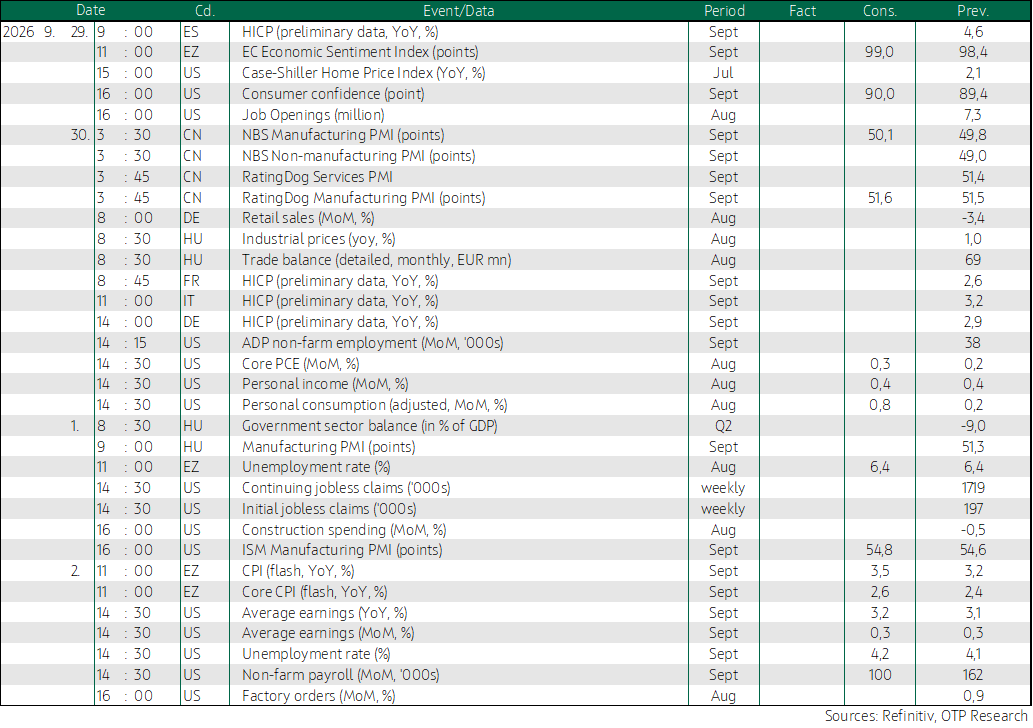
Today's key focus will be on Spain's CPI data, the eurozone's Economic Sentiment Indicator (ESI), as well as US consumer confidence and job openings figures.
Get more out of your investments!
Global Markets Services
OTP Global Markets offers a broad range of services in the field of local and international money and capital markets.
Read morePrivate Banking Services
Personal care and expertise with OTP Private Banking, along with the knowledge, security, and innovations of a multinational banking group.
Read more