
OTP Morning Brief: Donald Trump rejected Iran’s proposal to reopen the Strait of Hormuz
Related content
OTP Morning Brief: US producer price index came in above expectations, yet the US 10-year Treasury yield still declined
Western European equities continued to advance despite ongoing pressure on the technology sector. Wall Street indices also rebounded, recovering some ground after Wednesday’s sell-off. Healthcare was the standout performer on both sides of the Atlantic. Eurozone industrial production declined by 0.5% month-on-month in August. In the US, the producer price index accelerated to 6.3%, delivering another upside surprise in inflation developments. US retail sales increased by 0.8% compared to August. The US 10-year Treasury yield declined by more than 10 basis points. The long end of the Hungarian government bond yield curve also declined by 7-9 basis points. In Hungary, August wage data will be released today, while in the US, September industrial production figures are due.
OTP Morning Brief: US CPI data came in above expectations
European equity markets advanced, supported by strong results from ASML and the outstanding performance of the healthcare sector. US equity markets came under pressure following higher-than-expected September CPI data. The annual CPI rate accelerated to 3.7%, driven primarily by a surge in gasoline prices, while core CPI rose by 0.3% month-on-month, supported by higher housing costs and rising transportation service prices. Oil prices rose amid escalating tensions in the Middle East and the impact of the IEA's oil market report. US Treasury yields retreated after an initial increase, driven by Fed commentary, while European bond yields generally moved higher. The US macro calendar will be busy today, with investors focusing on September retail sales and producer price index data, as well as the New York Fed Manufacturing Index, weekly jobless claims, and business inventories. August industrial production data from the euro area will be released today.
European equity markets mostly moved higher on Friday and over the week as a whole, despite a larger-than-expected deterioration in German consumer confidence. US equity markets moved higher last week, while adverse developments emerged on Saturday regarding a potential settlement with Iran. Trade tensions between China and the US eased, and durable goods orders continued to point to strong investment activity. Long-term bond yields climbed to fresh record highs as the likelihood of a US rate hike in October increased further; over the week, the dollar strengthened while the forint weakened against the euro. No major macroeconomic data releases are scheduled for today, but central bank policymakers from Europe, the UK, and the US are due to deliver speeches, while the Dallas Fed Manufacturing Index will also be published.
European equity markets mostly moved higher on Friday and over the week as a whole, despite a larger-than-expected deterioration in German consumer confidence
European equity markets mostly moved higher on Friday and finished the week in positive territory, while energy markets showed signs of easing, helping to alleviate concerns over inflation risks. Following the correction in natural gas prices, government bond yields also stabilized, reducing the risk of further inflationary pressure building in Q4. The banking sector outperformed after a weaker spell, with shares of UniCredit, Deutsche Bank, and ING gaining between 1% and 3%. Companies linked to artificial intelligence infrastructure and software also delivered strong performance, tracking the positive momentum in the US technology sector. Shares of ASML, Infineon, and Prosus also moved higher.
However, the GfK Consumer Climate Index for October deteriorated by more than expected, as previously surging energy prices weighed on German households’ income expectations and dampened consumer sentiment. The data suggest that household demand remains fragile in the euro area’s largest economy.
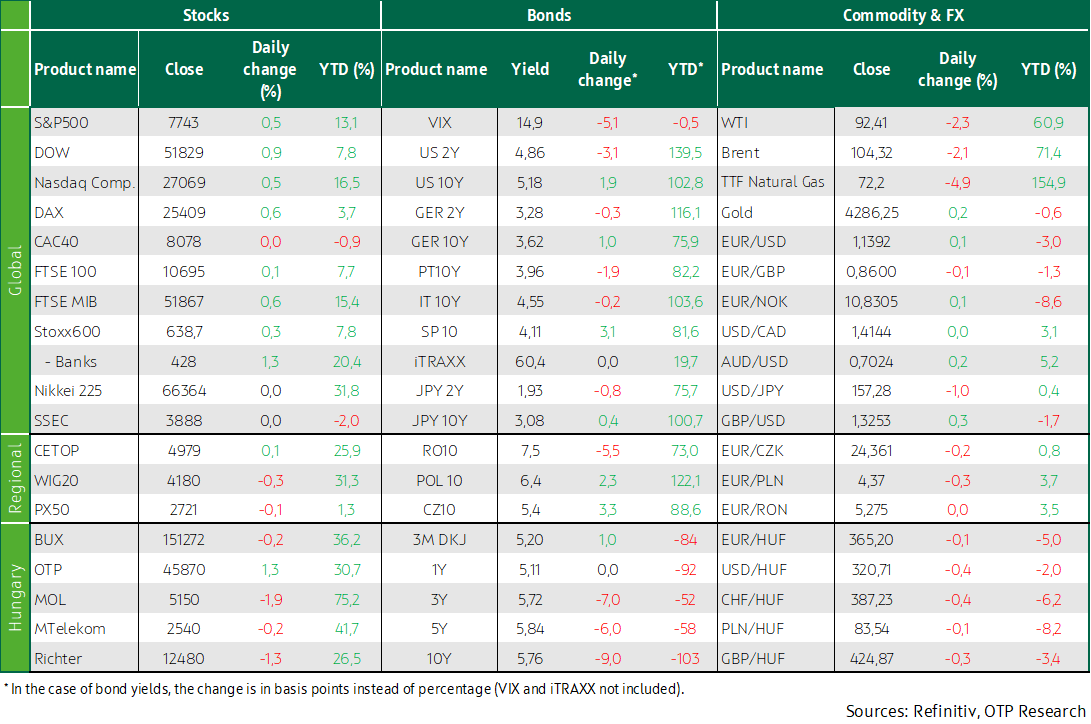
Major CEE equity indices declined, while among Hungarian blue chips, OTP bucked the trend with a 1.3% gain. The other three heavyweight stocks moved lower, with MOL posting the largest decline, falling 1.9%.
US equity markets moved higher last week, while adverse developments emerged on Saturday regarding a potential settlement with Iran, trade tensions between China and the US eased, and durable goods orders continued to point to strong investment activity
US equity markets ended the week higher despite a sharp rise in government bond yields during the period. On a weekly basis, the S&P 500 gained 1.2%, the Nasdaq advanced 2.1%, while the Dow added 0.3%. Investor sentiment was supported primarily by lower oil prices. Markets responded positively to reports suggesting that a diplomatic solution to the Middle East conflict could be taking shape and that the likelihood of the Strait of Hormuz reopening had increased. As a result, WTI crude fell 2.3% to USD 92.4 per barrel on Friday, while Brent declined 2.1% to USD 104.3 per barrel. On a weekly basis, WTI dropped 7.9%, whereas Brent edged 0.4% higher. However, it emerged on Saturday that President Trump had rejected Iran’s proposal to reopen the Strait of Hormuz under certain conditions. According to some officials, he also indicated in private discussions that military strikes could continue after the midterm elections. Iran’s conditions reportedly included ending military aggression, lifting the maritime blockade, removing economic sanctions, and unfreezing Iranian assets. These adverse developments could provide renewed support for oil prices this week.
The technology sector once again outperformed. The information technology sector rose 3.1% over the week, supported in part by continued optimism surrounding artificial intelligence. Meta’s share price surged nearly 13% during the week on positive expectations related to the company’s new Muse AI agent. Akamai Technologies gained 3% after announcing a multi-year strategic partnership with Anthropic. Investors also closely monitored developments in US-China relations. Chinese President Xi Jinping’s visit to the US and further progress in bilateral trade negotiations improved market sentiment after the two countries had previously extended their trade truce by an additional two months. According to reports from China on Saturday, the two sides reached an eight-point agreement that includes USD 30 billion in mutual tariff relief, the continuation of AI-related negotiations, and the establishment of a joint trade committee.
In the US, new orders for durable goods were unchanged in August compared with the previous month. The reading came in stronger than market expectations for a 0.4% monthly decline. As a result, the indicator stabilized following two consecutive months of growth. The main drag came from a 0.6% decline in transportation equipment orders. Within this category, orders for civilian aircraft and parts fell 4.3%, while motor vehicle and parts orders declined 0.6%. At the same time, several key industries recorded increases in new orders. Orders for defense aircraft and parts rose 5.9%, while bookings for computer products increased 1.5%. Excluding transportation equipment, durable goods orders rose 0.3% month-on-month, falling short of both the 0.6% market expectation and July’s 0.7% increase. However, non-defense capital goods orders excluding aircraft, one of the most closely watched leading indicators of corporate investment activity, rose 1.6%. This significantly exceeded both the 0.5% market consensus and the 0.6% increase recorded in July. The data suggest that US companies remain willing to invest and expand capacity despite an uncertain economic environment, sending a positive signal for the future outlook of economic growth.
Long-term bond yields climbed to fresh record highs as the likelihood of a US rate hike in October increased further; over the week, the dollar strengthened while the forint weakened against the euro
US Treasury yields stabilized toward the end of the week following a pronounced sell-off in previous sessions. The 10-year US Treasury yield finished the week at 5.18%, marking its highest level since 2007. The shorter-dated 2-year yield edged down to 4.86% on Friday but still ended the week 12 basis points higher. The rise in yields continued to be driven by hawkish comments from Fed policymakers, persistently elevated energy prices, and macroeconomic data pointing to ongoing strength in the US economy. Fed Governor Michael Barr indicated during the week that further monetary tightening may be necessary to bring inflation back to target. Accordingly, money markets priced in roughly a 64% probability of another rate hike in October. The bond market sell-off was not confined to the US: yields on Japanese, UK, and euro area government bonds also climbed to multi-year highs during the week, highlighting the synchronized adjustment of global fixed-income markets to a persistently higher interest rate environment.
The dollar continued to strengthen against the euro over the week, and together with ongoing uncertainty in energy markets, this put pressure on regional currencies, including the forint. The Hungarian currency ultimately weakened by 0.3% over the course of the week, closing at 365.2 against the euro.
Today's highlights
Asian equity markets were mixed this morning, while oil prices resumed their rise following adverse developments over the weekend. Alongside declines in Japanese and Chinese equities, US index futures also pointed to a weaker open, whereas the Australian market managed to post gains.
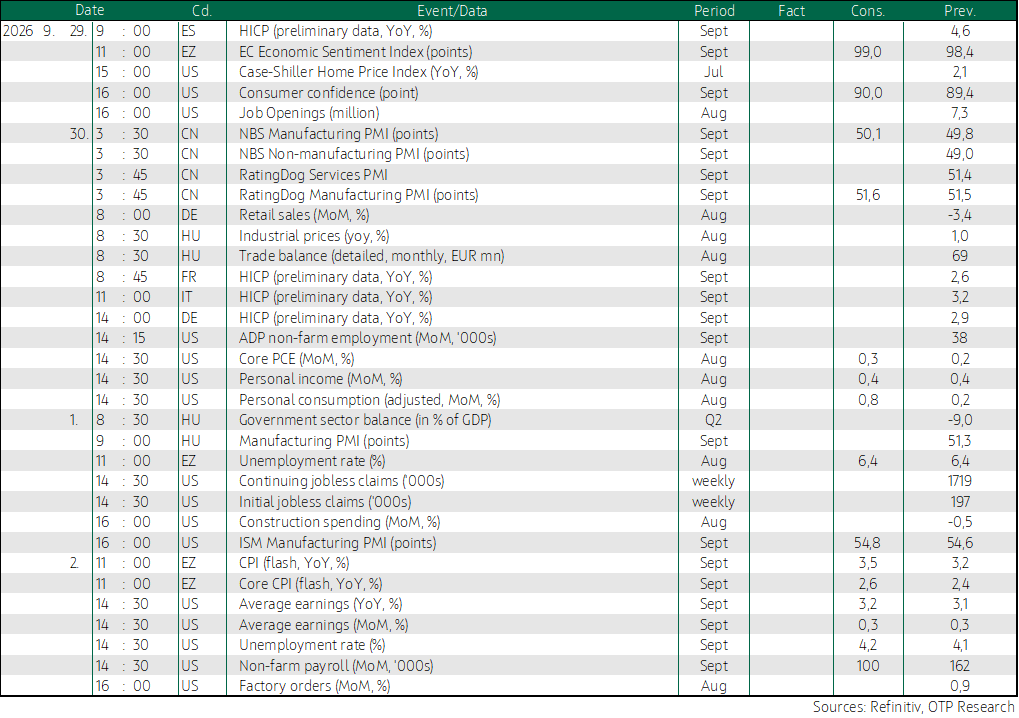
No major macroeconomic data releases are scheduled for today, but central bank policymakers from Europe, the UK, and the US are due to deliver speeches, while the Dallas Fed Manufacturing Index will also be published.
Get more out of your investments!
Global Markets Services
OTP Global Markets offers a broad range of services in the field of local and international money and capital markets.
Read morePrivate Banking Services
Personal care and expertise with OTP Private Banking, along with the knowledge, security, and innovations of a multinational banking group.
Read more