
OTP Morning Brief: Long-term yields continue to shatter records, energy prices surge
Related content
OTP Morning Brief: US CPI data came in above expectations
European equity markets advanced, supported by strong results from ASML and the outstanding performance of the healthcare sector. US equity markets came under pressure following higher-than-expected September CPI data. The annual CPI rate accelerated to 3.7%, driven primarily by a surge in gasoline prices, while core CPI rose by 0.3% month-on-month, supported by higher housing costs and rising transportation service prices. Oil prices rose amid escalating tensions in the Middle East and the impact of the IEA's oil market report. US Treasury yields retreated after an initial increase, driven by Fed commentary, while European bond yields generally moved higher. The US macro calendar will be busy today, with investors focusing on September retail sales and producer price index data, as well as the New York Fed Manufacturing Index, weekly jobless claims, and business inventories. August industrial production data from the euro area will be released today.
OTP Morning Brief: Chipmakers' weakness kept equity markets under pressure
Global markets were characterized by a subdued, risk-off sentiment on Tuesday. In Europe, concerns over the technological advances of Chinese chipmaker CXMT weighed on technology stocks, with the STOXX 600 falling 0.1%, while the DAX, CAC 40 and FTSE 100 also closed 0.1% lower. In the US, trading was driven by weakness in the semiconductor sector and mixed corporate reactions during the early stages of the earnings season: the Dow fell 0.3%, the Nasdaq declined 0.2%, while the S&P 500 was unchanged. Ahead of Wednesday’s US inflation data, a wait-and-see approach and demand for safe-haven assets led to a decline in long-term bond yields, with the US 10-year yield easing to 5.22% and the German Bund yield falling to 3.46%. The dollar weakened against major currencies, with EUR/USD rising to 1.1199, while the Hungarian forint remained stable. Today's macro calendar will be highlighted by the September US inflation data, Chinese export figures, and the Fed's Beige Book due later in the evening.
Neither the conflict involving Iran nor US-China relations saw a breakthrough on Thursday, while energy prices resumed their upward trajectory, with both European natural gas and oil prices rising by nearly 5%. Meanwhile, developed market bond yields swiftly surpassed the record levels reached the day before: US 10-year Treasury yields climbed as high as 5.21% intraday, while long-term sovereign bond yields across virtually all eurozone countries also advanced to multi-year highs.
No change in the Middle East, energy prices continue to rise
The two major geopolitical standoffs shaping market sentiment saw no meaningful progress. Xi Jinping's visit to Washington has so far produced little more than symbolic formalities, with no substantive developments, either positive or negative. As for the conflict between Iran and the US, although negotiations are taking place in New York on the sidelines of the UN General Assembly, they have yet to show any signs of progress. Iran continues to keep the Strait of Hormuz closed, while the US has not eased its maritime blockade against the Persian state.
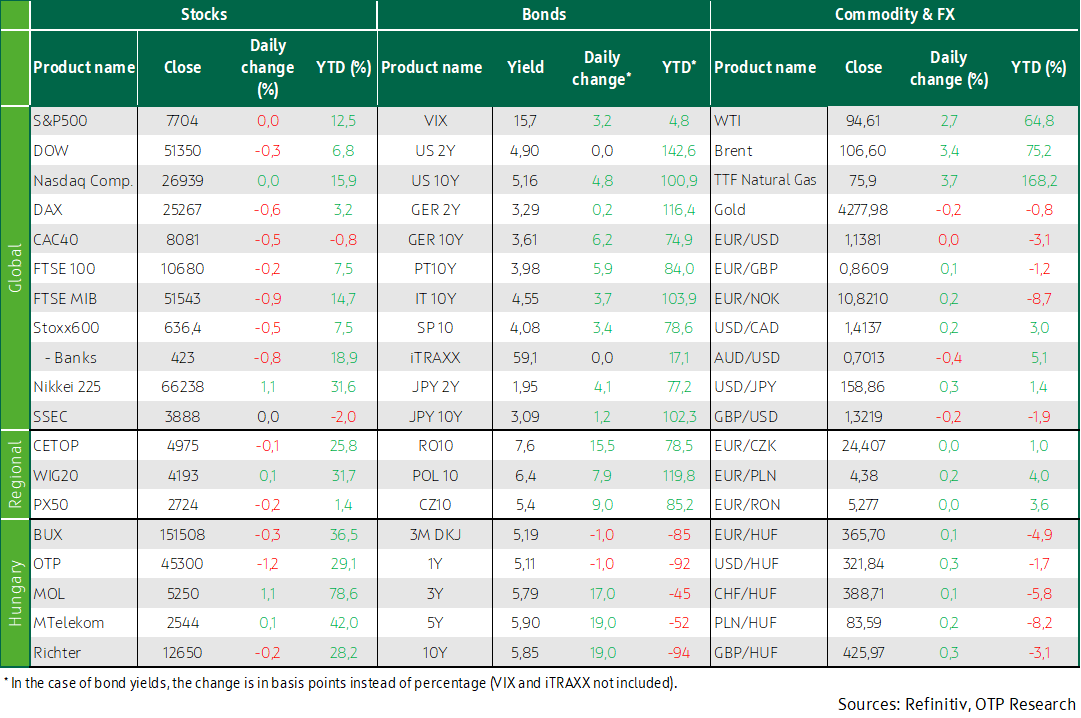
Energy markets remained under pressure, with WTI crude rising 3% on Thursday to nearly USD 95 per barrel, while Brent climbed 4% to above USD 107 per barrel. European natural gas prices (TTF) also staged a nearly 5% surge, approaching EUR 76/MWh. Although similar, or even slightly higher, price levels were seen last week, markets had appeared to be easing earlier this week. It was also notable that the Brent-WTI spread widened to nearly USD 13 per barrel yesterday, compared with around USD 5 or less just a few days earlier and throughout much of the summer. Similar spread levels were last seen in March. The widening differential further suggests that supply tightness in the oil market is having a more pronounced impact on Europe.
European equities closed slightly lower; the BUX was no exception
The negative sentiment seen the previous day persisted across European equity markets on Thursday. The Stoxx 600 spent nearly the entire session in negative territory and ultimately closed 0.5% below its previous day's level. Most sectors ended the day lower, with the energy sector standing out as the sole notable outperformer, gaining 1.1% on the back of rising oil and gas prices, while automakers came under particular pressure, falling 1.6%. One of the day's notable laggards was Rheinmetall, whose shares declined 3.3%. Price declines were not even offset by generally positive signals from the real economy. Germany's Ifo Business Climate Index improved further from 88.8 to 89.9, extending its uninterrupted advance since April and reaching its highest level in more than three years. The Ifo reading was also consistent with other business confidence indicators published across the eurozone in September, which continued to point to a gradually improving business environment despite geopolitical tensions and elevated energy prices.
The BUX was unable to buck the broader negative trend across European markets, slipping 0.3% compared with Wednesday's close. The decline was led by OTP, whose share price fell 1.2%. MOL, however, benefited from the sharp rise in energy prices during the session, gaining 1.1%. Other regional equity markets also finished the day modestly lower.
US equities also struggled
US equities were largely range-bound as well. The S&P 500 and the Nasdaq finished little changed from their levels two days earlier, while the Dow Jones slipped 0.3%, marking its third consecutive daily decline. Sector performance mirrored the pattern seen in Europe: the energy sector advanced, while virtually all other sectors moved lower, including technology stocks, with Nvidia shedding 0.4%. Meta and Alphabet, however, bucked the broader trend and both closed more than 4% higher.
Long-term bond yields reach fresh highs not seen in decades
The yield on the US 10-year Treasury climbed to 5.16% on Thursday, surpassing Wednesday’s 5.11% level, which had already marked its highest reading since 2007. Shorter maturities were largely unchanged, with the 2-year yield holding steady at 4.90%. Although long-term yields rose more sharply than shorter-dated ones yesterday, the US yield curve has generally flattened in recent days. The spread between 2-year and 10-year yields currently stands at 26 basis points, well below the average level of around 50 basis points seen over the past year. The upward march in long-term yields was not confined to the US. Germany’s 10-year government bond yield rose 6 basis points to 3.61%, setting another multi-year high, and similar moves were observed across virtually the entire eurozone. Regional markets were no exception: the Czech 10-year yield climbed nearly 10 basis points to 5.35%, while Poland’s rose 7 basis points to 6.37%, although both countries had reached slightly higher levels last week. Hungarian government bonds also followed the broader trend, with the 10-year yield rising 19 basis points to 5.85%. In contrast, short-term yields eased marginally, with 3-month and 12-month yields both declining by 1 basis point, to 5.19% and 5.11%, respectively.
There were few notable moves in the currency market. The EUR/USD exchange rate was essentially unchanged, while the Hungarian forint weakened 0.2% against the euro, closing at 366.08.
Today's highlights
Asian markets reflected optimism in Friday morning trading. As of 7:00 a.m. CET, Japan’s Nikkei 225 was up 1.3%, South Korea’s KOSPI had gained 0.9%, while Hong Kong’s Hang Seng was also trading 1.7% higher. Japanese government bonds, however, remained under pressure, with the 10-year yield rising to 3.093%, marking another high not seen since August 1996.
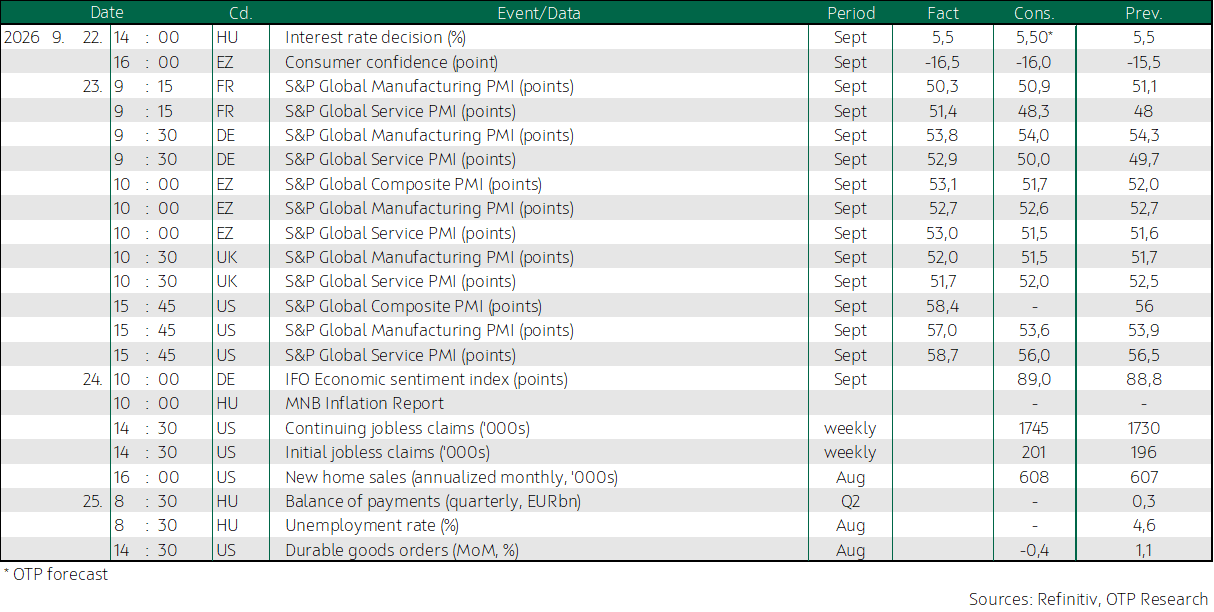
No major macroeconomic data releases are scheduled for today, although Germany’s GfK Consumer Climate Index and US durable goods orders data will be published.
Get more out of your investments!
Global Markets Services
OTP Global Markets offers a broad range of services in the field of local and international money and capital markets.
Read morePrivate Banking Services
Personal care and expertise with OTP Private Banking, along with the knowledge, security, and innovations of a multinational banking group.
Read more