
OTP Morning Brief: Rate hike expectations strengthened, while developed bond markets saw yields reach multi-decade highs
Related content
OTP Morning Brief: Chipmakers' weakness kept equity markets under pressure
Global markets were characterized by a subdued, risk-off sentiment on Tuesday. In Europe, concerns over the technological advances of Chinese chipmaker CXMT weighed on technology stocks, with the STOXX 600 falling 0.1%, while the DAX, CAC 40 and FTSE 100 also closed 0.1% lower. In the US, trading was driven by weakness in the semiconductor sector and mixed corporate reactions during the early stages of the earnings season: the Dow fell 0.3%, the Nasdaq declined 0.2%, while the S&P 500 was unchanged. Ahead of Wednesday’s US inflation data, a wait-and-see approach and demand for safe-haven assets led to a decline in long-term bond yields, with the US 10-year yield easing to 5.22% and the German Bund yield falling to 3.46%. The dollar weakened against major currencies, with EUR/USD rising to 1.1199, while the Hungarian forint remained stable. Today's macro calendar will be highlighted by the September US inflation data, Chinese export figures, and the Fed's Beige Book due later in the evening.
OTP Morning Brief: Oil prices rise, the technology sector struggles, and the earnings season gains momentum
The major European stock indices closed Monday's session in positive territory, with banks and utilities leading the advance. The BUX gained 0.9%, while Hungary’s blue-chip stocks delivered a mixed performance. TTF gas prices remain above EUR 84/MWh. Wall Street indices delivered a mixed performance yesterday, with the technology sector under pressure and semiconductor manufacturers posting declines. We saw an approximately 2% rise in crude oil prices. The euro weakened against the dollar as investors grew concerned about France’s fiscal position and the outlook for next year’s presidential election. The EUR/HUF exchange rate fell below 365. The earnings season continues today with reports from major companies.
Based on remarks made at the UN General Assembly, there appears to be little sign of a convergence in positions between the US and Iran. Brent crude futures climbed back above USD 100 per barrel. Major European and US equity indices closed in negative territory. The technology sector struggled in the US. Growth-supportive PMI readings were released in both Europe and the US, pointing to a resilient economic outlook. A hawkish message came from a Federal Reserve policymaker. Developed market long-term bond yields moved higher, while the dollar strengthened against the euro. The BUX advanced, while the forint weakened against major currencies. Japan’s 10-year government bond yield hit a 30-year high. The MNB will publish its latest Inflation Report today.
Positions remain far apart among the parties involved in the Middle East conflict; Brent climbs back above USD 100 per barrel
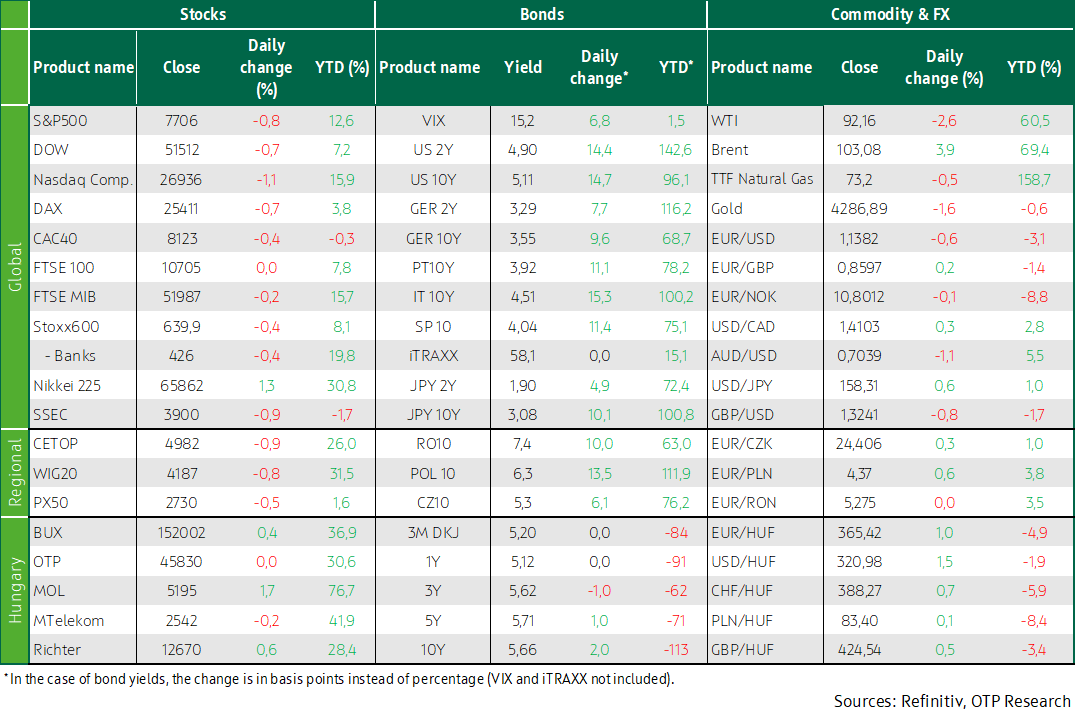
Negotiations between the US and Iran reached another milestone as representatives of both sides addressed the UN General Assembly. Iranian President Masoud Pezeshkian said yesterday that Tehran would never surrender to the US, following Donald Trump’s remarks at the same forum on Tuesday, in which he threatened Iran with “destruction.” These developments reinforced geopolitical concerns, suggesting that there is still no end in sight to the conflict that has been ongoing since February 28. WTI crude eased to near USD 92 per barrel, while Brent climbed back above USD 100. Developed equity markets moved lower, while bond yields increased.
US President Donald Trump welcomed Chinese President Xi Jinping to Washington yesterday for a three-day visit. Discussions are expected to focus on extending last year’s trade truce, the regulation of artificial intelligence, the Middle East conflict, and US arms sales to Taiwan.
Major European indices closed lower on Wednesday, while the BUX advanced
Major European indices turned lower on Wednesday following developments related to the Middle East conflict. Despite trading in positive territory earlier in the session, the pan-European Stoxx 600 closed 0.4% lower. At the sector level, energy stocks were the sole gainer, benefiting from higher oil prices, while all other sectors declined. Insurers posted the steepest losses, ending the day down 1.7%.
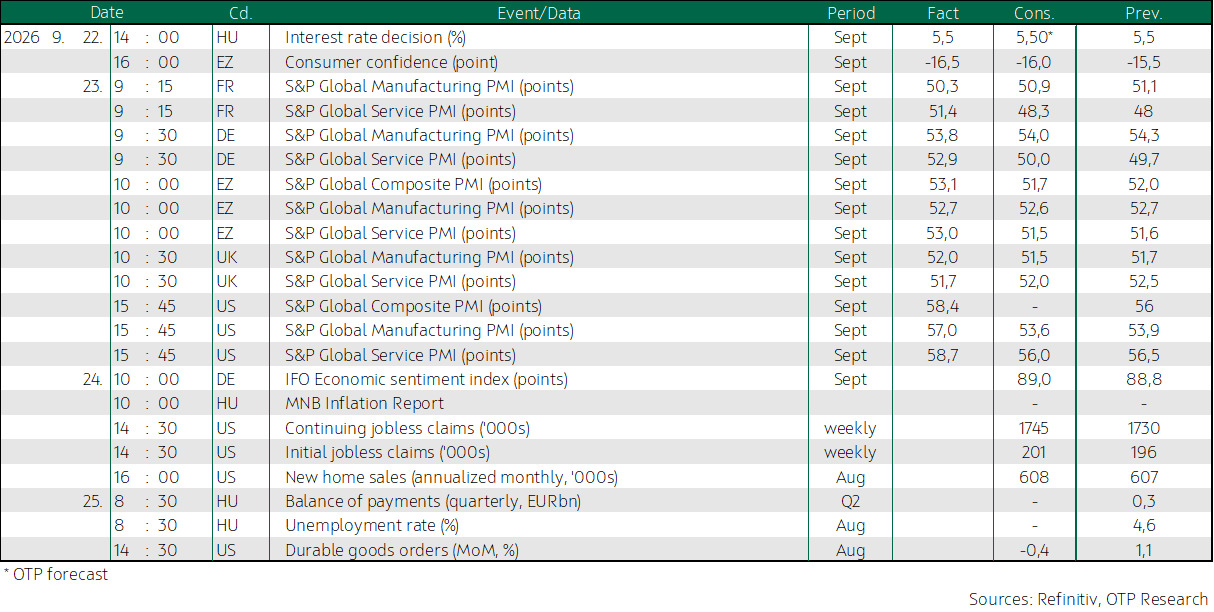
On the data front, the euro area received encouraging economic news, with September PMI readings coming in stronger than expected. The composite PMI rose from 52.0 to 53.1, driven primarily by the services sector, while manufacturing showed only modest improvement. The underlying details also painted a favourable picture from a CPI perspective: although input costs increased, there is still little evidence of second-round inflationary effects. The latest data reinforce expectations that the euro area economy will continue to expand in Q3.
The Hungarian stock market outperformed its regional peers, rising 0.4% despite losses across neighbouring markets. Hungary’s blue-chip stocks delivered mixed performances, with MOL and Richter among the gainers.
The TTF natural gas price continued to edge lower, slipping from EUR 82/MWh last Monday to nearly EUR 73/MWh today.
Wall Street indices closed lower, while the technology sector underperformed
Wall Street was hit by a series of negative developments on Wednesday. In addition to fading hopes for a resolution to the Middle East conflict, weak performance in the technology sector, rising bond yields and a hawkish message from a Federal Reserve policymaker all weighed on sentiment. While Meta advanced on the positive reception of its Muse artificial intelligence assistant, Alphabet and Amazon posted sharp declines, with the latter blocking Muse’s access to its platform. The PHLX Semiconductor Index, which tracks the 30 largest semiconductor companies listed in the US, fell 1.2%, with most chipmakers ending the session in negative territory, including Nvidia, AMD, Broadcom and Micron. Michael Barr, a member of the Federal Reserve Board of Governors, said that policymakers still have work to do even after September’s 25-basis-point rate hike. In his baseline scenario, further monetary policy action will likely be required to ensure that inflation returns to target at a sufficiently rapid pace.
Similar to Europe, PMI data took centre stage among the latest releases. The composite PMI rose to 58.4 in September from 56.0 in August, reaching its highest level since mid-2021. The improvement was driven primarily by the services sector, although manufacturing activity also strengthened, while both new orders and employment increased. At the same time, corporate input costs rose at their fastest pace since October 2022, feeding through to selling prices as well. The latest reading reinforces expectations that US economic growth will accelerate meaningfully in Q3 following the 1.5% expansion recorded in Q2, while also supporting the view that the Federal Reserve still has work to do to bring inflation under control.
Rate hike expectations strengthened across developed markets; the US 10-year Treasury yield climbed to 5.11%, its highest level since 2007; the forint weakened against major currencies
Amid persistent geopolitical risks and a hawkish message from Michael Barr, US long-term bond yields moved higher. The 10-year Treasury yield rose 14 basis points to 5.11%, its highest level since 2007, while the 2-year yield climbed 15 basis points to 4.9%, reaching its highest level since 2024. European bond markets also came under pressure on Wednesday, with the German 10-year yield rising 10 basis points to 3.55%. Even larger moves were seen in the Mediterranean economies, where yields increased by more than 10 basis points.
Rate hike expectations strengthened further, with market pricing for a Federal Reserve rate increase in October rising from 55% to 70%, while the probability of an additional hike in December also moved above 50%. Markets are now also pricing in two further 25-basis-point rate hikes from the ECB this year. The dollar strengthened against the euro, with EUR/USD easing to 1.138.
The Hungarian yield curve was largely unchanged yesterday, although yields at the longest maturities edged higher by a few basis points. Currencies across the CEE region weakened against both the euro and the dollar, with EUR/HUF rising to 365.52 and USD/HUF to 321.04, implying a 1.0% and 1.5% depreciation of the forint, respectively.
Demand was weak at the AKK’s six-month T-bill auction yesterday. The debt manager accepted bids totalling HUF 20 billion, in line with the announced amount, at an average yield of 5.16%, which was 5 basis points below the prevailing secondary market yield.
Today's highlights
Among the major Asia-Pacific equity markets, only the Nikkei 225 managed to advance after reopening following a three-day holiday break, ending this morning’s session up more than 1%, while South Korean markets remained closed today due to a public holiday. Japan’s 10-year government bond yield climbed to 3.075%, its highest level since August 1996. Oil prices edged lower during morning trading.
Equity futures point to a weaker open in both Europe and the US.
Germany’s September Ifo business climate index is due to be released today.
The MNB will publish its latest Inflation Report today.
In the US, the meeting between the Chinese and US presidents is likely to remain in focus.
Get more out of your investments!
Global Markets Services
OTP Global Markets offers a broad range of services in the field of local and international money and capital markets.
Read morePrivate Banking Services
Personal care and expertise with OTP Private Banking, along with the knowledge, security, and innovations of a multinational banking group.
Read more