
OTP Morning Brief: Nasdaq hits a new record high on the back of the AI rally, oil prices declined on Monday, while long-term yields moved lower
Related content
OTP Morning Brief: Modest gains in equities, stronger rise in energy prices
Both US and European equity markets posted modest gains last Friday. The BUX largely recouped the losses accumulated over the previous week. There was no positive turnaround in energy prices, however: oil prices rose both on the last trading day of the week and over the week as a whole, while European natural gas prices surged above EUR 82/MWh, reaching levels rarely seen since 2022. The US-Russia diesel agreement announced over the weekend is also unlikely to bring meaningful relief to the market, as the volumes involved are negligible relative to global demand. Following the sharp rise in yields seen in September, October has so far been characterized by ongoing uncertainty on bond markets as investors continue to search for direction.
OTP Morning Brief: Developed market bond yields edged lower yesterday
European indices declined yesterday amid rising oil prices, while the German government revised its GDP growth forecast upward; German exports lost momentum toward the end of the summer; meanwhile, ECB policymakers see upside risks to European inflation. Major US indices moved mostly lower; OpenAI's revenue fell significantly short of previously projected levels; meanwhile, the number of initial jobless claims declined in the US. Long-term yields in both the US and Europe declined following the sharp increase seen in the previous period, while Christopher Waller noted that further Fed rate hikes do not necessarily need to occur at consecutive meetings. The focus today will be on the latest reading of the University of Michigan Consumer Sentiment Index.
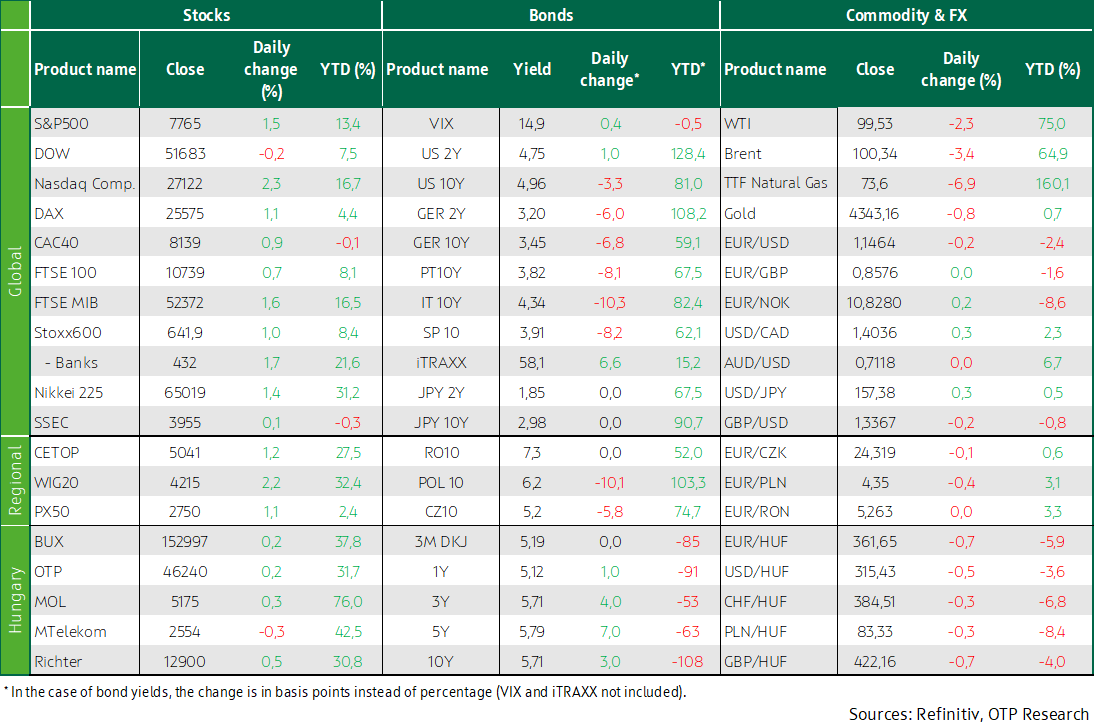
Optimistic expectations surrounding diplomatic efforts in the Middle East, coupled with reports reinforcing the recovery of Saudi oil shipments, pushed crude oil prices lower on Monday. Positive developments in the technology sector further strengthened investor expectations for expanding AI investment. The Nasdaq closed at a new all-time high, while both the S&P 500 and the STOXX 600 also advanced. Long-term yields declined, while expectations for further rate hikes by the Fed and the ECB eased only marginally. In Hungary, long-term yields moved higher, while the forint strengthened, with EUR/HUF closing below 362. Today, attention will be focused on the MNB's rate-setting meeting and the release of its new Inflation Report. On the international stage, market participants will be closely watching US President Trump’s address and bilateral meetings at the UN General Assembly today.
Diplomatic optimism in the Middle East pushed crude oil futures lower, while European equity markets moved higher on Monday
European equities started the week on a positive note. Expectations surrounding the latest diplomatic efforts aimed at ending the war with Iran drove a sharp decline in crude oil prices on Monday and contributed to lower long-term government bond yields across Europe. Improved sentiment boosted risk appetite, with the STOXX 600 closing more than 1% higher, a feat not seen since early July. All sector indices within the STOXX 600 ended the session in positive territory, with banks among the strongest performers. Société Générale gained nearly 2%, while Italy’s Banco BPM soared more than 4% following media reports that UniCredit and Crédit Agricole are considering a joint approach regarding BPM. Technology stocks were also among the top performers, as renewed enthusiasm for artificial intelligence lifted chipmakers such as Soitec (+10%) and Aixtron (+5%). Lower oil prices weighed on the energy sector. Healthcare underperformed slightly, with Novo Nordisk once again emerging as the worst-performing stock in the STOXX 600. The Danish drugmaker plunged nearly 8% amid looming patent expirations. Biopharmaceutical company Ipsen fell 5% after the US Food and Drug Administration (FDA) approved a generic version of the company’s flagship drug.
The DAX, FTSE 100 and CAC 40 closed 1.1%, 0.8% and 0.9% higher, respectively, rebounding after the downturn seen in recent weeks.
In the CEE region, the BUX inched 0.2% higher on Monday, while the WIG20 surged 2.2% and the PX advanced 1.1%. Among Hungarian blue chips, Richter posted the strongest gains, while MOL and OTP also outperformed the broader market. Magyar Telekom slipped 0.3%.
TTF European natural gas prices plunged nearly 8% to a two-week low on Monday, supported by renewed diplomatic efforts aimed at ending the conflict in the Middle East and improving shipping conditions. The market is closely monitoring the prospect of talks between US President Donald Trump and Iranian President Masoud Pezeshkian, as any progress toward resolving the conflict could ease concerns over potential disruptions linked to a closure of the Strait of Hormuz. Meanwhile, reports indicating that a growing number of LNG tankers and crude oil carriers are finding alternative routes out of the Persian Gulf also helped alleviate supply fears. Lower-than-expected demand at the latest German gas storage auctions added further downward pressure on prices. However, Germany’s historically low storage levels continue to highlight underlying supply risks ahead of the winter heating season.
Nasdaq closed at a new all-time high, as developments in the technology sector once again reinforced expectations for further expansion in AI-related capital expenditure
The week started on a strong note for US equities, driven by the continued rally in the technology sector, with the Nasdaq closing at a new all-time high. Chipmakers posted sharp gains, led by AMD, which soared 10%, pushing its market capitalization above the $1 trillion mark for the first time. The move followed the launch of Meta’s Muse AI agent, which reinforced investor expectations that demand for AMD’s EPYC CPUs and Instinct AI accelerators will continue to rise. Anticipation of stronger CPU demand also provided a boost to Intel (+12%) and other semiconductor names, with Broadcom and Micron rising 1.4% and 2.8%, respectively. Marvell rallied more than 5% after unveiling the industry's first 2 nm optical interconnect solutions for next-generation data centers ahead of the ECOC 2026 exhibition. The announcement also lifted Qualcomm, whose shares jumped more than 9%. Industry leader Nvidia closed 2.3% higher after announcing that Tesla, Hitachi and LG Energy Solution had qualified as battery storage service providers under its DSX Ready AI investment program. Tesla gained 3% on the news. Meta surged 11% on Monday after reports showed that its Muse AI agent had been downloaded 902,000 times over the previous six days, reaching the top of both the iOS and Google Play rankings despite Amazon blocking Muse’s access to amazon.com on Sunday over alleged violations of terms related to linked user accounts.
Oil prices fell for a fourth consecutive session on Monday as concerns over Middle Eastern supply disruptions continued to ease, while diplomatic efforts aimed at ending the US-Iran conflict gained momentum. President Trump is scheduled to address the UN General Assembly in New York on Tuesday and may meet Iranian President Pezeshkian during breaks in the proceedings. Trump is also expected to hold talks this week with leaders from other Gulf states as well as Chinese President Xi Jinping. In addition, the US administration has proposed the creation of a $5 billion fund to support the reconstruction of war-damaged infrastructure across the Middle East. Saudi Arabia has shipped an average of 2.9 million barrels of crude oil per day through the Strait of Hormuz over the past six days. Satellite imagery indicates that supertankers with a combined capacity of 14 million barrels were stationed at Saudi Arabia’s Gulf export terminals over the weekend, marking the highest observed tanker presence since June.
Long-term yields declined across developed bond markets alongside falling oil prices, while French CDS spreads climbed to their highest level since 2020
Optimism surrounding developments in the Middle East led to a 2-3% decline in oil prices, easing concerns over the inflation outlook to some extent. Long-term yields generally moved lower across developed bond markets, with the US 10-year Treasury yield falling to 4.96% and the German 10-year Bund yield declining to 3.45%. The US two-year Treasury yield edged 1 bp higher to 4.75%, highlighting that expectations for further monetary tightening in the US changed only marginally. According to CME FedWatch pricing, markets continue to assign a probability of more than 50% to a 25 bp rate hike in October, while an additional increase in January remains the most likely outcome for next year. These expectations were reinforced by comments from Chicago Federal Reserve President Austan Goolsbee on Monday, who stated that US inflation has likely moved beyond the tariff- and energy-related shocks seen over the past 18 months and is now also being driven by strong demand, potentially requiring the Fed to raise rates at a faster pace. Markets are also pricing in further tightening by the ECB, with current expectations implying that the policy rate could rise to as high as 3.5% by 2027. Scope Ratings downgraded France’s sovereign credit rating, while five-year French sovereign CDS spreads climbed to their highest level since May 2020. French CDS spreads have risen by just over 7 bps since last Monday, marking the largest weekly increase since June 2024, when snap elections called by President Emmanuel Macron resulted in political deadlock. The uncertainty that followed has continued to raise investor concerns about the sustainability of France’s fiscal position. EUR/USD remains below 1.15.
In the Hungarian bond market, yields edged higher on Monday in the long-end segment, with the 10-year benchmark yield standing at 5.71% according to the Government Debt Management Agency’s (ÁKK) early afternoon benchmark fixing. By contrast, both Polish and Czech 10-year yields declined noticeably during the session. The forint strengthened modestly, with EUR/HUF falling below 362 on Monday.
Today's highlights
Asian equity markets are trading with a positive tone, as Monday’s technology-driven rally provided a modest boost to regional indices as well. The CSI 300 and Hang Seng are posting slight gains, while South Korean and Taiwanese benchmarks are also in positive territory ahead of the morning close. Markets in Japan remain closed for the first three days of the week due to public holidays.
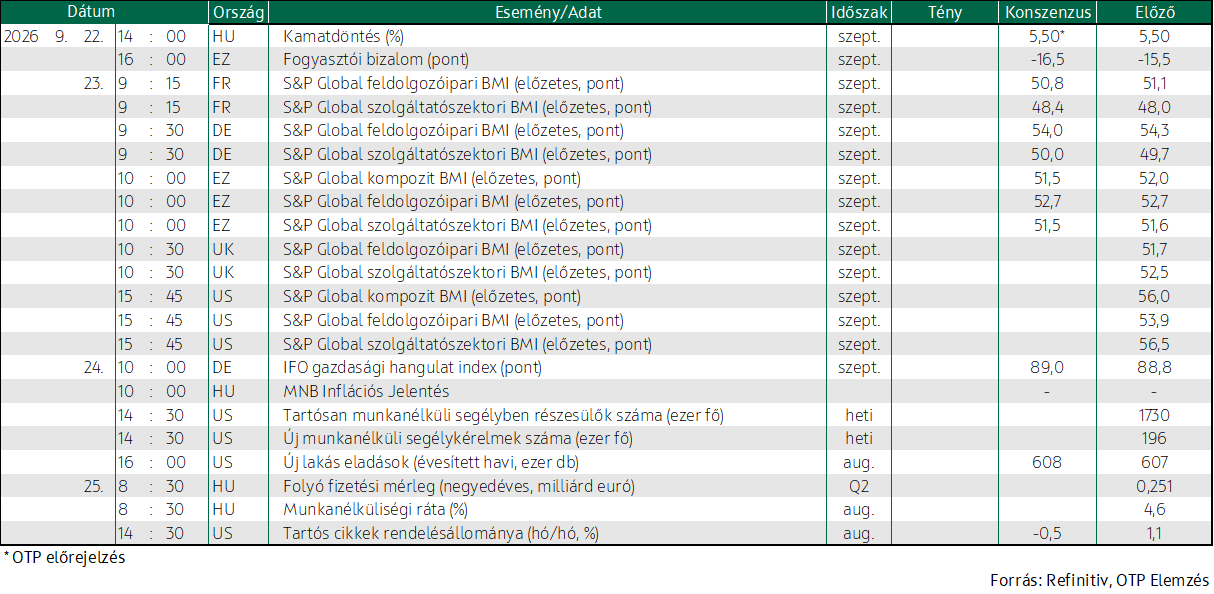
Apart from the euro area’s September consumer confidence index, no major macroeconomic data releases are scheduled for today.
In Hungary, the key event of the day will be the MNB’s rate-setting meeting, where policymakers are widely expected to keep interest rates unchanged. Market participants will also focus on the press conference following the decision. In addition, the MNB will release its latest Inflation Report. Given the recent increase in energy prices, the 2027 headline CPI forecast could be revised higher, while the core CPI projection may be lowered.
The Government Debt Management Agency (ÁKK) will hold its regular three-month Treasury bill auction today.
Get more out of your investments!
Global Markets Services
OTP Global Markets offers a broad range of services in the field of local and international money and capital markets.
Read morePrivate Banking Services
Personal care and expertise with OTP Private Banking, along with the knowledge, security, and innovations of a multinational banking group.
Read more