
OTP Morning Brief: European equities retreat, bond yields rebound
Related content
OTP Morning Brief: Developed market bond yields edged lower yesterday
European indices declined yesterday amid rising oil prices, while the German government revised its GDP growth forecast upward; German exports lost momentum toward the end of the summer; meanwhile, ECB policymakers see upside risks to European inflation. Major US indices moved mostly lower; OpenAI's revenue fell significantly short of previously projected levels; meanwhile, the number of initial jobless claims declined in the US. Long-term yields in both the US and Europe declined following the sharp increase seen in the previous period, while Christopher Waller noted that further Fed rate hikes do not necessarily need to occur at consecutive meetings. The focus today will be on the latest reading of the University of Michigan Consumer Sentiment Index.
OTP Morning Brief: Long-end yields temporarily moved higher, putting equity markets under pressure
Wednesday's trading session was relatively uneventful, with a familiar pattern once again unfolding as the situation in the Persian Gulf drove oil prices higher, pushed yields up, and weighed on equity markets. The correction came within the day, as declining oil prices helped pull the US 10-year yield back from its multi-decade high of 5.36% to around 5.30%. The German 10-year yield followed a similar intraday pattern and ultimately ended the session unchanged from Tuesday's close at 3.48%. The EUR/USD closed at a 17-month low, just below 1.12. Equity markets, however, failed to regain momentum, with both the Nasdaq and the S&P pulling back from their recent highs as investors continued to digest the financing plans of AI-related companies. In Europe, banks led the declines, topping the list of worst-performing sectors. Regional stock markets, including Hungary’s, posted notable declines. The EUR/HUF rose to near 366. Hungarian long-term yields declined. Hungary’s September CPI came in slightly lower than expected. Asian equity indices declined in early trading. Today, German export data will be released, while weekly jobless claims figures are due from the US.
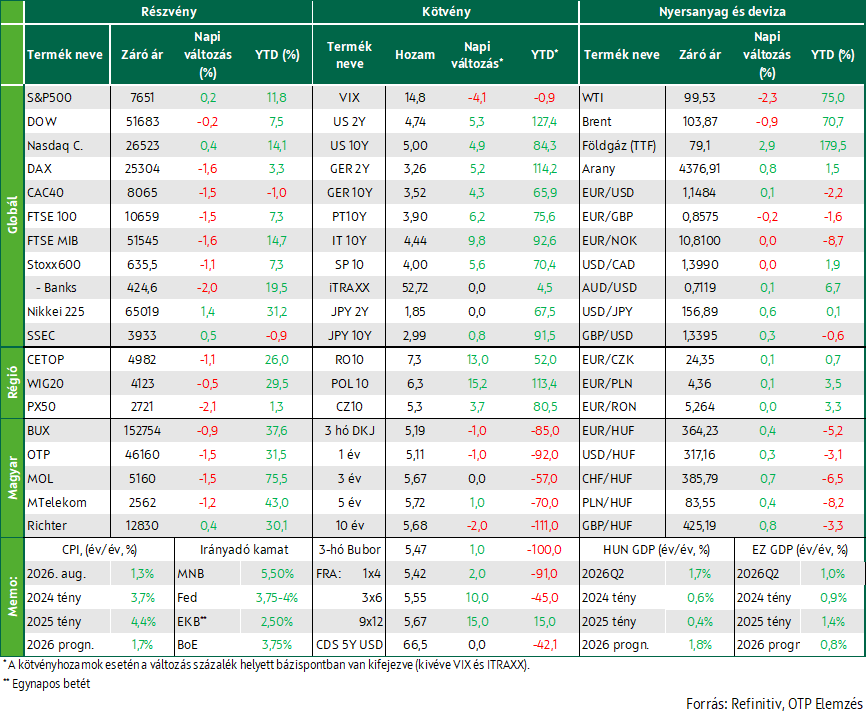
European equities erased their gains accumulated over the week on Friday, while in the US only a late-session rebound lifted markets, led primarily by the technology sector. Long-term government bond yields also rebounded, moving back toward the historic highs reached earlier in the week, levels not seen in 15-18 years in the US and Western Europe, and in four years across the CEE region. Little macroeconomic data were released, but what did emerge largely supported the narrative of the rate-hiking central banks, namely the Fed and the ECB, that economic activity remains resilient.
European markets erased their gains for the week on Friday, with the broadly negative sentiment, which also weighed on the CEE region, further exacerbated by a series of adverse company-specific developments
European equities closed sharply lower on Friday, with the STOXX 600 declining 1.1% on the final trading day of the week and 0.6% over the week as a whole. This extended the index’s slide since early August, bringing its cumulative loss to around 4%. Friday’s decline was broad-based, affecting all sectors except technology. Among the weakest performers were the automotive and telecommunications sectors, which fell 3.3% and 3.4%, respectively. Volkswagen shares dropped 5.6%, marking the company’s worst trading day since September last year, after it announced a one-off charge of EUR 10 billion. Mercedes-Benz shares declined 4.8% despite the absence of any major company-specific news. The telecommunications sector was dragged lower by Airtel Africa (-11.3% DoD), a UK-listed operator serving 14 African countries, after negative reports emerged regarding the valuation of one of its subsidiaries ahead of a planned IPO later this week. Shares of Swiss food giant Nestlé also fell 2.6% after Russia nationalised the company’s local assets. By contrast, Raiffeisen International managed to recover modestly on Friday (+1.0%) after a short seller alleged on Thursday that the banking group may have exposure to Russian trade flows subject to restrictions, triggering an intraday share price decline of around 10%. Overall, European equity markets struggled on Friday, although the negative sentiment was driven to a significant extent by a number of company-specific stories.
Macroeconomic news flow was relatively quiet on Friday, though not entirely uneventful. Germany’s August Producer Price Index (PPI) delivered a negative surprise, with prices rising by 1.1% month-on-month, well above the consensus expectation of 0.4%. On an annual basis, German producer price growth accelerated to 4.6%, also significantly exceeding the market forecast of 4.1%, while marking the highest reading since April 2023. This adds to a growing number of macro indicators suggesting that inflationary pressures are building across the euro area and continues to support the ECB’s more hawkish policy stance.
The main CEE equity indices were likewise unable to escape Friday’s negative market sentiment. The CETOP fell 1.1%, the WIG20 declined 0.5%, the PX50 dropped 2.1%, while the BUX lost 0.9%. Among Hungarian blue chips, only Richter managed to post gains (+0.4%), whereas the remaining constituents recorded declines of between 1.2% and 1.5%. No major regional macroeconomic releases were published on Friday, with the exception of Poland’s August industrial production data, which showed annual growth of 4.3%. While this fell short of the 6.8% consensus forecast, it remained comfortably above the average recorded over the past three years.
US indices erased their intraday losses into the close on Friday, while macroeconomic data releases and policymakers’ comments continued to underscore the resilience of the US economy
On Friday, US equity markets initially followed the negative sentiment seen in Europe after the opening bell, but recovered most of their losses by the close. The Dow Jones ended the session down 0.2%, while the S&P 500 gained 0.2% and the Nasdaq advanced 0.4%. The rally was led by the technology sector, which rose 0.8% by the end of the day and has now largely recouped the losses suffered earlier in the week amid sector-wide concerns over the potential risks associated with AI. Shares of consumer durables manufacturers declined by an average of 0.6%, while banks and energy companies were broadly unchanged. Nevertheless, energy stocks remain close to their all-time highs, in line with oil prices that, despite easing somewhat during the week, continue to trade above USD 100 per barrel (Brent closed at USD 103.9/bbl, down 0.9% both on Friday and compared to the end of the previous week).
In terms of macroeconomic releases, the final trading day of the week was relatively uneventful in the US following Wednesday’s rate decision, the key event of the previous week. August industrial production data, published on Friday, sent mixed signals: output was unchanged month-on-month, although it is worth noting that comparable indicators in Europe have recently pointed to declining activity, while on an annual basis production grew by 1.4%, exceeding market expectations. Overall, the data broadly reinforced the Fed’s narrative accompanying Wednesday’s rate hike, namely that the US economy remains in good shape and that, alongside its employment mandate, the central bank can increasingly focus on bringing down inflation. On Friday, Kansas City Fed President Jeffrey Schmid expressed a similar view in a speech, stating: “Aside from inflation, the economy is performing well. The labour market is in balance. Unemployment is 4.1%, which most observers would consider full employment.” The remarks further strengthened market expectations that the Fed could deliver additional rate hikes in October and potentially again in December.
Long-term bond yields rebound toward the multi-year highs reached earlier in the week
The temporary decline in long-term US interest rates following the Fed’s policy decision on Wednesday proved short-lived. Yields resumed their upward trajectory on Friday, with both the 2-year and 10-year Treasury yields rising by around 5 basis points to 4.74% and 5.00%, respectively. Earlier in the week, on Tuesday, long-term yields reached fresh cycle highs, with the 10-year Treasury yield briefly approaching 5.04%, a level last seen in the months preceding the collapse of Lehman Brothers in the summer of 2008.
The picture was similar in Europe. German 10-year government bond yields also reached a cycle high last Tuesday, touching 3.57%, before easing by around 10 basis points over Wednesday and Thursday and then rebounding to 3.52% on Friday. However, unlike in the US, comparable yield levels in Europe were last seen not before the Lehman collapse, but during the euro area sovereign debt crisis in 2009. A broadly similar pattern was observed across most European bond markets, albeit with some variation. For example, French 10-year government bond yields reached a new post-euro crisis high at Friday’s close, ending the session at 4.57%. One notable difference between the recent rise in European yields and the period preceding Mario Draghi’s famous 2012 “whatever it takes” speech is that yield spreads between euro area member states have remained relatively contained despite the upward move in borrowing costs. For instance, the spread between Spanish and German 10-year yields stood at just 48 basis points on Friday, compared with more than 80 basis points even in 2018, when the overall yield environment was substantially lower. There are, however, some notable exceptions. The spread between French and German 10-year yields has widened significantly over the past two years, reaching 70 to 80 basis points, levels not seen since 2012.
CEE bond market developments were broadly in line with the trends seen elsewhere. Long-term Czech and Polish government bond yields also reached fresh four-year highs during the week, standing at 5.3% and 6.3%, respectively. These are the highest levels recorded since the escalation of the Russia-Ukraine war in 2022. Hungarian yields likewise climbed to their highest levels since May, with the 10-year government bond yield standing at 5.68% based on Friday’s AKK fixing. At the same time, Hungarian government bonds have held up relatively well compared to their regional peers. Since their July lows, 10-year Hungarian yields have risen by around 70 basis points, broadly matching the increase seen in Czech and Slovak bonds, while Polish 10-year yields have surged by roughly 110 basis points over the same period.
There were no major currency market moves during the second half of last week.
Today's highlights
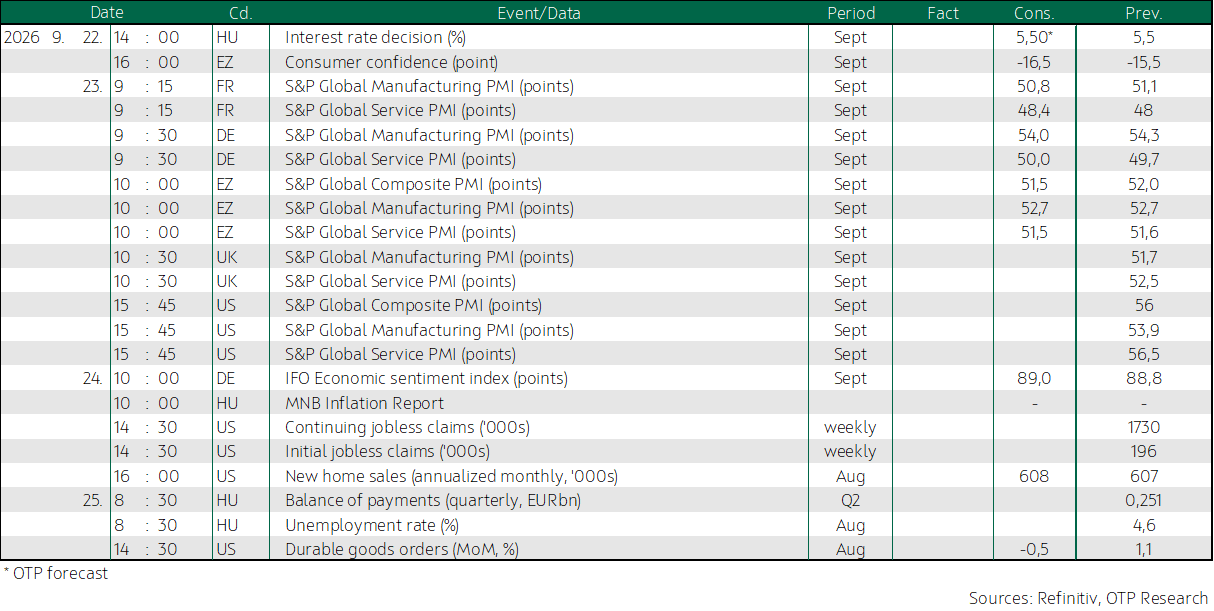
No major macroeconomic data releases or policy announcements are expected on Monday, either from developed markets or from the CEE region. The most closely watched scheduled event of the week will be the MNB’s rate-setting meeting on Tuesday. In addition, several business sentiment indicators from European countries are due to be published during the week. Asian markets nevertheless started the week on a positive note. As of 7:00 a.m. CET, Hong Kong’s Hang Seng Index was up 0.6%, Japan’s Nikkei gained 1.4%, while the Korean equity market was trading 1.8% higher. (Szigel Gábor)
Get more out of your investments!
Global Markets Services
OTP Global Markets offers a broad range of services in the field of local and international money and capital markets.
Read morePrivate Banking Services
Personal care and expertise with OTP Private Banking, along with the knowledge, security, and innovations of a multinational banking group.
Read more