
OTP Morning Brief: Bank of Japan raises interest rates
Related content
OTP Morning Brief: Long-end yields temporarily moved higher, putting equity markets under pressure
Wednesday's trading session was relatively uneventful, with a familiar pattern once again unfolding as the situation in the Persian Gulf drove oil prices higher, pushed yields up, and weighed on equity markets. The correction came within the day, as declining oil prices helped pull the US 10-year yield back from its multi-decade high of 5.36% to around 5.30%. The German 10-year yield followed a similar intraday pattern and ultimately ended the session unchanged from Tuesday's close at 3.48%. The EUR/USD closed at a 17-month low, just below 1.12. Equity markets, however, failed to regain momentum, with both the Nasdaq and the S&P pulling back from their recent highs as investors continued to digest the financing plans of AI-related companies. In Europe, banks led the declines, topping the list of worst-performing sectors. Regional stock markets, including Hungary’s, posted notable declines. The EUR/HUF rose to near 366. Hungarian long-term yields declined. Hungary’s September CPI came in slightly lower than expected. Asian equity indices declined in early trading. Today, German export data will be released, while weekly jobless claims figures are due from the US.
OTP Morning Brief: Easing bond yields lifted equity markets on Tuesday
The rise in bond yields seen in recent days eased, supporting markets in both Europe and the US. In the euro area, Germany’s August industrial orders, French industrial output, and the region’s retail sales figures generally painted a negative picture. The BUX rose by 1.3%. In the US, both the S&P 500 and the Nasdaq closed at record highs. Although Brent crude started the day lower, it moved back toward the $100 per barrel mark by the close, driven by the Houthi attacks. A series of protests in France heightened uncertainty. The forint strengthened to nearly 365 against the euro. Asian equity indices declined in early trading. Today, Hungary’s CPI data will be worth watching.
The correction in oil prices improved sentiment across European equity markets, while both the UK and Czech central banks left their benchmark interest rates unchanged, in line with expectations. Following the previous day's losses, the major US indices moved higher. US housing market data came in weaker than expected, while labor market indicators continued to paint a favorable picture. Long-term yields declined in both overseas and European markets a day after the Fed’s rate hike, supported by the drop in oil prices, while the forint strengthened against both the euro and the US dollar. For the remainder of the day, attention will focus on UK retail sales data, US industrial production, and the performance of the leading index.
The correction in oil prices improved sentiment across European equity markets, while the UK and Czech central banks kept their key policy rates unchanged, in line with expectations
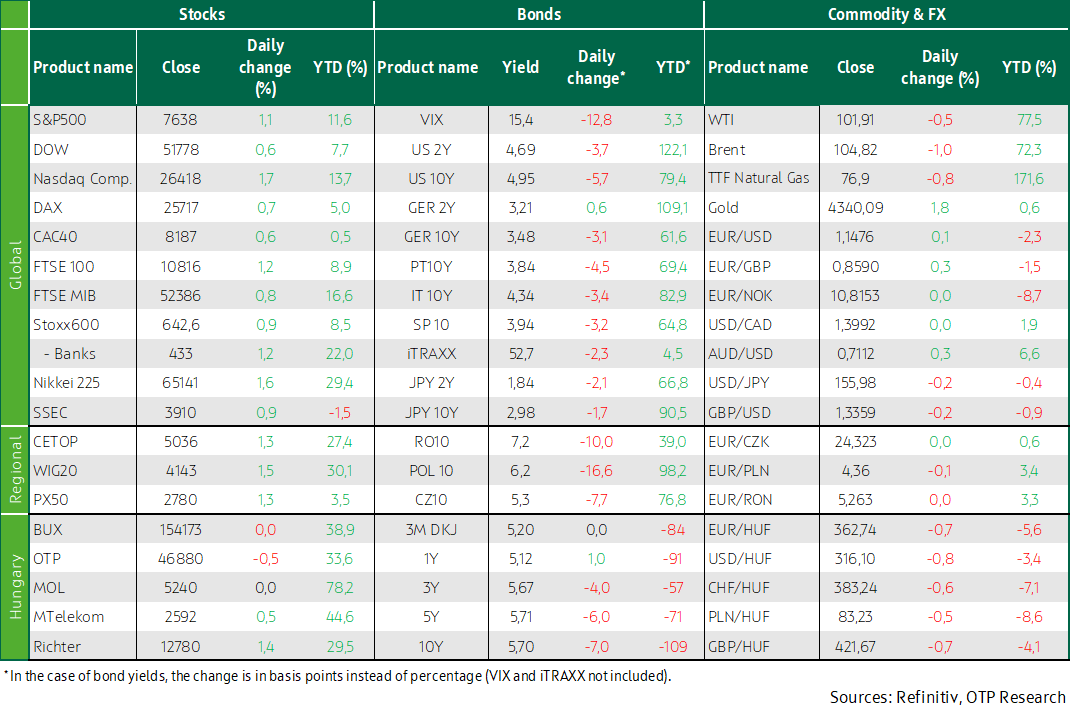
European equities closed sharply higher, with the STOXX 600 index gaining 0.9%. Risk appetite was primarily supported by easing energy prices after Saudi Arabia indicated that the East-West crude oil pipeline could resume operations shortly. As a result, European natural gas and fuel prices declined, helping to ease concerns over a further surge in CPI. At the sector level, banks outperformed, with shares of Santander, BBVA, and Deutsche Bank each rising by around 2%. Energy-intensive industrial companies also delivered strong performance, as Siemens Energy, Schneider Electric, and Siemens all advanced. Overall, lower energy prices and stabilizing bond yields improved investor sentiment toward European equity markets.
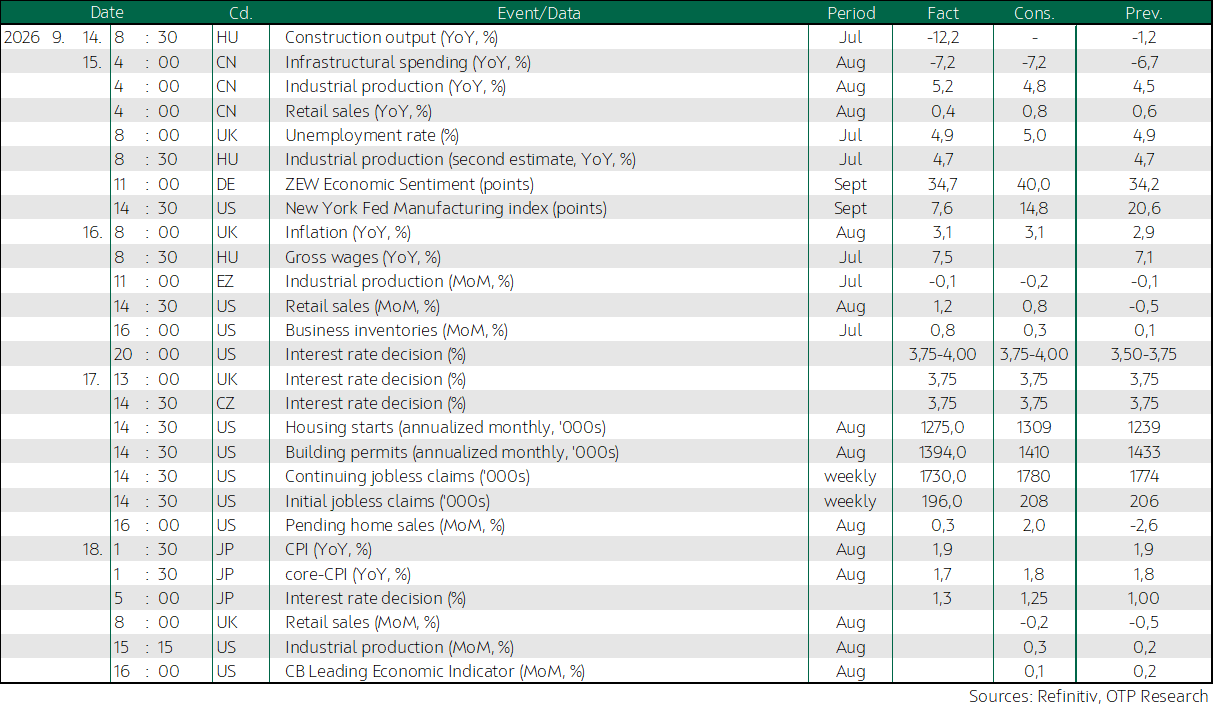
The Bank of England’s Monetary Policy Committee left the Bank Rate unchanged at 3.75% at its September meeting, in line with market expectations. The decision was passed by a 6-3 vote, with three policymakers continuing to favor a 25-basis-point rate hike, the same split seen at the July meeting. According to the central bank, the prolonged conflict in the Middle East has significantly increased crude oil and refined energy prices. The Committee emphasized that monetary policy must ensure the sustainable return of CPI to the 2% target, although the magnitude and persistence of the energy price shock remain uncertain. In the Bank’s assessment, there is currently limited evidence that higher energy prices have triggered broad-based second-round effects on wages and pricing. However, policymakers warned that these risks could intensify if energy prices remain elevated for an extended period. Alongside the decision to keep rates unchanged, the Bank unanimously reaffirmed its commitment to gradually unwind its stock of previously purchased government bonds through 2034, reducing its gilt holdings by an average of GBP 46 billion per year. The decision signals that while interest rates are being kept on hold for now, the central bank will continue shrinking its balance sheet and maintaining a restrictive monetary stance to bring CPI back under control.
Major indices across the CEE region moved higher, while the BUX was broadly unchanged. Among Hungarian blue chips, OTP edged lower, MOL traded flat, whereas the other two benchmark constituents posted gains. The Czech National Bank left its two-week repo rate unchanged at 3.75% at its September meeting, in line with market expectations. This marked the second consecutive meeting at which the central bank paused its easing cycle. Although annual CPI slowed to 1.9% in August, remaining below the central bank’s 2% target, policymakers noted that the inflation outlook for 2027 remains elevated, warranting continued caution in the conduct of monetary policy.
Major US indices rebounded following the previous session’s losses, as weaker-than-expected US housing market data contrasted with still-resilient labor market indicators
US equities advanced after recovering from the previous session’s losses, supported by declining government bond yields and lower oil prices. Gains were led by the technology sector. Shares of Nvidia and Amazon both climbed by more than 2%, while Microsoft added 1.5%. Among companies linked to the artificial intelligence theme, Qualcomm and Intel posted gains of 2.1% and 7.7%, respectively. Risk appetite also benefited from easing energy prices. WTI crude oil fell by 0.5% to below USD 102 per barrel after reports related to Saudi oil shipments helped alleviate concerns over potential supply disruptions. At the same time, markets continued to assess the implications of the Federal Reserve’s tighter monetary policy stance. Following the central bank’s 25-basis-point rate hike the previous day, investors welcomed the Fed’s determination to tackle persistently elevated CPI, although the conflict in the Middle East and developments in energy markets remained key sources of uncertainty. According to market participants, persistently high oil prices could complicate efforts to bring CPI lower, potentially necessitating further monetary tightening in the months ahead.
In the US, housing starts declined by 2.6% month-on-month in August, falling to an annualized rate of 1.275 million from 1.309 million in July. The figure came in well below market expectations and marked the second consecutive monthly decline. Housing construction activity fell to its lowest level since October 2025, primarily due to rising mortgage rates and deteriorating housing affordability. Building permits decreased by 2.7% month-on-month to an annualized 1.394 million units in August, also missing market expectations of 1.41 million. Pending home sales increased by 0.3% month-on-month in August, partially reversing the revised 2.6% decline recorded in July. However, the increase fell significantly short of market expectations, which had pointed to a 2.0% expansion, while activity remained well below the peaks seen in 2021, when mortgage rates were near historic lows at around 3%. All three indicators are consistent with the weakness observed in the US housing market in recent months. Elevated mortgage rates continue to weigh on housing demand and new investment activity, while the weaker-than-expected building permits data suggest that residential construction is unlikely to provide meaningful support to economic growth in the coming months.
In the US, initial jobless claims fell by 10,000 to 196,000 in the second week of September. The reading came in significantly below the market consensus of 208,000 and marked the lowest level since July's 189,000, which had represented a nearly 60-year low. Continuing claims declined by 39,000 to 1.73 million in the first week of September, reaching their lowest level since January 2024. This also points to a stronger-than-expected labor market. Taken together, the data further reinforce the view that the US labor market remains exceptionally tight and continues to demonstrate resilience despite concerns about a broader economic slowdown.
US and European long-term bond yields declined a day after the Fed’s rate hike, aided by lower oil prices, while the Hungarian forint strengthened against both the euro and the US dollar
US Treasury yields declined a day after the Federal Reserve raised its policy rate by 25 basis points for the first time in three years. The yield on the 10-year US Treasury note fell by nearly 6 basis points to 4.95%, while the 2-year yield eased to 4.69%. The Fed maintained a hawkish tone in its communication following Wednesday’s decision. According to policymakers’ projections, the majority still expect at least one additional rate hike this year, while some officials see room for as many as two further increases. Markets also monitored tensions between the Fed and Donald Trump after the US president once again argued in favor of lower interest rates and criticized the central bank’s leadership. Following its gains on Wednesday, the US dollar underwent a modest correction and weakened slightly against the euro yesterday. Lower bond yields were also supported by declining oil prices, which helped ease concerns over a further rise in CPI.
In European bond markets, yields moved broadly in the same direction as their US counterparts, albeit to a lesser extent. The yield on the 10-year Bund fell by 3 basis points to 3.48%, retreating after having reached its highest level since June 2009 on Tuesday. In Hungary, yields beyond the one-year segment declined by 4-8 basis points during the session, with the 10-year government bond yield closing at 5.7% following a 7-basis-point drop. Lower oil prices also provided support to the Hungarian forint, which strengthened against both the euro and the US dollar on Thursday.
Today's highlights
Overall, sentiment across Asian markets was positive this morning. Japanese equities extended their gains following the Bank of Japan’s policy meeting, where the central bank raised its key policy rate by 25 basis points to 1.25%, in line with market expectations. Attention subsequently shifted to the Bank’s forward guidance and the extent of any additional monetary tightening that may be signaled in light of ongoing CPI and wage growth trends, an issue that has also drawn pressure from the US Treasury Secretary amid recent foreign exchange market developments. Meanwhile, Japan’s August CPI figures, also released today, painted a mixed picture. Headline CPI remained unchanged at 1.9% year-on-year, while core CPI slowed to 1.7%, undershooting expectations and remaining below the central bank’s 2% target for the seventh consecutive month.
Later today, market attention will focus on UK retail sales figures, as well as US industrial production and the Conference Board Leading Economic Index, which may provide further insights into the strength of economic activity and the outlook for growth on both sides of the Atlantic.
Get more out of your investments!
Global Markets Services
OTP Global Markets offers a broad range of services in the field of local and international money and capital markets.
Read morePrivate Banking Services
Personal care and expertise with OTP Private Banking, along with the knowledge, security, and innovations of a multinational banking group.
Read more