
OTP Morning Brief: The Fed raised rates, while Europe benefited from the correction in oil prices
Related content
OTP Morning Brief: News of Anthropic's potential stock market debut drove the rally in the technology sector
Major European and US equity indices moved higher. In Europe, the defence sector led the gains, while technology stocks spearheaded the rally in the US. Anthropic submitted documentation for its stock market listing, putting the spotlight back on AI investment spending. Saudi Arabia and Iran held talks aimed at easing tensions between the two countries, while crude oil prices edged lower. There was little movement in developed bond markets, with investors focusing on the ECB's and the Fed's interest rate decisions due later this week. The US dollar extended its gains against the euro. The BUX climbed by more than 1% yesterday. The Hungarian forint continued to weaken against the major currencies. The earnings season continues today with major names such as Coca-Cola and Boeing reporting results.
OTP Morning Brief: Oil and gas prices hit multi-year highs as equity markets slide
By the end of last week, oil prices had climbed to their highest levels since spring, while European natural gas prices approached levels last seen in late 2022, driven by escalating tensions in the Middle East. Equity markets also turned lower by the end of the week: while the energy sector benefited from higher commodity prices and soared to record highs, all other sectors came under pressure. In the bond market, the US 10-year Treasury yield dipped back below 5%, while its German counterpart closed at a one-and-a-half-month low. French, Mediterranean, and CEE bond yields showed little movement on Friday, but over the course of the week they rose noticeably overall.
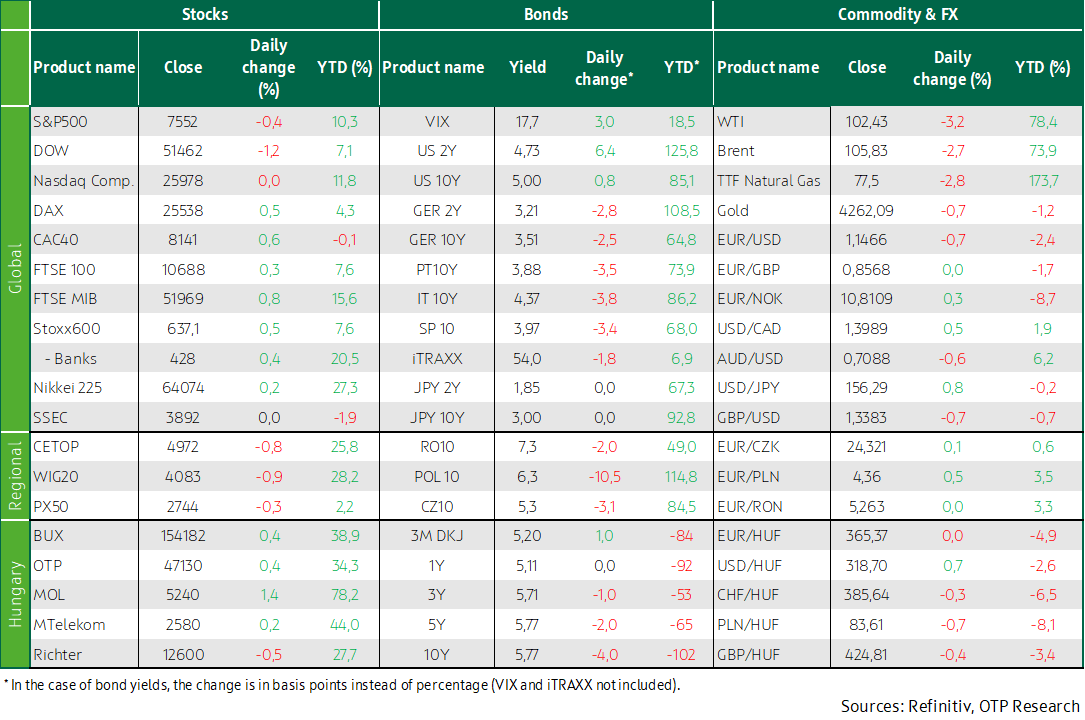
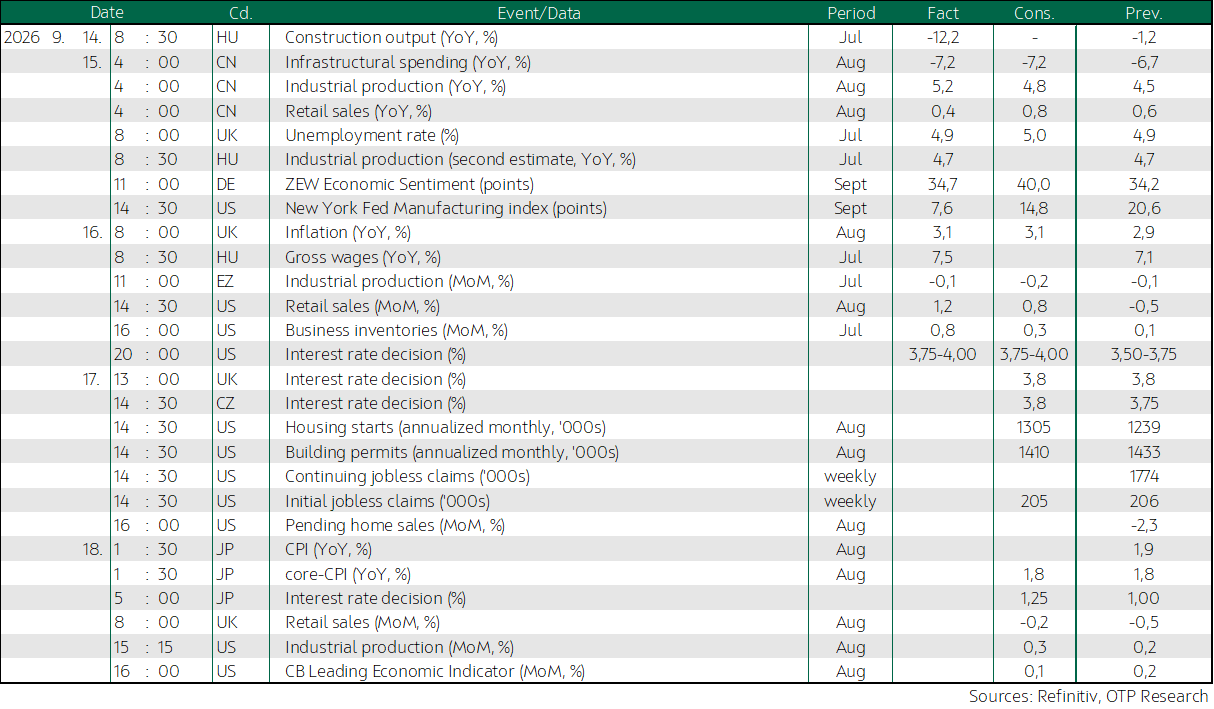
Alongside the Fed's rate decision, the decline in oil prices shaped market sentiment on Wednesday. The central bank raised the target rate range by 25 basis points, in line with expectations, while a majority of policymakers did not rule out the possibility of another rate hike before year-end. Following the Fed's communication, US equity markets moved into negative territory, government bond yields rose, and the dollar strengthened. Investor sentiment improved in Europe, supported primarily by declining energy prices. Both Brent and WTI crude prices fell by nearly 3% following reports of additional supply from Saudi Arabia, while TTF gas prices declined by a similar magnitude. The STOXX 600 index gained 0.5%, while yields in European bond markets edged lower. In Hungary, the BUX gained 0.4%, while July wage data continued to point to robust growth in earnings and real wages. Today, attention will focus on the UK and Czech rate decisions, as well as US jobless claims and housing market data.
The correction in oil prices improved sentiment on European stock markets
European equity markets closed higher on Wednesday. The pan-European STOXX 600 index advanced 0.5%, while most major European benchmarks also finished the session in positive territory. Market sentiment was supported by lower oil prices after reports emerged that Saudi Arabia was offering additional crude cargoes to the market through Oman, easing concerns over supply risks. As a result, both Brent and WTI crude prices fell by nearly 3%, while European natural gas prices also posted a decline of a similar magnitude. The move in energy prices weighed on the European energy sector, whereas travel and leisure stocks gained 1.2%, supported by expectations of lower fuel costs.
Major Western European stock indices also closed in positive territory, with the FTSE 100 rising 0.3%, the DAX gaining 0.5%, and the CAC 40 finishing 0.6% above its previous close.
European macroeconomic data released on Wednesday delivered a mixed picture overall. In the UK, annual CPI rose to 3.1% in August from 2.9% in July, in line with expectations. The acceleration in CPI was driven primarily by higher transport costs, as motor fuel inflation soared to 23% following increases in petrol and diesel prices. Price pressures also intensified across housing and household services, communication, as well as recreational and cultural services, while food CPI remained unchanged. Core CPI held steady at 2.6%, suggesting that underlying inflationary pressures showed no meaningful strengthening.
Eurozone industrial output in July 2026 was slightly better than market expectations, declining by 0.1% month-on-month, matching the decrease recorded in June. The monthly contraction was primarily driven by weaker production of non-durable consumer goods, while growth in energy output also lost momentum. In contrast, the production of intermediate goods and capital goods improved following weaker performance in the previous month, and output of durable consumer goods also developed favourably. Among the euro area's largest economies, performance varied considerably: industrial production fell by 1.5% in Germany and 0.4% in France, while Spain recorded growth of 0.6%.
Among the major CEE indices, the WIG20 and PX50 closed down 0.9% and 0.3%, respectively, while the BUX gained 0.4%. Most Hungarian blue chips ended the session higher, with Mol posting the strongest performance. Richter closed 0.5% lower. In Hungary, gross average earnings rose by 7.5% year-on-year to HUF 745,500 in July 2026. Thanks to the expansion of tax allowances for families and mothers, net average earnings increased at a faster pace of 9.1%, while real wages were 7.8% higher than a year earlier.
The Fed signalled further tightening, sending US equities lower
The Fed raised the target rate range by 25 basis points to 3.75-4.00% at its meeting yesterday, in line with expectations. According to the central bank’s latest projections, the outlook for US economic growth improved slightly for both this year and next, while the unemployment rate is expected to remain lower than previously anticipated. Policymakers also revised their forecasts for this year’s PCE inflation and core PCE inflation marginally higher, by 0.1 percentage point each, while the 2027 projection was left unchanged. The updated dot plot showed that 16 of the 18 policymakers see at least one additional 25-basis-point rate hike as likely before the end of the year.
Leading US indices were still trading higher ahead of the rate decision, but market sentiment turned negative following the Fed’s communication. The Dow Jones fell 1.2%, the S&P 500 declined 0.4%, while the Nasdaq closed virtually unchanged, down just 0.01%. At the sector level, technology was the best-performing segment within the S&P 500, supported by gains in semiconductor stocks. In contrast, the energy sector dropped 3% as oil prices moved lower. Chevron fell 2.9%, Exxon Mobil lost 3.5%, while Devon Energy and ConocoPhillips retreated by more than 5%.
Among corporate developments, Intel stood out with a 4% share price gain following media reports that SK Hynix is in talks with the company on a US memory manufacturing partnership. Robinhood fell 5.5% amid regulatory uncertainty surrounding the US crypto sector and an insider trading case, while Boeing declined 3.7% after the company's CEO indicated that efforts to stabilise 737 MAX production were progressing more slowly than expected.
Data released yesterday continued to point to a resilient US economy. Retail sales rose by 1.2% month-on-month in August 2026, significantly exceeding market expectations. The increase was driven primarily by higher sales at gasoline stations, while online retailers, miscellaneous store retailers, electronics and appliance stores, as well as food services and drinking places also posted strong growth. In contrast, a modest decline was recorded at building material and garden equipment stores. Core retail sales, which exclude autos, fuel, building materials and food services and are closely watched as a gauge of GDP, increased by 1.4% in August, substantially outperforming market expectations and marking the strongest monthly expansion since September 2024. Business inventories rose by 0.8% month-on-month in July, well above the market consensus of 0.3%, corresponding to annual growth of 3.8%. The stronger-than-expected reading was primarily supported by a sharp increase in wholesale inventories, while inventory levels at retailers and manufacturers also moved higher.
The Fed’s rate hike and the prospect of further tightening pushed US yields higher, while the correction in energy prices brought temporary relief to European bond markets
US Treasury yields moved higher on Wednesday following the Fed’s rate decision. The yield on the two-year US Treasury rose to as high as 4.74%, its highest level since July 2024. Markets had been trading at lower yield levels ahead of the Fed meeting, but the central bank’s communication reinforced the possibility of further policy tightening. The two-year yield closed at 4.73%, up 6.4 basis points, while the benchmark 10-year yield ended the session at 5.00%, an increase of 0.8 basis points. The dollar strengthened against major currencies following the rate hike, with the euro falling 0.7% to USD 1.147 on Wednesday.
Relief was seen in European bond markets, supported by the decline in oil prices and a wait-and-see approach ahead of the Fed’s rate decision later in the day. The yield on the 10-year Bund fell by 2.5 basis points to 3.5%, after climbing to its highest level since June 2009 on Tuesday. The more monetary policy-sensitive German two-year yield declined by nearly 3 basis points to 3.2%, having reached an almost two-year high earlier in the week.
Longer-dated Hungarian government bond yields also moved lower yesterday, with the 10-year yield closing at 5.77% after declining by 4 basis points. The forint was broadly unchanged against the euro on Wednesday, while strengthening by 0.7% against the dollar.
Today's highlights
Asia also saw mixed but generally favourable sentiment. Investors responded positively to Fed Chair Kevin Warsh’s firm commitment to fighting CPI, which helped reduce market uncertainty. In early trading, Japan’s Nikkei 225 gained 0.4%, while South Korea’s Kospi advanced 0.7%. In contrast, China’s SSEC fell 0.3%, and Hong Kong’s Hang Seng declined 0.9%.
Today, attention will focus on the UK and Czech rate decisions, as well as US jobless claims and housing market data.
Get more out of your investments!
Global Markets Services
OTP Global Markets offers a broad range of services in the field of local and international money and capital markets.
Read morePrivate Banking Services
Personal care and expertise with OTP Private Banking, along with the knowledge, security, and innovations of a multinational banking group.
Read more