
OTP Morning Brief: Fed expected to raise interest rates today, while crude oil prices continue to rise
Related content
OTP Morning Brief: Oil and gas prices hit multi-year highs as equity markets slide
By the end of last week, oil prices had climbed to their highest levels since spring, while European natural gas prices approached levels last seen in late 2022, driven by escalating tensions in the Middle East. Equity markets also turned lower by the end of the week: while the energy sector benefited from higher commodity prices and soared to record highs, all other sectors came under pressure. In the bond market, the US 10-year Treasury yield dipped back below 5%, while its German counterpart closed at a one-and-a-half-month low. French, Mediterranean, and CEE bond yields showed little movement on Friday, but over the course of the week they rose noticeably overall.
OTP Morning Brief: Earnings season continues to drive equities higher, while the French 10-year yield climbs above 5%
Stock markets moved higher yesterday in both Europe and the US, with technology stocks leading the gains on both sides of the Atlantic. Individual earnings reports released so far do not indicate that the AI investment boom is set to slow in the coming months. French financial indicators, however, are coming under increasing pressure from social and political uncertainty across both the corporate and public sectors: while French retail giant Carrefour issued a profit warning due to the unrest, French long-term bond yields soared to their highest level since 2002. The rise in yields also affected other countries, with the yield on 10-year Hungarian government bonds moving higher as well.
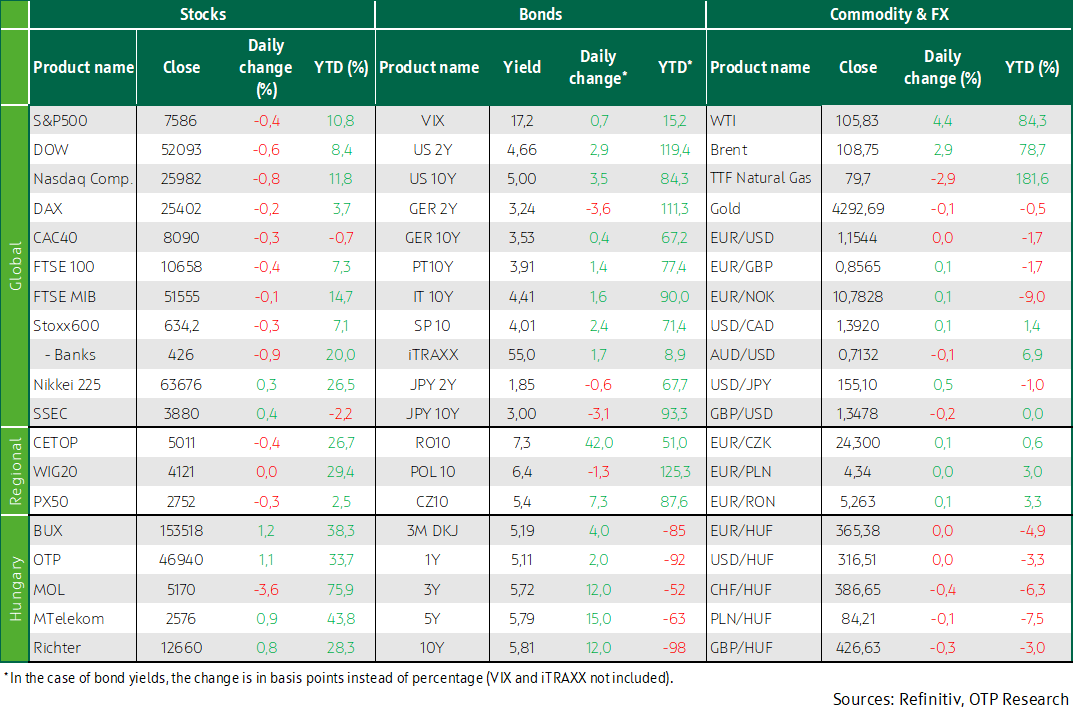
On Tuesday, market sentiment was shaped by tensions in the Middle East and caution ahead of the Fed’s interest rate decision. Oil prices continued to soar following the attacks on Saudi oil infrastructure, fueling risk-off sentiment across both Europe and the US. The STOXX 600 fell to a three-month low, while the Dow declined 0.6%, the S&P 500 slipped 0.4%, and the Nasdaq dropped 0.8%. Energy companies outperformed on the back of soaring oil prices, while the US 10-year Treasury yield climbed back above 5%. In Europe, financial and luxury stocks remained under pressure, although German investor sentiment improved across the region, while the Hungarian market outperformed thanks to gains in OTP, Richter, and Magyar Telekom. Today’s focus will be on the Fed’s interest rate decision, alongside US retail sales, euro area industrial production, UK CPI data, and Hungarian wage figures.
STOXX 600 falls to a three-month low amid soaring oil prices
Rising oil prices and caution ahead of the Fed’s interest rate decision fueled risk-off sentiment across European markets. The STOXX 600 declined 0.3%, closing at its lowest level since mid-June. Most sectors moved lower, with financial stocks coming under particular pressure. The banking sector fell 0.9%, while financial services providers dropped 1.9%. Investor sentiment was further weighed down by warnings from Bank of America management about a potential decline in investment banking revenue, adding to pressure on the banking industry. Shares of UBS fell 3.4%, placing the Swiss lender among the session’s biggest losers. In contrast, the energy sector rose 1.3% as oil prices continued to surge. The rally was supported by Saudi Arabia’s decision to suspend operations on its key east-west oil pipeline following drone attacks, halt some loading activities at the Red Sea port of Yanbu, and notify several European buyers of the cancellation of September crude shipments, further heightening concerns over global supply risks.
The leading Western European stock indices all closed in negative territory, with the FTSE 100 falling 0.4%, the DAX declining 0.2%, and the CAC 40 slipping 0.3% compared to their previous close. The luxury sector remained under pressure amid slowing sales and weaker earnings prospects, with LVMH shares dropping 2.6%. As a result, L'Oréal overtook LVMH in market capitalization, becoming France’s most valuable listed company.
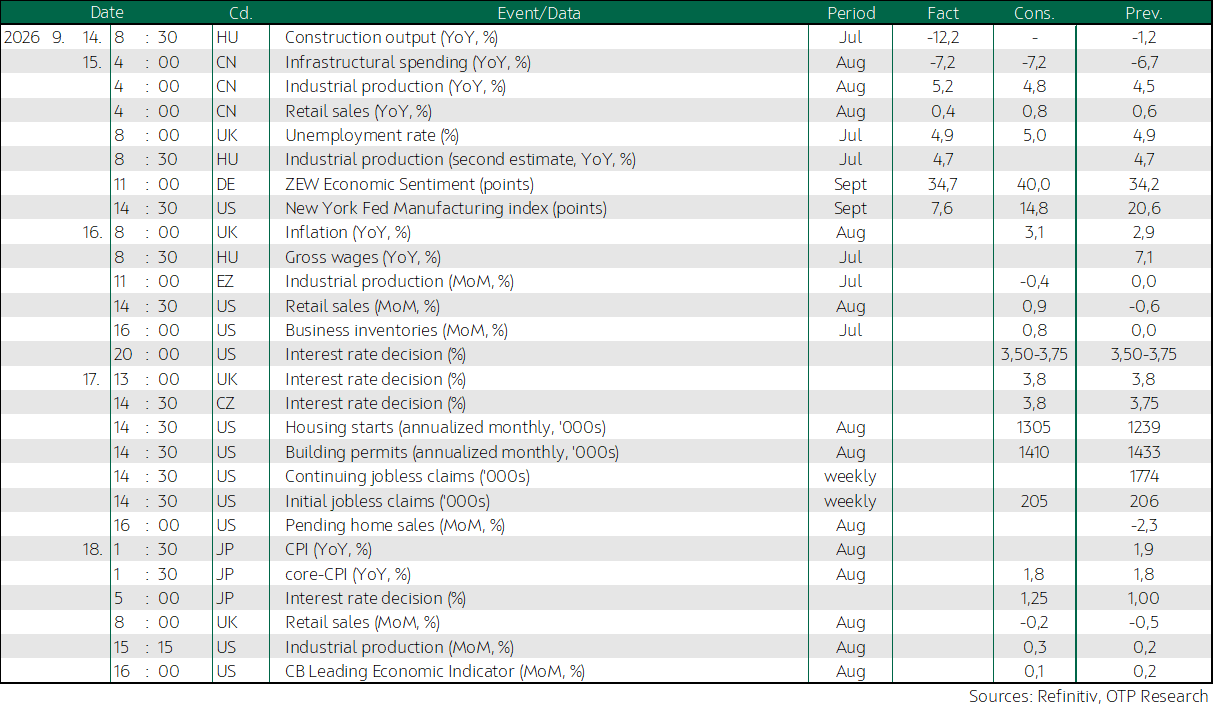
Macroeconomic data painted a mixed picture across Europe. In the UK, the number of job vacancies fell to a four-year low ahead of the Bank of England’s interest rate decision, pointing to a gradual cooling of the labor market. However, the unemployment rate unexpectedly held steady at 4.9%, while employment increased by 66,000 compared to the previous three-month period. In Germany, investor sentiment stabilized, with the ZEW index rising to 34.7, its highest level since February, while perceptions of current economic conditions also improved markedly. In Hungary, industrial output expanded by 4.7% year-on-year in July, slowing from June’s 10.1% growth rate, but production increased by 1.7% on a monthly basis. Growth continued to be driven primarily by the automotive industry, as well as the manufacture of computers, electronic and optical products.
Regional markets delivered mixed performance, with the BUX rising 1.2%, the WIG20 closing unchanged, and the PX index slipping 0.3%. The Hungarian equity market outperformed, primarily supported by gains of 1.1% in OTP, 0.8% in Richter, and 0.9% in Magyar Telekom, which were sufficient to offset the 3.6% decline in MOL shares.
US indices close lower ahead of the Fed’s Wednesday interest rate decision
Middle East risks intensified further after Yemen’s Houthi rebels launched additional attacks against Saudi Arabia. The strikes on Saudi oil infrastructure heightened concerns over supply disruptions, triggering a significant 3-4% surge in oil prices. As a result, Brent crude rose 2.8% to $108.7 per barrel, while WTI climbed 3.0% to $105.8 per barrel, marking a four-month high.
The leading US indices closed in negative territory, with the Dow falling 0.6%, the S&P 500 declining 0.4%, and the Nasdaq dropping 0.8%. Trading was primarily driven by rising oil prices, elevated bond yields, and concerns surrounding the outlook for the AI sector. Among the S&P 500 sectors, energy was the only one to post gains, advancing 2.3%, while consumer discretionary stocks were the weakest performers, retreating 1.8%.
Technology and AI-related stocks delivered mixed performance. Nvidia posted a modest gain following Monday’s pullback, while Alphabet, Amazon, and Microsoft all closed down more than 1%. Investor attention remained focused on recent reports suggesting that several leading AI companies had called for a slowdown in the pace of artificial intelligence development due to safety concerns, raising questions about the sustainability of the current AI investment cycle. In company-specific news, Dave & Buster’s shares plunged 19% after the company reported weaker-than-expected quarterly revenue, while Waystar advanced 7% following media reports about a potential sale of the business. A positive development for Boeing was that the company is reportedly close to finalizing an order for 150 737 MAX aircraft from Turkish Airlines.
On the macroeconomic front, the Fed’s decision on Wednesday remains the primary focus for investors. The New York Fed’s Empire State Index fell to 7.6 from 20.6 previously, signaling a slowdown in manufacturing activity, while price pressures continued to intensify.
US yields rise, German 10-year benchmark yield remains stable, while the forint strengthens
US Treasury yields moved higher ahead of the Fed’s interest rate decision on Wednesday. The 2-year benchmark yield edged up 3 basis points to 4.66%, while the 10-year yield rose by nearly 4 basis points to close at 5.0%, its highest level since 2007. According to CME FedWatch, markets have almost fully priced in a rate hike today, with implied odds above 90%, marking a significant shift from expectations seen a week ago. Investors are also pricing in an additional 25bp rate increase by December, while current market expectations still point to two further rounds of tightening next year.
In the euro area, benchmark yields on 10-year government bonds continued to rise, although the 10-year Bund remained near the previous session’s more than one-and-a-half-year high of 3.54%. The German 2-year yield edged lower, but markets continue to price in a nearly 70% probability of a 25bp rate hike in December. In the foreign exchange market, the EUR/USD exchange rate was little changed at 1.154.
The Hungarian government bond market was also hit by the strong sell-off that had already swept through developed fixed-income markets, with benchmark yields rising sharply along the longer end of the curve. Based on the Government Debt Management Agency’s early afternoon benchmark quotations, the 3-year yield climbed 12 basis points to 5.72%, the 5-year yield surged by around 15 basis points to 5.79%, while the 10-year benchmark yield rose 10 basis points to 5.81%, with further increases visible later in the session. Hungarian forint FRA rates also moved markedly higher yesterday, reflecting the unwinding of earlier interest rate cut expectations. The forint remained stable, trading at 365.38 against the euro and 316.51 against the US dollar.
Today's highlights
Asian markets delivered mixed performance ahead of the Fed’s interest rate decision later today. The MSCI Asia Pacific ex-Japan Index rose 0.3%, driven primarily by gains in Taiwanese equities, while Chinese markets remained under pressure. Japan’s Nikkei advanced 0.3% during morning trading, leaving investors across the region broadly cautious and in wait-and-see mode ahead of the Fed announcement.
Today’s key event will be the Fed’s interest rate decision, where policymakers are widely expected to deliver a 25bp rate hike. Ahead of the announcement, investors will closely watch August US retail sales data. In Europe, attention will turn to July industrial production figures for the euro area, while in the UK, August CPI data will be in focus. On the Hungarian macroeconomic calendar, July gross wage data will be the main release of interest.
Get more out of your investments!
Global Markets Services
OTP Global Markets offers a broad range of services in the field of local and international money and capital markets.
Read morePrivate Banking Services
Personal care and expertise with OTP Private Banking, along with the knowledge, security, and innovations of a multinational banking group.
Read more