
OTP Morning Brief: US 10-year Treasury yield rises to a level not seen in a long time
Related content
OTP Morning Brief: Earnings season continues to drive equities higher, while the French 10-year yield climbs above 5%
Stock markets moved higher yesterday in both Europe and the US, with technology stocks leading the gains on both sides of the Atlantic. Individual earnings reports released so far do not indicate that the AI investment boom is set to slow in the coming months. French financial indicators, however, are coming under increasing pressure from social and political uncertainty across both the corporate and public sectors: while French retail giant Carrefour issued a profit warning due to the unrest, French long-term bond yields soared to their highest level since 2002. The rise in yields also affected other countries, with the yield on 10-year Hungarian government bonds moving higher as well.
OTP Morning Brief: Better-than-expected earnings reports supported US equity indices
Major European indices closed slightly lower yesterday; Germany’s ZEW index declined more than expected; the UK unemployment rate developed favourably; and the MNB left its base rate unchanged, in line with expectations. Major indices closed mostly higher, supported by favourable earnings reports; several companies with significant AI exposure rebounded following the recent sell-off, while housing market data continued to point to weak activity in the US. Long-term US and European bond yields edged lower, while Hungarian long-term government bond yields rose more markedly following their decline in recent days. Today, UK CPI data will be in the spotlight.
On Monday, escalating complications surrounding the Middle East conflict were compounded by AI-related concerns, prompting leading AI companies such as Anthropic, OpenAI, and xAI to signal a potential slowdown in the pace of development. This, in turn, weighed heavily on the technology sector in both Europe and the US. In the US, additional concerns emerged as the steadily rising yield on the 10-year Treasury bond climbed above 5%. Meanwhile, energy prices also continued to rise, with Brent crude ending the day at around $106 per barrel. In China, industrial activity remained robust, while retail sales and investment figures pointed to underlying weaknesses in the economy.
European stocks decline led by the tech sector, while Hungarian construction output continues to fall
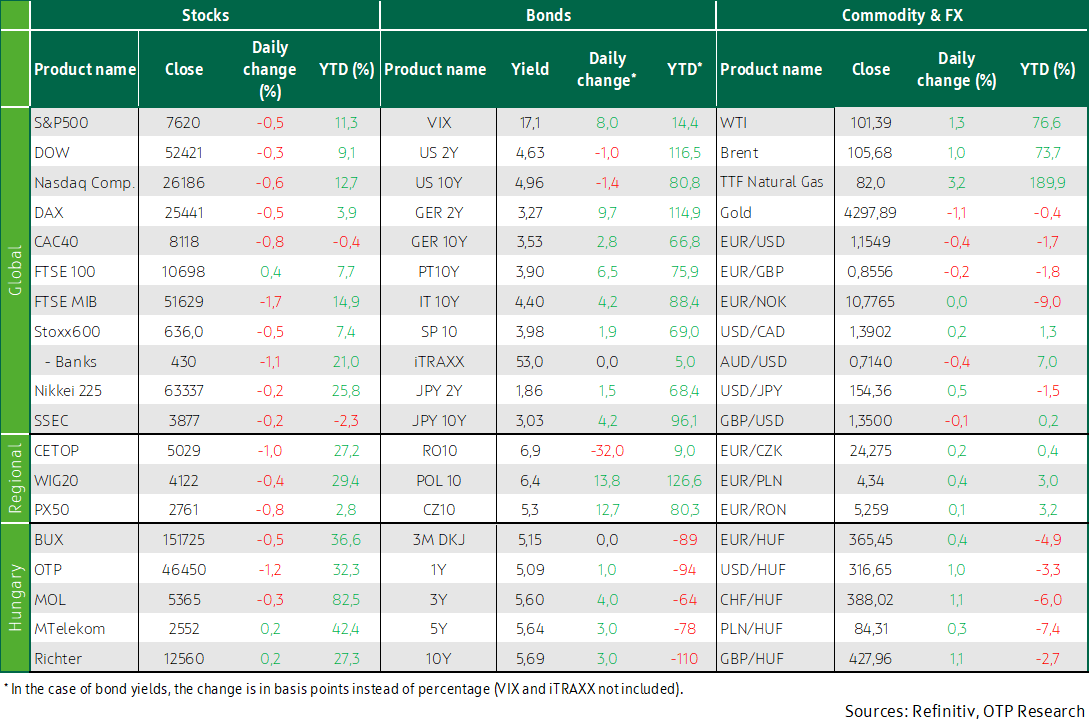
On the first trading day of the week, news flow was dominated by reports that the world's leading artificial intelligence companies had argued in favor of slowing the pace of development, citing potential risks to humanity. This was compounded by attacks launched by Yemen's Houthi rebels against Saudi Arabia, which pushed oil prices higher and further weighed on investor sentiment, with the assaults recurring in the early hours of Tuesday. As a result, the pan-European STOXX 600 index declined by 0.5%, alongside a similar drop in Germany's benchmark index and a 0.8% retreat in the French market, while the UK's FTSE 100 managed to edge higher. Among sectors, technology was one of the weakest performers, falling 2.1%. French chipmaker Soitec was the worst-performing stock in the STOXX 600, with its share price plunging 12.5%. By contrast, the software sector, which is particularly exposed to AI developments, advanced, led by stocks such as Octave Intelligence, Capgemini, Sage and Relx, which gained between 5.0% and 7.5%. The healthcare sector outperformed the broader market, rising 2.7%. Within the segment, GSK climbed 4.7% after reporting positive clinical trial results for two lung cancer treatments, providing an additional boost to sector sentiment.
The CEE region also closed Monday's session in negative territory, with the WIG20 declining 0.4%, the BUX falling 0.5%, and the PX 50 retreating 0.8%. Among Hungarian blue chips, the downturn was led by OTP, which dropped 1.2%, while Richter and Magyar Telekom posted modest gains. Meanwhile, the decline in Hungary's construction sector, which has been ongoing since April, continued in July, with output falling 4.6% month-on-month and remaining 12.2% below its level a year earlier.
Major AI firms signal a slowdown in development, sending related stocks sharply lower
The pullback in AI-related stocks was already evident during Monday morning's Asian trading session and subsequently weighed on US markets at the open, as investors were concerned not only about higher oil prices but also about rising bond yields. The tech-heavy Nasdaq closed 0.6% lower, while the S&P 500 and the Dow declined by 0.5% and 0.3%, respectively. Eight of the eleven sector indices within the S&P 500 finished in negative territory. Technology suffered the sharpest decline, falling 1.7%, followed by the industrial sector, which dropped 1.4%. Nvidia shares weakened by 3.4%, while Micron Technology lost more than 5% of its value. Broadcom and AMD each posted declines of more than 4%. The semiconductor index plunged 5.9%, trimming its gain for 2026 to 57%. At the same time, the prospect of a slowdown in AI development provided support for US software companies, with ServiceNow (+7.4%), Adobe (+5.3%), and Workday (+4.6%) all moving higher. Bank of America shares fell 5.1% after CEO Brian Moynihan stated that investment banking fee income is expected to decline by at least 10% in Q3.
Brent crude traded near $106 per barrel on Monday after briefly reaching $110 intraday, its highest level in four months. Saudi Arabia shut down its strategically important East-West pipeline, which bypasses the Strait of Hormuz, after it was hit by a drone attack. Ukrainian President Volodymyr Zelensky stated that Ukraine is prepared to halt attacks on Russian energy facilities if Russia takes similar steps, while expressing doubts about Moscow's willingness to abide by any agreement. These developments further heightened supply concerns, while the number of cargo vessels passing through the Strait of Hormuz fell sharply over the weekend.
US 10-year Treasury yield rises above a level not seen in years
The yield on the US 10-year Treasury note reached the key 5% psychological threshold on Monday and continued to rise overnight, climbing to its highest level since 2007 and standing at 5.025% in early trading. The latest leg of the increase was triggered by renewed Houthi attacks against Saudi Arabia. The rise in yields comes ahead of Wednesday's policy decision, where investors widely expect the Federal Reserve to deliver another interest rate hike. Over the past month, several factors have driven long-term yields higher, including persistently elevated CPI, growing expectations for a higher interest rate path, large volumes of corporate and government bond issuance, rising energy prices, and concerns over the US's long-term fiscal outlook. Increasing expectations of tighter global monetary policy also pushed German bond yields to levels not seen in years, with the German 10-year yield closing at 3.531%, its highest reading since 2007. Meanwhile, the dollar strengthened by 0.4% against the euro.
Hungarian yields also moved higher in line with international trends, with yields on bonds with maturities exceeding one year rising by 3-4 basis points, leaving the 10-year government bond yield at 5.69% at the close. The Government Debt Management Agency (ÁKK) held a discount Treasury bill exchange auction yesterday, allowing investors to swap securities maturing at the end of September and October for instruments maturing in nine months, at an average yield of 5.2%. Demand was strong, with HUF 27.5bn of bids accepted compared with the initially announced HUF 10bn. During the day, the forint weakened by 0.4% against the euro, ending the session at 365.45.
Today's highlights
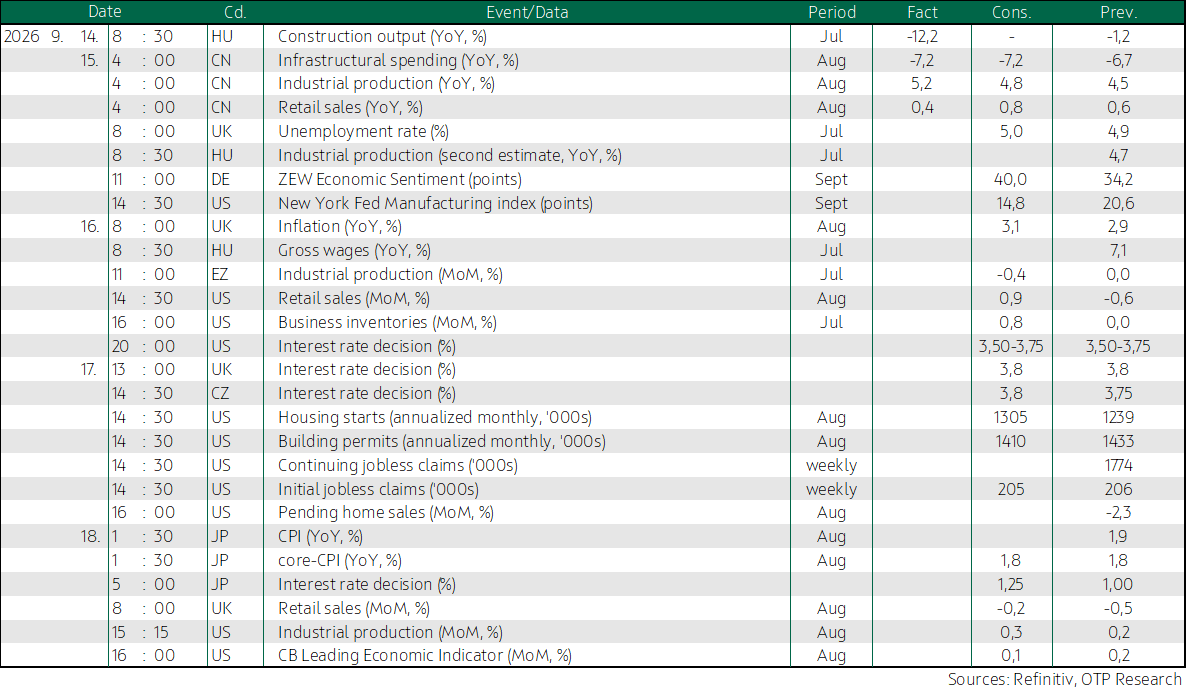
Several Chinese economic indicators were released today. China's industrial sector remained strong in August, supported by the AI-driven technology boom, which continued to boost factory activity. Industrial output increased by 5.2% year-on-year, accelerating from 4.5% in July and exceeding the market expectation of 4.8%. In contrast, retail sales rose by just 0.4% in August, following a 0.6% increase in July and falling short of the 0.8% consensus forecast, highlighting ongoing weakness in household consumption, which was also reflected in the Q2 GDP data. Fixed-asset investment declined by 7.2% during the first eight months of the year, marking the steepest contraction since April 2020, as companies remained cautious about new spending while problems in the real estate sector continued to weigh on consumption and constrain economic growth. The divergence within the data was evident, as technology investment increased by 5.2% over the period, while real estate investment plunged 19.9%.
Asian markets extended their weak performance on Tuesday, with most benchmarks trading modestly lower in morning dealings. The Nikkei and the SSEC were both down 0.2%, while the Kospi posted a larger decline of 0.7%.
Data releases scheduled for today include the UK's July unemployment rate, Germany's ZEW economic sentiment index, and the New York Fed Manufacturing Index. However, market direction is likely to be driven primarily by developments in the Middle East and the latest news surrounding AI, rather than by macroeconomic data releases.
Get more out of your investments!
Global Markets Services
OTP Global Markets offers a broad range of services in the field of local and international money and capital markets.
Read morePrivate Banking Services
Personal care and expertise with OTP Private Banking, along with the knowledge, security, and innovations of a multinational banking group.
Read more