
OTP Morning Brief: Rate hike expectations strengthened across developed markets
Related content
OTP Morning Brief: Earnings season continues to drive equities higher, while the French 10-year yield climbs above 5%
Stock markets moved higher yesterday in both Europe and the US, with technology stocks leading the gains on both sides of the Atlantic. Individual earnings reports released so far do not indicate that the AI investment boom is set to slow in the coming months. French financial indicators, however, are coming under increasing pressure from social and political uncertainty across both the corporate and public sectors: while French retail giant Carrefour issued a profit warning due to the unrest, French long-term bond yields soared to their highest level since 2002. The rise in yields also affected other countries, with the yield on 10-year Hungarian government bonds moving higher as well.
OTP Morning Brief: Better-than-expected earnings reports supported US equity indices
Major European indices closed slightly lower yesterday; Germany’s ZEW index declined more than expected; the UK unemployment rate developed favourably; and the MNB left its base rate unchanged, in line with expectations. Major indices closed mostly higher, supported by favourable earnings reports; several companies with significant AI exposure rebounded following the recent sell-off, while housing market data continued to point to weak activity in the US. Long-term US and European bond yields edged lower, while Hungarian long-term government bond yields rose more markedly following their decline in recent days. Today, UK CPI data will be in the spotlight.
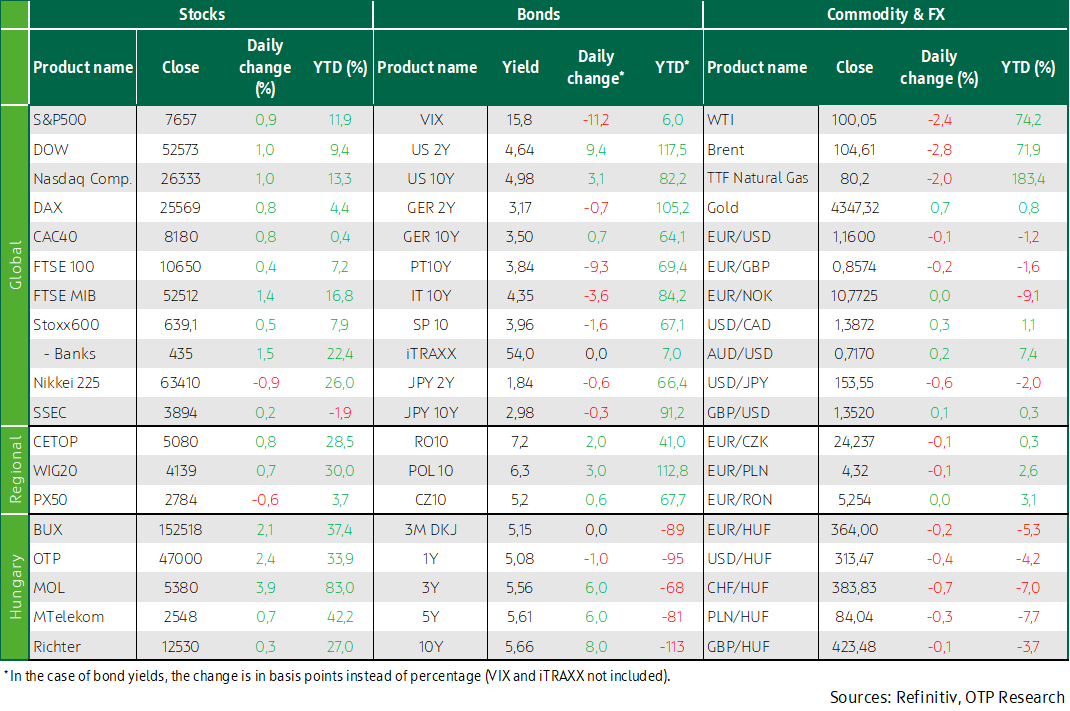
The escalation of the Middle East conflict pushed Brent and WTI prices above USD 100 per barrel. The European TTF benchmark climbed above EUR 80/MWh. The Friday rebound in developed equity markets was not enough to offset the losses accumulated earlier in the week. The BUX advanced both on Friday and on a weekly basis. Developed market long-term bond yields reached multi-year highs. The US dollar strengthened against the euro. The long end of the Hungarian yield curve shifted higher, while the forint weakened against major currencies. The week's most anticipated event will be the Fed's policy meeting, while the Bank of England and the Bank of Japan will also announce their interest rate decisions.
Middle East conflict escalated; Brent and WTI prices rose above USD 100 per barrel; US diesel prices reached record highs; the TTF benchmark climbed above EUR 80/MWh
The escalation of the Middle East conflict set the tone across equity, bond and currency markets last week. By Thursday, both Brent and WTI prices had climbed above USD 100 per barrel before undergoing a marginal correction on Friday, although they still posted gains of more than 9% on a weekly basis. The US and Iran exchanged attacks on several occasions, while the Iranian-backed Houthi movement in Yemen targeted Saudi Arabian cities and seized Perim Island, which divides the Bab el-Mandeb Strait, effectively taking control of the waterway and disrupting free passage along a key Red Sea shipping route. As a precautionary measure, Saudi Arabia suspended operations on the East-West crude oil pipeline on Friday after the infrastructure had come under multiple attacks the previous day.
Meanwhile, attacks between Russia and Ukraine continued to intensify. Over the weekend, Donald Trump urged Kyiv to refrain from targeting the part of Russia’s energy infrastructure responsible for diesel fuel supply, arguing that such actions would harm the entire global economy. US heating oil and diesel prices surged to record highs.
The European TTF natural gas benchmark soared by more than 15% week-on-week, rising above EUR 80/MWh by Friday and reaching its highest level since late 2022. In addition to geopolitical tensions, prices have been driven higher by concerns that low inventory levels could leave the region vulnerable to sharp price increases during the heating season.
Friday's gains across major European equity markets were insufficient to erase the losses accumulated earlier in the week, while the BUX closed higher both on Friday and for the week as a whole
Major European equity indices opened Friday’s session with cautious gains as crude oil prices eased. However, the positive daily performance was not enough to offset the losses accumulated earlier in the week, when investor sentiment was weighed down by persistently high energy prices, rising CPI expectations, elevated government bond yields, and expectations ahead of the ECB’s policy meeting on Thursday. The pan-European Stoxx 600 advanced 0.5% on Friday and finished the week 1.7% higher. At the sector level, telecommunications and banks, which benefited from rising rate expectations, were the strongest performers on the final trading day of the week, while energy stocks, supported by the rise in oil prices, were the clear winners over the week as a whole.
The ECB’s policy meeting was the most closely watched event of the week. As expected, the central bank raised its key deposit and lending rates by 25 basis points to 2.50% and 2.65%, respectively. The key question was not the latest rate hike itself, but rather what markets should expect through year-end. The press conference struck a broadly hawkish tone, with Christine Lagarde noting that CPI could remain above target for longer than previously anticipated. In the updated projections, the ECB left its 2025 CPI forecast unchanged at 3.0%, while raising its 2026 forecast to 2.5% from 2.3%. Market pricing now clearly points to another 25-basis-point rate hike by year-end, while expectations are increasingly shifting toward the possibility that the ECB’s deposit rate could be 50 basis points higher by December.
Central and Eastern European equity markets advanced both on Friday and over the week as a whole, with the exception of the PX50. The Prague index underperformed partly due to profit-taking following its recent record highs. The BUX gained 2.1% on Friday, making a meaningful contribution to its 3.2% weekly rise. Among Hungarian blue chips, MOL was the top performer, rising in tandem with oil prices and climbing more than 8% over the course of the week, while OTP added nearly 5%. Despite Friday’s rebound, Magyar Telekom and Richter were unable to recoup their earlier losses and ended the week down by more than 2%. The most important Hungarian data release of the past week was the publication of August CPI figures. According to data from the Hungarian Central Statistical Office (KSH), Hungarian CPI accelerated to 1.3% in August from 1.2% in July. While the headline reading came in below expectations, measures that better capture underlying inflation trends accelerated instead of posting the anticipated slowdown.
Leading Wall Street indices declined on a weekly basis despite Friday's gains; US rate hike expectations strengthened following the release of August CPI and producer price data
The leading Wall Street indices closed Friday’s session with gains of around 1%, as oil prices eased somewhat, although rate hike expectations strengthened following the release of inflation data. Looking at the week as a whole, however, Friday’s rebound, much like in Europe, was not enough to erase the losses accumulated earlier during the shortened trading week. Most S&P 500 sector indices advanced on Friday, with healthcare standing out as the main laggard. Meanwhile, the technology sector performed strongly after Oracle reported better-than-expected results, helping lift Dell (+12.0%) to a record high, while Hewlett Packard gained 12.4% and HP advanced 8.4%. Investors also reacted to the announcement by online vehicle auction platform Copart that it would acquire ACV Auctions in a deal valued at nearly USD 1.9 billion, sending ACV Auctions shares 44% higher. The VIX index, often referred to as Wall Street’s fear gauge and a measure of implied volatility in S&P 500 options, declined on Friday but still rose 9% over the course of the week.
The most important US data release on Friday, and indeed of the week, was the publication of the August CPI figures. Core CPI accelerated by 0.3% month-on-month, above the expected 0.2%, while headline CPI rose by 0.4% month-on-month, driven primarily by soaring energy prices. Together with the producer price data released on Thursday, these figures reinforced rate hike expectations. While markets had previously priced in a single 25-basis-point Fed rate hike in December, current market pricing now implies both a September and a December rate hike.
Rate hike expectations strengthened and long-term yields moved higher across developed markets; the long end of the Hungarian yield curve also shifted upward, while the forint weakened against major currencies
The market viewed the ECB’s post-meeting communication as more hawkish than expected, strengthening rate hike expectations and pushing eurozone long-term government bond yields higher. The German 10-year yield climbed to 3.5%, rising 17 basis points over the week, while French, Italian and Spanish 10-year yields increased by an even larger 20-26 basis points. This marks the upper end of the trading range established in the post-Covid period. In the US, strengthening rate hike expectations also drove bond yields higher, with the 10-year Treasury yield rising by nearly 20 basis points to close to 5%, its highest level since 2023. On Thursday, the US Treasury launched its expanded buyback programme in the long-dated bond market.
The short end of the Hungarian yield curve remained broadly unchanged both on Friday and over the week as a whole, while the long end shifted higher by 15-21 basis points during the week, including a more pronounced 6-9 basis point increase on Friday. Demand was strong at last week's auctions conducted by the Government Debt Management Agency (ÁKK). Based on the FRA curve, Hungarian rate cut expectations eased during the week, with markets pricing in at most a 25-basis-point cut from the MNB by year-end. The forint weakened against major currencies, with EUR/HUF rising from around 362 to nearly 363.5 by Friday.
Today's highlights
Most major Asia-Pacific indices are on track to close in negative territory this morning, as investors assess both developments in the Middle East conflict and AI-related news over the weekend. In an essay published on Saturday, Anthropic CEO Dario Amodei called on the AI industry to slow the development of its most advanced models and keep them under strict oversight, an initiative that has also received support from senior executives at OpenAI and Google DeepMind, as well as Elon Musk. In a separate interview released on Saturday, OpenAI CEO Sam Altman said that the startup does not plan to go public this year, as such a move would not be appropriate at present, despite comments by the company's CFO a month earlier suggesting that OpenAI could launch an IPO by 2027 at the latest. Meanwhile, crude oil prices started the week higher following reports related to the Saudi Arabian crude oil pipeline.
Equity futures point to a mixed opening in Europe, while Wall Street is set to start today's session lower.
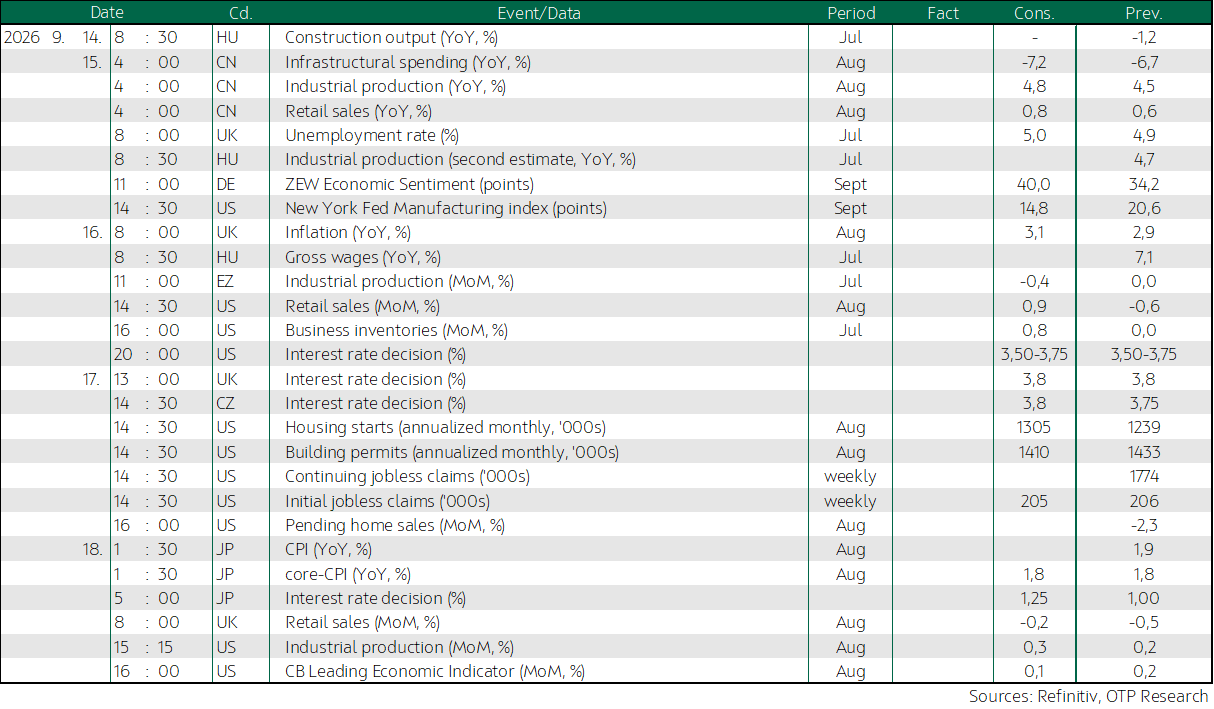
The Hungarian Central Statistical Office (KSH) will release July construction output data today.
The week's most anticipated event will be the Fed's policy meeting, which concludes on Wednesday. Market pricing currently implies a 25-basis-point rate hike both at the upcoming meeting and in December, although uncertainty remains elevated.
The Bank of Japan and the Bank of England will also hold policy meetings this week, with markets expecting a 25-basis-point rate hike from the former and no change in rates from the latter.
Get more out of your investments!
Global Markets Services
OTP Global Markets offers a broad range of services in the field of local and international money and capital markets.
Read morePrivate Banking Services
Personal care and expertise with OTP Private Banking, along with the knowledge, security, and innovations of a multinational banking group.
Read more