
OTP Morning Brief: The ECB’s rate decision comes amid a rising yield environment
Related content
OTP Morning Brief: Major indices started the week lower in Europe, while US equities advanced
Following last week's weak performance, the US equity market started the week on a stronger footing, while in France and across the broader euro area investor sentiment was weighed down by domestic political uncertainty. At the same time, market participants were positioning ahead of this week's earnings releases from Meta, Tesla and SpaceX. Bond yields edged higher across developed market sovereign debt markets. In Hungary, Péter Magyar outlined key details of the 2027 budget proposal. Most Asian equity markets traded in negative territory during the morning session.
OTP Morning Brief: Further declines in the US technology sector on Friday
Selling pressure on the technology sector remained elevated across developed equity markets on Friday. However, favorable corporate earnings offset the weakness in the IT sector in Europe. European equity markets also posted weekly gains, marking their strongest weekly performance since June. In the US, the decline in equity indices continued, with concerns surrounding AI-related companies further amplified by the CoreWeave episode. The sell-off in equity markets prompted investors to shift toward safer assets, while long-term bond yields continued to decline. The US 10-year Treasury yield declined by 15 bps over the past week, closing Friday’s session at 5.1%, supported in part by easing expectations of further rate hikes. Based on futures pricing, the Fed is expected to leave interest rates unchanged at next week’s meeting. Eurozone bond yields also moved lower, tracking developments in overseas fixed-income markets. The euro strengthened to 1.124 against the dollar. Long-term yields also declined sharply in the Hungarian government bond market over the past week, with the 10-year yield falling by 29 bps to a three-month low of 5.31%. Oil prices continued to rise amid the unresolved situation in the Middle East. European natural gas futures soared to an early four-year high over the past week. This week, in the Hungarian market, attention will focus on the 2027 budget to be released today and the MNB’s interest rate decision meeting on Tuesday.
European markets turned sharply lower on Wednesday. Google said it will invest at least €13 billion in artificial intelligence infrastructure in Finland over the next two years. The European diesel market remains extremely tight. TTF natural gas prices are approaching €80/MWh. Wall Street indices also closed lower. As Brent rose above $100 and the US Treasury announced a smaller-than-expected bond buyback, both US and German long-term yields moved higher. However, the Japanese 10-year yield corrected to below 2.9% on Tuesday, while expectations of further rate hikes strengthened and the yen appreciated to a seven-month high against the dollar. Today, attention will be focused on the ECB’s rate decision and the US Producer Price Index (PPI) for August.
European equities declined, while the European diesel market remains extremely tight
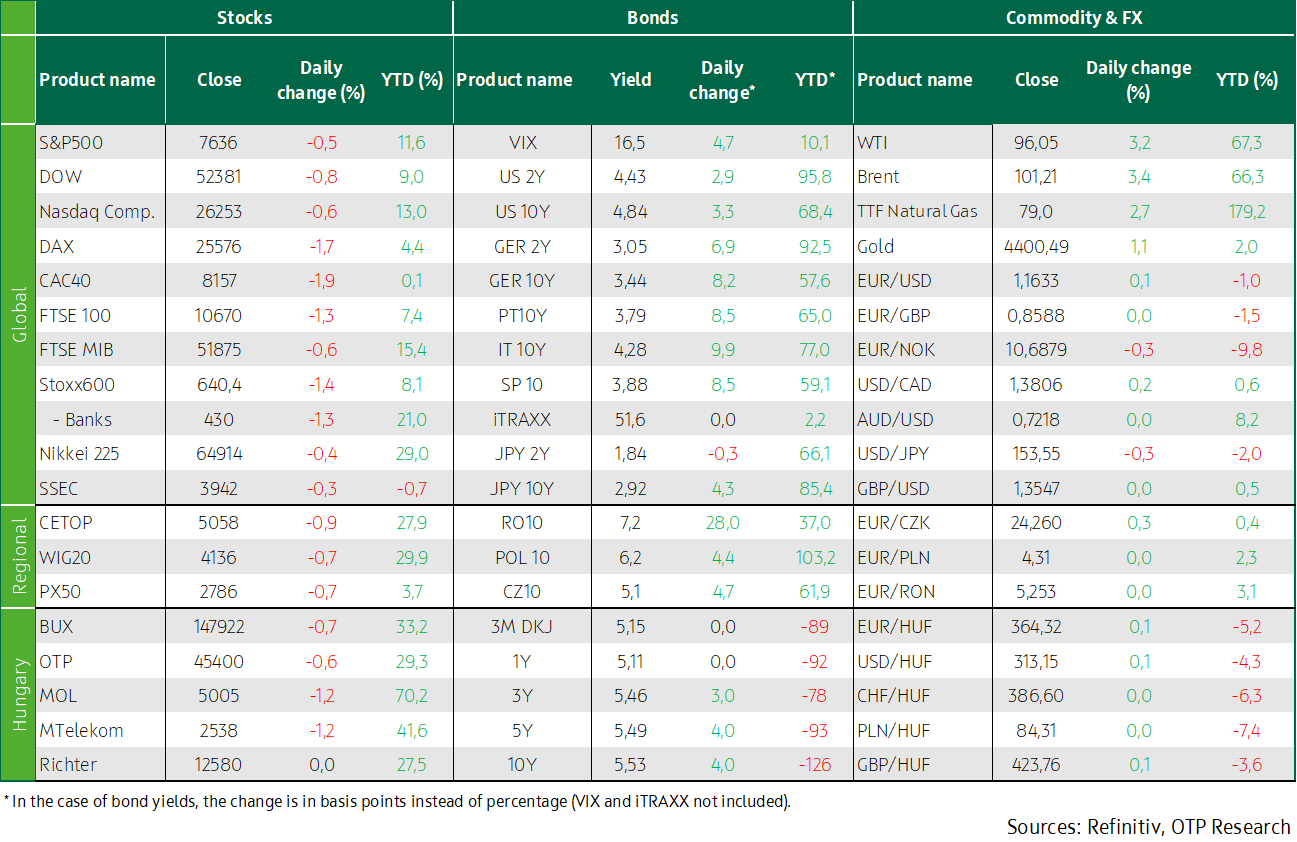
European markets turned sharply lower on Wednesday. The STOXX Europe 600 fell 1.4%, while the DAX declined 1.7%, the CAC 40 dropped 1.9%, and the FTSE 100 lost 1.3%. Fortum was the top-performing stock in the STOXX 600, soaring 15.8% after the Finnish utility signed a long-term power purchase agreement with Google. The technology giant said it will invest at least €13 billion in artificial intelligence infrastructure in Finland over the next two years. The energy sector was the only one to post gains in Europe, rising 0.3%, while all other major sectors ended the session in negative territory. Shares of Inditex, the owner of Zara, fell 3.6% after the Spanish fast-fashion retailer reported weaker-than-expected Q2 earnings.
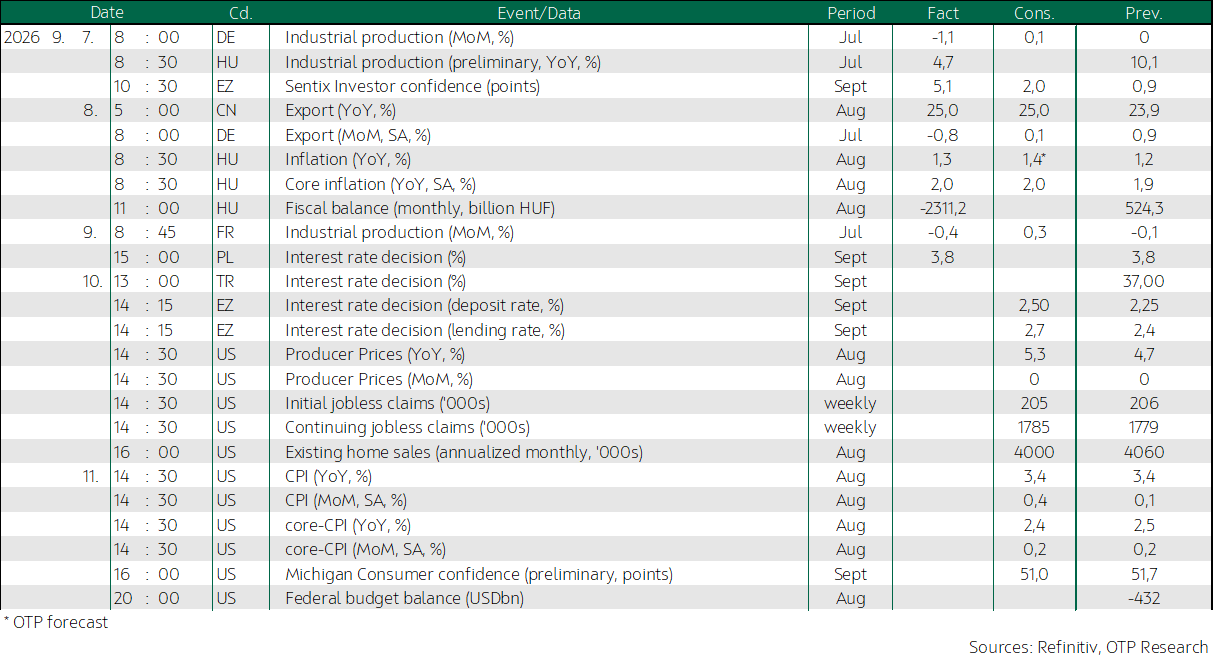
In July, French industrial production fell 0.4% month-on-month, missing the consensus forecast of a 0.3% increase. Moreover, the June figure was revised lower. Meanwhile, the National Bank of Poland left its policy rate unchanged at 3.75%.
The European fuel market remains extremely tight. Diesel futures are trading close to $200 per barrel. Record-high refining margins are being driven by the escalating conflict in the Middle East and drone attacks targeting Russian refineries. The widening diesel crack spread, defined as the difference between the wholesale price of diesel and the cost of the crude oil used to produce it, may also reflect seasonal demand factors specific to diesel, as well as refinery maintenance shutdowns that are typically scheduled for the autumn period and related market expectations. Structurally, the EU is short of diesel and typically relies on imports to cover 10-20% of its consumption.
In the region, the Hungarian, Polish, and Czech stock market indices each declined by 0.7% on Wednesday.
The price of European benchmark TTF natural gas rose 2.7% to €79/MWh.
Wall Street indices extended their decline
Wall Street indices continued to drift lower on Wednesday, while Brent crude futures rose above $100 per barrel for the first time since late July. Iran said on Wednesday that it had attacked ten vessels near the Strait of Hormuz, while the US sank five Iranian oil tankers, marking a significant escalation in tensions in the Middle East. The S&P 500 fell 0.5%, the Nasdaq Composite declined 0.6%, and the Dow Jones dropped 0.8%. The sell-off was broad-based, with all sectors ending lower except energy and utilities. Materials, retail, and household and industrial goods were the worst-performing sectors, each posting losses of more than 2%.
According to the latest Reuters survey, around 70% of respondents expect the Federal Reserve to leave interest rates unchanged at next week’s meeting. This is down from 90% in August, when expectations for a rate hold were considerably stronger. At the same time, according to FedWatch data, market pricing now implies a probability of more than 60% that the Fed will raise rates at next week’s meeting.
Developed-market yields mostly moved higher, with the yen standing out as the exception
The yield on the US 10-year Treasury rose by 3.3 basis points to 4.84%, its highest level since November 2023. The increase was partly driven by the US Treasury’s announcement that it would repurchase up to $6 billion of Treasuries with maturities of 10 to 20 years, an amount that fell short of market expectations. However, yields pared some of their intraday gains after exceptionally strong demand was seen at the US government's $39 billion 10-year Treasury auction. On Tuesday, the US Treasury had already successfully sold $58 billion of 3-year notes, while a further $22 billion of 30-year bonds is due to be issued on Thursday. Meanwhile, the German 10-year yield surged by more than 8 basis points to 3.44%, its highest level since 2011. Rising crude oil prices, a widening diesel crack spread, and drought conditions all pose CPI risks in Europe, a development that is also being reflected in bond yields.
The Japanese yen extended its gains from the nearly seven-month high reached on Tuesday, as traders continued to unwind short positions in the Japanese currency. Expectations are mounting that the Bank of Japan will accelerate the pace of its rate hikes, while repatriation flows by Japanese investors are also expected to pick up. The yen closed at 153.55 against the dollar on Wednesday, while the yield on the 10-year Japanese government bond corrected to below 2.9% on Tuesday from its early-September peak above 3%.
The Hungarian 10-year government bond yield rose by 4 basis points to 5.53%. Yesterday, the Government Debt Management Agency (ÁKK) sold HUF 20 billion of discount Treasury bills maturing in April at an average yield of 5.13%, with demand nearly three times the amount offered.
Today's highlights
Asian markets were also trading lower heading into the close. The Nikkei declined 0.5%, while the KOSPI and the SSEC both fell by around 0.4%, and the Hang Seng dropped 1.3%. Meanwhile, the Japanese 10-year government bond yield rose by more than 4 basis points on Thursday, moving back above 2.9%.
Following a relatively quiet day on the macroeconomic front on Wednesday, attention today will focus on the ECB’s rate decision and the US Producer Price Index (PPI) for August. On Friday, the US will release its August Consumer Price Index (CPI), providing a clearer picture of US inflation trends in the second half of the week, ahead of the Fed’s rate-setting meeting next Wednesday.
Get more out of your investments!
Global Markets Services
OTP Global Markets offers a broad range of services in the field of local and international money and capital markets.
Read morePrivate Banking Services
Personal care and expertise with OTP Private Banking, along with the knowledge, security, and innovations of a multinational banking group.
Read more