
OTP Morning Brief: Escalation continued in the Middle East
Related content
OTP Morning Brief: Further declines in the US technology sector on Friday
Selling pressure on the technology sector remained elevated across developed equity markets on Friday. However, favorable corporate earnings offset the weakness in the IT sector in Europe. European equity markets also posted weekly gains, marking their strongest weekly performance since June. In the US, the decline in equity indices continued, with concerns surrounding AI-related companies further amplified by the CoreWeave episode. The sell-off in equity markets prompted investors to shift toward safer assets, while long-term bond yields continued to decline. The US 10-year Treasury yield declined by 15 bps over the past week, closing Friday’s session at 5.1%, supported in part by easing expectations of further rate hikes. Based on futures pricing, the Fed is expected to leave interest rates unchanged at next week’s meeting. Eurozone bond yields also moved lower, tracking developments in overseas fixed-income markets. The euro strengthened to 1.124 against the dollar. Long-term yields also declined sharply in the Hungarian government bond market over the past week, with the 10-year yield falling by 29 bps to a three-month low of 5.31%. Oil prices continued to rise amid the unresolved situation in the Middle East. European natural gas futures soared to an early four-year high over the past week. This week, in the Hungarian market, attention will focus on the 2027 budget to be released today and the MNB’s interest rate decision meeting on Tuesday.
OTP Morning Brief: US producer price index came in above expectations, yet the US 10-year Treasury yield still declined
Western European equities continued to advance despite ongoing pressure on the technology sector. Wall Street indices also rebounded, recovering some ground after Wednesday’s sell-off. Healthcare was the standout performer on both sides of the Atlantic. Eurozone industrial production declined by 0.5% month-on-month in August. In the US, the producer price index accelerated to 6.3%, delivering another upside surprise in inflation developments. US retail sales increased by 0.8% compared to August. The US 10-year Treasury yield declined by more than 10 basis points. The long end of the Hungarian government bond yield curve also declined by 7-9 basis points. In Hungary, August wage data will be released today, while in the US, September industrial production figures are due.
Escalation in the Middle East continued, with the Houthis now targeting Saudi facilities, pushing Brent crude prices close to $100 and intensifying global CPI concerns. Despite this, European equity indices showed only minimal movement, while the major US stock indices started the week in negative territory. German exports came in weaker than expected. Hungarian CPI was 1.3% year-on-year in August. Hungary’s budget deficit exceeded HUF 2,000 billion in August, although the figure was distorted by the pre-financing of the RRF program. US and Hungarian bond yields rose, German yields declined, while the forint remained largely unchanged. Today, attention is likely to focus on French industrial data and the Polish interest rate decision.
Major European indices barely moved on Tuesday, while Hungarian CPI stood at 1.3% in August
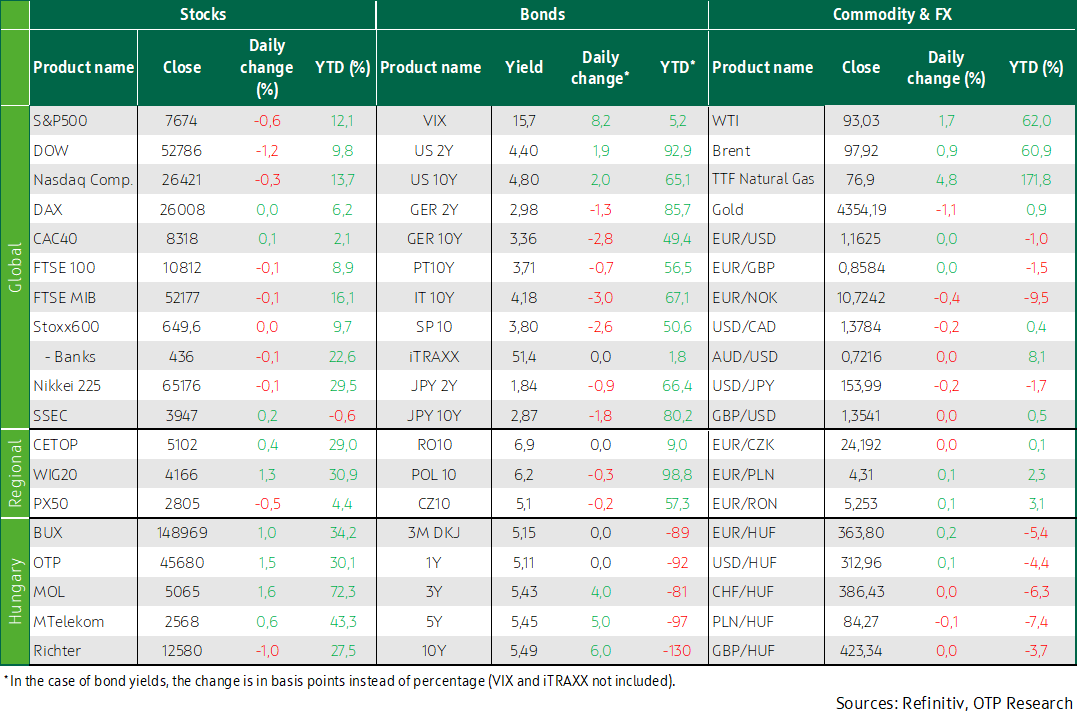
European markets were largely flat on Tuesday, with the Stoxx 600 and the DAX remaining close to unchanged. The CAC 40 posted a slight gain, while the FTSE 100 recorded a negligible loss. Investors stayed cautious as oil prices continued to rise. Among sectors, materials outperformed with a 2% advance, supported by higher copper prices, while healthcare lagged behind with a 2.3% decline. The sector's weakness was partly driven by a 10.9% drop in Novartis shares after the company's experimental treatment for muscular atrophy failed a Phase III clinical trial, marking its second major R&D setback within days. Notable gainers during the session included Rheinmetall (+3.2%), Volkswagen (+2.6%), which extended its post-restructuring rally, and Anglo American (+2.8%), benefiting from higher commodity prices.
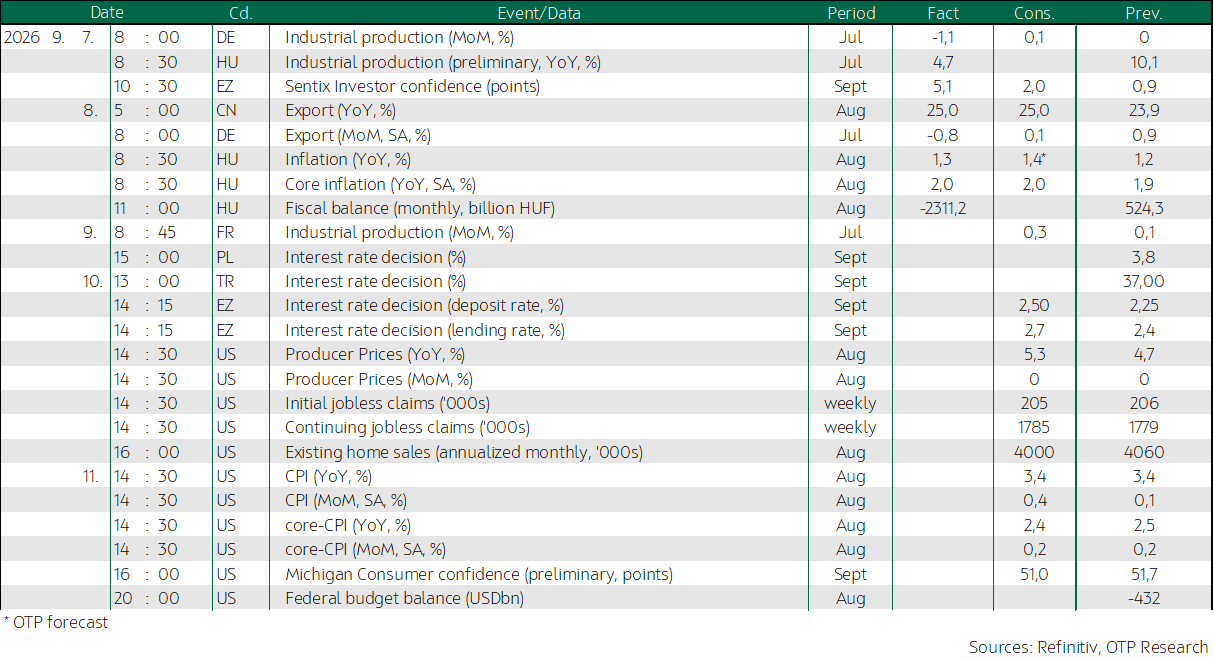
Germany's exports fell by 0.8% month-on-month in July 2026, undershooting market expectations for a slight increase. Weaker exports to the euro area and China more than offset stronger shipments to the US. On an annual basis, however, exports rose by 6.1%.
The CEE region delivered a mixed performance, with Poland's WIG20 outperforming after gaining 1.3%, while Hungary's BUX advanced 1.0% and the Czech PX closed the session down 0.5%. The Hungarian index was supported primarily by OTP (+1.5%) and MOL (+1.6%). Hungarian CPI came in at 1.3% year-on-year in August, slightly below our 1.4% forecast. At the same time, core CPI, which better captures underlying price trends, exceeded expectations. This was partly driven by stronger-than-expected increases in market service prices, likely reflecting the expiry of voluntary fee reductions by financial service providers last month. In contrast, regulated prices rose less than anticipated.
Tensions in the Middle East intensified further, while major US indices closed in negative territory
Major US indices moved lower as escalating tensions in the Middle East pushed oil prices higher and reinforced CPI concerns. The already intense conflict worsened further on Tuesday after the Iran-backed Houthi movement in Yemen targeted Saudi energy facilities, setting oil infrastructure ablaze and raising the risk of a significant expansion of the six-month-long war in the Middle East. Additional developments emerged overnight after the market close, with reports indicating that Iran had attacked a US military base in Jordan, although Jordanian authorities stated the strike was unsuccessful, while the US destroyed five Iranian oil tankers.
The Dow fell 1.2%, while the S&P 500 and Nasdaq declined 0.6% and 0.3%, respectively, on the first trading day following Labour Day. The S&P software index dropped 1.4% amid renewed concerns that OpenAI’s new Astra model could replace specialized software applications, weighing on shares of companies such as Salesforce (-3.9%) and ServiceNow (-5.0%). Intel surged 9.0% and Qualcomm gained 3.2% after reaching an agreement with Amazon to develop custom AI chips. Apple shares slipped 1.2% ahead of the company’s event, where it is expected to unveil its latest smartphone under the leadership of new CEO John Ternus. Cryptocurrency-related stocks moved lower after Bitcoin pulled back from the $80,000 level, with Coinbase losing 3.1% and Strategy falling 4.4%.
Gradual escalation continued to lift oil prices, with Brent crude futures rising 0.9% to settle at $97.92 per barrel on Tuesday, while WTI gained 1.7%, ending the session at $93.03 per barrel.
Developed market yields moved in opposite directions, while RRF pre-financing weighed on Hungary’s fiscal balance in August
US Treasury yields edged higher on Tuesday, with the two-year yield reaching 4.40% and the 10-year yield rising to 4.794%, narrowing the spread between them to 40 basis points. As energy prices continued to rise gradually, investors focused on Friday’s CPI release, which could prove decisive for the outcome of the September rate decision. Meanwhile, German Bund yields retreated from their previous 15-year highs as European investors assessed not only global challenges but also the uncertain political situation in Germany. At the same time, markets widely expect the ECB to deliver another rate hike at Thursday’s policy meeting. The euro was little changed against the dollar on Tuesday.
Hungarian government bond yields resumed their upward trend, rising by 4 to 6 basis points across the curve. Fiscal sustainability has remained a key driver of heightened market volatility in recent months, with the central government budget posting a deficit of HUF 2,311.2 billion in August. The sharp deterioration compared to the previous month was largely attributable to the pre-financing of RRF programs, which worsened the fiscal balance by HUF 2,186.9 billion. Hungary’s debt management agency (AKK) offered HUF 30 billion of discount treasury bills and accepted HUF 25 billion at an average yield of 5.24%. The forint weakened slightly against the euro, trading near 363.8 by the end of the session.
Today's highlights
Asian markets delivered a mixed performance amid rising geopolitical tensions and higher oil prices. China’s SSE Composite fell 0.2%, while Hong Kong’s Hang Seng declined 0.4%. In Japan and South Korea, however, AI-related optimism outweighed negative geopolitical sentiment, lifting the Nikkei by 0.2% and the Kospi by 1.2%. Overnight, news emerged that alongside the conventional conflict, Trump also continued his trade dispute with Canada by imposing tariffs on dairy products, alcoholic beverages and automobiles, with the measures set to take effect on September 29.
Today, July industrial production data from France and the Polish interest rate decision are likely to be in focus.
Get more out of your investments!
Global Markets Services
OTP Global Markets offers a broad range of services in the field of local and international money and capital markets.
Read morePrivate Banking Services
Personal care and expertise with OTP Private Banking, along with the knowledge, security, and innovations of a multinational banking group.
Read more